If you’re building a custom integration, syncing store data, or extending your retail operations with third-party tools, the Lightspeed API is your entry point.
In this guide, we will walk you through how to get the Lightspeed API via 7 easy-to-follow steps, including:
- Step 1: Navigate to Settings > Store Settings > Developers.
- Step 2: Click the New API key and give it a descriptive name.
- Step 3: Click Save to register the new key
- Step 4: Select the switch under SETTINGS to enable the API key.
- Step 5: Set the permissions you want to grant by ticking the
- checkboxes.
- Step 6: Choose Save. The API key will appear in the DETAILS section.
- Step 7: To retrieve the API secret, click Show to reveal.
Let’s get started!
How to Get Lightspeed API: The Step-by-Step Guide
Before diving in, make sure you have an active Lightspeed account with the appropriate admin permissions. Then, follow these steps to obtain your Lightspeed API.
Step 1: Go to Developers under Settings > Store Settings.
Step 2: Choose the New API key and give the API key a name (such as the name of the integration or your developer).
Step 3: Click Save
Step 4: To enable the API key, choose the switch under SETTINGS.
Step 5: The checkboxes for the permissions you want to grant should be selected.
Step 6: Choose Save. The API key will appear in the DETAILS section.
Step 7: To display the API secret, choose Show.
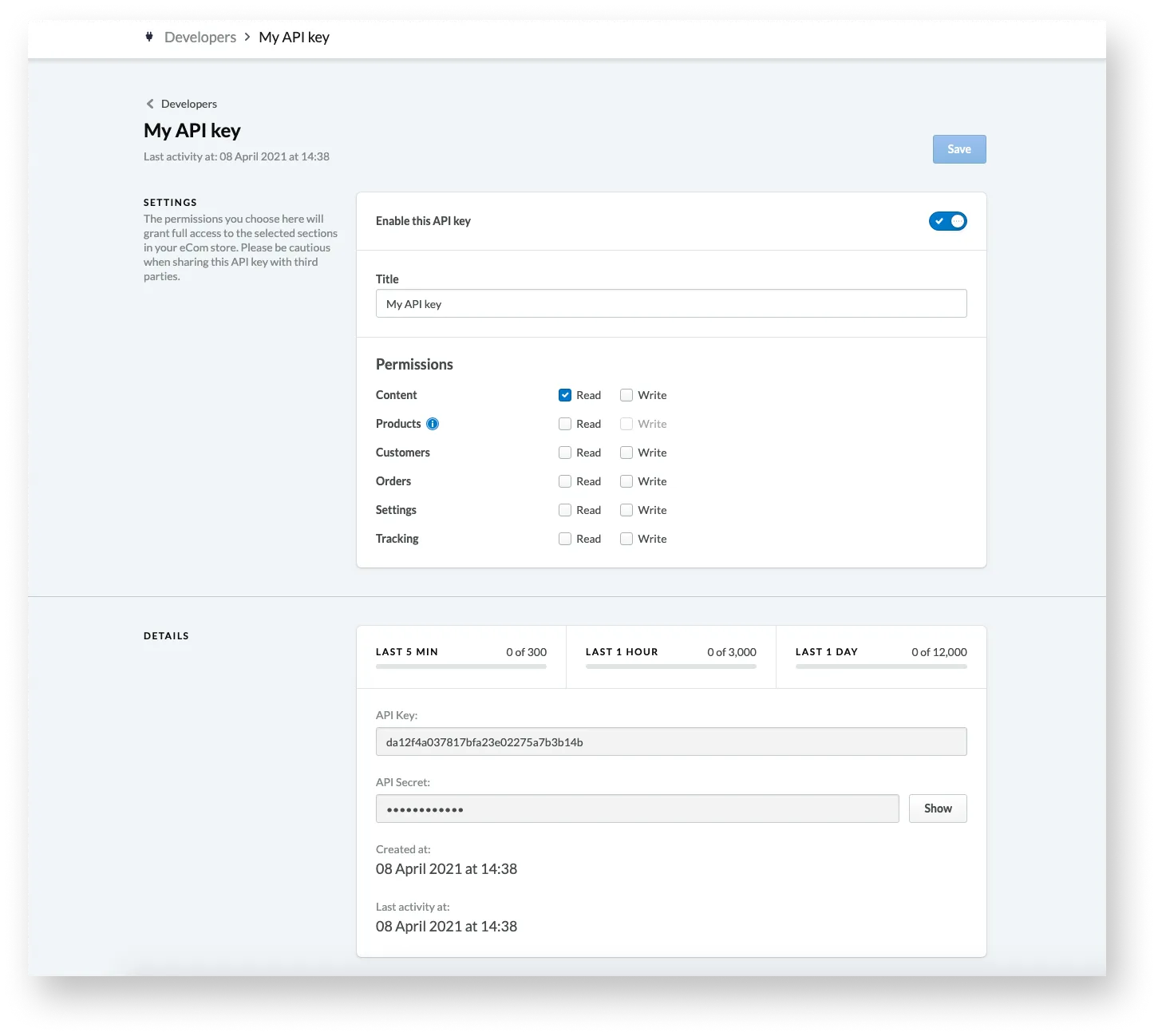 An API key has now been successfully established, and its permissions have been set. The API key and secret are now available for copying and pasting, so give them to your developer. You can also use them yourself to gain access to your account using the API.
Common Use Cases for Lightspeed API Integration
The Lightspeed API enables merchants and developers to build custom integrations and automated workflows that make running a retail or hospitality business more efficient and scalable. Below are the most common and impactful ways teams put the Lightspeed API to work.
1. Inventory synchronization
One of the most widely adopted use cases is keeping stock levels accurate across all sales channels simultaneously. By connecting Lightspeed to a warehouse management system, ERP, or online marketplace via the API, inventory updates in one place automatically cascade across others, eliminating the risk of overselling or stockouts.
2. Connect with migration tools
Businesses migrating their store data to or from Lightspeed can use the Lightspeed API in combination with a migration tool like LitExtension to transfer products, customers, orders, and other key data accurately and efficiently. This is particularly useful for merchants replatforming from platforms like Shopify, WooCommerce, or Magento, ensuring a smooth, automated migration with minimal manual effort and data loss risk.
3. ERP & accounting integration
Businesses running enterprise-level operations use the API to connect Lightspeed with ERP and accounting systems for streamlined financial management and dynamic pricing. Financial data can be exported via the API into accounting platforms, giving finance teams a real-time view of business performance without relying on manual exports.
4. Custom reporting & business intelligence
Teams that need deeper insight than Lightspeed’s native reports provide use the API to extract sales, revenue, and product performance data into BI tools or data warehouses. This enables custom dashboards, trend analysis, and cross-platform reporting, particularly useful for businesses with complex product catalogs or multi-outlet operations.
Whether your goal is operational efficiency, richer customer data, or a fully connected retail stack, the Lightspeed API provides the foundation to build workflows that scale with your business.
Best Practices for Managing Lightspeed API
Getting your Lightspeed API integration running is only half the work. How you manage, secure, and maintain it over time determines whether it stays reliable as your business scales. Following these best practices from the start will reduce recurring issues and save significant debugging time.
- Store your API key in environment variables or a secrets manager and never commit it to a public repository.
- If a key is accidentally exposed, revoke it immediately and generate a new one.
- Create a separate API key for each integration or developer so you can revoke one without disrupting others.
- Only enable the permission checkboxes your integration actually needs.
- Restrict scopes to the minimum necessary to reduce exposure.
- Revisit and audit permissions whenever an integration’s scope changes.
- Batch API requests wherever possible instead of making individual calls per record.
- Avoid scheduling automated syncs during peak traffic hours to reduce contention.
- Set up automated monitoring that flags unusual error rates, unexpected 401s, or drops in data throughput.
- Log every API request and response with timestamps in your production environment to speed up root-cause analysis.
- Configure alerting thresholds so your team is notified of failures before they impact business operations.
A well-managed API integration is easier to maintain, easier to hand off, and far more resilient to platform updates and business growth.
How to get LightSpeed API – FAQs
Is this posible to get the Lightspeed API key?
Yes, getting a Lightspeed API key is straightforward and requires no developer expertise. Any Lightspeed account holder with admin access can generate one directly from the backend. The only prerequisite is having an active Lightspeed account with the appropriate subscription plan that includes API access.
Why do I need to obtain an API key on Lightspeed?
An API key is what authorizes external applications, tools, or custom-built integrations to communicate securely with your Lightspeed store. Without it, third-party systems have no authenticated way to read or write your store's data. Therefore, whether you're connecting an inventory management system, syncing orders to a fulfillment platform, or building a custom reporting dashboard, the API key is the credential that makes that data exchange possible.
How to get LightSpeed API: Final Words
In short, the Lightspeed API opens the door to a more connected, automated, and efficient operation. We hope that this guide has given you the complete guide to obtaining your credentials with ease and how to manage them properly.