Shopify to WooCommerce Migration
 Based on 3,000+ reviews on:


Shopify to WooCommerce Migration Process
Our managed migration follows three high-level stages. Each stage includes the detailed audit, mapping, testing, validation, and launch tasks explained later on this page.

We audit your Shopify catalog, customers, orders, apps, metafields, and custom structures, then review your WooCommerce environment and confirm what is included, what needs custom handling, and what must be rebuilt separately.

We map Shopify data to the appropriate WooCommerce fields and run a test migration. You can review representative products, customers, orders, images, and relationships before approving the full transfer.

After approval, we migrate the agreed data while your Shopify store remains available. Our team then validates record counts, values, images, relationships, URLs, and duplicates before launch preparation.
How to Migrate from Shopify to WooCommerce Using CSV Exports
LitExtension’s Files Migration lets you transfer Shopify products, customers, and orders from exported files. Once your WooCommerce store is ready, follow these three steps.
Step 1. Export Your Shopify Data and Connect WooCommerce
In your Shopify admin, export the records you want to migrate:
- Products: Go to Products > Export, select all products, and export a CSV file.
- Customers: Go to Customers > Export, choose all customers, and export a CSV file.
- Orders: Go to Orders > Export, select the orders or date range you need, choose CSV, and click Export orders.
Keep each data type in separate files and preserve the rows linking products with their variants and images. Leave Shopify image URLs accessible until the migration finishes.
Sign in to the LitExtension app, create a New Migration, and select Files (CSV, Excel, Google Sheets) as the Source Cart Type. Upload your Shopify exports, including any split files, with up to 50 files and 50 MB per file.
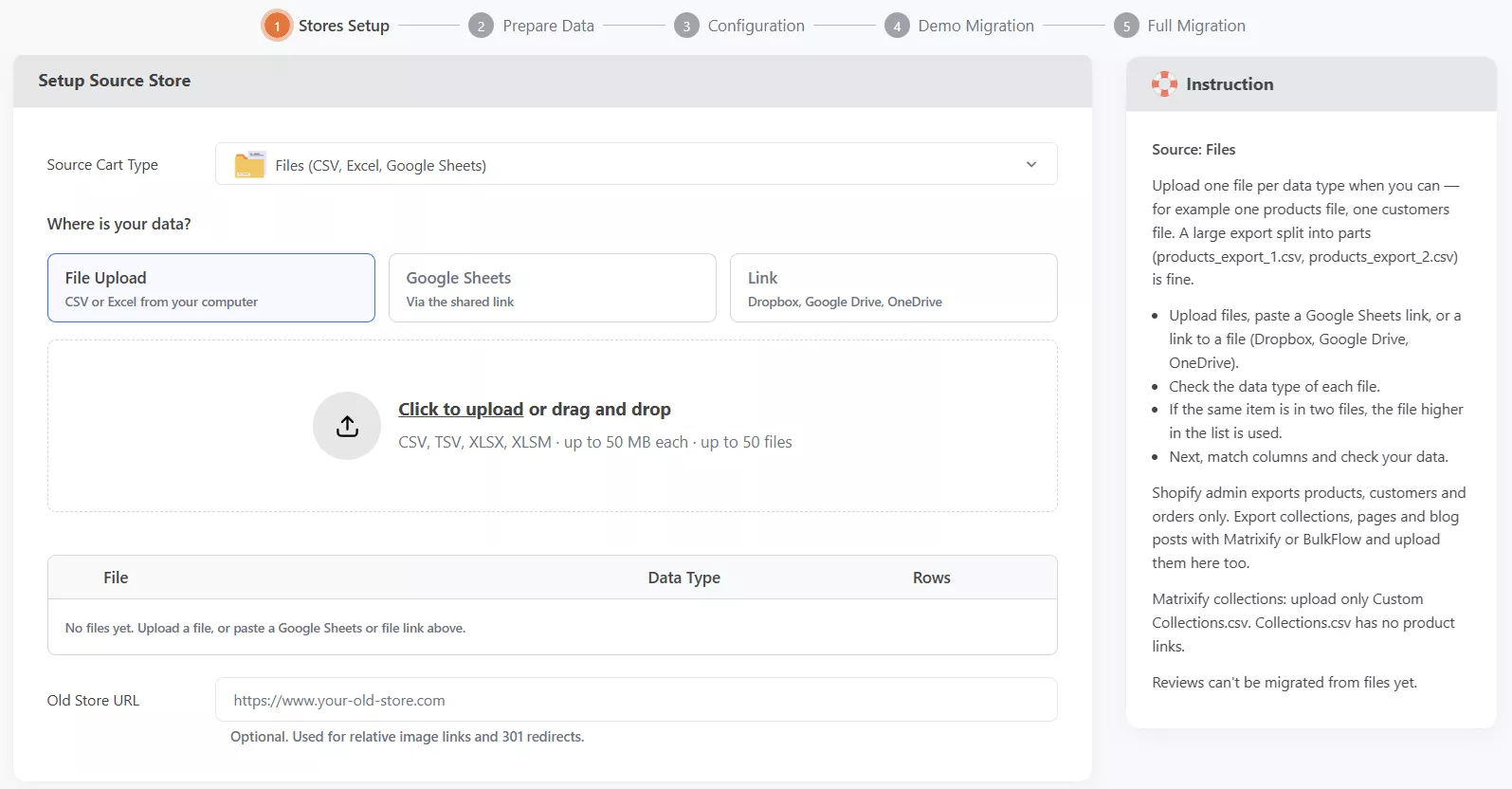
Check each file’s Data Type. If a product or customer appears in multiple files, the first file takes priority. Add the optional Old Store URL for relative image paths or supported redirects.
Select WooCommerce as the Target Cart Type and follow the connection instructions. Back up existing WooCommerce data and pause automated emails or workflows that imported records could trigger. Then continue to Prepare Data.
Step 2. Map Shopify Data to WooCommerce and Check for Errors
Review the automatically matched fields and sample records in Field Mapping. Confirm the Product Identifier that groups each Shopify product with its variants and images. For Customer Identifier, choose an appropriate ID, email, or phone column. Check SKUs, option values, addresses, and order relationships.
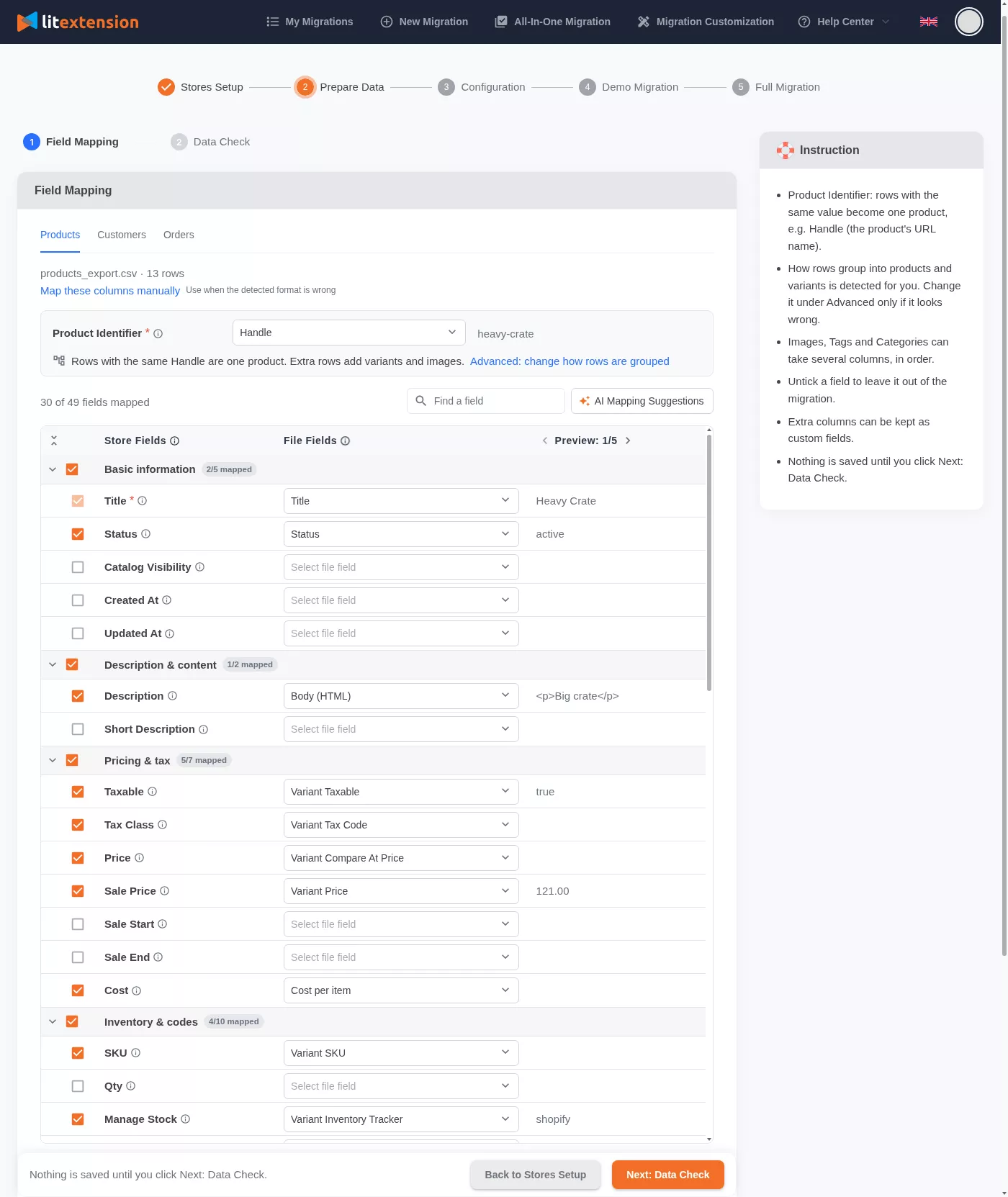
Click Next: Data Check to validate the files without importing data. Ready records are eligible for migration, including those with Warnings. Review the warnings and Skipped / Duplicates; Errors prevent affected records from being imported.
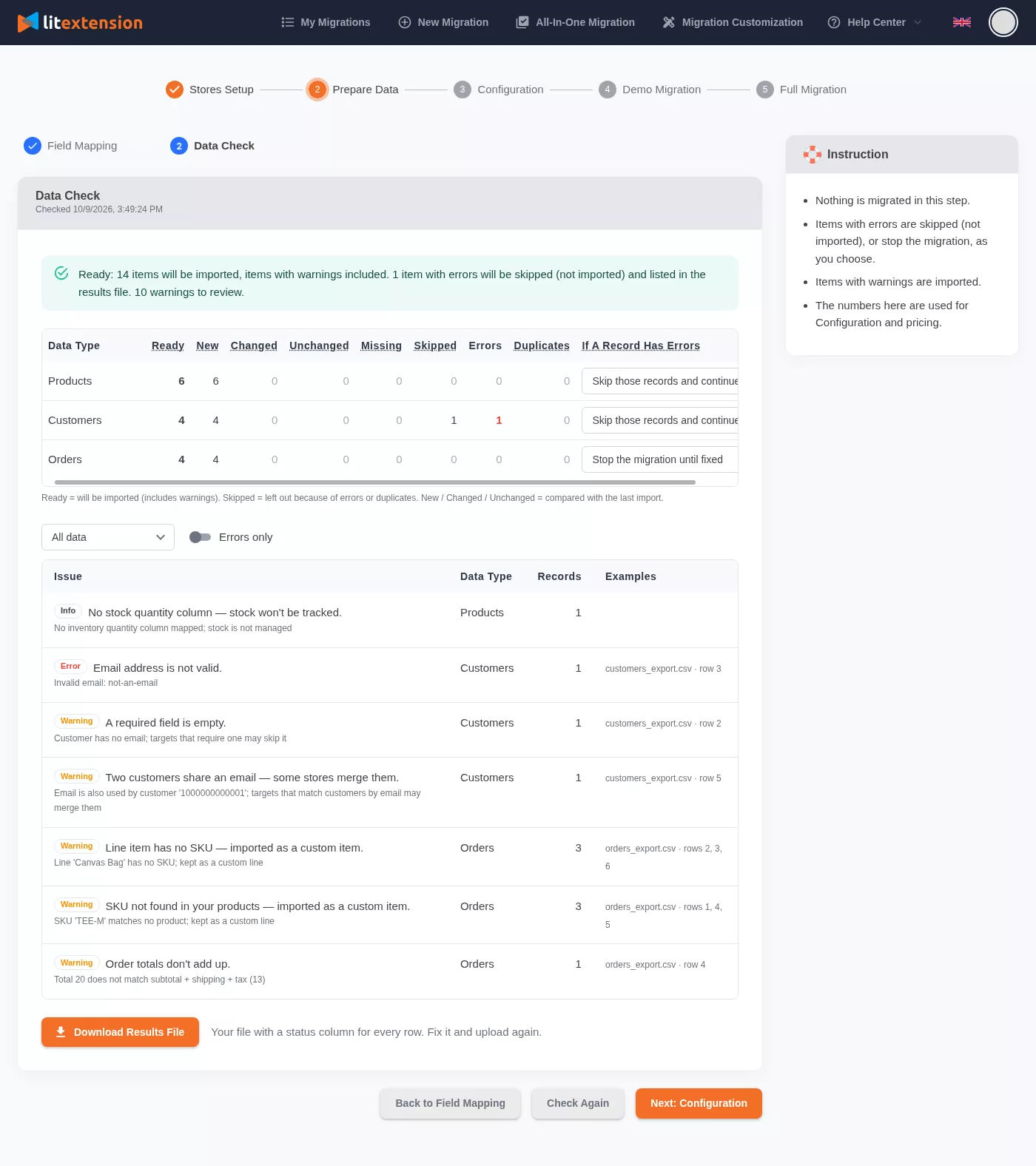
To fix problems, download the Results File, correct the affected rows, replace the uploaded files, and click Check Again. You can skip invalid records or block their data type until corrected. Repeat Data Check whenever a file or mapping changes.
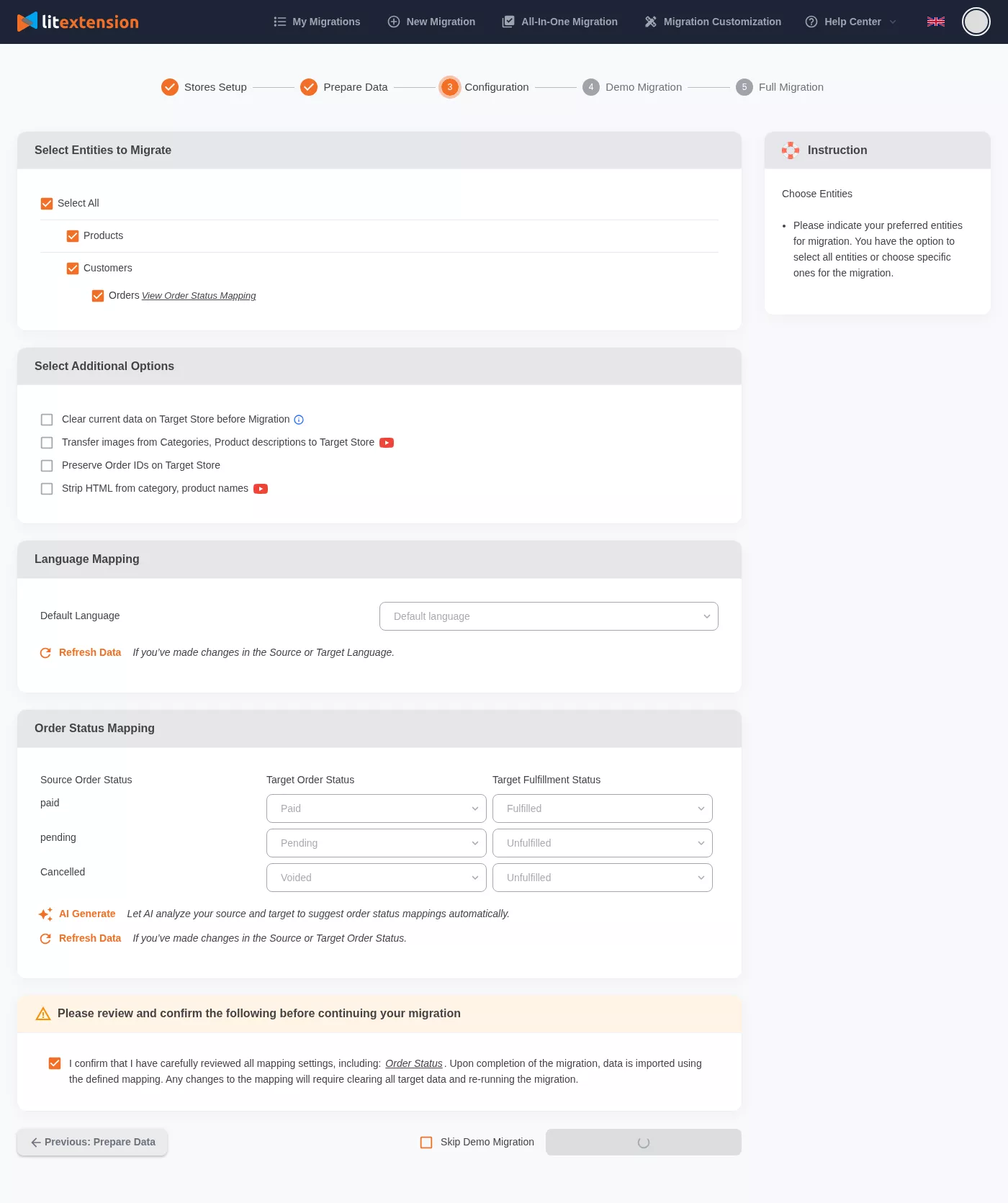
Open Configuration, select the supported data types and additional options you need, review Order Status Mapping where available, and confirm your settings.
Step 3. Test the Transfer and Complete Your Migration
Run Free Demo Migration and use View to inspect the sample records in WooCommerce. Check variations, prices, stock, images, customer addresses, order totals and statuses, and any selected redirects. If something is wrong, adjust the files or mapping, run Check Again, and select Demo Again.
After a successful demo and an up-to-date Data Check, click Next: Confirm Orders, review the price, complete payment, and start Full Migration. Only selected records eligible after Data Check are transferred.
Keep the source files unchanged while each migration runs. Track progress in My Migrations; LitExtension emails you when it finishes. Compare the completed WooCommerce records with your selected, eligible Shopify data.
This method uses the exports you upload. If Shopify continues taking orders, plan a follow-up transfer using updated exports.
Before You Move from Shopify to WooCommerce
- Prepare WooCommerce: Set up suitable WordPress hosting, install WooCommerce, and choose a compatible theme. Allow enough resources for your catalog and planned extensions.
- Keep a backup: Retain original Shopify exports and a recent WooCommerce backup for reference and recovery.
- Review essential features: List the Shopify apps, custom fields, and workflows your new store needs.
- Plan SEO and launch: Record important Shopify URLs, identify their WooCommerce destinations, and assign responsibility for testing, domain changes, and launch monitoring.
What Transfers from Shopify to WooCommerce?
The available records depend on your migration method and source data. Common migrations include products, variations, customers, addresses, orders, line items, coupons, collections, pages, blog posts, images, and supported SEO fields.
The product, customer, and order exports used above cover those datasets. Collections, pages, and blog posts need compatible additional exports, such as supported Matrixify or BulkFlow files, or a managed migration. Reviews are not currently supported through LitExtension Files Migration.
| Shopify data | WooCommerce destination | What to check |
|---|---|---|
| Collections | Product categories or tags | Category assignments and any automated collection rules that need rebuilding |
| Product options and variants | Attributes and variations | Option combinations, SKUs, prices, and stock |
| Customers and orders | WooCommerce customers and orders | Addresses, line items, and customer-order relationships |
| Order and fulfillment statuses | WooCommerce order statuses | Status mappings and any custom statuses |
| Discount codes | WooCommerce coupons | Eligibility rules and usage limits |
| Pages and blog posts | WordPress pages and posts | Content, authors, dates, images, and supported SEO fields |
| Metafields and metaobjects | Custom fields or plugin-managed data | Compatible destination fields, plugins, or custom development |
| Handles and URLs | Slugs and permalinks | 301 redirects from old Shopify URLs to the correct pages |
Subscriptions, memberships, bundles, gift cards, store credit, loyalty points, app-based reviews, B2B data, multilingual content, multiple currencies, digital files, and other custom records need individual assessment. Their transfer may require additional exports, a compatible WooCommerce plugin, or custom mapping.
Shopify themes, Liquid code, installed apps, stored payment credentials, checkout customizations, and platform-specific automation rules do not transfer directly. Customer passwords are not included in Shopify’s standard exports, so plan for customers to set new WooCommerce passwords.
What Happens to Your Shopify Apps?
Choose a WooCommerce plugin or custom solution for each essential Shopify app. Check whether the original app can export its data and whether the replacement can import it; installing a similar plugin does not move the data automatically.
Map transferable app data separately and test the complete workflow before launch, especially subscriptions, loyalty, fulfillment, reviews, and bundles.
Have LitExtension Manage Your Shopify to WooCommerce Migration
If you prefer expert help, LitExtension’s All-in-One Migration service handles the data transfer and validation for you:
- Confirm the scope and mapping. Review your Shopify records, apps, custom data, and WooCommerce setup with the migration team. Agree on the data, redirects, custom work, and required access.
- Review a test migration. Inspect sample WooCommerce records and confirm that products, variations, images, customers, orders, and relationships work as expected. Resolve mapping issues before the full transfer.
- Run and validate the full migration. The team transfers the agreed data while Shopify remains available for sales, then checks counts, field values, images, relationships, URLs, and duplicates. Review the results before launch.
- Prepare the final transfer and launch. Arrange the applicable transfer of recent Shopify data. Test checkout, payments, tax, shipping, email, analytics, and replacement app workflows before switching your domain.
Post-migration services address different needs:
- Recent Data Migration: Transfers supported new records created after the initial migration.
- Smart Update: Updates supported fields in existing product records.
- Re-migration: Runs the migration again when needed.
Availability, free usage limits, and support periods depend on your migration package. Confirm these details, along with who will handle each launch task, before the project starts.
Theme design, app replacement, custom plugin development, payment gateway account setup, integrations, hosting, and ongoing maintenance are separate unless included in your plan.
Can You Migrate from Shopify to WooCommerce Manually?
For a small product catalog, you can export Shopify products and use WooCommerce’s built-in product CSV importer. Prepare the file for WooCommerce’s product format, including variation relationships, then open Products > All Products > Import in WordPress to upload and map the columns.
The built-in importer handles products. Moving customer and order history requires additional import tools or a migration service, while app data and redirects need their own preparation.
Choose LitExtension Files Migration to work from Shopify exports, or a managed migration for help with complex data and transfer validation. Request a free consultation to confirm the scope and cost of your Shopify to WooCommerce migration.
Join 200,000+ merchants that have migrated with LitExtension. Request a free consultation to review your Shopify data, identify custom requirements, and receive a migration plan aligned with your WooCommerce setup and launch goals.
Shopify Data You Can Migrate to WooCommerce
We migrate supported Shopify products, customers, orders, coupons, pages, blog posts, images, and SEO fields to their corresponding WooCommerce records. Metafields, app-managed data, reviews, subscriptions, bundles, and other custom structures are assessed separately before migration.


-
Products
- Title and description
- Product handle to WooCommerce slug
- Images and supported media
- SKU
- Regular and compare-at prices
- Inventory quantity and tracking status
- Weight
- Options, attributes, and variants
- Collections to product categories
- Supported metafields and custom fields
- SEO title and meta description
Product Categories
- Name and description
- Slug
- Image
- Supported SEO title and meta description
-
Customers
- First and last name
- Email address
- Phone number
- Company
Customer Addresses
- First and last name
- Company
- Street address and apartment or suite
- City, state, ZIP code, and country
- Phone number
-
Orders
- Order number and creation date
- Customer or guest details
- Billing and shipping addresses
- Line items, product names, SKUs, quantities, and prices
- Subtotal, discounts, taxes, shipping, and order total
- Supported payment and fulfillment status mapping
-
Coupons
- Discount code and type
- Discount value
- Start and end dates
- Minimum purchase requirements
- Usage limits and supported customer eligibility rules
-
Pages
- Title
- Page content
- Slug
- Supported SEO title and meta description
-
Blog Posts
- Title and content
- Author
- Featured image
- Publication status and date
- Tags
- Supported SEO title and meta description
*Migration availability depends on your Shopify setup, WooCommerce configuration, and the apps or plugins that store the data. If an item is not listed, request a free technical assessment.


Our team manages the store assessment, data mapping, test migration, full transfer, validation, and eligible post-migration updates. You receive one migration plan and a dedicated point of contact from consultation through completion.









How Your Data Is Secured During Migration
Migration data is transferred through secured connections and access is limited to authorized specialists when technical support or custom handling is required. Credentials and imported records are handled under LitExtension’s data security, access-control, GDPR, and NDA policies. Review the Data Security Policy for full details.






Why Choose Shopify to WooCommerce Migration Services


Shopify to WooCommerce Reviews From Our Customers

They handled smoothly the migration of my store (customers, orders, coupons, reviews, products, etc), from Shopify to Woocommerce. And they were very responsive if there was any issue! Recommended!
LitExtension was always professional, patient, and very reliable during an extensive migration effort we were involved. They answered all the questions, and kept track of all the problems until we reached a final solution. Excelent service!
Very great customer service. I use litextension to migrate from shopify to woocommerce and now it is working pretty well !