Shopify to Etsy migration is handled entirely by LitExtension’s All-in-One team. No technical skill is required on your end, our experts manage the whole process from start to finish, keeping your listings, product data, and images secure and complete while your Shopify store stays active.
Start with a Free Demo Migration to preview how your data will appear on Etsy. Once you approve the results, we run the Full Migration, and you’re covered by up to 60 days of support after it completes.




How to Perform Shopify to Etsy Migration

1. Consulting with Migration Experts
Share your Shopify and Etsy store details with our team. We review your listing structure, transferable data, and Etsy’s specific requirements before defining the migration plan.

2. Data Mapping and Store Setup
Our experts create or update your Etsy listings directly through Etsy’s API, rather than relying on CSV import, mapping your Shopify product data to Etsy’s listing format and running a Demo Migration so you can review the results before the full transfer.

3. Perform Full Data Migration
After the demo is approved, we run the full migration on our servers, monitor the transfer, and validate your listings so your Etsy shop is ready for your final launch review.
Shopify to Etsy Migration vs. Integration: Which one is right for you?
- Migration (best done with a service like LitExtension) is the right path if you’re planning to migrate Shopify to Etsy entirely, shutting down your Shopify store and moving your whole business to Etsy as your new primary sales channel – transferring your full catalog, images, variants, and history in one go, rather than rebuilding by hand.
- Integration / Syncing is the right path if you want to keep both platforms running side by side, with ongoing two-way sync of inventory, orders, and pricing – so you’re not manually updating stock in two places every time something sells.
| Migration | Integration/Syncing | |
|---|---|---|
| Best for | Leaving Shopify for Etsy | Selling on both platforms at once |
| Data transfer | One-time, full catalog | Ongoing, continuous sync |
| Shopify store after | Usually closed | Stays active |
| Manual work required | Minimal (with a migration tool) | Minimal (with a sync tool), but ongoing |
Can You Migrate Shopify to Etsy? What to Check First
Etsy is a marketplace, not a store builder, so a Shopify to Etsy move has two questions: can your products be sold there, and what data can actually come across. Check both before you export anything.
Does Etsy Allow Your Products?
Etsy requires that items be made, designed, handpicked, or sourced by the seller. Reselling mass-produced goods is generally not allowed, and drop shipping is only permitted for craft and party supplies. Print-on-demand and other production partners are allowed when the designs are your own, and their use should be disclosed. If your Shopify store sells commercially available products made by others, only part of your catalog may be eligible, and listings that break these rules can be removed. Read Etsy’s Creativity Standards before you decide to migrate Shopify to Etsy.
What Moves and What Does Not
| Shopify data | Can it move? | What to know |
|---|---|---|
| Titles, descriptions, prices, and SKUs | Yes, with limits | Etsy titles stop at 140 characters, and descriptions should be plain text. |
| Images | Yes | Up to 20 photos and 2 short videos per listing. Photos look best at 2000 pixels wide or more. |
| Variants | Yes, with mapping | Etsy supports up to three variation types, and unique prices, SKUs, or quantities for up to 400 option combinations. Products with more combinations need to be simplified. |
| Tags | Yes, up to 13 | Choose your best search keywords from Shopify’s tags. |
| Categories and attributes | Manual | Etsy requires its own category for each listing, and the right attributes depend on it. |
| Shipping and policies | Manual | Set up Etsy shipping profiles and shop policies yourself. |
| Customers and order history | Needs a plan | Etsy’s listing tools focus on products, so keep your Shopify records and ask your expert what your project will include. |
| Theme, pages, and URLs | No | Etsy shops use Etsy’s layout, and listing URLs are created when you publish, so they cannot match your Shopify addresses. |
Before You Export Shopify Products to Etsy
- Remove ineligible products: leave out items Etsy would not allow, so you do not spend time on listings that may be removed.
- Clean your product data: fix missing SKUs, shorten long titles, and rewrite descriptions as plain text.
- Prepare your photos: download your images in a suitable format at 2000 pixels wide or more.
- Open and set up your Etsy shop: add your shop policies, shipping profiles, and payment details before you start listing.
- Keep Shopify running: do not close your store until your Etsy listings are live and checked.
How to Export Shopify Products to Etsy (Manual CSV Method)
To move products from Shopify into Etsy, you must export Shopify products to Etsy and then manually create corresponding Etsy listings. There are three main steps to export Shopify products to Etsy.
Step 1: Export Your Shopify Products
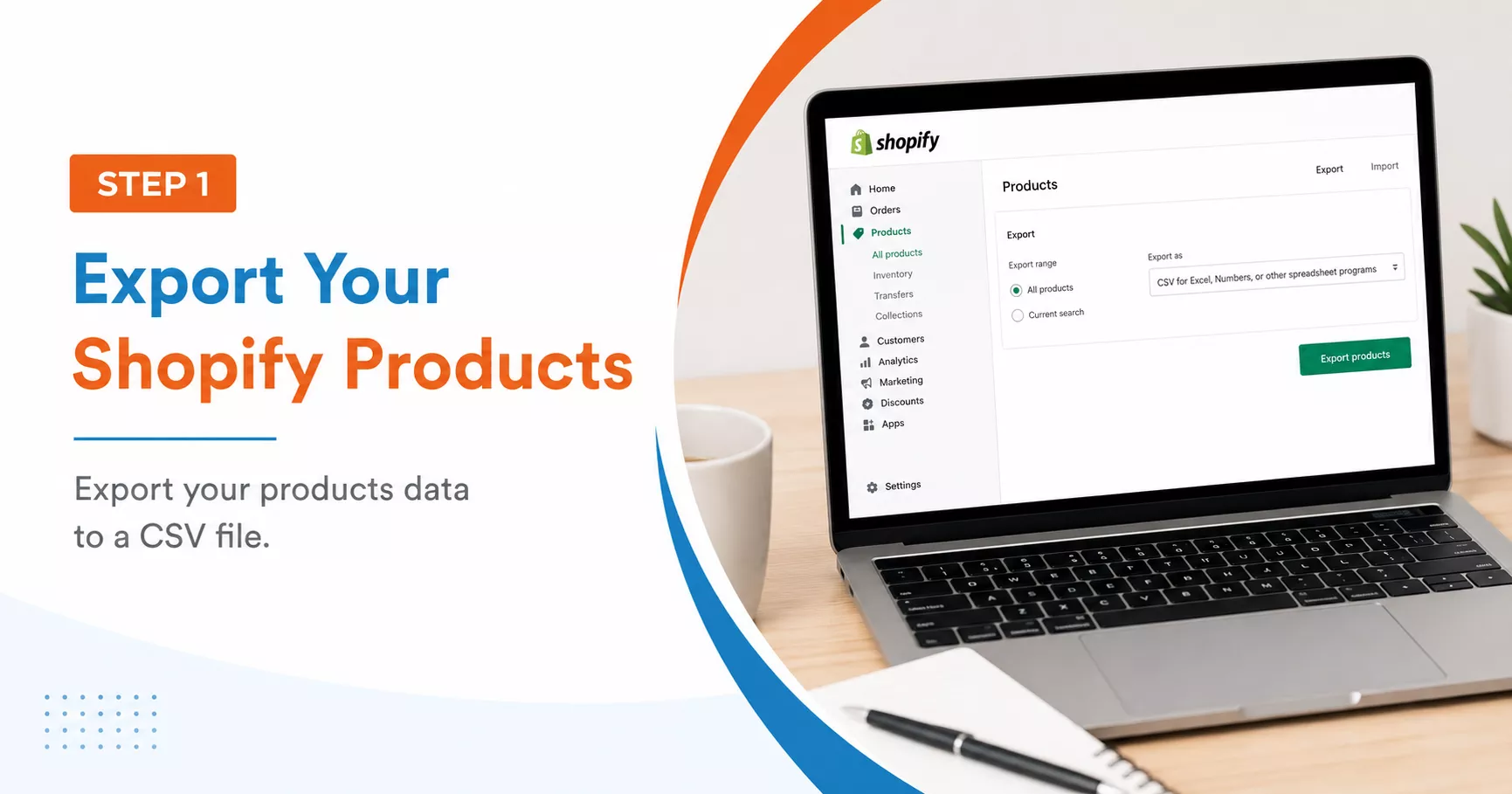
To export products from Shopify:
- In your Shopify admin, navigate to Products → Export.
- Choose All products and a CSV format, then click Export products.
- Shopify’s CSV will contain image URLs.
- To get the actual image files, open each URL in a browser or use the Files section in Shopify admin.
- For example, in Shopify Settings → Files, find each product image, click Copy link, then paste that URL into your browser to download the image.
- Save images in a supported format (Etsy requires JPG or PNG).
- Organize them locally (Etsy lets you upload up to 20 photos per listing)
- Locate key columns: Title, Description, Variant Price, Variant SKU, Option1 Name/Value, Option2/3 Name/Value, and Tags.
- For each product row, note the title, description, price, SKU, and option values.
- You need to clean up formatting to make it plain text suitable for Etsy.
- Also check Tags: Shopify tags are comma-separated in one field, you can split these into up to 13 separate Etsy tag slots later.
Step 2: Prepare Data for Etsy Listings
With your Shopify data ready, plan how it maps to Etsy’s listing form.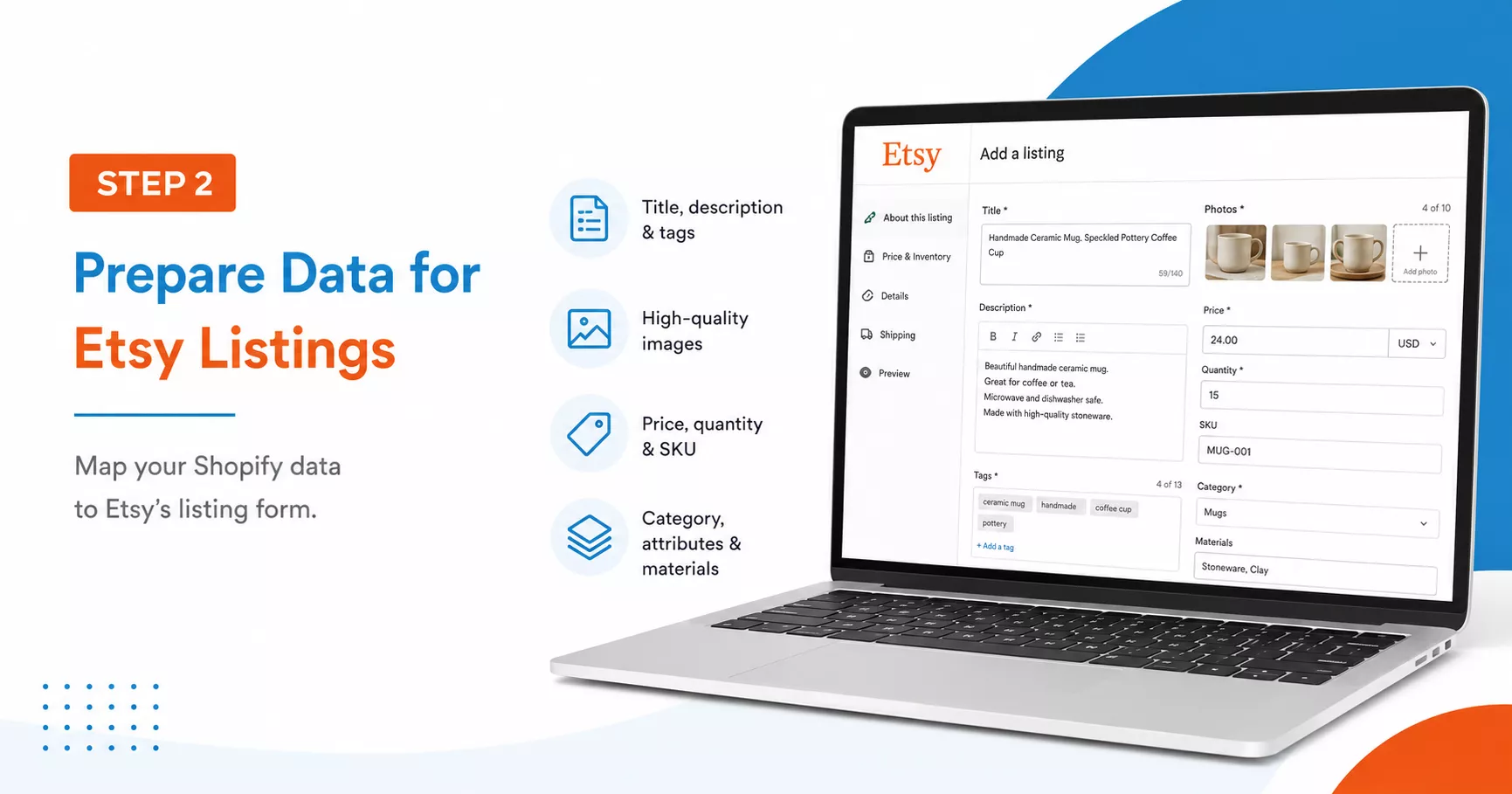
Key considerations:
- Title: Etsy titles can be up to 140 characters. Copy your Shopify product Title into Etsy’s title field, truncating if necessary. Use as many relevant keywords as possible (Etsy suggests <15 words), but keep within length limits.
- Description: Copy the Shopify Description text (plain text) into Etsy’s description box. Ensure it fully explains the product and includes keywords buyers might use. Remove any unsupported HTML or code; Etsy supports rich text but not raw HTML.
- Images: When creating the Etsy listing, upload the downloaded images. Etsy allows up to 20 photos per listing. Make sure images meet Etsy’s requirements (.jpg or .png; min ~2000px for detail). Name or order them logically.
- Price and Currency: Enter the Shopify Variant Price as the listing’s price. Etsy will display the price in your shop’s currency. Ensure your Etsy shop’s currency matches or convert as needed. The CSV’s price is a number without symbol; enter it exactly in Etsy’s price field.
- Quantity: In Etsy’s Price & Inventory section, set the Quantity to your stock level for that product. If Shopify tracked inventory at one location, use that number; otherwise set as appropriate.
- SKU: Etsy allows an SKU for each listing (and for each variant). If you used SKUs in Shopify, enter the product’s SKU (or variant SKU) in Etsy’s SKU field to keep consistency.
- Tags: Etsy allows up to 13 tags. If your Shopify CSV had tags, use up to 13 of those or otherwise add keywords that describe the item. Enter them in the “Tags” section (comma-separated in CSV, but in Etsy’s UI you add each tag one by one)
- Materials: If applicable, fill the Materials field in Etsy’s Details tab with product materials. Shopify doesn’t have a standard “materials” column by default, but if you know what it’s made of (from product info), list it here.
- Category and Attributes: Etsy requires you to choose a category for each listing. In the Details → Category section, type a keyword and select the closest match. Once a category is set, Etsy will show relevant attributes (color, size, etc.); fill these if they apply. This information isn’t in your Shopify CSV, so assign it manually.
Step 3: Import Your Products to Etsy
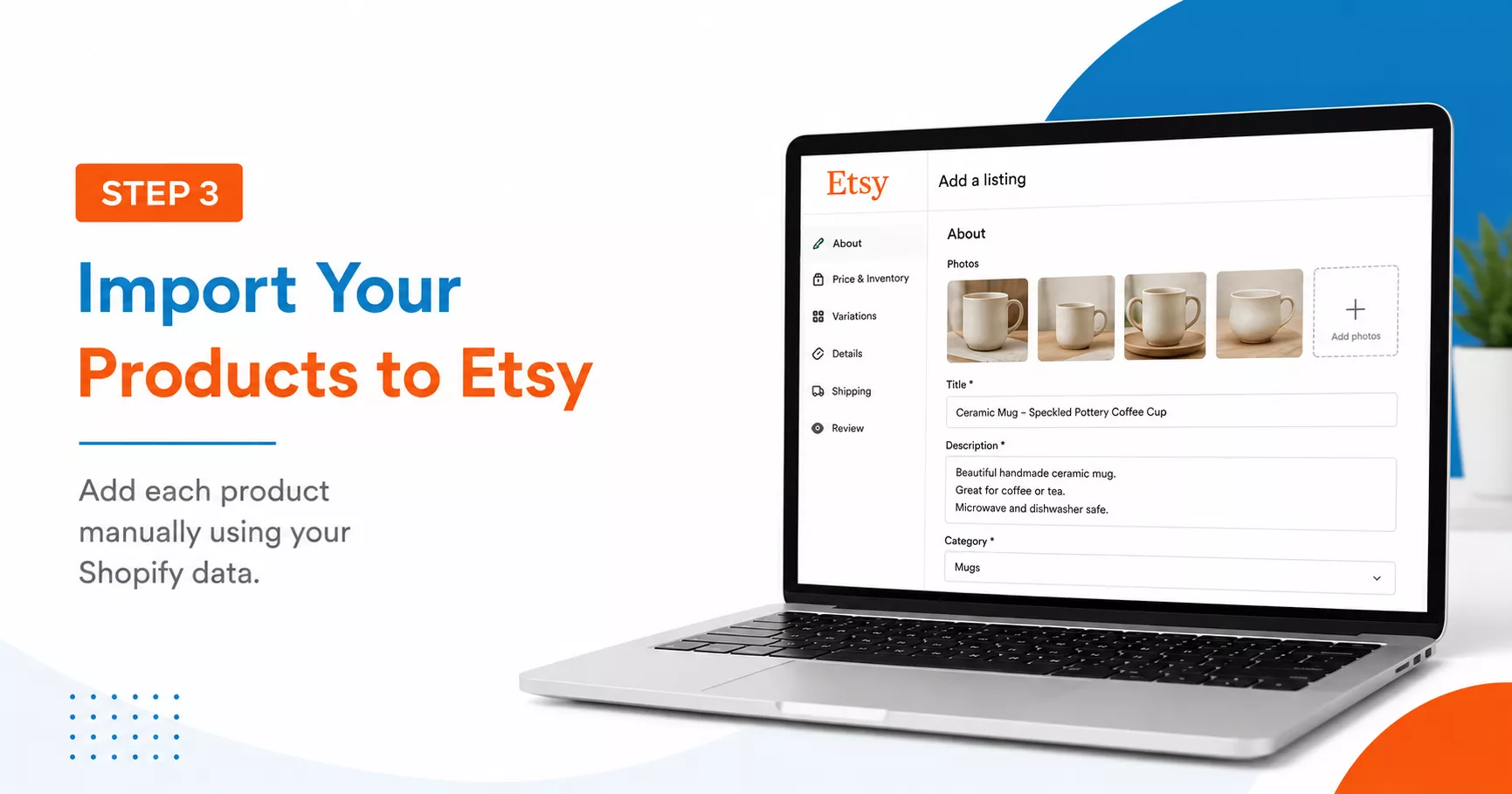
The basic steps on Etsy are:
- Sign in to Etsy Shop Manager: In Etsy, go to You > Shop Manager, then click Listings.
- Add a new listing: Click Add a listing. The listing form has several tabs (“About”, “Price & Inventory”, “Variations”, etc.). You will fill each tab using your Shopify data.
- About tab:
- Photos: Click Add photos and upload your product images (saved from Shopify). Arrange them (first photo will be the thumbnail).
- Title: Paste the product title (≤140 chars). Make it descriptive.
- Description: Paste the product description. Be sure it reads well; Etsy suggests using buyer-search keywords.
- Category: Use the search box to select the best category.
- Personalization: Leave blank unless offering custom text.
- Price & Inventory tab:
- Price: Enter the price from Shopify.
- Quantity: Enter available stock.
- SKU: Enter the Shopify SKU if you tracked one. (Optional for Etsy)
- Variations tab (if applicable): If the Shopify product had variants (e.g. Size, Color), replicate them here. Click Add variations. You can add up to three attributes. Then enter each option value. Toggle on “Price” or “Quantity” if you need different prices or inventory by variant. For example, if each color has a different price, turn on the price toggle and enter each variant’s price. Etsy will then display fields to input prices/quantities per variant.
- Details tab: Fill in any category-specific details that apply. This includes gender, primary color, secondary color, etc. These are selected from dropdowns once you’ve set a category. Also add Tags (up to 13) copied from Shopify or relevant keywords, and Materials if used.
- Shipping (Processing) tab: Etsy will require shipping profiles or processing times. Shopify’s CSV doesn’t include shipping info, so you’ll set this up in Etsy as appropriate for the product.
- Publish listing: When all fields are complete, click Publish. Your listing is now live. Etsy notes it may take up to 48 hours to appear in search.
Other Ways to Export Shopify Products to Etsy
Common Mistakes When You Export Shopify Products to Etsy
- Long titles: Etsy cuts titles off at 140 characters, so shorten them before you paste.
- HTML in descriptions: remove raw code and formatting that Etsy does not support.
- Small photos: photos under 2000 pixels wide get a warning and can look soft.
- Too many variants: check your option combinations against Etsy’s variation limits before you rebuild a product.
- Digital products with variations: Etsy does not support variations on digital listings, so split them into separate listings.
- Missing shipping profiles: create them first, or each listing will stop at the shipping step.
After You Migrate Shopify to Etsy
- Check each listing: confirm photos, variations, prices, and quantities match your Shopify product.
- Decide how to handle stock: if you keep selling on both platforms for a while, update inventory in both places or use a sync tool to avoid overselling.
- Review your category and tags: listings found through search depend on accurate categories, attributes, and tags.
- Update links you control: point social profiles, email signatures, and marketing links to your Etsy shop once you are ready to switch.
- Close Shopify last: keep it available briefly after launch, so you can compare records if anything looks wrong.
Join 200,000+ businesses that have migrated with LitExtension. Start a Free Demo Migration to preview how your Shopify products, customers, orders, and URLs will be transferred to Etsy before running the full migration.
What Data Can Be Migrated from Shopify to Etsy
Use the tabs below to see which Shopify data fields we can migrate to Etsy.

-
Products
- Name, SKU, Short Description, Full Description, Status.
- Manufacturer.
- Price.
- Quantity.
- Weight, Width, Height, Depth.
- Tags.
- Variants.
- Thumbnail Image, Additional Images.
Can’t find the data you need to migrate to Etsy? Contact us or click on the Live Chat in the right corner for a free consultation.


Leave The Work For The Experts

How Your Data Is Secured During Migration?

Server Security

Data Security

Data Access Restriction

GDPR Compliance

NDA

Payment Security
Why Choose Shopify to Etsy Migration Services










Who We Truly Are? Let Our Customer Define!

I am in the process of moving my existing website over to Shopify. As this is my 4th iteration of my website, I knew I didn’t want to do the migration part myself again! Using this service meant that I could concentrate on running my business for a couple of days while the migration was being done for me.

Lotus was phenomenal! She is detailed-oriented and works extremely fast! She helped with the migration from Shopify to Esty in no time. Thank you so much Lotus and everyone at LitExtension!
We migrate with Litextension our shop from Shopify to Esty. The team was great to work with. During the process we identified a few issues. But everything was fully resolved in two days. We are satisfied with the work from Litextension.
