Based on 3,000+ reviews on :


Move your WooCommerce store to Magento with LitExtension’s automated migration tool, or hand it to our All-in-One experts if you’d rather not touch the setup. Transfer products, customers, orders, and categories while your WooCommerce store keeps running the entire time, no technical skill required. Customer password migration is available for supported platform pairs, our team confirms compatibility during consultation.
Start with a Free Demo Migration to preview your data on Magento. Once you approve the results, run the Full Migration, and you’re covered by up to 60 days of support after it completes.
How to Perform WooCommerce to Magento Migration

Select WooCommerce as your Source Cart and Magento as your Target Cart, then enter your store URL and follow the setup instructions to link both systems.

Choose which entities to bring over, products, categories, customers, orders, and more, then map your order statuses and turn on whichever Migration Options fit your Magento setup.

Run a free Demo Migration to preview a sample of your data on Magento. Once you approve it, launch the Full Migration, it keeps processing on our servers even after you close your browser.
No longer fit with WooCommerce? Looking to migrate your online store to Magento? Look no further! LitExtension WooCommerce to Magento migration service will transfer your WooCommerce store to the Magento platform, migrating the confirmed entities and fields listed above, so your store is up and running in no time.
The A-Z WooCommerce to Magento migration process includes these below steps:
- Step 1: Fill in the Source Cart and Target Cart
- Step 2: Select Entities You Want to Migrate
- Step 3: Perform Full WooCommerce to Magento Migration
In case you want to dig deep into a complete guide on switching from WooCommerce to Magento 2, please look at our comprehensive WooCommerce to Magento 2 migration guide. Now, let’s head straight to 3 critical steps of the WooCommerce to Magento migration with LitExtension.
Before You Begin: Migration Prerequisites
Before you migrate WooCommerce to Magento, a bit of preparation upfront will make the whole process go far more smoothly. Here’s what to get ready first:
- Back up your WooCommerce store: export a full backup of your database and files before touching anything, so you have a fallback if something goes wrong during the migration.
- Set up your Magento store: install Magento, or have your Magento Commerce/Adobe Commerce instance ready and accessible, before you start.
- Verify your hosting meets Magento’s requirements: Magento needs more server resources than WooCommerce, so check your PHP version, memory limits, and database requirements against Magento’s official system requirements first.
- Clean up your data: remove out-of-stock products, duplicate customers, and outdated content from WooCommerce beforehand, so you don’t carry unnecessary clutter into your new Magento store.
- Check for data that lives in plugins: some WooCommerce stores track manufacturers, custom order statuses, or customer groups through separate plugins rather than core fields. Confirm you still have access to those plugins before migration, or that data may not get captured during extraction.
- Confirm your reviews are accessible: if you use a reviews plugin, make sure it’s active and its data is reachable, so review content can be pulled in along with the rest of your store data.
Step 1: Fill in the Source Cart and Target Cart
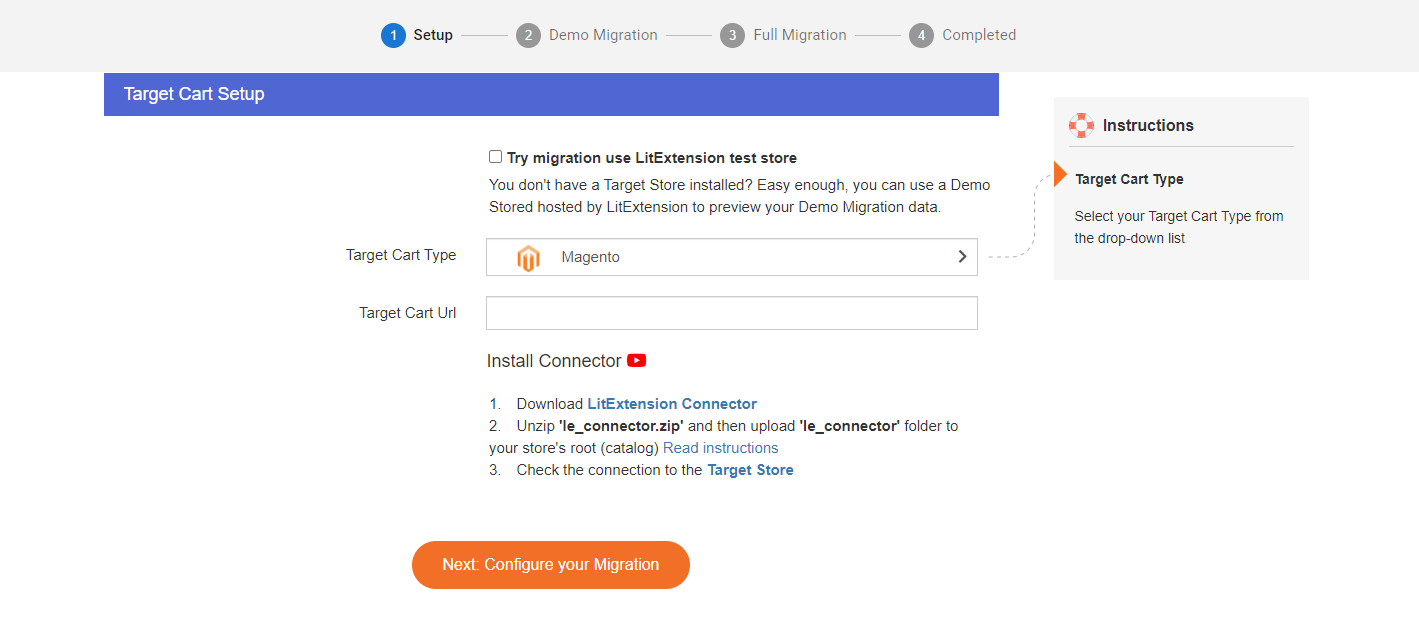
After logging in, select “Create New Migration” in the top right corner of the screen to begin configuring the migration. Choose WooCommerce as your source cart and fill out the fields for the source store’s URL, admin username, and admin password. The connector can then be downloaded by clicking download LitExtension connector, extracted from the zip file, and uploaded to the root folder of Source Store. To facilitate the data transfer, this connector serves as a conduit between LitExtension and your Source Store. Without requiring personal inspection, Connector Installation will be automatically verified and displayed on the screen.
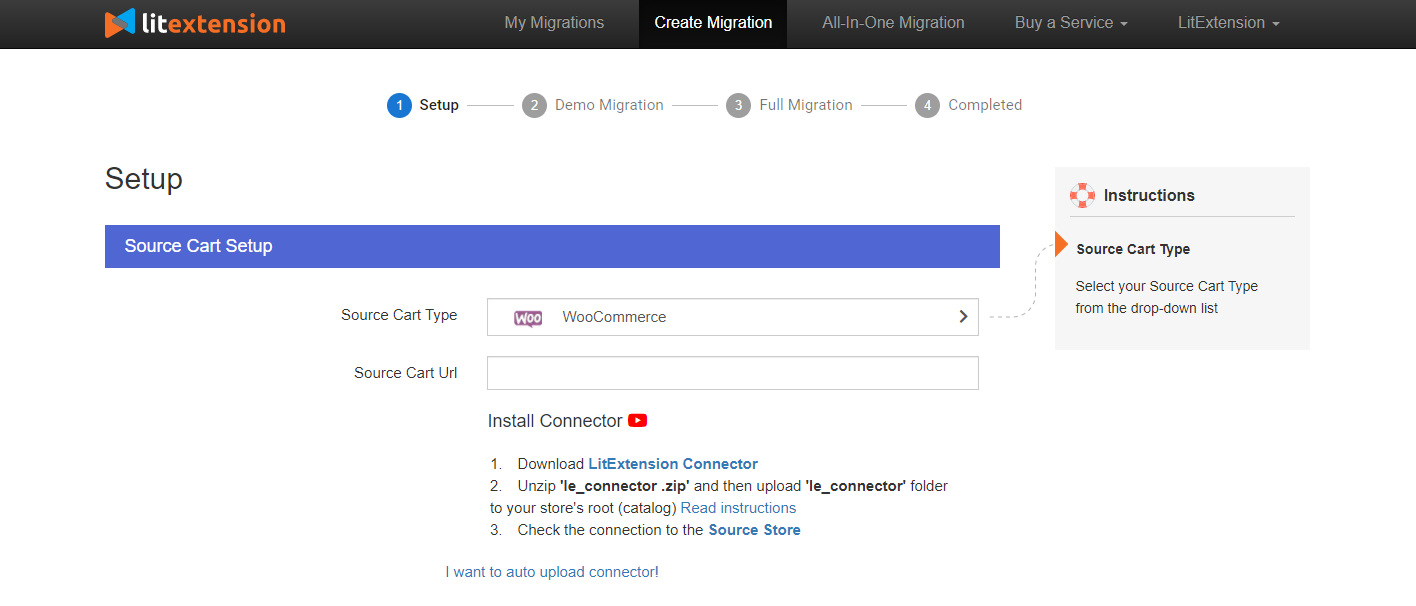
For Target Cart, select Magento and repeat the same procedure!
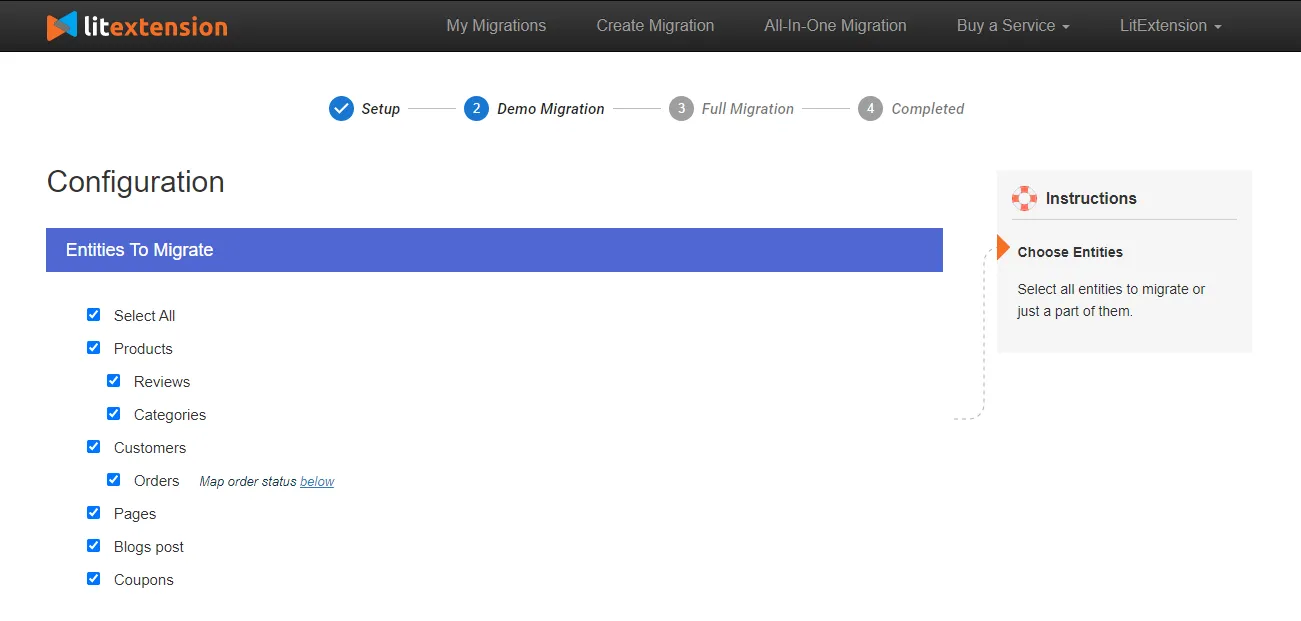
Step 2: Select Entities You Want To Migrate
At this step, you can either choose to migrate all the entities or just tick certain types of data you want. For example, Products and Customers only.
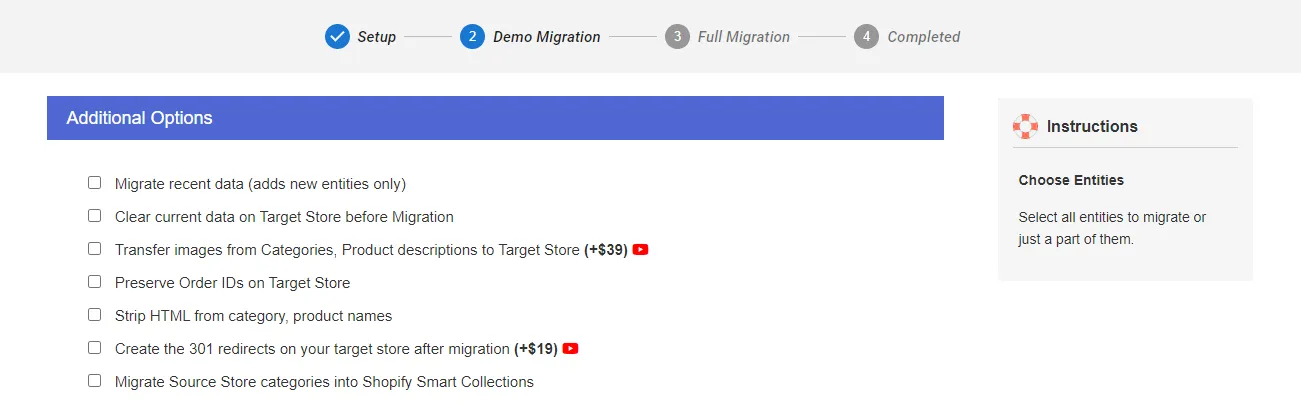
LitExtension also provides other Additional Options to extend your data import functionality such as Preserve Order IDs or Strip HTML Tags from Category and Product Names to migrate WooCommerce to Magento. These features not only save you from having to perform other important tasks manually, but they also guard against significant re-platforming issues.
Additionally, you can map your order status at this point so that it will be shown appropriately on the Magento website. As with WooCommerce’s store, you may choose the Order status on Magento to suit your needs in a similar or different method.
Data mapping: Order statuses & customer groups
Since WooCommerce and Magento don’t share identical structures, a few fields need to be mapped rather than copied over directly. Order statuses are the most common example: WooCommerce statuses like Processing, On Hold, and Completed need to be matched to their closest Magento equivalents, and LitExtension lets you configure this mapping so orders display correctly on your new store. The same logic applies to customer groups. If you use custom customer roles or wholesale/retail segmentation in WooCommerce, map them to the matching Magento customer groups during this step, so pricing and permissions carry over as expected.
Step 3: Perform full WooCommerce to Magento Migration
Finally, you have the option to run the full migration immediately or first attempt a demo.
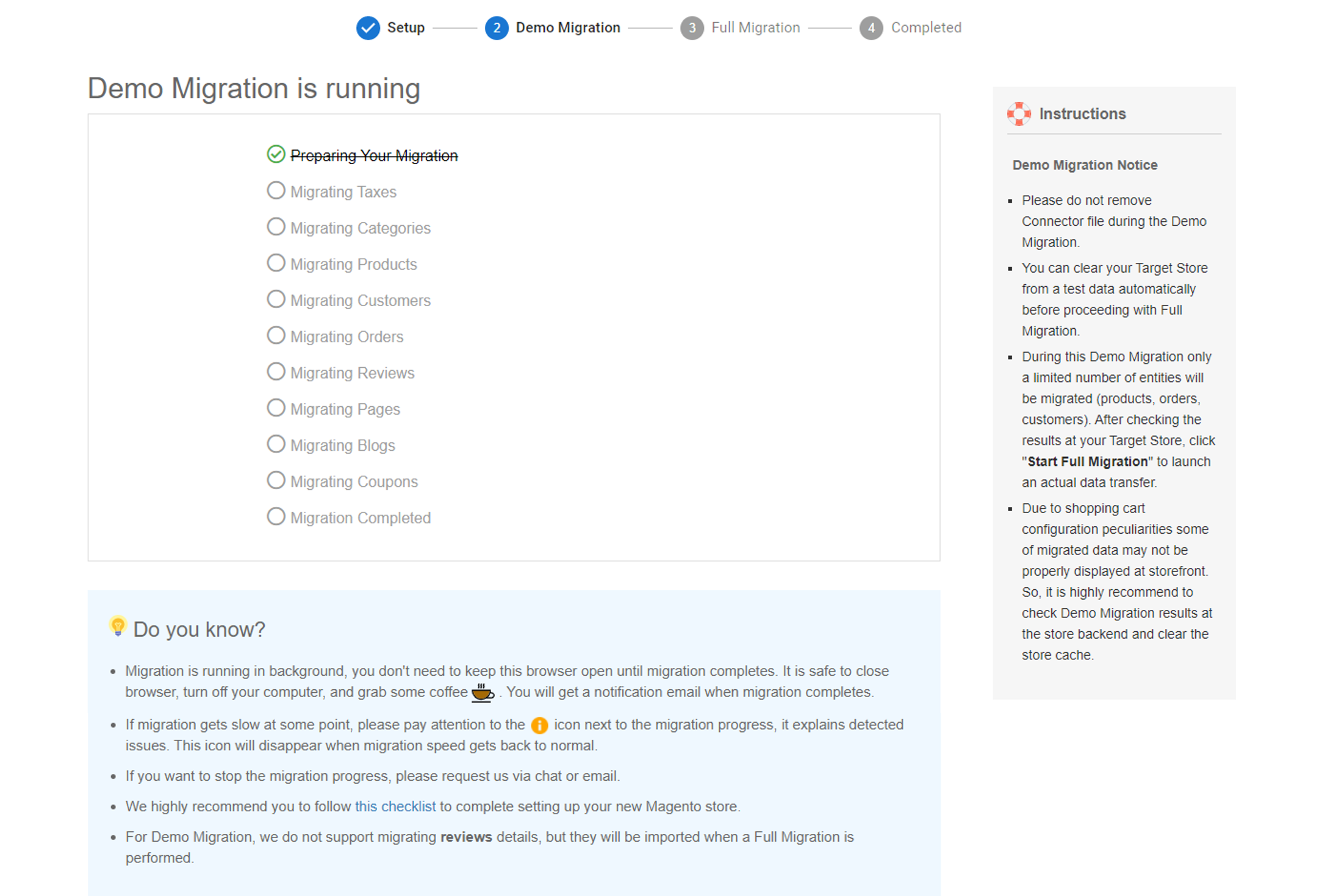
- To try demo: begin by migrating a set number of entities. Activities as the real migration will be seen.
- To run full migration: To perform full migration right away, click the “Skip Demo Migration” button. You can now shut down your computer and have a coffee. After the WooCommerce to Magento 2 migration is finished, the LitExtension system will send you an email.
Common Challenges When Migrating WooCommerce to Magento
A WooCommerce to Magento migration usually comes with a handful of predictable snags. Knowing about them ahead of time means fewer surprises once your store is live:
- Reindexing after migration: Magento relies on indexes to display products, prices, and categories correctly. Run a full reindex once your migration finishes, or your storefront may show outdated or missing data.
- Large catalogs slow down extraction: if your WooCommerce store holds 10,000+ products, extracting that volume of data takes longer and puts extra load on your server. Plan to run the migration during low-traffic hours.
- Passwords need a separate module: customer passwords aren’t migrated by default because of how each platform encrypts them. You’ll need a dedicated password migration module, or customers will need to reset their passwords on the new store.
- Themes and design don’t transfer: WooCommerce and Magento use entirely different theme systems, so your store’s look and feel needs to be rebuilt on a Magento theme rather than carried over automatically.
Migrate Extension and Custom Codes from WooCommerce to Magento 2
You might add some extensions to your WooCommerce store to improve the performance of your company, and you don’t want to lose those extra features. You must locate comparable Magento applications in order to preserve those extensions, and we will assist you with the data transfer task. In some circumstances, LitExtension can assist you if you also wish to maintain the functionalities established by bespoke WooCommerce code. These custom codes will be examined and made appropriate for your new Magento store.
Therefore, since switching to Magento with LitExtension is simple as pie, don’t hesitate to do so! Leave your WooCommerce to Magento migration in the capable hands of our All-in-One Migration Package if you lack technical expertise.
Our Magento migration experts will lift the weight of manual tasks off your shoulder and handle the migration at a committed response time, with a personal assistant and free additional options.
Which Shopping Carts Can Be Migrated to Magento?
Proud to be a top Magento migration expert, LitExtension can help you transfer all your data from 140+ eCommerce platforms to Magento accurately and securely.
Here are some of the most popular Magento migration pairs that LitExtension supports:
- Shopify to Magento
- BigCommerce to Magento
- WooCommerce to Magento
- Volusion to Magento
- OpenCart to Magento
- WordPress to Magento
8 Reasons Why WooCommerce to Magento Migration Is An Optimal Choice
Still weighing whether the switch is worth it? Here are the main reasons store owners choose to migrate WooCommerce to Magento:
1. Magento gives you complete control over your monthly pricing
Magento eCommerce is an open-source platform. Which means it doesn’t charge any penny for monthly subscriptions. Hence, when opting for Magento pricing, you will have complete control over how much you spend to maintain your business.
The overall operating cost depends mainly on your chosen hosting provider, third-party plugins, and other development services.
2. Magento opens the door for unlimited customization options
Magento allows all users to intervene deeply with their website source code. You gain the freedom to tweak, add, or remove any element of your online store. As long as your virtual presence does not go against Magento regulations, this platform sets no boundaries to website design.
You can add custom code to Magento to add some personal touches to your website after you migrate WooCommerce to Magento 2.
In short, WooCommerce migration to Magento would be a great solution if you are looking for a platform that grants you complete control over your site.
3. Magento is built to scale up and expand your business easily
Magento is designed to scale with the growth of your business. It can handle a large number of products, orders, and concurrent users. Hence, even if you are running a high-volume online store, Magento can always cater to your needs, and a WooCommerce to Magento product import now can save you headache later.
On top of that, if you are planning to sell globally, Magento has all the localization features needed for your international business. It supports multi-languages, multi-currencies, and multi-store management in one single dashboard.
Easily appeal to customers from other countries with Magento language package.
4. Magento is packed with an extensive selection of apps to enhance your business
There’s no doubt that Magento is one of the platforms that offer the widest variety of third-party plugins. This eCommerce solution currently has over 3,800 add-ons on its Magento Marketplace, divided into 9 categories. It can be right at your service no matter what functionality you want to integrate, including apps that connect your store to marketplaces like Amazon and eBay for selling across multiple channels from one dashboard.
5. Magento provides a safe and secure eCommerce platform for your business
Despite being an open-source eCommerce platform, Magento security is always heightened. This platform implements several strict measures based on the Adobe Secure Product Lifecycle to protect its users from cyber attacks and illegal data extraction.
For example, Magento has rolled out strengthened hashing algorithms to manage your passwords better. Additionally, this platform also complies with industry security standards, regulations, and certifications like PCI compliance, GDPR, and SSL.
6. Magento is built as a commerce platform from the ground up
WooCommerce runs on top of WordPress, a publishing engine, and turns it into a store by stacking plugins for products, checkout, shipping, and everything else. Magento takes the opposite approach: catalog, checkout, pricing, and order management are native, core parts of a single commerce platform, not add-ons bolted onto a blogging tool. That difference in foundation is a big part of why a WooCommerce to Magento migration often makes sense once a store outgrows what plugins can comfortably support.
7. Magento offers native B2B capabilities
If your business sells to other businesses, Magento (through Adobe Commerce) comes with built-in B2B features, including company accounts, quote requests, and contract-specific pricing, all available natively. On WooCommerce, replicating the same functionality usually means stitching together several separate plugins, which adds cost and maintenance overhead over time.
8. Magento gives you deeper reporting and analytics
Magento’s admin panel comes with far more built-in reporting than WooCommerce offers out of the box, covering sales trends, inventory levels, and customer behavior in detail. WooCommerce can get there too, but usually only by adding several analytics plugins on top. With Magento, that level of insight is part of the platform from day one, which matters a lot once you’re managing a larger catalog and need to make decisions based on real data rather than guesswork.
Here’s a quick way to see how core WooCommerce concepts map onto Magento once you migrate WooCommerce to Magento:
| WooCommerce concept | Magento equivalent |
|---|---|
| Plugins for core commerce features | Native platform features |
| Multilingual plugins (e.g. WPML) | Native multi-store & multi-language management |
| Coupon plugins | Built-in cart and catalog price rules |
When is the Perfect Time to Perform the WooCommerce to Magento Migration?
If your current online store is experiencing any of the following issues, it is advisable to consider a Magento migration in the near future:
- You want complete control over your website but the current platform has several limitations
- The loading speed of your website is so slow that it might cause frustration to customers
- Your business has scaled up, and your current eCommerce platform cannot meet your demand
- Your current website has crashed, and you want to switch to Magento
When migrating to Magento might not be the right move
Magento isn’t the best fit for every store. If you’re running a small catalog of a few hundred products or fewer, don’t need B2B functionality, and have a limited budget for hosting and ongoing maintenance, Magento’s server requirements and the technical team needed to maintain it may outweigh the benefits. In these cases, staying on WooCommerce, or moving to a hosted platform like Shopify, is often the more practical choice.
When Magento is the strongest fit
A WooCommerce to Magento migration tends to pay off most for stores with a large catalog (thousands of SKUs), businesses running multiple stores or selling in multiple languages, B2B companies, and anyone who needs full ownership of their code and infrastructure or advanced, rule-based pricing.
23 Tips to Optimize Your Store After the WooCommerce to Magento 2 Migration
Now that all your data has been successfully transferred to your new Magento store, it’s time to optimize it. These actions will ensure a smooth and seamless experience for your customer when shopping on your site.
- Enable Full Page Cache (FPC) to reduce server response time and improve your site speed
- Compress and optimize all your media files, including images, videos, and other visual assets.
- Minify CSS and JavaScript by eliminating unnecessary characters, whitespaces, and comments
- Optimize database performance
- Configure your server settings like PHP data limit, execution time, and MySQL configuration
- Include relevant keywords in meta tags.
- Verify your 301 redirects work correctly by testing a handful of your old product URLs
- Submit your new sitemap to Google Search Console
- Test your checkout flow end-to-end, from adding a product to cart through payment confirmation
- Verify customer accounts and logins work, and test password reset if passwords were migrated
- Check your category structure and confirm products are assigned to the correct categories
- Test your site’s internal search and faceted navigation to make sure filtering works as expected
- Verify all product reviews transferred correctly and display on the right products
- Test mobile responsiveness and page load speed across a few different devices
- Update your DNS settings once you’re ready to go live
- Install essential extensions, such as payment gateways, shipping methods, and marketing tools, before launch
- Run a security review and apply the latest Magento patches before you go live
- Notify your customers ahead of launch, so the switch doesn’t catch anyone off guard
- Give your team time to get familiar with Magento’s admin panel, since it works quite differently from WooCommerce’s dashboard inside WordPress
- Monitor your SEO rankings and organic traffic over the first 30, 60, and 90 days
- Use LitExtension’s Recent Data Migration to bring over any new orders or customers created while the migration was running
- Set up ongoing monitoring for your store’s uptime, performance, and error logs, so you catch issues early rather than after customers notice
- Decommission your old WooCommerce installation once your Magento store has run stable for a few weeks
We are happy to help, so reach out to one of our agents if you run into any hiccups during your stay!
Join 200,000+ businesses that have migrated with LitExtension. Start a Free Demo Migration to preview how your WooCommerce products, customers, orders, and URLs will be transferred to Magento before running the full migration.
What Data Can Be Migrated From WooCommerce to Magento
Use the tabs below to see which WooCommerce data fields we can migrate to Magento.


-
Products
- Name, SKU, Short Description, Full Description, Status.
- Manufacturer.
- Tax Class.
- Price, Special Price.
- Quantity, Manage Stock.
- Meta Title, Meta Description.
- Weight, Width, Height, Depth.
- Tags.
- Up-sells, Cross-sells.
- Attributes: Name, Values.
- Downloadable Products: Files, Max Downloads, Expiration Date.
- Grouped Products: Associated Products.
- Variants: Name, SKU, Weight, Quantity, Manage Stock, Image, Price, Special Price.
- Thumbnail Image, Additional Images.
Product Categories
- Name.
- Description.
- Sort Order.
- Image.
- Meta Title, Meta Description.
-
- First Name, Last Name, Email.
- Billing Address.
- Password, username.
- Status.
- Created Date.
- Displayname.
-
- Order ID.
- Order Date.
- Order Status.
- Order Items (Name, SKU, Option), Product Price, Quantity.
- Sub Price, Discount Price, Tax Price, Shipping Price, Total Price.
- Order Comments.
- Customer Name, Email.
- Billing Address.
- Shipping Address.
-
- Name.
- Slug.
- Description.
- Image.
-
- Tax Class (Name).
- Tax rate (Country, Rate).
-
- Description.
- Coupon Code.
- Coupon Date.
- Customer Groups.
- Uses Per Coupon, Uses Per Customer.
- Discount Amount/Percent.
- Coupon from date, Coupon to date.
-
- Status.
- Rate.
- User Name, User Email.
- Comment.
- Created Date.
-
- Title.
- Created Date.
- URL.
- Description.
- Thumbnail Image.
-
- Name.
- Created Date.
- URL.
- Description.
- Categories.
- Thumbnail Image.
-
- Products (Name, Description, Attribute).
- Categories (Name, Description).
- CMS Page (Name, Description).
- Blogs (Name, Description).
- Manufacturer.
Can’t find the data you need to migrate? Contact us or click on the Live Chat in the right corner for a free consultation.


Leave The Work For The Experts

How Your Data Is Secured During Migration?

Server Security

Data Security

Data Access Restriction

GDPR Compliance

NDA

Payment Security
Why choose Automated WooCommerce to Magento Migration


Migrate From WooCommerce To Other Platforms








Who We Truly Are? Let Our Customer Define!

Litextension helped us a lot with the migration from Woocommerce to Magento. Despite various customization options within the platform, the migration went smoothly and all data was migrated.
I used LitExtention migration service for transfer a shop from Woocommerce to Magento. They did an excellent job and offered a post-migration service for fix all the problems. Very fast to reply. I recommend to use their migration service, it save you a lot of time and money!
Thank you so much to all the team especially MARIA. They were very friendly and helped a lot in my migration from Woocommerce to Magento 2. They saved me a lot of time and were very helpful during the migration process and after it in handling the issues appeared. They sometimes needed to write custom code for me to have the expected results and that was more than perfect. Also, they suggest solutions to issues that they were not involved in. You have a great tool and a wonderful team. Thanks a million and I would very much recommend the services of Litextension.