If Shopify’s transaction fees on third-party gateways, rising app costs, or checkout customization are limiting your store’s growth, it might be time to consider Shopify competitors.
With over 15 years of experience working with 200,000+ merchants, we’ve got the insider insights and have narrowed it down to 10 options worth considering. Below, we’ll break down each one by its pricing, key features, and who it best fits, so you can select the best Shopify competitors for your specific business requirements and background.
Key Takeaways:
- Best overall Shopify competitor: WooCommerce, for merchants who want full control of their code, data, and SEO.
- Best for B2B and multi-storefront: BigCommerce, if you use an embedded payment provider.
- Most budget-friendly: Wix, with eCommerce plans starting at $29/month and no platform transaction fees.
- Best for new merchants: Square Online, thanks to its free plan and simple setup for stores just getting started.
- Best for enterprise: Adobe Commerce, for brands with dedicated development teams.
Shopify At A Glance: Why Merchants Look for Shopify Competitors
Shopify is a hosted eCommerce platform that lets merchants build, manage, and scale an online store without handling their own hosting or infrastructure. Since launching in 2006, it has grown from a niche tool for small sellers into one of the default choices for launching a DTC brand, with plans ranging from $5/month to $2,300+/month.
If you want more information and expert insight on this platform, please check out our in-depth Shopify reviews and Shopify features breakdown.

Its scale also reflects that reach. As reported by BuiltWith, Shopify currently hosts over 6.7 million websites worldwide, including notable Shopify store examples like Kylie Cosmetics, Decathlon, and Gymshark. That said, Shopify isn’t the right fit for every business, and here are the main reasons merchants look for a Shopify competitor.
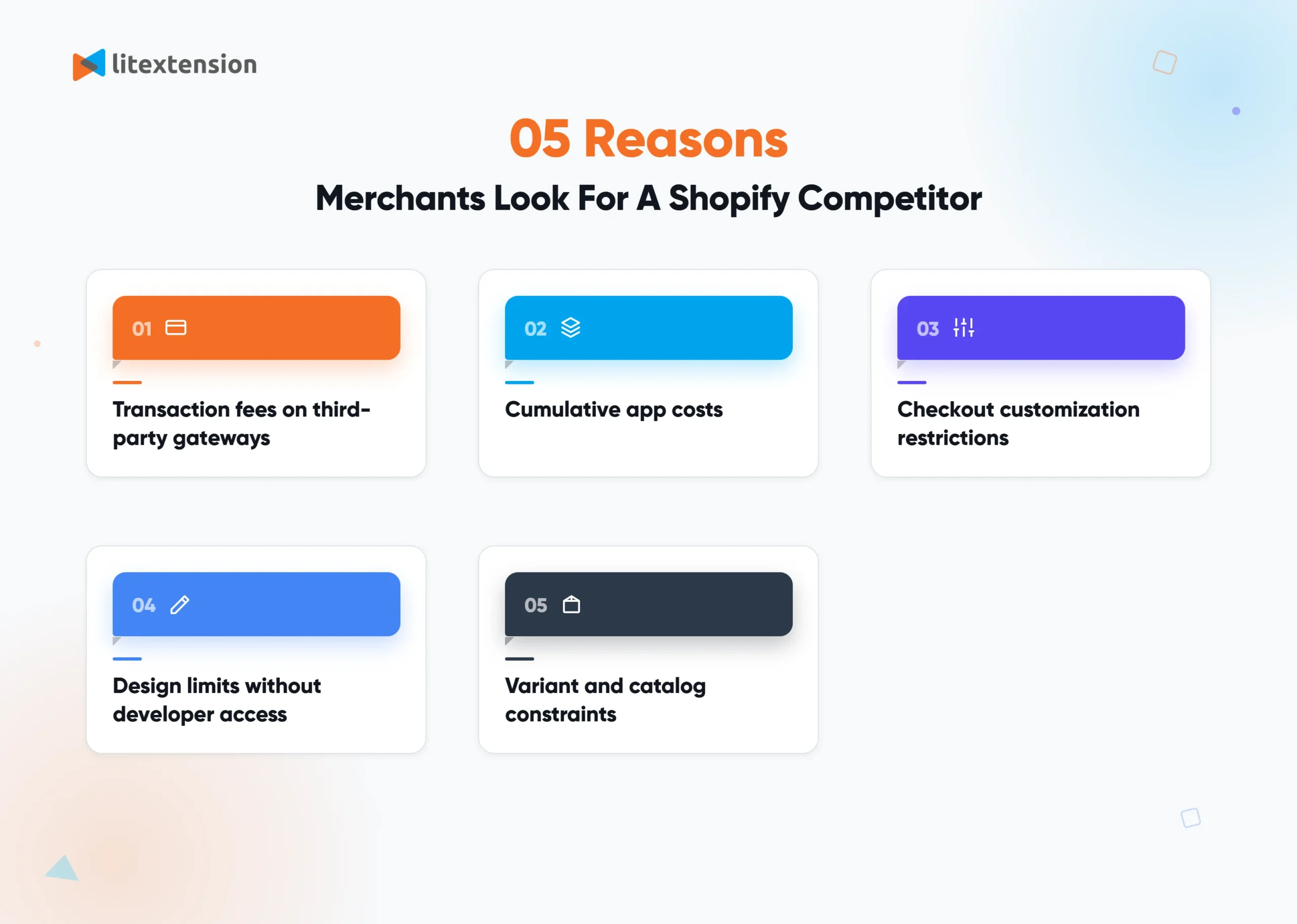
- Transaction fees on third-party gateways: Shopify charges up to 2% whenever a merchant uses a payment processor other than Shopify Payments. In markets where Shopify Payments isn’t supported, that fee applies to every sale.
- Cumulative app costs: Some features that BigCommerce or WooCommerce bundle natively might require paid Shopify apps. For a fully-featured store, these subscriptions add up fast.
- Checkout customization restrictions: Full checkout customization is gated behind Shopify Plus. Hence, brands that need advanced features below that tier hit a hard ceiling.
- Design limits without developer access: Shopify’s Liquid templating language constrains what non-developers can customize. Platforms like Wix, Squarespace, and Webflow offer more visual freedom out of the box.
- Variant and catalog constraints: While Shopify now supports up to 2,048 variants per product, that ceiling comes with caveats: merchants are still capped at 3 options per product, and Liquid themes can only render the first 250 variants without custom development.
Now that the reasons for the move are clear, it’s time to review each Shopify competitor to see what they offer and what they cost.
Best Shopify Competitors in 2026: Our Top Picks
Each Shopify competitor solves a different problem that Shopify merchants run into, whether that’s cost, design freedom, B2B functionality, or catalog complexity. Use the table to narrow your options fast, then jump to the platform’s full review further down for pricing details, pros and cons, and where it outshines.
| Platform | Where It’s Better | Pricing | Best For | Migration Complexity |
|---|---|---|---|---|
| WooCommerce | No monthly platform fee; full code and data ownership; unlimited variants | Free plugin (hosting typically $5–$50/month) | Content-heavy, SEO-driven stores with developer access | Low |
| BigCommerce | No fee on embedded payment gateways; native B2B tools; multi-storefront support | $39–$399/month (Core to Scale), billed monthly | B2B brands and multi-channel operations | Low |
| Wix | Lower entry price; no platform transaction fees; stronger visual design freedom | $17–$159/month | Beginners and small stores wanting design control | Medium |
| Squarespace | Award-winning templates; 0% transaction fees from Core plan up | $16–$99/month (billed annually) | Design-first creatives and small catalogs | Medium |
| Adobe Commerce (Magento) | Unlimited customization; complex B2B and multi-store workflows | Free (Open Source) to $190,000+/year (Enterprise) | Large enterprises with dedicated dev teams | High |
| Square Online | Seamless Square POS sync; free plan available | Free, $49/month (Plus), $149/month (Premium) | Retailers already using Square in-person | Medium |
| Shift4Shop | Free platform for qualifying US merchants; built-in CRM and SEO tools | Free (US, $1,000+/month via Shift4 Payments) to $299/month | US-based small to mid-sized businesses | Low |
| Shopware | Open-source flexibility; API-first, headless-ready architecture | Free (Community Edition) to $2,400+/month (Cloud) | European merchants and developer-led teams | Low |
| Big Cartel | Permanent free plan; no transaction fees; very short learning curve | Free (5 products) to $30/month | Artists, makers, and micro-sellers | Medium |
| Webflow | Full visual/layout control; clean HTML/CSS output | $14/month (site) plus $29–$212/month (eCommerce) | Design-focused agencies and brands | High |
1. WooCommerce – Best for Full Data Ownership
Who should use WooCommerce?
WooCommerce is the right Shopify competitor for merchants with developer access who want full ownership of their store’s code and data, especially content-heavy or SEO-driven brands already built on WordPress.
WooCommerce user ratings: 4.4/5 on G2 | 4.5/5 on Capterra
WooCommerce is a free, open-source eCommerce plugin for WordPress. According to BuiltWith, WooCommerce currently powers roughly 3.4 million live websites worldwide, making it one of the largest eCommerce footprints among Shopify competitors.
We’ve reviewed and tested WooCommerce as part of our ongoing comparisons of Shopify competitors, and what stands out most is its core trade-off. You get full backend access and zero monthly platform fee, but you take on hosting, security, and maintenance yourself. For a deeper look into this platform and how both of them stack up, we have compiled an in-depth WooCommerce review and WooCommerce vs Shopify comparison, so don’t forget to check it out.
| Where WooCommerce Is Better | Where Shopify Still Wins |
|---|---|
| No monthly platform fee; costs are hosting and optional plugins | Ready to sell in minutes, no hosting or server setup required |
| Full backend access with no checkout customization restrictions | Built-in 24/7 support on every paid plan |
| Deeper native SEO and content control through WordPress | No plugin-conflict risk; Shopify manages the core platform for you |
| No product variant limits | Predictable, fixed monthly pricing with no scaling license fees |
| 65,000+ plugins, often without per-app subscription pricing | Lower technical barrier for non-developer teams |
WooCommerce itself is free to install, which is part of why it remains one of the most popular Shopify competitors among budget-conscious merchants. Your real WooCommerce costs come from hosting (typically $5–$50/month), a domain, an SSL certificate, and any premium plugins or themes you add on top.
For a small store, total monthly cost often lands well under Shopify’s Basic plan; for a store that needs enterprise-grade hosting, security monitoring, and a developer on retainer, the total cost of ownership can climb past what a Shopify Advanced or even Plus plan would cost, since you’re assembling and maintaining the infrastructure yourself.
Need Help to Migrate Your Store from Shopify to WooCommerce?
LitExtension Automated Migration Tool transfers products, customers, and orders
from Shopify to WooCommerce – fast, accurate, and hassle-free.

2. BigCommerce – Best for B2B and Multi-Storefront Selling
Who should use BigCommerce?
BigCommerce is a good fit for growing mid-market businesses, B2B brands, and merchants running multiple storefronts who want native B2B tools and SEO controls without stacking paid apps on top.
BigCommerce user ratings: 4.2/5 on G2 | 4.4/5 on Capterra
As a hosted SaaS platform, BigCommerce is arguably the most direct competitor Shopify has in the mid-market. BuiltWith reports the platform’s live footprint at roughly 35,000 websites, a fraction of Shopify’s or WooCommerce’s numbers, but that smaller base reflects a platform built more deliberately for businesses that have already scaled past the basics.
What we noticed most while testing BigCommerce is how much it ships natively that Shopify locks behind paid apps or its Plus tier. Custom pricing groups, company accounts, quote management, and multi-storefront support are all there from the start, not bolted on later. If you want the full breakdown, our BigCommerce review and our BigCommerce vs Shopify comparison cover both platforms side by side in more detail.
| Where BigCommerce is better | Where Shopify still wins |
|---|---|
| No platform fee on embedded gateways like Stripe, PayPal, and Adyen | Flat-fee pricing with no GMV-triggered auto-upgrades |
| Native B2B tools: pricing tiers, company accounts, quote management | A much larger theme and app marketplace |
| Multi-storefront support under one account, no separate subscription needed | Easier for non-technical merchants to pick up |
| Deeper control over URLs and metadata for SEO | No surcharge to track on non-embedded payment providers |
| Built-in one-page checkout on every plan, not gated behind an upgrade | More predictable long-term pricing as you scale |
As of June 2026, BigCommerce pricing plans go by new names: Core ($39/$29), Growth ($105/$79), Scale ($399/$299), and Performance (custom pricing, starting around $1,499/month). If you stick to an embedded payment provider and avoid platform transaction fees altogether. That said, when you step outside that list, BigCommerce now charges an Open Payment Provider Fee: 2% on Core, 1% on Growth, and 0.6% on Scale, stacked on top of whatever your processor already charges.
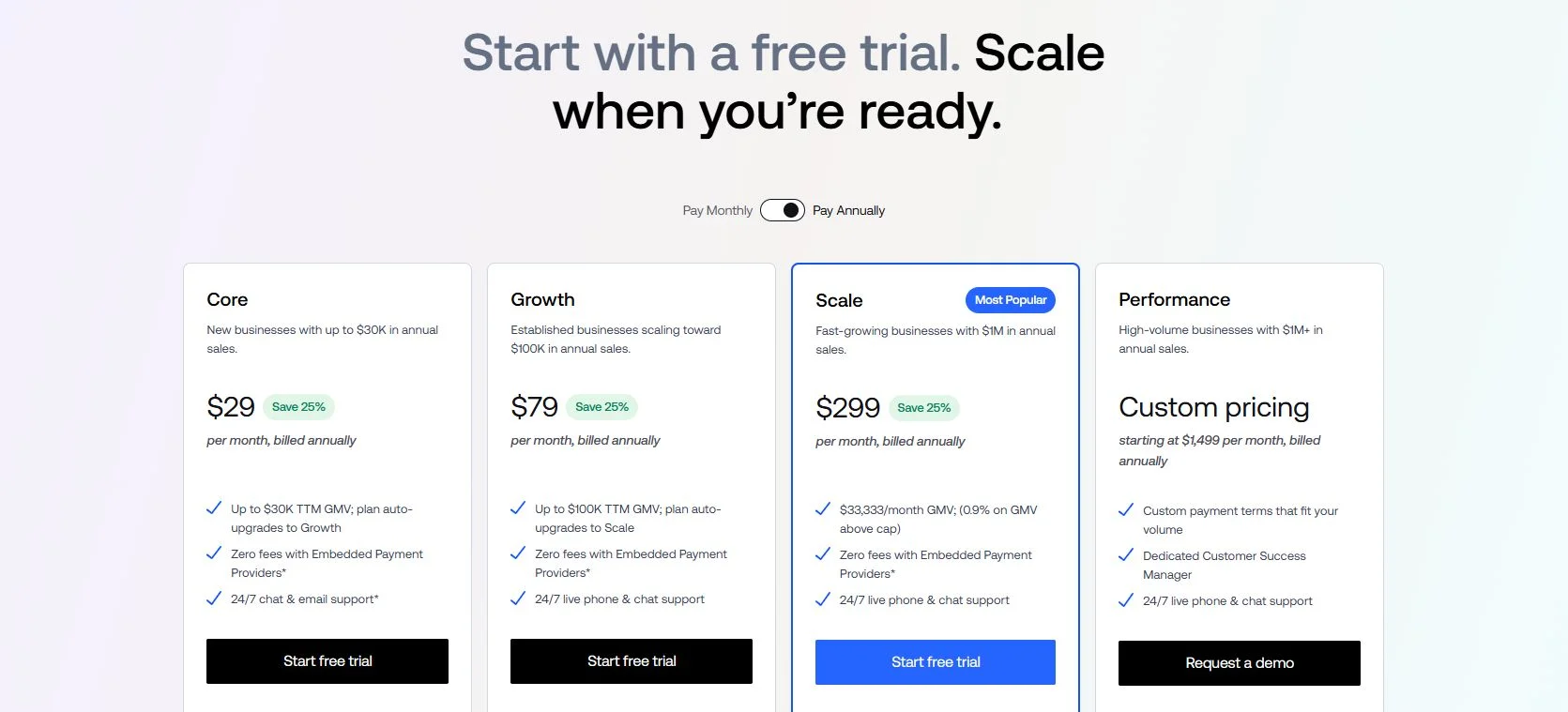
That’s a real shift in how BigCommerce pricing compare to Shopify’s, since “zero transaction fees” used to be its cleanest selling point. It’s also worth knowing that the revenue thresholds that trigger an automatic plan upgrade dropped this year, from $50K to $30K on Core and from $180K to $100K on Growth, so a store with steady, unremarkable growth could land on a pricier tier sooner than it would have last year.
3. Wix – Best for Design-First and First-Time Sellers
Who should use Wix?
If design control matters more to you than backend flexibility, or you’re launching a store without a developer on hand, Wix is among the best Shopify competitors for you.
Wix user ratings: 4.2/5 on G2 | 4.5/5 on Capterra
Wix started as a general-purpose website builder and added a genuinely capable eCommerce layer on top, which is part of why it’s one of the best Shopify competitors for beginners. Currently, according to BuiltWith, Wix is the home for over 4.4 million online stores across the globe.
In our own testing, what set Wix apart was how far its AI-assisted builder and drag-and-drop editor go without ever touching Shopify’s Liquid templating. For merchants without dev resources, that gap in design freedom is significant. We’ve written up a full Wix review and a Wix vs Shopify comparison if you want the complete picture before deciding.
| Where Wix is better | Where Shopify still wins |
|---|---|
| Zero platform transaction fees on every eCommerce plan | Handles large or complex catalogs more comfortably |
| More visual freedom without writing any code | Deeper backend access for custom development |
| Cheaper eCommerce entry point than Shopify Basic | A more mature, larger third-party app ecosystem |
| Native booking, event, and multilingual tools included | Holds up better at high traffic volumes |
| A much larger free template library | Stronger native support for international and multi-currency selling |
Wix doesn’t charge platform transaction fees on any of its eCommerce plans. After the free (non-commerce) tier, Wix pricing runs Light at $17/month, Core at $29/month (the actual minimum for selling), Business at $39/month, and Business Elite at $159/month, undercutting Shopify’s comparable plans across the board when billed the same way.
For a smaller store, that usually translates into a lower total cost of ownership than Shopify, especially since features like abandoned cart recovery and multi-currency selling are bundled into the Business plan rather than sold as separate apps. The catch is scalability: Wix wasn’t built for large catalogs, complex B2B pricing, or heavy API integrations, so once a store grows past what its mid-tier plans can handle, that cost advantage shrinks fast, or disappears entirely.
4. Squarespace – Best for Design-First Small Brands
Who should use Squarespace?
Squarespace is one of the best Shopify competitors for creatives, service businesses, and lifestyle brands that care more about how the store looks than how much it can scale.
Squarespace user ratings: 4.4/5 on G2 | 4.6/5 on Capterra
Squarespace started as a website builder for portfolios and blogs before growing a solid eCommerce layer on top. BuiltWith estimates that while Squarespace attracts over 8 million websites worldwide, only 80K+ of them are built for eCommerce.
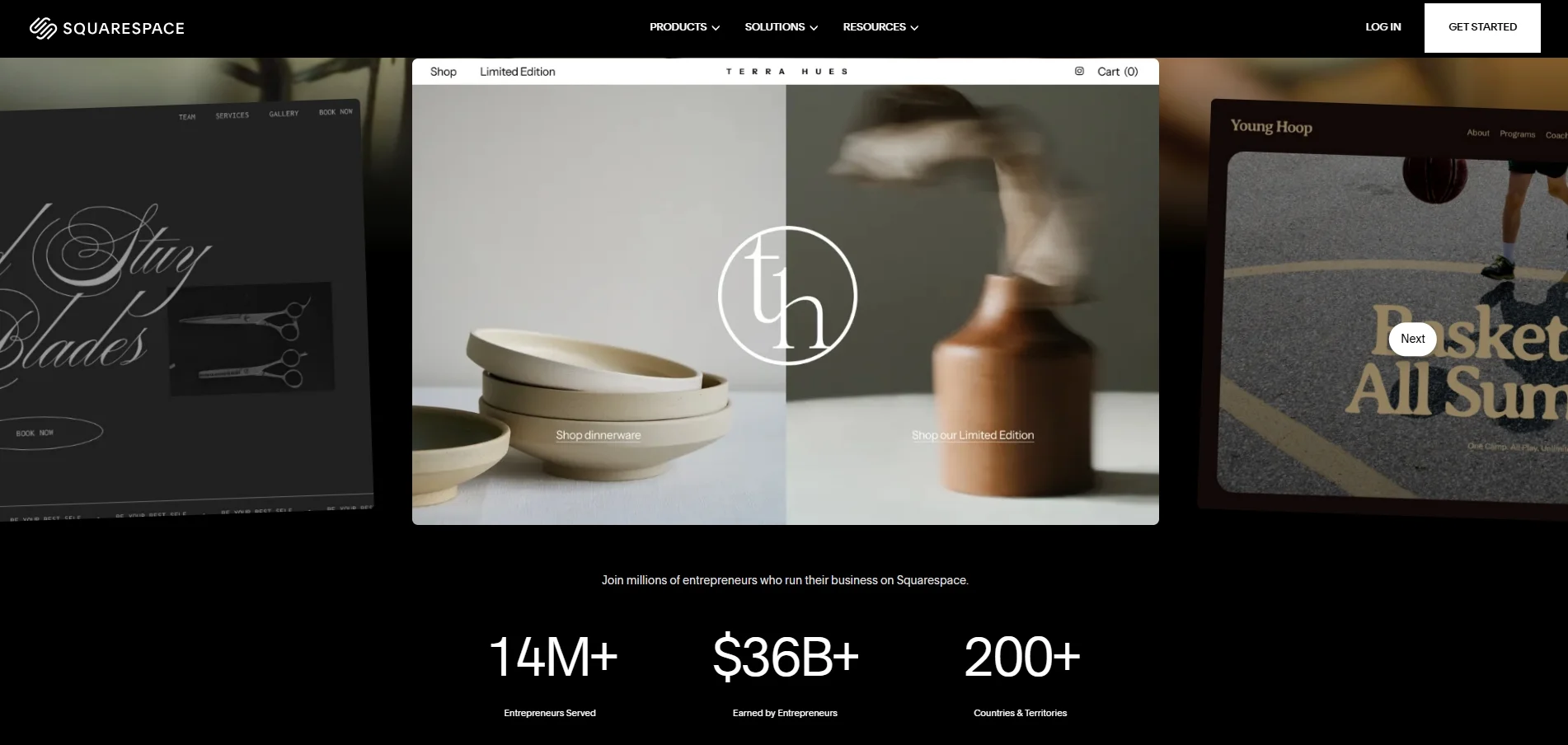
What stood out to us in testing is how tightly content and commerce are integrated. Blogging, memberships, and store pages all live in the same editor, which is unusual among the platforms on this list. For the full picture, check out our Squarespace review and our Squarespace vs Shopify comparison.
| Where Squarespace is better | Where Shopify still wins |
|---|---|
| 0% transaction fees from the Core plan up | Handles larger, more complex catalogs with less friction |
| Award-winning templates built for content-heavy brands | Native multi-currency and international selling |
| Tighter content-commerce integration for blogging and memberships | Stronger point-of-sale integration |
| Lower entry price than Shopify Basic | Broader third-party app and integration ecosystem |
| Built-in scheduling, memberships, and gated content | More headroom to scale as order volume grows |
The current Squarespace pricing includes 4 main tiers: Basic ($25/month), Core ($39/month), Plus ($65/month), and Advanced ($139/month). Basic still carries a 2% transaction fee on online store sales; that fee drops to 0% starting on Core and stays at 0% through Advanced. Credit card processing rates also improve at each tier, from 2.9% + $0.30 on Basic and Core down to 2.5% + $0.30 on Advanced.
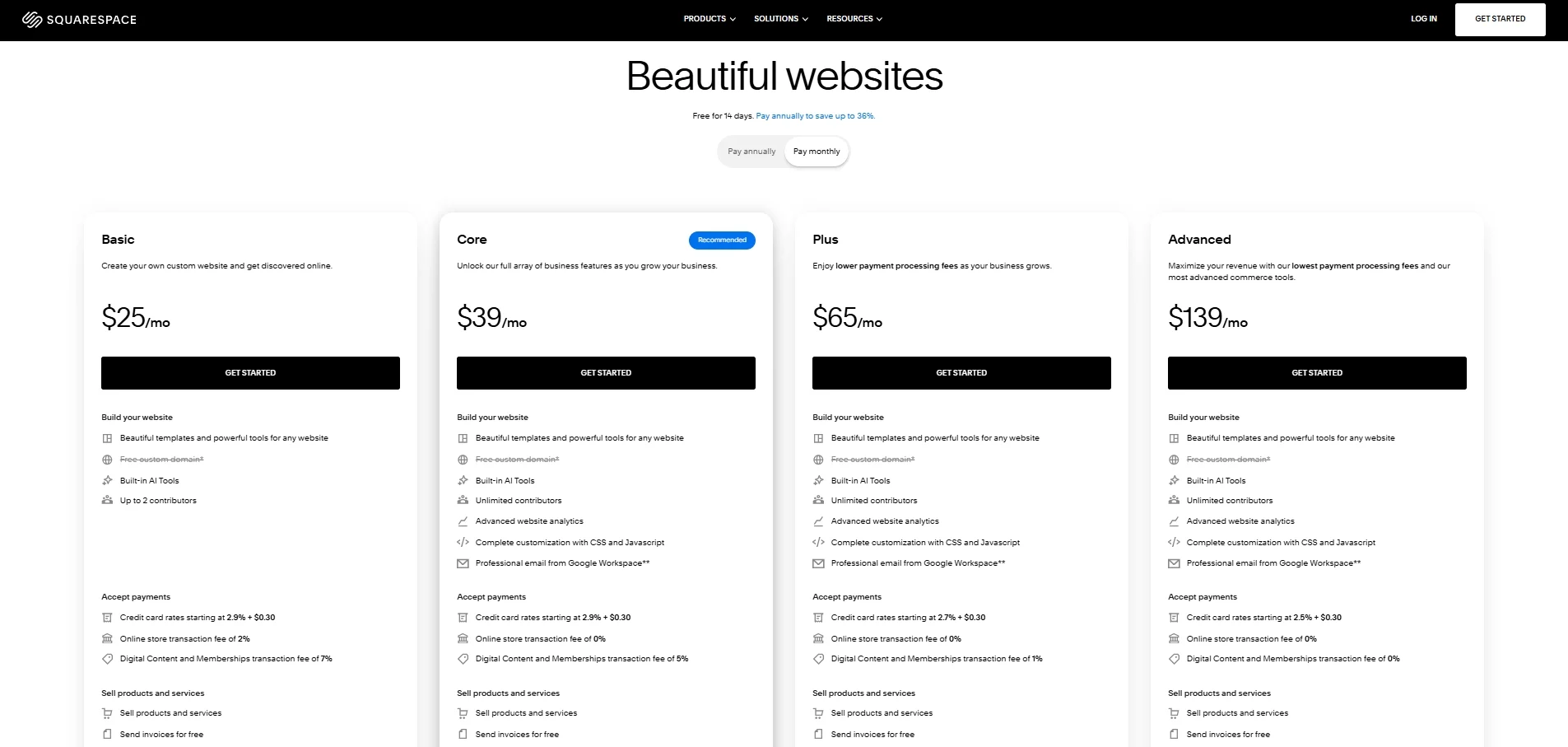
Where Squarespace’s total cost of ownership gets less competitive is at scale. It isn’t built for large product catalogs, complex inventory logic, or advanced B2B workflows, so a store that outgrows a small, design-forward catalog will likely find itself paying for a platform that was never meant to carry that weight, and looking at BigCommerce or Shopify instead.
5. Adobe Commerce – Best for Complex Enterprise Builds
Who should use Adobe Commerce?
Adobe Commerce is the right Shopify competitor for large enterprises and brands with complex B2B needs and a dedicated dev team. However, it might not be a good fit without in-house technical resources, since implementation takes months and a serious budget.
Adobe Commerce user ratings: 4/5 on G2 | 4.3/5 on Capterra
Adobe Commerce is Adobe’s licensed enterprise eCommerce platform, built for merchants who need complete control over their store’s architecture. According to BuiltWith, around 175,000 live websites currently run Adobe Commerce, a footprint concentrated among mid-to-large retailers with the budget and technical resources to support it.
| Where Adobe Commerce is better | Where Shopify still wins |
|---|---|
| Full backend control with no platform-imposed restrictions on checkout or workflows | Launches in days, not months |
| Native B2B tools: company accounts, custom pricing, quote management | No developer required to set up or run day-to-day |
| True multi-store and multi-language support without per-store add-on fees | Fixed, predictable pricing that doesn’t scale with GMV |
| Built-in PWA Studio and AI-powered personalization via Adobe Sensei | Lower total cost of ownership for small-to-mid-sized stores |
| Unlimited product and catalog customization | Simpler maintenance; Adobe manages hosting and security on Cloud plans, but you still pay for it |
Adobe Commerce is priced by GMV, not a flat fee, and licensing is quote-based. On-premises typically runs $22,000 to $125,000+/year; the Cloud edition, which includes managed hosting, runs $40,000 to $190,000+/year.
Factor in hosting, development, and maintenance, and total cost of ownership commonly lands at 2 to 3x the license fee, or roughly $122,000 to $450,000+/year for a mid-sized store. That makes Adobe Commerce one of the most expensive Shopify competitors on this list.
6. Square Online – Best Shopify Competitors for POS-First Businesses
Who should use Square Online?
Square Online is the right Shopify competitor if you already run Square in a physical location, a café, boutique, or service business, and want your online and in-person inventory to sync without extra work.
Square Online user ratings: 4.2/5 on G2 | 4.6/5 on Capterra
Square Online grew out of Square’s point-of-sale business, and that lineage still defines what it does best. BuiltWith usage tracking puts Square Online at around 365,000 live websites, a smaller footprint than the general-purpose builders on this Shopify competitors list, but one heavily weighted toward retailers and restaurants already inside the Square ecosystem.

What stood out most in testing is how little setup it takes to sync inventory between a physical counter and an online store, something most other platforms, Shopify included, need a third-party app to replicate cleanly. Our Square Online Store review and Square vs Shopify comparison go deeper on the trade-offs.
| Where Square Online is better | Where Shopify still wins |
|---|---|
| Native, real-time sync with Square POS | Far more design flexibility and customization |
| Free plan available to test before committing | Deeper international and multi-currency support |
| Built-in restaurant ordering and appointment tools | Larger, more mature third-party app ecosystem |
| Simple, fast setup for existing Square merchants | Handles complex or large catalogs more comfortably |
| Competitive in-person processing rates | More advanced discount and promotional tools |
Square’s current structure runs three unified tiers: Free, Plus (49/month/location), and Premium(149/month/location). The Free plan carries higher processing rates (3.3% + 30¢ online), which drop on Plus and Premium (2.9% + 30¢ online).
For a business already paying for Square hardware and processing in-store, total cost of ownership is genuinely low, since there’s no separate eCommerce subscription to justify. That advantage disappears fast once a merchant needs real design flexibility or a large catalog; in this case, other Shopify competitors might be a better fit.
7. Shift4Shop – Best for Free US-Based Selling
Who should use Shift4Shop?
Shift4Shop is the right Shopify competitor for US-based small to mid-sized businesses that want a feature-rich platform at zero monthly cost.
Shift4Shop user ratings: 3.9/5 on G2 | 4.6/5 on Capterra
Formerly known as 3dcart, Shift4Shop has an unusually compelling offer for the right merchant. According to BuiltWith, around 1,000 live websites currently run Shift4Shop, a modest footprint compared to other Shopify competitors. This usage reflects a platform built for a specific segment rather than broad appeal.
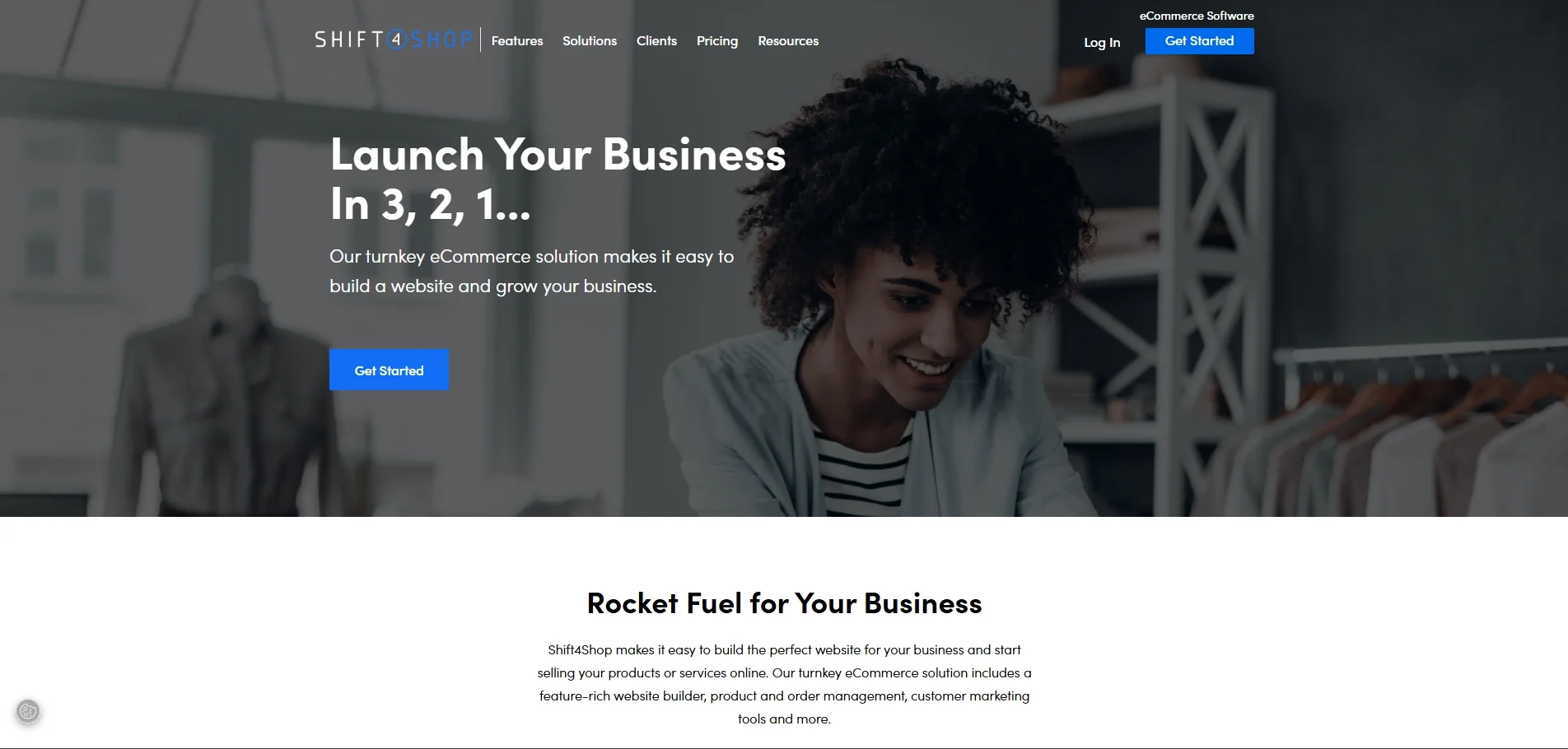
What stood out most in testing is how much it ships free once a merchant qualifies: built-in SEO tools, a CRM, an affiliate program, and API access with no equivalent offer from Shopify. For more information about this platform, please check out our in-depth Shift4Shop review.
| Where Shift4Shop is better | Where Shopify still wins |
|---|---|
| Free plan for qualifying US merchants | More polished, intuitive admin interface |
| Built-in CRM, affiliate program, and blog, no paid apps needed | Free plan available in every market, not just the US |
| Advanced native SEO: custom URLs, meta tags, schema markup | Stronger third-party app and theme ecosystem |
| API access for custom development | Faster, more consistent customer support |
| No transaction fees | Easier setup for non-technical merchants |
Shift4Shop’s End-to-End plan is free for US merchants processing $1,000 or more per month through Shift4 Payments. Merchants who don’t qualify, or who are outside the US, pay a flat monthly fee instead, generally in the $29 to $299 range depending on the plan.
For a qualifying US merchant, Shift4Shop’s total cost of ownership is hard to beat: enterprise-grade features at $0/month; only standard payment processing fees apply. Step outside that narrow eligibility window, though, and the value proposition weakens considerably compared to Shopify’s more consistent, region-agnostic pricing.
8. Shopware – Best for European and API-First Businesses
Who should use Shopware?
Shopware is one of the best Shopify competitors for mid-sized to enterprise businesses, particularly in Europe, that need a flexible, developer-friendly platform with strong international selling and either agency or in-house technical support.
Shopware user ratings: 4.4/5 on G2 | 4.6/5 on Capterra
Shopware is the dominant Shopify alternative in the European market and a credible enterprise option globally. According to BuiltWith, approximately 15,700 live websites currently run Shopware, a footprint concentrated heavily in Europe rather than spread globally.
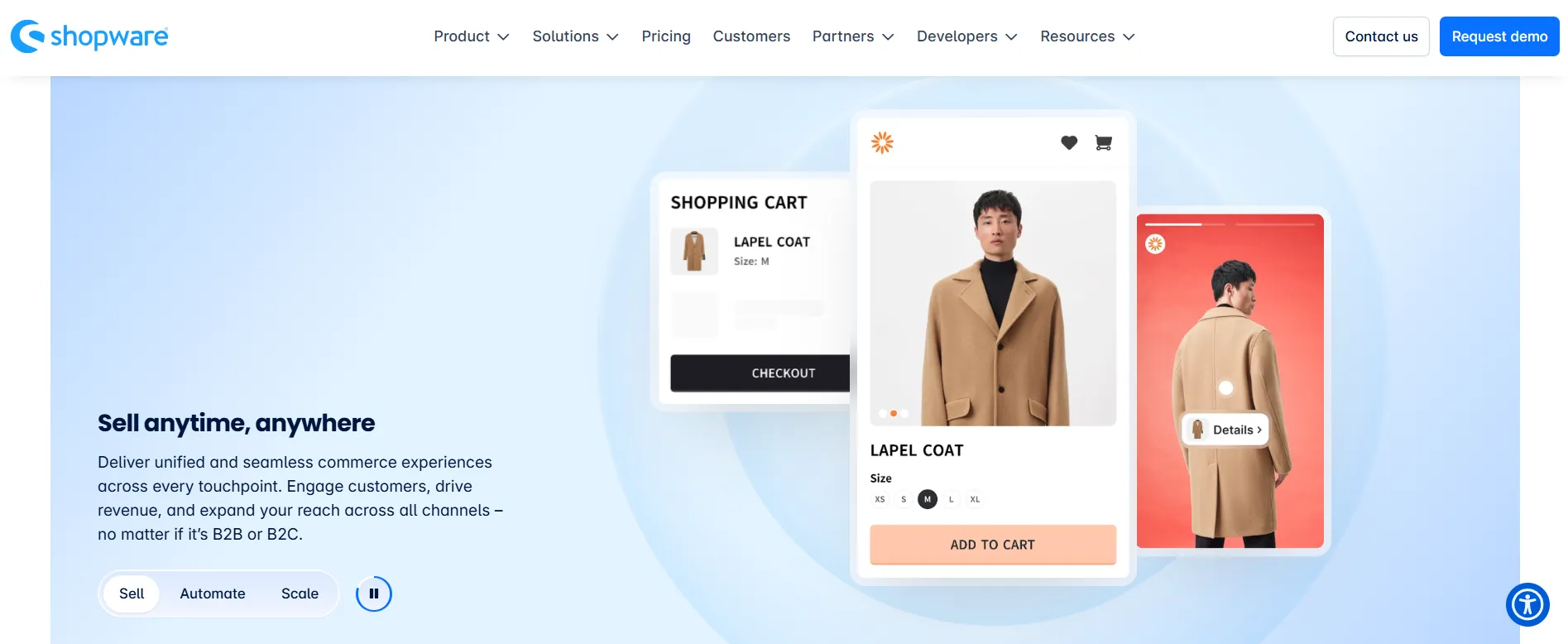
We spun up a test store on Shopware’s Community Edition, and what stood out most is how naturally it fits an API-first, headless setup. Its open-source backend gives full access out of the box, which makes it a natural fit for teams building custom storefronts rather than working within a fixed theme system. Take a look at our Shopware review and Shopware vs Shopify comparison to explore more about this platform.
| Where Shopware is better | Where Shopify still wins |
|---|---|
| Open-source Community Edition with full backend access | No developer or agency required to launch |
| API-first, headless-ready architecture | Much larger global app and theme ecosystem |
| Advanced multi-currency and multi-language for international selling | Simpler, faster setup for non-technical merchants |
| Extensive plugin marketplace for custom storefronts | Predictable flat-fee pricing |
| Strong native fit for complex B2B and B2C operations | Larger, more accessible support community outside Europe |
Shopware’s Community Edition is free and self-hosted, so your real costs are hosting, development, and any premium plugins. The Cloud (commercial) editions run considerably higher, from roughly $600 to $2,400+/month, with custom enterprise pricing above that.
For a European or developer-led team, Shopware’s total cost of ownership can stand among the most affordable Shopify competitors. But once you move to Cloud plans or need agency support to implement it properly, the total cost climbs well past what a comparable Shopify plan would cost.
9. Big Cartel – Best for Artists and Micro-Sellers
Who should use Big Cartel?
Big Cartel is among the best Shopify competitors for artists, makers, and musicians who want a simple, low-overhead way to sell online without paying for infrastructure they’ll never use.
Big Cartel user ratings: 4.2/5 on G2 | 4.6/5 on Capterra
Big Cartel doesn’t compete with Shopify on features or scale, and that’s by design. As reported by BuiltWith, nearly 90,000 live websites currently run on Big Cartel, a footprint made up almost entirely of small, independent sellers rather than growing brands chasing enterprise features.

When we tested Big Cartel as part of this Shopify competitors article, what stood out most was how deliberately limited the feature set is, in a good way. There’s no attempt to compete with Shopify’s app ecosystem or POS integrations; instead, the dashboard stays clean, and the learning curve is short enough that we had a working test store live in under fifteen minutes. Our Big Cartel review and Big Cartel vs Shopify comparison cover the details.
| Where Big Cartel is better | Where Shopify still wins |
|---|---|
| Permanent free plan for up to 5 products | Scales to large or complex catalogs |
| No platform transaction fees | Native SEO, dropshipping, and POS tools |
| Extremely short learning curve | Abandoned cart recovery and marketing automation |
| Clean, minimal, easy-to-customize templates | Much larger app and integration ecosystem |
| Mobile app for on-the-go store management | Built for merchants planning to grow past a small catalog |
In terms of Big Cartel pricing, there are 3 main tiers: Gold (free, up to 5 products), Platinum ($9.99/month), and Diamond ($19.99/month, up to 500 products). There are no transaction fees on any tier.
For a micro-seller testing the waters or selling a small, stable catalog, Big Cartel’s total cost of ownership is about as low as it gets, often free entirely. The moment a store needs to scale past a few hundred products or add real marketing automation, though, Big Cartel’s minimalism becomes a limitation rather than an advantage, and the total cost of switching platforms later becomes the real number to watch.
10. Webflow – Best for Design-Led Storefronts
Who should use Webflow?
Webflow is the right Shopify competitor for design-focused brands, agencies, and professionals who want total creative control over their storefront’s layout and visual experience, and who are comfortable working within Webflow’s design environment.
Webflow user ratings: 4.4/5 on G2 | 4.6/5 on Capterra
Webflow is not a conventional eCommerce platform; it’s a visual development tool with a capable commerce layer built on top. According to BuiltWith, around 90,000 live websites currently use Webflow’s eCommerce features specifically, out of a much larger base of over 650,000 live Webflow sites overall.
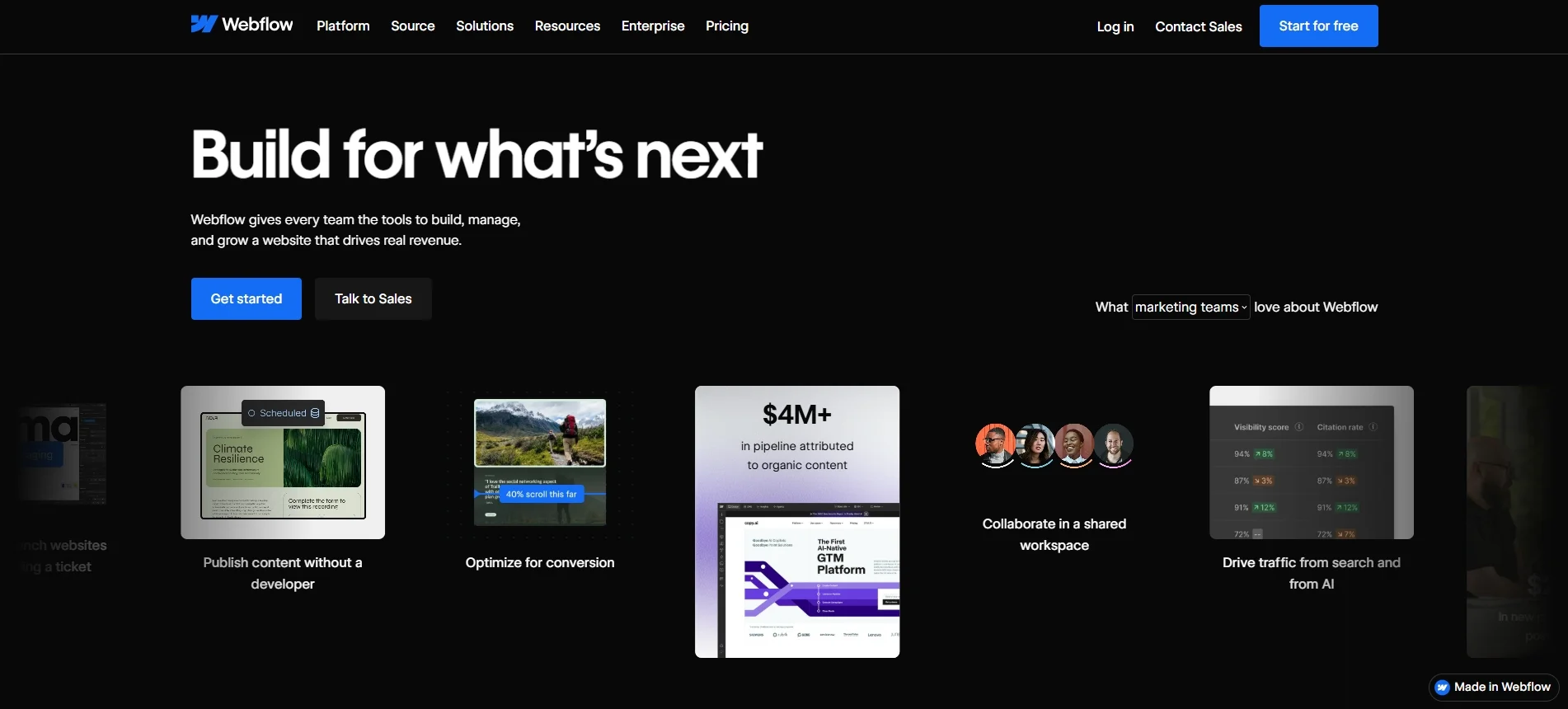
We built a test storefront on Webflow as part of our Shopify competitors review, and what stood out most is the level of design control. Every layout, animation, and interaction is customizable through a visual canvas that generates clean HTML and CSS, a level of design freedom no other template-based platform on this list matches. That control comes with a real learning curve, though; our team’s non-designers took noticeably longer to get comfortable in Webflow’s editor than in Shopify’s.
| Where Webflow is better | Where Shopify still wins |
|---|---|
| Unmatched visual/layout control without touching code | Built specifically for eCommerce, not adapted to it |
| Clean, semantic HTML/CSS output, strong for SEO | Handles large catalogs and complex inventory natively |
| CMS-driven, ideal for content-rich or custom product pages | Far more payment gateway options |
| Fully customizable cart and checkout styling | No transaction fee on the entry-level plan |
| Ideal for high-design, low-SKU storefronts | Larger, more mature commerce-specific app ecosystem |
Webflow’s site plans start at $14/month, with eCommerce-specific plans layered on top: Standard ($29/month), Plus ($74/month), and Advanced ($212/month), billed annually. The Standard eCommerce plan carries a 2% transaction fee.
For a small, design-forward storefront, Webflow’s total cost of ownership is one of the cheapest Shopify competitors at the entry level, especially when the visual experience itself is what drives conversion. That value proposition weakens for larger catalogs or complex inventory, since Webflow’s eCommerce layer wasn’t built to carry that weight the way a dedicated commerce platform is.
How to Choose the Right Shopify Alternative
The right platform depends on what Shopify’s limitations are actually costing you.
1. If the problem is transaction fees
BigCommerce eliminates them on all plans, including third-party gateways. That’s the clearest financial argument for switching. For international merchants where Shopify Payments isn’t available, the savings compound with every sale.
2. If the problem is overall cost
WooCommerce removes the monthly platform fee entirely. You pay hosting instead. For US merchants meeting the volume threshold, Shift4Shop’s free plan is worth a direct evaluation. For small stores, Wix Core ($29/month) and Squarespace Basic ($16/month) are meaningfully cheaper than Shopify at entry level.
3. If the problem is design flexibility
Wix and Squarespace give more creative control without coding. Webflow goes furthest, but requires comfort with its visual development environment. Shopware and WooCommerce go furthest of all, but require developer resources.
4. If the problem is scaling complexity
BigCommerce for SaaS with enterprise features built in. Magento for complete infrastructure control with a dedicated development team. Both handle multi-store, multi-currency, and B2B use cases that Shopify gates behind Plus pricing.
5. If you’re a POS-first business
Square Online integrates cleanest with Square’s point-of-sale system. If your primary channel is in-person and you want to expand online without rebuilding your operational stack, this is the most frictionless path.
One factor cuts across all of these: data portability. Before choosing any platform, confirm you can migrate your products, customer records, and order history cleanly, without downtime. LitExtension supports migrations between all platforms listed above, with a Free Demo Migration that lets you verify the transfer before committing.
Shopify competitors: FAQs
What is the biggest competitor to Shopify?
WooCommerce is the most widely used Shopify alternative globally, powering a large share of all eCommerce stores through its open-source WordPress plugin. BigCommerce is the strongest direct competitor for growing mid-market businesses, while Wix leads among beginners and small stores. For enterprises, Magento (Adobe Commerce) is the primary alternative.
Is anything better than Shopify?
It depends on what Shopify’s limitations are costing you. If transaction fees are the problem, BigCommerce eliminates them on all plans. If design flexibility matters more, Squarespace and Wix offer more creative freedom out of the box. If you need full control without monthly fees, WooCommerce is the stronger option. Shopify remains the best all-around platform for scaling DTC and B2C stores that want a managed, hosted environment.
Which platform is cheaper than Shopify?
Wix (from $29/month for eCommerce), Squarespace (from $16/month), Square Online (free plan available), and Big Cartel (free for up to 5 products) are all cheaper than Shopify at entry level. Similarly, reading a Shopify starter plan review reveals lower-cost options within Shopify itself, though third-party options remain strong alternatives. WooCommerce has no monthly platform fee, though hosting and plugin costs add up. The real comparison is total cost of ownership, not just the subscription price.
What are the main drawbacks of Shopify?
Shopify’s main drawbacks are transaction fees on third-party payment gateways (0.5 to 2% depending on plan), reliance on paid apps for features that competitors bundle natively, and limited design customization without coding knowledge. Furthermore, advanced flexibility often requires upgrading—a distinction commonly analyzed in Shopify vs Shopify Plus comparisons. For international merchants where Shopify Payments is not available, the transaction fee issue is especially significant.
Can I switch from Shopify to another platform without losing data?
Yes. LitExtension supports migrations from Shopify to 140+ platforms, including WooCommerce, BigCommerce, Magento, Wix, and Squarespace. The Free Demo Migration lets you test the transfer of 20 items before committing. Products, customers, orders, categories, and reviews can all be migrated. Your Shopify store remains live throughout the process.
Is WooCommerce better than Shopify?
WooCommerce is better than Shopify if you need full ownership of your store’s code and data, a deeply integrated content and SEO strategy through WordPress, or the ability to avoid monthly platform fees. Shopify is better if you want a fully managed, hosted environment with predictable scaling, a stronger native app ecosystem, and less technical overhead.