Move your WordPress content and supported store data to Shopify with LitExtension’s All-in-One Migration Service. Our experts manage migration planning, data mapping, transfer, and validation, so your team can focus on preparing the new store while your current website stays live during the data migration.
Whether you need to transfer blog posts and pages or products, customers, and orders managed by an eCommerce plugin, we review your WordPress setup and confirm the scope before migration begins. Custom fields and plugin-specific data are assessed individually, with any additional requirements agreed upon upfront.
(*) Not sure whether to migrate? See when moving from WordPress to Shopify makes sense →
Based on 3,000+ reviews on:

 Serchen



How WordPress to Shopify Migration Works with LitExtension

Our migration experts review your WordPress website structure, WooCommerce setup if applicable, custom fields, plugins, and migration requirements. This helps define the right scope before your WordPress to Shopify migration begins.

Our team configures the migration environment and maps your supported WordPress content and eCommerce data to Shopify’s structure, based on the scope agreed upon with you. This helps products, customers, orders, blog posts, pages, images, and other selected entities transfer as accurately as possible.

Once the setup is complete, LitExtension starts the full migration from WordPress to Shopify. The process continues securely in the background while your selected data is transferred to the new Shopify store.
Full WordPress to Shopify Migration Walkthrough
The following walkthrough expands on the three-step process above and explains how LitExtension experts manage each stage of an All-in-One WordPress to Shopify migration.
Step 1: Consultation and Migration Planning
We begin by reviewing how your current WordPress website is built. This includes its content structure, active plugins, custom fields, data volume, and any eCommerce system used to manage products, customers, or orders.
This review helps us separate standard WordPress content, such as blog posts, CMS pages, and images, from commerce data generated by WooCommerce or another plugin. We then confirm which entities can be transferred to Shopify and identify any data that requires custom mapping, transformation, or a compatible Shopify app.
During this stage, we work with you to define:
- The content and store data included in the migration.
- Additional options and custom migration requirements.
- The target Shopify setup and any required apps.
- The expected timeline, deliverables, and validation criteria.
Once the scope is agreed upon, our team prepares the migration plan and confirms the information or access needed to begin the project.
Step 2: Data Mapping and Demo Migration
Our team prepares the source WordPress website and target Shopify store for migration. You authorize the connection to Shopify through the LitExtension Store Migration app, while our experts configure the migration environment and review the selected data.
We map supported WordPress content and eCommerce data to Shopify’s corresponding structures. Depending on your setup, this may include mapping blog posts, CMS pages, products, variants, categories, customers, orders, coupons, reviews, metadata, custom fields, and embedded images.
Because WordPress plugins and Shopify may organize the same information differently, this stage may also involve:
- Mapping product categories to Shopify collections.
- Converting supported product options into Shopify variants.
- Assigning custom data to suitable Shopify fields or metafields.
- Preparing URL redirects where the source and target URL structures differ.
- Confirming how unsupported or plugin-specific data should be handled.
We then run a Demo Migration using sample data from the agreed scope. The demo allows our team and your team to review data mapping, formatting, images, relationships, and display results in Shopify before the full migration begins. If an issue is identified, we adjust the configuration and confirm the expected result with you.
Step 3: Full Migration and Result Validation
After the Demo Migration is reviewed and approved, LitExtension transfers the remaining data based on the confirmed configuration. The migration runs in the background, and your current WordPress website can remain available while the data is being transferred.
Once the Full Migration is complete, our team validates the results against the agreed project scope. The checks may include:
- Entity counts and selected data fields.
- Product variants, images, inventory, and category relationships.
- Customer details and order history where supported.
- Blog posts, CMS pages, formatting, and embedded images.
- Metadata, custom fields, and configured URL redirects.
If we identify migration-related discrepancies, our experts investigate and resolve them before final delivery. You can then review the migrated Shopify store and provide feedback based on the validation criteria confirmed during the planning stage. If new products, customers, orders, or content were added to your WordPress website during the project, our team can assess whether Recent Data Migration or another eligible post-migration service is appropriate for transferring or updating that data.
Manually Transfer Data from WordPress to Shopify
You can manually migrate a WordPress site to Shopify, but the process varies by data type and by how the source website is built. WordPress content, eCommerce records, website design, and plugin functionality cannot all be transferred through a single export and import process.
Manual migration is more suitable for smaller websites and users who are comfortable preparing CSV files, rebuilding content, and checking the results themselves.
Step 1: Back Up and Review Your WordPress Data
Create a complete backup of your WordPress files and database before making any changes. Then inventory the content and store data you want to retain, including posts, pages, images, products, customers, orders, reviews, metadata, and existing URLs.
The available export method depends on where each type of data is stored:
- WordPress posts and pages: The built-in WordPress export tool creates an XML file containing selected website content. Shopify does not natively convert this file into Shopify pages or blog posts.
- Products and other store data: If your website uses WooCommerce or another eCommerce plugin, export the data using the plugin’s available tools. The exported fields and formats will vary by plugin.
- Images and media: Keep the source media files and URLs accessible until the Shopify website has been reviewed.
- Custom fields and plugin data: Document where this information should appear in Shopify and whether a compatible field, metafield, or app is required.
Record your existing WordPress URLs at this stage. You will need them later to create redirects to the corresponding Shopify pages.
Step 2: Prepare and Import Data into Shopify
Create the required structures in Shopify before importing your data. This may include product collections, customer metafields, blogs, pages, and any apps needed to receive reviews or plugin-specific information.
Use an appropriate transfer method for each data type:
- Blog posts and CMS pages: Recreate smaller amounts of content manually or use a compatible import app or API for larger websites. See our guide on how to migrate WordPress blog to Shopify for content-specific instructions. Review headings, links, formatting, and embedded images after import.
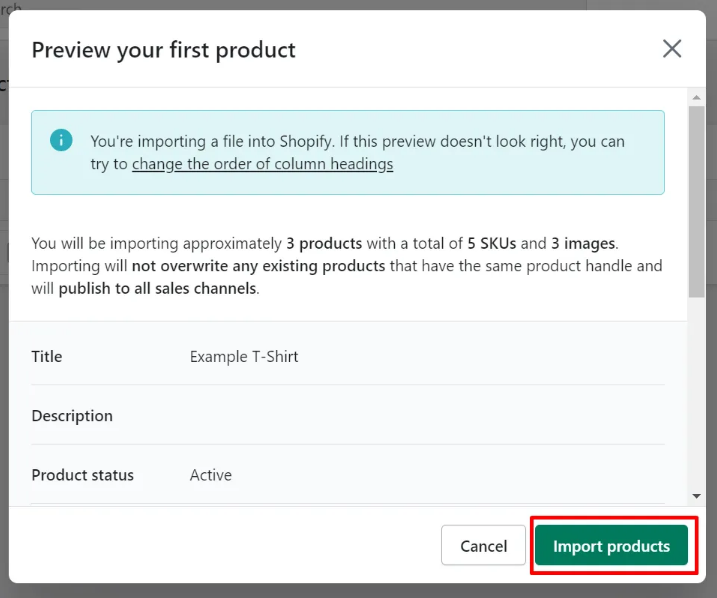
- Products: Map the exported product fields to Shopify’s product CSV format. Check titles, descriptions, SKUs, prices, inventory, variants, images, tags, and collection assignments before importing the file.
- Customers: Prepare a customer CSV that follows Shopify’s required structure. Customer passwords cannot be transferred through a standard CSV import, so customers may need to activate their accounts or create new passwords.
- Orders, reviews, and plugin-specific data: These records may require a compatible Shopify app, API-based import, or custom migration process because Shopify’s standard import tools do not cover every data type.
Test a small sample before importing the complete dataset. Correct any field-mapping, formatting, encoding, or image issues found in the sample.
Step 3: Rebuild and Validate the Shopify Website
A WordPress theme cannot be installed directly on Shopify because the two platforms use different theme systems. Select or build a Shopify theme, recreate the required page layouts, and replace WordPress plugin functionality with Shopify features or compatible apps.
After importing the data, review the Shopify store carefully:
- Compare the number of imported records with the source data.
- Check products, variants, prices, inventory, images, and collections.
- Review customer details and any imported order history.
- Test blog posts, pages, menus, internal links, and mobile display.
- Configure payments, shipping, taxes, notifications, and checkout settings.
- Create 301 redirects from old WordPress URLs to the relevant Shopify URLs.
- Place test orders before connecting the final domain.
Keep the WordPress website and its backup available until the Shopify store has been fully reviewed. If your website has a large content archive, custom fields, complex product structures, or historical orders, LitExtension’s All-in-One Migration Service can reduce the manual work involved. Our experts review your WordPress setup, confirm the supported data, and manage the transfer and validation based on the agreed scope.
WordPress to Shopify Migration Checklist
Use this checklist to prepare the source website, review the migrated data, and reduce disruption when launching the new Shopify store.
- Back up the WordPress website: Keep a complete copy of the website files, database, media library, and exported store data until the Shopify migration has been fully validated.
- Inventory the data and functionality: List the posts, pages, products, customers, orders, forms, memberships, subscriptions, custom fields, and plugin features that must be retained or replaced.
- Record important URLs: Export indexable WordPress URLs and map them to the most relevant Shopify destinations. Prioritize pages that receive organic traffic or backlinks when preparing 301 redirects.
- Prepare the Shopify environment: Configure the required plan, theme, apps, markets, shipping, taxes, payments, policies, and user permissions before the final launch.
- Review a sample before the full transfer: Check representative products, customers, orders, blog posts, pages, images, metadata, and custom fields during the Demo Migration.
- Validate the complete Shopify store: Compare entity counts and inspect navigation, internal links, redirects, mobile display, product variants, inventory, checkout, notifications, and test orders.
- Plan the final data update: Record data created on WordPress after the Full Migration and transfer eligible recent records before directing customers to Shopify.
- Keep WordPress available temporarily: Do not delete the source website or backup immediately after launch. Retain access until the Shopify store and redirects have been monitored and confirmed.
Point the domain to Shopify only after the migrated data, storefront settings, redirects, and purchase flow have been reviewed.
What Data Can Be Migrated From WordPress to Shopify
LitExtension can transfer supported WordPress content and eCommerce data to Shopify, including CMS pages, blog posts, images, products, categories, customers, orders, coupons, reviews, and related fields.
Available data depends on the plugins and custom structures used on your WordPress website. We check your source setup before migration to confirm which entities and fields Shopify can receive.


-
Products
- Name, SKU, Full Description, Status, Manufacturer, Weight.
- Price, Special Price.
- Stock Status, Manage Stock, Quantity.
- Meta Title, Meta Description.
- Product Tags.
- Barcode.
- Variants: SKU, Weight, Attributes, Quantity, Price, Special Price, Name, Thumbnail Image.
- Additional Images.
- Metafields.
Product Categories
- Name, Description.
- Image.
- Meta Title, Meta Description.
-
- First Name, Last Name, Email.
- Newsletter.
- Billing Address:
First Name, Last Name, Company, Address 1, Address 2, Country, State, City, Zip Code. Telephone, . - Shipping Address:
First Name, Last Name, Company, Address 1, Address 2, Country, State, City, Zip Code, Telephone.
-
- Order Number.
- Order Status.
- First Name, Last Name, Email.
- Billing Address:
First Name, Last Name, Company, Address 1, Address 2, Country, State, City, Zip Code, Telephone, Fax. - Shipping Address:
First Name, Last Name, Company, Address 1, Address 2, Country, State, City, Zip Code, Telephone. - Order Items (Name, SKU, Option), Product Price, Quantity.
- Sub Price, Discount Price, Tax Price, Shipping Price, Total Price.
- Order Comments.
-
- Name.
-
- Coupon Code, Coupon Date, Coupon Expire Date.
-
- Created Date.
- Rate.
- User Name.
- Title.
- Comment.
-
- Title, Description.
- URL.
- Image.
- Categories.
-
- Title, Description.
- Categories.
- SEO URLs.
- Images.
-
- Products (Name, Description, Attribute)
- Categories (Name, Description)
- CMS Page (Name, Description)
- Blogs (Name, Description)
- Note: Additional fee may apply
*The available entities and fields may vary depending on your WordPress plugins, custom data structure, and Shopify configuration. See how your data maps to Shopify →


Leave The Work For The Experts
If you’re non-tech, let our Shopify migration experts handle your migration from A to Z.
Save your time for more important tasks.

Migrate From WordPress To Other Platforms








How Your Data Is Secured During Migration?

Server Security

Data Security

Data Access Restriction

GDPR Compliance

NDA

Payment Security
Why choose WordPress to Shopify Migration Services


Who We Truly Are? Let Our Customer Define!

This is our second time using LitExtension and it’s been my pleasure to work with such a fine and competent group. We migrated an extremely complicated blog from WordPress to Shopify. There is no way we could have done this as efficiently internally and in a reasonable timeframe. If you are undecided on if they can do this job, THEY CAN!
The best experience I have had from any customer support. Imported products, content & blogs from WordPress to Shopify in a fast, efficient manner and worked tirelessly to ensure everything was perfect. I then deleted all my blogs by accident and Kane restored them within an hr for me which saved me big time!
Our Customer Care Agent was wonderful to have assigned to our project. He was immediately responsive to any questions or concerns we had regarding our migration from WordPress to Shopify. He ensured all of our information was properly handled. We are so appreciative of his time and work. Highly recommend LitExtension. Great product and people!
The LitExtension team was so helpful before, during, and after the migration of our website (from WordPress to Shopify)! I really appreciated all of their knowledge and expertise. Would recommend them to anyone looking to migrate their website.