If you are a growing business owner, I’m sure you’ve heard whispers of Shopify Plus. But the question is, is it really worth the hype? Is it the perfect solution for high-volume businesses? Everything will be answered in this Shopify Plus reviews. In today’s article, let’s take a close look at:
- What is Shopify Plus?
- How much does Shopify Plus cost?
- Shopify Plus pros & cons
- Our Shopify Plus ratings by criteria
- Shopify Plus vs Shopify Advanced
- Is Shopify Plus worth it?
- Other Shopify Plus alternatives for enterprise
Let’s get right in!
What is Shopify Plus?
Before diving into the nitty-gritty of features and pricing, let’s take a step back and understand what Shopify Plus is. First released in 2014, Shopify Plus is a fully hosted, enterprise-grade eCommerce solution tailored to the unique demands of high-growth businesses and large-scale merchants. Simply speaking, I often describe Shopify Plus to our clients as a “VIP section” of the Shopify ecosystem, offering an exclusive level of service and customization that goes far beyond the standard pricing tier. 

Shopify Plus Pricing and Cost of Ownership
My Shopify reviews will not be completed without analyzing the true cost of owning a Shopify Plus store. Hence, in this section, let’s take a look at how much does this platform cost. Shopify Plus pricing starts at $2,300 USD per month on a 3-year term, or $2,500 USD per month on a 1-year term, for standard setups and integrations. However, more complex, higher-volume businesses may switch to a variable platform fee based on their revenue and business model, and this fee differs for B2B and D2C orders. Shopify doesn’t publish the exact variable rate. Based on our team’s estimates at LitExtension, it typically ranges from 0.3% to 0.4% of your total revenue, depending on your contract terms. For example, if your monthly GMV (Gross Merchandise Value) is $1M, your Shopify Plus platform fee could be up to $4,000 per month. 
- Transaction fees: If Shopify Payments is your primary payment gateway, orders processed through it aren’t charged third-party transaction fees; you only pay card processing rates, which vary by country. If you use a third-party payment provider instead, Shopify charges 0.20% per transaction on top of your provider’s fees.
- App subscription: Charge for any third-party apps you install into your Shopify Plus store
- Development cost: Charge if you decide to hire a professional Shopify development service to build and maintain your online presence.
- Additional stores: Your main store and 9 expansion stores are included in the platform fee. Each additional store costs $300 USD per month, or a revenue share across all stores.
For a detailed breakdown of how much this platform costs, don’t forget to check out our article on Shopify Plus pricing.
What Does Shopify Plus Really Cost Per Month?
The platform fee is only part of the bill. The ranges below come from Shopify’s pricing page and from estimates published by Shopify Plus agencies. Treat the agency figures as planning numbers, not quotes, because they change with your catalog, integrations, and team.
| Cost item | Typical range | What drives it |
| Platform fee | From $2,300/month (3-year term) or $2,500/month (1-year term), or a variable fee for higher-volume businesses | Contract term, revenue, and B2B versus D2C mix (Shopify’s published pricing) |
| Third-party apps | About $500 to $2,000+/month (agency estimate) | Apps for reviews, subscriptions, search, loyalty, and other add-ons |
| Custom development | About $5,000 to $30,000+ one time (agency estimate) | Checkout extensions, Shopify Functions, integrations, and theme work |
| Payment processing | Card rates vary by country; add 0.20% per transaction with a third-party gateway | Whether Shopify Payments is your primary gateway |
| Additional stores | $300/month each, or a revenue share, beyond your main store and 9 expansion stores | How many storefronts you run |
| Migration | Shopify does not charge for migration; paid migration services are available | Data volume and complexity |
Adding the platform fee and apps gives a recurring floor of roughly $2,800 to $4,300+ per month before payment processing, development, and any variable fee. Agencies describe all-in spend for mid-market brands at $4,000 to $10,000+ per month, which is also a practitioner estimate. Sources do not agree on the variable fee. Our estimate is 0.3% to 0.4% of revenue. Some agencies report 0.25% to 0.40% with a negotiated cap, reported at about $40,000 a month, which we could not confirm, and another reports 0.25% on monthly revenue above $800,000. Shopify does not publish the rate, so get your terms in writing from Shopify sales before you budget. Contract terms matter too. Plus is sold on 1-year or 3-year terms, and one Capterra reviewer reported unexpected billing after cancelling. Ask about cancellation and downgrade terms before you sign.
Ready to Move Your Store to Shopify Plus?
LitExtension Automated Migration Tool transfers products, customers, and orders to Shopify Plus – fast, accurate, and hassle-free.
Shopify Plus Reviews – Pros and Cons
| Pros | Cons |
|
|
Shopify Plus Reviews by Criteria: Our Ratings
To give you a balanced picture, we rated Shopify Plus across 11 criteria, from performance to support. Each score reflects both what the platform does well and where it falls short, based on our hands-on experience, Shopify’s official documentation, and feedback from real Shopify Plus merchants. For a full list of what the plan includes, check out our guide to Shopify Plus features. Our overall score is the simple average of the 11 criteria scores below, with no weighting. Disclosure: LitExtension sells data migration services for moving to Shopify Plus, and the scores are our own editorial assessment.
| Criteria | Score | Quick verdict |
| Pricing & Value for Money | 3.5/5 | Clear starting price, but apps, development, and variable fees add up fast |
| Scalability & Performance | 5/5 | Built to handle traffic spikes and flash sales |
| Ease of Use | 4/5 | Familiar Shopify admin; advanced features need technical skills |
| Customization & Checkout | 4.5/5 | Full checkout customization, within SaaS limits |
| Automation | 4/5 | Launchpad is Plus-only; Flow is now on all plans |
| Omnichannel & POS | 4.5/5 | 20 POS Pro locations included |
| International Selling | 4/5 | 9 expansion stores, but more stores mean more upkeep |
| B2B Commerce | 4/5 | Advanced B2B controls; core B2B is now on all plans |
| Marketing & Customer Acquisition | 3.5/5 | Shopify Audiences is strong but limited to the US and Canada |
| Team Management & Security | 5/5 | Unlimited staff, custom user groups, PCI DSS Level 1 |
| Support & Learning Resources | 3.5/5 | Priority 24/7 support, but mixed reviews on complex issues |
| Overall | 4.1/5 | A top choice for high-volume brands that can justify the cost |
What Real Users Say About Shopify Plus
We checked the public G2 and Capterra pages in October 2026. Review counts change, so check the live pages for the latest numbers.
| Most praised on G2 | Most criticized on G2 |
| Ease of Use (97 mentions) | Expensive (59 mentions) |
| Customer Support (42) | Limited Customization (39) |
| Reliability (40) | Limited Features (24) |
| Quick Setup (36) | Missing Features (21) |
| Easy Setup (34) | Extra Costs (19) |
Who is writing the reviews? About 68.8% of G2 reviewers are small businesses, 27.5% are mid-market, and only 3.7% are enterprise. Many reviews therefore describe Plus from a smaller store’s point of view. Read the praise for ease of use in that light, and weigh the cost complaints against your own sales volume. Capterra: reviewers rate ease of use 4.6 and customer service 4.4 out of 5. Praise centers on ease of use, integrations, checkout and workflow customization, and stability. Complaints include support after setup, app costs, extra fees on non-Shopify payment gateways, and, from one reviewer, unexpected billing after cancelling. Time to value: G2’s product page lists a typical implementation time of 3 months and a return on investment in 12 months.
1. Scalability & Performance (5/5)
Scalability is the signature strength of Shopify Plus. The plan includes a high-volume checkout built for flash sales and product drops, advanced bot protection during high-demand releases, and up to 10x higher API rate limits on select APIs compared to standard plans. In practice, this means you don’t have to worry about servers, bandwidth, or traffic spikes during your biggest sales events. What we like:
- High-volume checkout and bot protection designed for flash sales and limited drops.
- Unlimited bandwidth, transactions, and SKUs, with no infrastructure to manage.
- Higher API capacity for heavy integrations with ERPs, OMS, and other back-office systems.
What could be better:
- Platform speed doesn’t guarantee store speed: heavy themes and too many apps can still slow down your storefront.
This strength is also what real merchants mention most often. As one graphic designer at a small business put it in a G2 review (May 2026):
“Shopify Plus is great because it just works when things get big.”
2. Ease of Use (4/5)
Shopify Plus runs on the same admin as other Shopify plans, so teams already familiar with Shopify can get started quickly. The interface guides you through each step, from adding products and setting up payment gateways to configuring shipping options and crafting your store policies, without much technical guesswork. What we like:
- Intuitive admin that non-technical teams can use day to day.
- Easy content editing on pages without much coding.
What could be better:
- Plus-exclusive capabilities (checkout extensions, Shopify Functions, headless storefronts) usually require developers or a Shopify Plus Partner.
- Shopify updates its interface often, so teams need to keep up with changes.
3. Customization & Checkout (4.5/5)
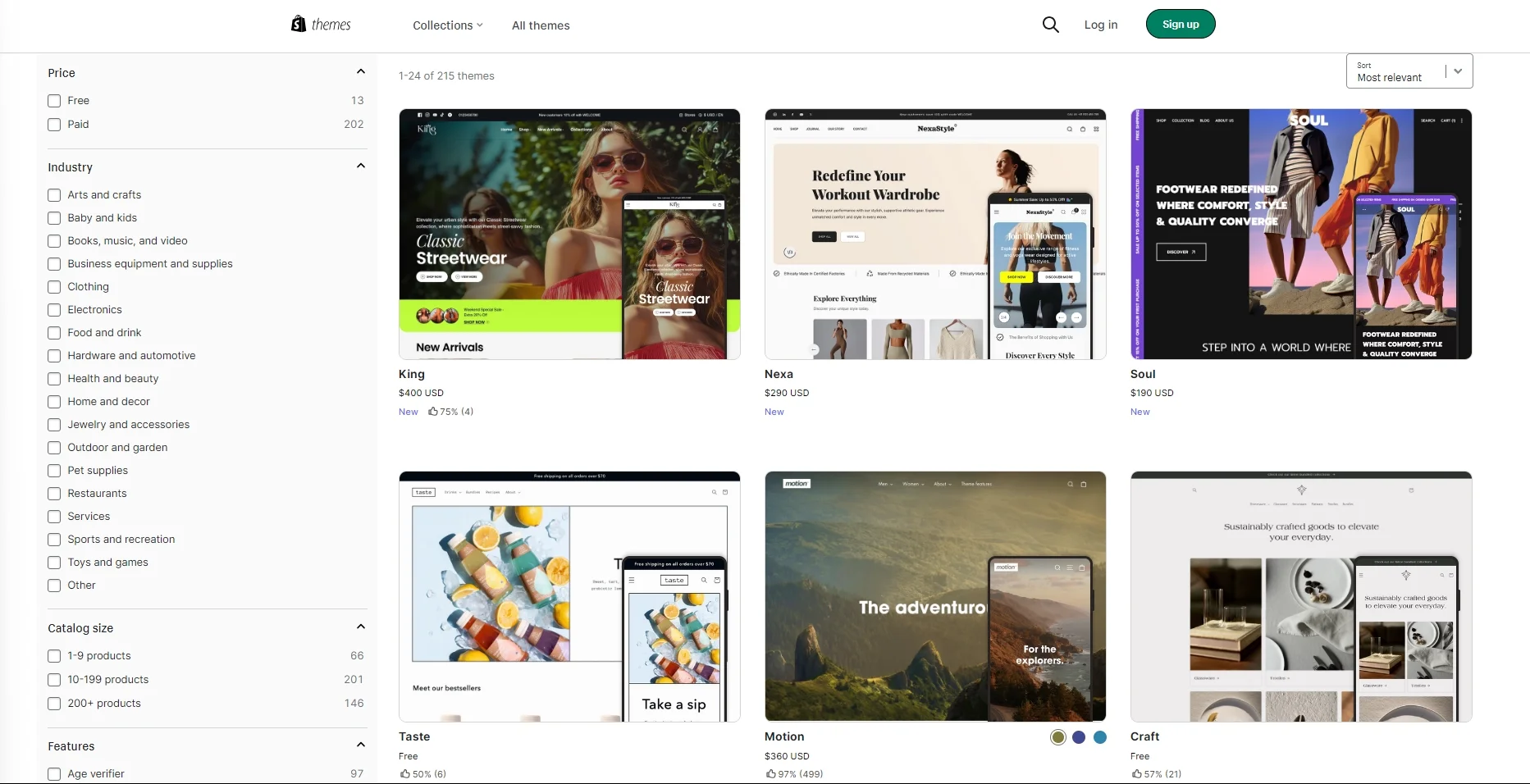
From my perspective, one of the most outstanding features that Shopify Plus offers is its exceptional level of customization. It provides the tools and flexibility to build the exact eCommerce solution your brand demands without being limited by pre-set functionalities. So, how does Shopify Plus achieve this? Firstly, it offers a vast library of themes, both free and paid, to give you a solid starting point for your design. But the real magic happens when you go beyond the surface. Besides full access to your theme’s Liquid code, Shopify Plus unlocks Plus-only APIs, additional API capacity, Shopify Functions for custom backend logic, and up to 25 headless storefronts built with Hydrogen and deployed on Oxygen. 
- Full checkout customization, while lower plans only get limited options.
- Shopify Functions let you build custom discount, shipping, and payment logic.
- Up to 25 headless storefronts for brands that want full front-end control.
What could be better:
- As a SaaS platform, Shopify Plus still has limits, so you can’t control every detail like you would on a custom-built site.
- Since Shopify Scripts stopped running on June 30, 2026, older checkout customizations had to be rebuilt with Shopify Functions.
- Many advanced features rely on paid third-party apps, which increases your total cost.
4. Automation (4/5)
Shopify Plus gives you exclusive access to Launchpad, which lets you schedule and run sales events, product drops, and inventory restocks automatically. You can change product prices at the start and end of an event, release products to your sales channels at a set time, schedule theme changes, and track the event’s performance on a real-time dashboard. 
- Launchpad takes the manual work out of flash sales and product launches.
- Flow handles repetitive tasks with no-code workflows.
What could be better:
- Flow is available on lower plans too, so automation is less of a Plus-only advantage than it used to be.
- Complex workflows can take time to set up correctly.
5. Omnichannel & POS (4.5/5)
While Shopify Plus excels in the online world, its capabilities extend seamlessly to physical retail environments through Shopify POS Pro. This robust tool equips merchants with everything they need to manage in-person sales, unifying their online and offline operations. Shopify POS Pro processes transactions quickly and securely, accepting various payment methods, including credit cards, debit cards, and mobile wallets. It also integrates with your Shopify Plus inventory and customer database, providing you with real-time insights into your sales, stock levels, and customer behavior across both your online and physical stores. Better yet, the first 20 POS Pro locations are included in every Shopify Plus plan. If you run more than 20 locations and use Shopify Payments as your primary payment provider in store, the POS Pro cost is waived for up to your first 200 retail locations. You can also track inventory across up to 200 locations. Learn more in our Shopify POS Lite vs Pro comparison. 
- 20 POS Pro locations included, compared with $89/month per location on other plans.
- One account and inventory shared across online and in-store sales.
What could be better:
- The waiver beyond 20 locations depends on using Shopify Payments in store.
- POS hardware is a separate cost.
6. International Selling (4/5)
For ambitious brands aiming to reach a global customer base, Shopify Plus provides a distinct advantage through its expansion store functionality. This feature allows businesses to create dedicated online stores tailored to specific countries or regions, so you can present your products and brand messaging in a way that resonates with local audiences. Unlike simply translating your existing website, expansion stores offer a deeper level of customization. You have the flexibility to manage currencies, languages, payment gateways, and even product catalogs on a per-store basis. 
- 9 expansion stores included for localized catalogs, currencies, and languages.
- Shopify Markets covers localization on a single store.
What could be better:
- Each extra store adds operational work, and stores beyond 9 cost extra.
- Some international tax and compliance needs may still require apps.
7. B2B Commerce (4/5)
While Shopify is widely known for its prowess in the B2C space, Shopify Plus takes things a step further by offering robust features for B2B (business-to-business) commerce. With B2B on Shopify, you can sell to wholesale buyers from the same store as your DTC customers. You can create company profiles and locations, assign catalogs with custom pricing, set quantity rules and quantity price breaks, and offer net payment terms. While these core B2B features are now available on all Shopify plans from Basic upward, Shopify Plus adds unlimited B2B catalogs, catalogs assigned directly to specific companies and locations, deposit requirements, partial payments, and payment requests per fulfillment. Beyond creating a smooth ordering experience, Shopify Plus also comes with powerful integration with leading ERP (Enterprise Resource Planning) and CRM (Customer Relationship Management) systems. This connectivity streamlines data flow between your eCommerce platform and other critical business systems, whether it’s syncing inventory levels in real time, managing customer data across multiple touchpoints, or automating order fulfillment processes to reduce manual work. Furthermore, the platform’s robust infrastructure can handle high order volumes, complex shipping requirements involving freight and specialized carriers, diverse payment options including net payment terms, and intricate tax calculations, including exemptions for tax-exempt organizations. If you’re comparing wholesale-focused options, check out our list of the best wholesale eCommerce platforms. What we like:
- B2B and DTC run from one store and one back office.
- Customer-level pricing and flexible payment options like deposits and partial payments.
What could be better:
- Core B2B is now on lower plans, so B2B alone may not justify upgrading.
- Some buyer-side account features are still basic.
Let Our Experts Handle Your Shopify Plus Migration!
With the All-in-One Migration Service, our experts take care of everything, ensuring a seamless and stress-free migration.
8. Marketing & Customer Acquisition (3.5/5)
Understanding the importance of reaching the right customers, Shopify Plus offers an exclusive feature called Shopify Audiences. Unlike generic audience targeting options offered by most advertising platforms, Shopify Audiences taps into the vast data insights of the Shopify ecosystem to identify consumers actively browsing for products similar to yours, even if they haven’t yet interacted with your brand directly. 
What we like:
- Audience lists built from Shopify’s network data, exported straight to major ad platforms.
- Built-in reports and attribution, shared with the Advanced plan.
What could be better:
- Merchants outside the US and Canada can’t use Audiences, the main Plus-only marketing perk.
- Some reporting still lags behind dedicated analytics apps.
9. Team Management & Security (5/5)
As your eCommerce business grows, so too does your team. Shopify Plus recognizes this need for scalability by offering unlimited staff accounts, eliminating the restrictions on the number of users who can access and manage your online store. With unlimited staff accounts, you can grant access to your Shopify Plus backend to all team members, from marketing and customer service representatives to warehouse staff and financial analysts. Each team member can be assigned specific roles and permissions, ensuring they only have access to the information and tools relevant to their responsibilities. On top of that, Shopify Plus lets you create custom user groups to assign permissions in bulk. The plan is also Level 1 PCI DSS and SOC 2 certified, with built-in fraud analysis and bot mitigation. What we like:
- Unlimited staff accounts, compared with 15 on Advanced.
- Custom user groups make permission management easier for large teams.
What could be better:
- Permission structures take some planning to set up well for big teams.
10. Support & Learning Resources (3.5/5)
Shopify Plus comes with priority 24/7 phone and chat support. Shopify Plus Academy provides a curated collection of self-paced courses in Shopify Academy designed specifically for Shopify Plus merchants, alongside the Shopify Community forums and a network of certified Shopify Plus Partners for custom work. 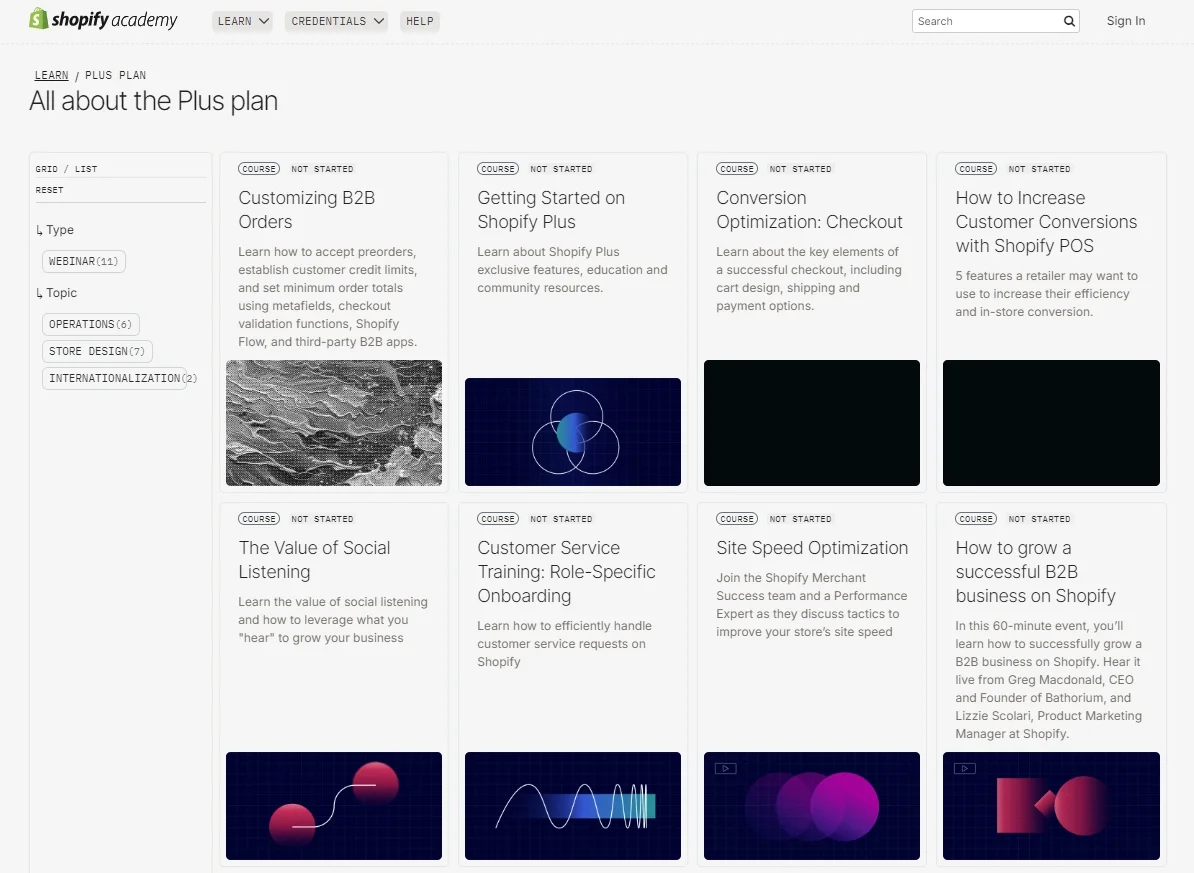
- Fast access to priority support around the clock.
- Plus-specific learning resources and a large Partner ecosystem.
What could be better:
- Dedicated Merchant Success Managers are no longer standard for most Plus merchants.
- Answers on complex issues can be slow or generic.
Support quality is also where user reviews are the most mixed. Many reviewers praise how quickly they can reach the team, but others note slower answers when it matters most. As an IT and cybersecurity coordinator wrote in a Capterra review (June 2025):
“I also feel support response is slower during peak seasons.”
Shopify Plus vs Shopify Advanced
If you’re on Shopify Advanced and wondering whether to upgrade, the table below compares both plans side by side, based on Shopify’s published US pricing.
| Criteria | Shopify Advanced | Shopify Plus | Who has the edge? |
| Price | $399/month (billed monthly) or $299/month (billed yearly) | From $2,300/month (3-year term) or $2,500/month (1-year term) | Advanced: far lower fixed cost |
| Online card rates (US) | 2.5% + 30¢ | 2.25% + 30¢ | Plus: lower rate on every order |
| In-person card rates (US) | 2.4% + 10¢ | 2.3% + 10¢ | Plus |
| Third-party payment fee | 0.6% | 0.2% | Plus |
| Staff accounts | 15 | Unlimited | Plus |
| Inventory locations | 10 | 200 | Plus |
| POS Pro | $89/month per location | 20 locations included (up to 200 with Shopify Payments) | Plus |
| B2B | Up to 3 catalogs | Unlimited catalogs, direct company catalogs, deposits, partial payments | Plus |
| Checkout customization | Limited | Full | Plus |
| Expansion stores | Not included | Up to 9 | Plus |
| Headless storefronts | 1 | 25 | Plus |
| API rate limits | Up to 2x on select APIs | Up to 10x on select APIs | Plus |
| Support | Enhanced live chat | Priority support | Plus |
| Plus-only tools | – | Launchpad, Shopify Audiences, custom functions, custom user groups | Plus |
| Shopify Markets & reports | Included | Included | Tie |
When does Plus pay for itself? Based on our team’s rough calculation using Shopify’s published US rates, the 0.25-point lower online card rate covers the price gap between Advanced (billed yearly) and Plus (3-year term) at around $800,000 in monthly online card sales. If you use a third-party payment provider, the 0.4-point lower transaction fee closes that gap at around $500,000 per month. This doesn’t include a variable platform fee, apps, or development costs.
- Stick with Advanced if you’re still growing toward high volume, don’t need checkout customization or expansion stores, and your team fits within 15 staff accounts.
- Upgrade to Plus if your sales volume makes the lower rates pay off, or you need full checkout control, multiple stores, advanced B2B, or large-scale retail.
For a deeper comparison, read our Shopify Plus vs Advanced guide, and see all plan prices in our Shopify pricing breakdown.
Is Shopify Plus Worth It?
Shopify Plus is worth it when your volume or complexity is high enough to use what only Plus offers. Use this guide to check where you stand.
| Factor | Plus is likely worth it when | Advanced is likely enough when |
| Sales volume | Monthly online card sales reach about $800,000 with Shopify Payments, or about $500,000 with a third-party gateway, so lower fees offset the higher fixed cost | Sales are below those levels and lower fees are your main reason to upgrade |
| Checkout | You need full checkout control with Checkout Extensibility and Shopify Functions | Standard checkout with limited options meets your needs |
| Stores and retail | You run several storefronts (up to 9 expansion stores) or many retail locations (20 POS Pro locations included) | You run one store, and Shopify Markets covers your localization |
| B2B | You need unlimited catalogs, catalogs assigned to specific companies, deposits, or partial payments | Core B2B such as company profiles, catalogs, and net terms already covers you |
| Integrations | You connect heavy ERP or OMS systems and need higher API capacity | Your integrations are light |
| Team and budget | You have developers or budget for a Shopify Plus Partner, since many Plus-only features need technical work | You have no technical resources and want a simple setup |
Our rule of thumb: if your sales are below the levels above and none of the Plus-only needs apply, stay on Advanced and revisit the decision as your volume or complexity grows. The break-even figures exclude the variable platform fee, apps, and development costs.
What Changed in Shopify Plus in 2026
Several changes have narrowed the gap between Plus and lower plans, so older reviews may be out of date:
- Shopify Scripts: they stopped running on June 30, 2026. Checkout customizations now rely on Shopify Functions and Checkout Extensibility.
- Shopify Flow: it is now available on Basic, Grow, and Advanced plans. Launchpad remains Plus-only.
- B2B: core B2B features are now on all plans from Basic upward. Plus adds unlimited catalogs, deposits, and partial payments.
- Shopify Markets: every plan now includes unlimited country or region markets.
- Sidekick: since late 2025, you can describe a workflow to Sidekick and it builds the Flow automation for you.
- BigCommerce: its Enterprise plan has been called Performance since June 2026, which matters when you compare alternatives.
The takeaway: Plus is now less about Flow, core B2B, or localization, and more about checkout control, multiple stores, scale, and lower fees at high volume.
Other Shopify Plus Alternatives for Enterprise
Shopify Plus isn’t the only enterprise option. Depending on your tech stack, catalog complexity, and budget, one of the platforms below may be a better fit. Here’s how the most commonly compared enterprise commerce platforms stack up.
| Platform | Deployment | Pricing | Native B2B | Best for |
| Shopify Plus | SaaS | From $2,300/month; variable fee for higher-volume businesses | Yes | Fast-growing DTC and hybrid B2B/DTC brands that want a managed platform |
| BigCommerce (Performance plan, formerly Enterprise) | SaaS, headless-ready | From $1,499/month (billed annually), custom pricing | Yes | Mid-market to enterprise brands wanting open SaaS and B2B on one back end |
| Adobe Commerce (Magento) | SaaS (Cloud Service), PaaS, or on-premises | Custom quote | Yes (separately licensed B2B module) | Complex catalogs and B2B/B2C businesses with development teams |
| Salesforce Commerce Cloud | Cloud, vendor-managed | Custom quote; B2B priced as a % of GMV | Yes (separate B2B product) | Large B2C brands already using Salesforce CRM |
| commercetools | Headless, API-first, cloud-native | Custom quote, order-based | Yes | Large enterprises with strong in-house engineering teams |
| SAP Commerce Cloud | Cloud | Price on request, based on annual orders or GMV | Yes | Manufacturers and distributors running SAP ERP |
- BigCommerce: The closest SaaS rival to Shopify Plus, with a lower published starting price. Since June 2026, its Enterprise plan is called Performance. See our Shopify Plus vs BigCommerce Enterprise comparison.
- Adobe Commerce: Offers the deepest code-level control and now has a SaaS option, but needs more development resources. Read Shopify Plus vs Magento.
- Salesforce Commerce Cloud: Strongest when you’re already invested in the Salesforce ecosystem. Learn more in Shopify vs Salesforce Commerce Cloud.
- commercetools: Maximum composable flexibility, but no out-of-the-box storefront. See commercetools vs Shopify.
- SAP Commerce Cloud: Built for large B2B and B2B2C operations tied to SAP ERP.
Should You Migrate to Shopify Plus?
Deciding whether to migrate to Shopify Plus is a complex decision that requires careful consideration of your current situation and future goals. Are you satisfied with your existing platform, but feel it’s limiting your growth potential? That’s often the first sign that it might be time for a change. Perhaps you’re struggling to handle increasing order volumes, or you’re finding it challenging to manage multiple storefronts or international sales channels efficiently. These are areas where Shopify Plus truly excels, offering the robustness and flexibility that rapidly scaling businesses require. However, diving headfirst into Shopify Plus without understanding the financial situation is never a wise move. When researching Shopify Plus reviews, you’ll quickly realize that the cost difference compared to standard Shopify plans is a recurring theme. While the enhanced features, priority support, and potential for significantly increased revenue are enticing, it’s crucial to evaluate if the investment aligns with your current budget and projected growth. Beyond the financial aspect, Shopify Plus reviews often highlight the learning curve associated with the platform. While Shopify, in general, has earned a reputation for being user-friendly, the sheer volume of features and customization options available with Shopify Plus can feel overwhelming, especially for teams accustomed to simpler platforms. Be prepared to dedicate time and resources to training your team and potentially partnering with Shopify experts during the initial transition phase. Our guides on how to upgrade to Shopify Plus and Shopify Plus migration cost can help you plan ahead.
How Long Does a Shopify Plus Migration Take?
G2’s product page lists a typical implementation time of 3 months, and agencies estimate roughly 90 to 120 days for a full Plus launch. Data transfer is usually only one part of that timeline. Theme work, checkout customization, integrations, and testing often take longer. Shopify does not charge for migration, but you are responsible for the migration work, and custom development may require a Shopify Plus Partner at extra cost.
Migrate to Shopify Plus seamlessly and stress-free!
LitExtension helps you move products, customers, orders, and other key data to Shopify Plus accurately and securely, with minimal disruption to your business.
Long story short, migrating to a new platform is a decision that needs to be taken seriously. Therefore, my advice is that you should take time scrolling through different Shopify Plus reviews, and comparing features, pricing, and user experiences to gain a comprehensive understanding of what the platform truly offers. Weigh the potential benefits against the costs and the commitment required for a successful implementation. If, after careful consideration, you find that your business is truly at a turning point, requiring the advanced features, scalability, and priority support that Shopify Plus provides to grow beyond borders, then, by all means, take the leap.
Shopify Plus Reviews – FAQs
Is Shopify Plus worth it?
What are the limitations of Shopify Plus?
What’s the difference between Shopify and Shopify Plus?
Is Shopify Plus better than Shopify Advanced?
What are the best alternatives to Shopify Plus for enterprise?
Who should use Shopify Plus?
How much does Shopify Plus cost per month in total?
What do users say about Shopify Plus?
Does Shopify Plus include B2B features?
What replaced Shopify Scripts?
How many stores does Shopify Plus include?
Is Shopify Plus good for small businesses?
Final Thoughts
And that brings us to the end of my Shopify Plus reviews today. With an overall score of 4.1/5 from our team, the platform certainly lives up to its reputation as a leading eCommerce solution for large businesses and enterprises, especially in scalability, customization, and team management, though its cost and support quality are worth weighing carefully. Whether you’re a rapidly scaling D2C brand, a global enterprise, or a B2B company seeking a competitive edge, Shopify Plus offers the tools, flexibility, and support you need to succeed. If you like this article, don’t forget to check out other Shopify blogs on our website to get more insights about this platform.