
BigCommerce vs GoDaddy are both eCommerce website builders that operate on the SaaS model. This means you pay them a recurring licensing fee to run an eCommerce website, add products, manage customers, etc. That being said, BigCommerce and GoDaddy are as different as chalk and cheese. BigCommerce is famous for its enterprise-grade eCommerce features and scalability. Meanwhile, GoDaddy is known as a quick solution to launch an online store.
Don’t know which one to choose yet? No worries! After reading our in-depth comparison between them, you will. Let’s explore how the two platforms stack up against one another in 7 key aspects:
- Pricing
- Ease of use
- Templates
- eCommerce features
- Apps & integration
- SEO functions
- Security
- Customer support
BigCommerce vs GoDaddy Quick Comparison
Before diving into the BigCommerce vs GoDaddy detailed comparison, let’s take a look at how each platform stacks up.
BigCommerce | GoDaddy | Which one wins? | |
Pros | - Advanced eCommerce features out of the box - No transaction fees - Supports multi-channel selling across platforms - Headless commerce and API-first architecture for custom builds - Over 1,000 third-party app integrations | - Affordable entry-level pricing, starting from around $9.99/month - Quick and beginner-friendly setup process - All-in-one solution covering domain, hosting, and website builder - AI-assisted website creation tool for a faster onboarding | |
Cons | - Higher starting price compared to GoDaddy - Annual revenue (GMV) limits on Standard, Plus, and Pro plans - Steeper learning curve for beginners due to the depth of features - Advanced theme customization requires coding knowledge | - Basic eCommerce features that are not suited for scaling - Limited theme customization compared to dedicated eCommerce platforms - Cannot sell digital products natively - App market is still limited | |
Pricing |
|
| GoDaddy |
Ease of Use | BigCommerce is intuitive, but its diverse features come with a learning curve. | GoDaddy allows users to quickly build a website with its basic feature suite. | GoDaddy |
Templates | BigCommerce has over 200 eCommerce themes. You can preview and switch themes as easily as you want. | GoDaddy has around 100 themes as well. But the platform auto-assign a template based on the category you select at onboarding. | BigCommerce |
eCommerce Features | You have advanced eCommerce features, multi-channel integration, and B2B capabilities. | GoDaddy only offers merchants basic eCommerce features. | BigCommerce |
SEO | BigCommerce offers various SEO tools to optimize your products for rich snippets, customizable URLs, etc. | GoDaddy only offers alt text editing and keyword suggestions. | BigCommerce |
Security | BigCommerce’s compliant with PCI and proactively protects merchants’ stores from potential threats. | GoDaddy is secure but doesn’t do much help in fraud prevention. | BigCommerce |
Customer Support | BigCommerce offers round-the-clock live chat and phone support for all plan users. | GoDaddy’s phone call is only available on selected hours. | BigCommerce |
#1. Pricing – GoDaddy Wins
The verdict:
GoDaddy is a more affordable solution than GoDaddy. The highest plan of GoDaddy is still lower than the lowest plan of BigCommerce so obviously, GoDaddy is a more suitable choice for those on a tight budget.
BigCommerce is now offering 4 main pricing packages, which all come with hosting, a free SSL certificate, and built-in sales and marketing features.
- Standard ($50K online revenue): $39/month ($29/month if billed annually)
- Plus ($180K online revenue): $105/month ($79/month if billed annually)
- Pro ($400K online revenue): $399/month ($299/month if billed annually)
- Enterprise: Custom pricing based on your needs.
GoDaddy also offers 4 pricing plans, but at a much lower price range– from $12.99 to $26.99 per month.
- Basic: $9.99/month or $10.99/month (billed annually)
- Premium: $14.99/month or $14.99/month (billed annually)
- Commerce: $20.99/month or $16.99/month (billed annually)
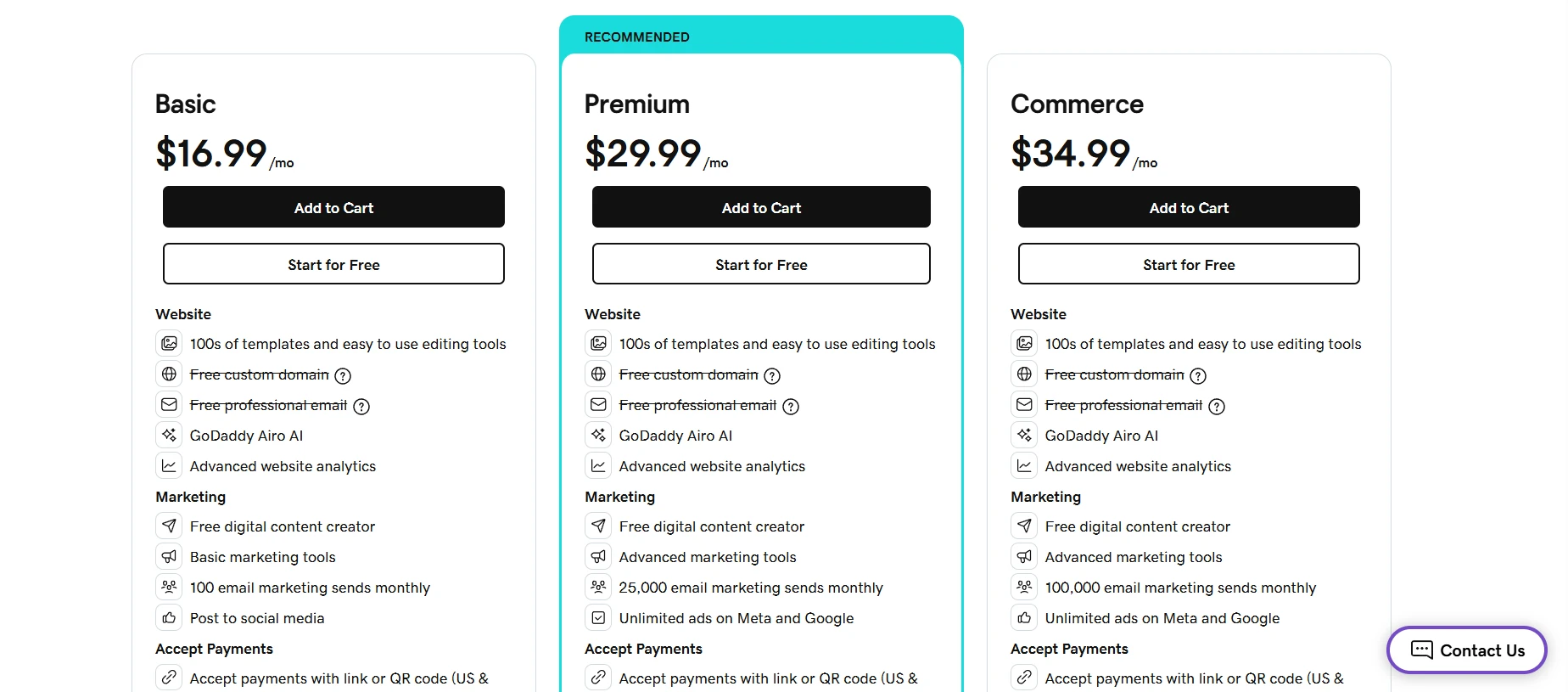
Clearly, between the two platforms, GoDaddy is a much more affordable option. Not only does GoDaddy offer more economical pricing plans, but they also don’t limit the Gross Merchandise Value for each plan like BigCommerce does.
Nevertheless, there are reasons why many merchants still choose BigCommerce over GoDaddy, regardless of the pricing, which we’ll discuss later on. If neither platform feels right, it’s also worth browsing other BigCommerce alternatives before deciding.
#2. Ease of Use – GoDaddy Wins
The verdict:
GoDaddy is easier to use than BigCommerce. BigCommerce is easy to use but packed with many features that can take time to learn. Meanwhile, setting up an eCommerce website with GoDaddy is a bit easier.
BigCommerce provides users with an intuitive admin dashboard where they can manage all aspects of their online store operations – a usability point also discussed in a BigCommerce vs Squarespace comparison. You can easily customize your theme, add products, handle orders, etc., in one place – a workflow also raised in a Wix vs Bigcommerce comparison.
However, be well-noted that BigCommerce will come with a learning curve, especially when it comes to customizing your theme or managing advanced eCommerce functionalities. To learn more about this platform, please take a look at our in-depth BigCommerce reviews for more insights.
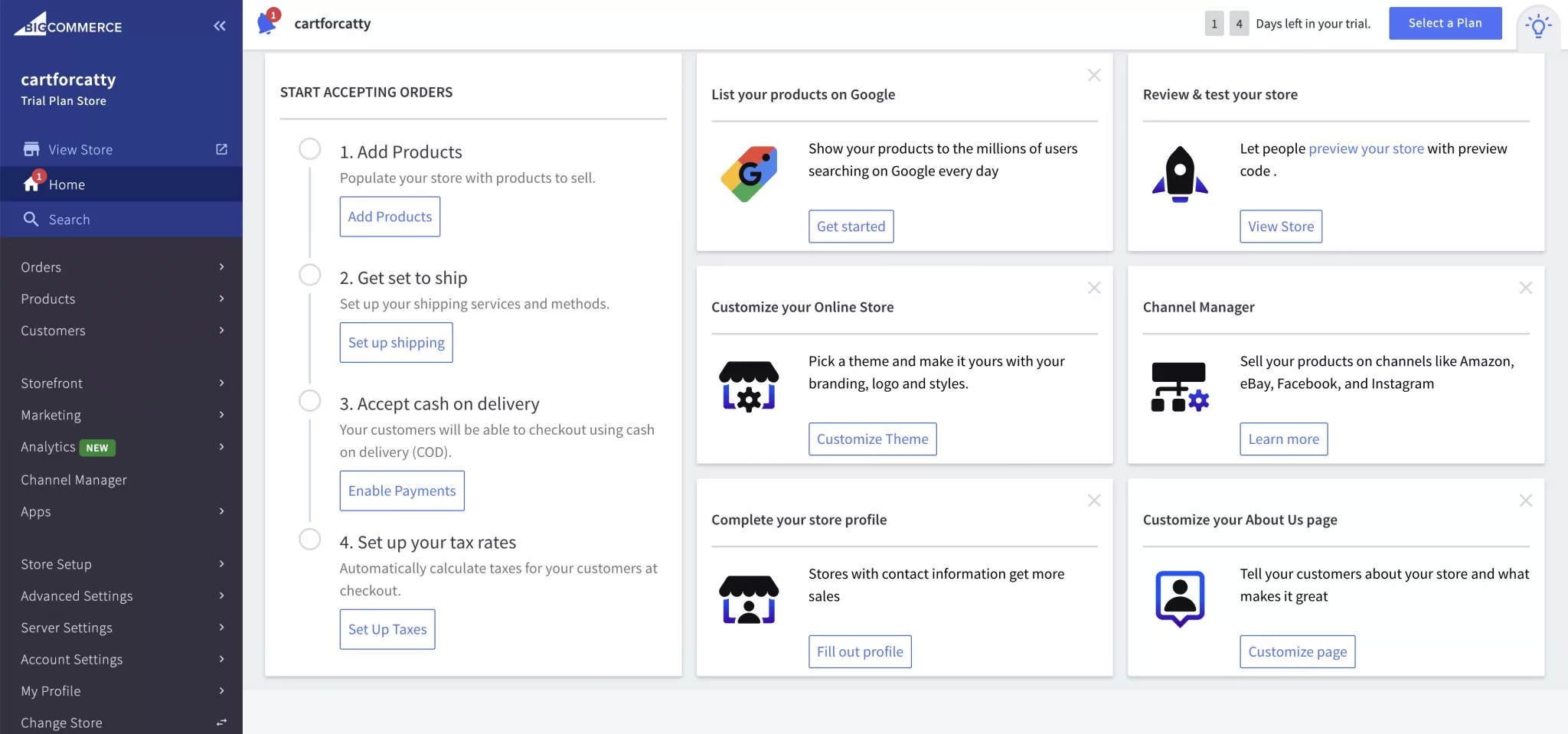
Ease of use is an aspect where GoDaddy shines. After you sign up for an account, GoDaddy gets you on board with all the steps of the website creation process, from adding content to connecting your domain, etc. Plus, their Artificial Design Intelligence can even automatically create a basic website tailored to your preferences.
#3. Templates – BigCommerce Wins
The verdict:
BigCommerce wins over GoDaddy convincingly. BigCommerce offers you 200 themes that you can easily preview and select. While GoDaddy gives you 100 themes, they don’t let you freely choose a theme you prefer. Instead, the platform assigns a template based on the category you select at the onboarding step.
BigCommerce themes give you almost 200 different choices and 12 of them are free. If you want a fancy BigCommerce theme, it usually costs between $150 and $400. The good thing is you can look at a theme before you buy it. Also, you can change to a different theme later if you want, which you can’t do with GoDaddy – a flexibility worth noting in a BigCommerce vs Big Cartel comparison for small sellers.

GoDaddy has about 100 themes, but unfortunately, you can only pick from the group you chose at the start. We think this is annoying because it means you can’t see all the themes and pick the one you like best.
Another thing worth noting is that GoDaddy themes are quite limited compared to BigCommerce’s optimization options. For instance, you can only edit text and make some basic design changes instead of having full control over individual elements of your website, like with BigCommerce.
#4. eCommerce Features – BigCommerce Wins
The verdict:
BigCommerce leaves GoDaddy in the dust. With advanced inventory management, multi-channel integration and stuff, BigCommerce has much superior eCommerce functionalities than GoDaddy ever could.
Regarding eCommerce features, BigCommerce clearly offers more comprehensive and advanced functionalities than GoDaddy. This shouldn’t come as a surprise tho. At the end of the day, BigCommerce positions itself as a scalable eCommerce platform, while GoDaddy is just a domain registrar & general website builder – a positioning also discussed in a BigCommerce vs Magento comparison.
Let’s have a look at BigCommerce vs GoDaddy’s eCommerce features side by side:
eCommerce features | BigCommerce | GoDaddy |
Inventory management |
|
|
Payment gateways |
|
|
Headless commerce |
|
|
Cross-channel eCommerce |
|
|
B2B Capabilities |
|
|
#5. Apps & Integrations – BigCommerce Wins
The verdict:
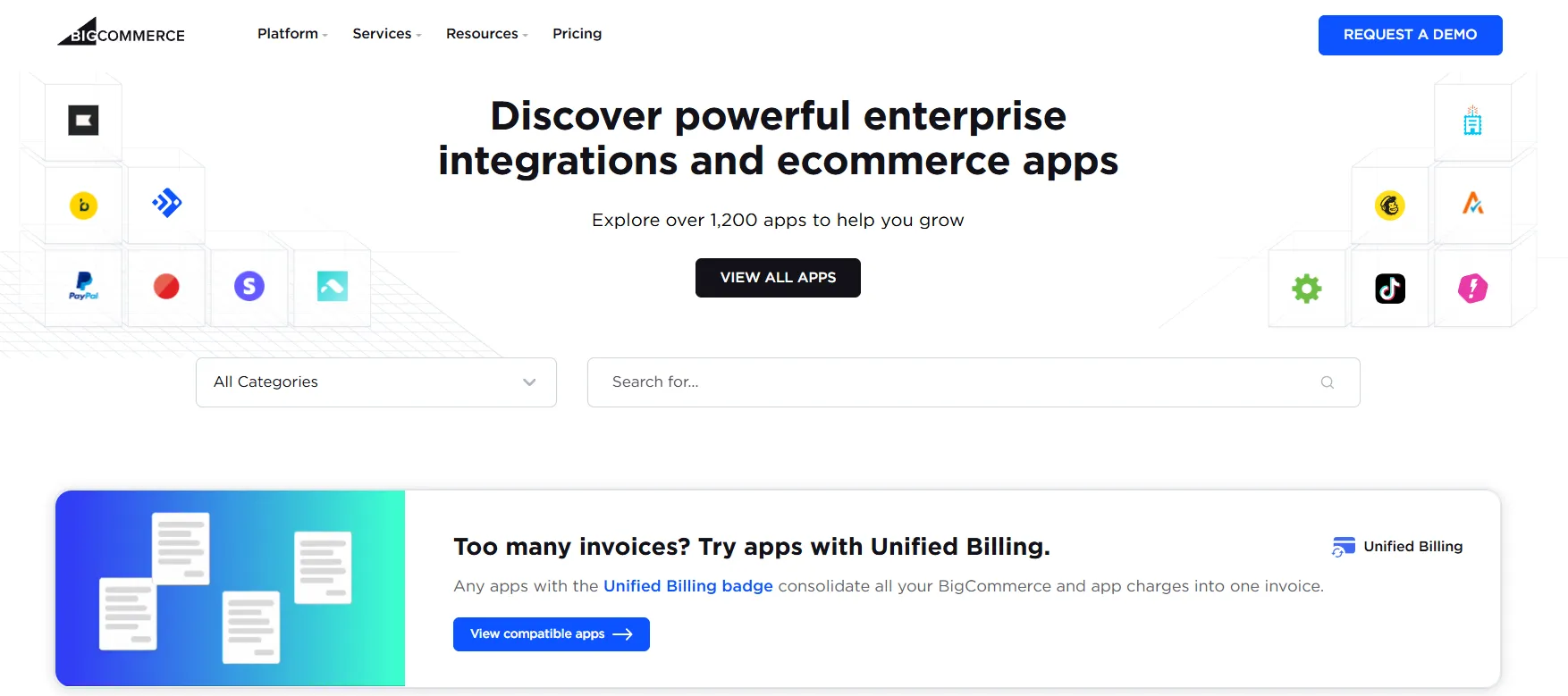
Between BigCommerce vs GoDaddy in terms of apps and integrations, BigCommerce takes the lead, offering a significantly larger and more capable app ecosystem than GoDaddy with over 1,000 integrations available.
When it comes to extending your store’s functionality, BigCommerce has a clear advantage. Its App Marketplace hosts over 1,000 apps and integrations spanning every major category, including shipping and fulfillment, accounting software, and ERP systems – a marketplace size also discussed in a Drupal vs Bigcommerce comparison. Most of the essential apps are free, and the paid ones are competitively priced – a pricing structure often compared in a BigCommerce vs Shopify discussion.
Beyond the marketplace, BigCommerce also supports headless commerce and API-first architecture, meaning developers can connect almost any external system directly to your store without being limited to what is listed in the App Marketplace – though enterprises running a commercetools vs Bigcommerce comparison for a fully headless build may still prefer commercetools’ architecture. This makes it particularly well-suited for mid-size and enterprise merchants who rely on a custom tech stack – a flexibility frequently cited in a BigCommerce vs WooCommerce comparison.
GoDaddy, on the other hand, has made meaningful progress in this area. Its Websites + Marketing platform now includes an App Market, and you can connect your store with a handful of popular tools. That said, the selection remains limited compared to BigCommerce, and some core capabilities, such as advanced email marketing automation or multi-channel inventory sync, may still require workarounds or manual setup.
For merchants who plan to run a lean, simple storefront, GoDaddy’s integration options may be sufficient. However, if your business relies on a connected ecosystem of tools to manage operations, marketing, and fulfillment efficiently, BigCommerce is the stronger choice by a considerable margin.
#6. SEO Functions – BigCommerce Wins
The verdict:
BigCommerce provides more advanced SEO tools than GoDaddy. BigCommerce enables you to fully optimize your eCommerce web store for search engines with various advanced SEO features. With GoDaddy, you can only edit alt text and get some keyword suggestions to manually insert into your product listings.
Here are some of the top BigCommerce SEO features that can help your website rank higher on search engine results pages (SERPs):
- SEO-friendly URL structure: Customize URL structures for products, web pages, and categories.
- Mobile-friendliness: All templates are responsive and support AMP format – a mobile-readiness point also noted in a BigCommerce vs Volusion comparison.
- Microdata/Rich snippets: Enhance search results with ratings, pricing, brand, and stock information.
- On-page SEO: Easily adjust page titles, metadata, and headings.

GoDaddy, meanwhile, gives you very little things to do with search engine optimization. As of the time being, here’s what GoDaddy offers in terms of SEO:
- Keyword suggestion: The GoDaddy SEO tool gives you a list of keyword suggestions while you’re on-boarding.
- Alt text edit: You can add alt text to optimize your images for search engines.
- Report: The tool has an analytics dashboard so you can track your SEO performance.
#7. Security – BigCommerce Wins
The verdict:
BigCommerce beats GoDaddy when it comes to security. Both platforms are quite secure. However, BigCommerce goes the extra mile to proactively deal with emerging threats and fraud. With GoDaddy, you’ll have to be responsible for fraud prevention measures.
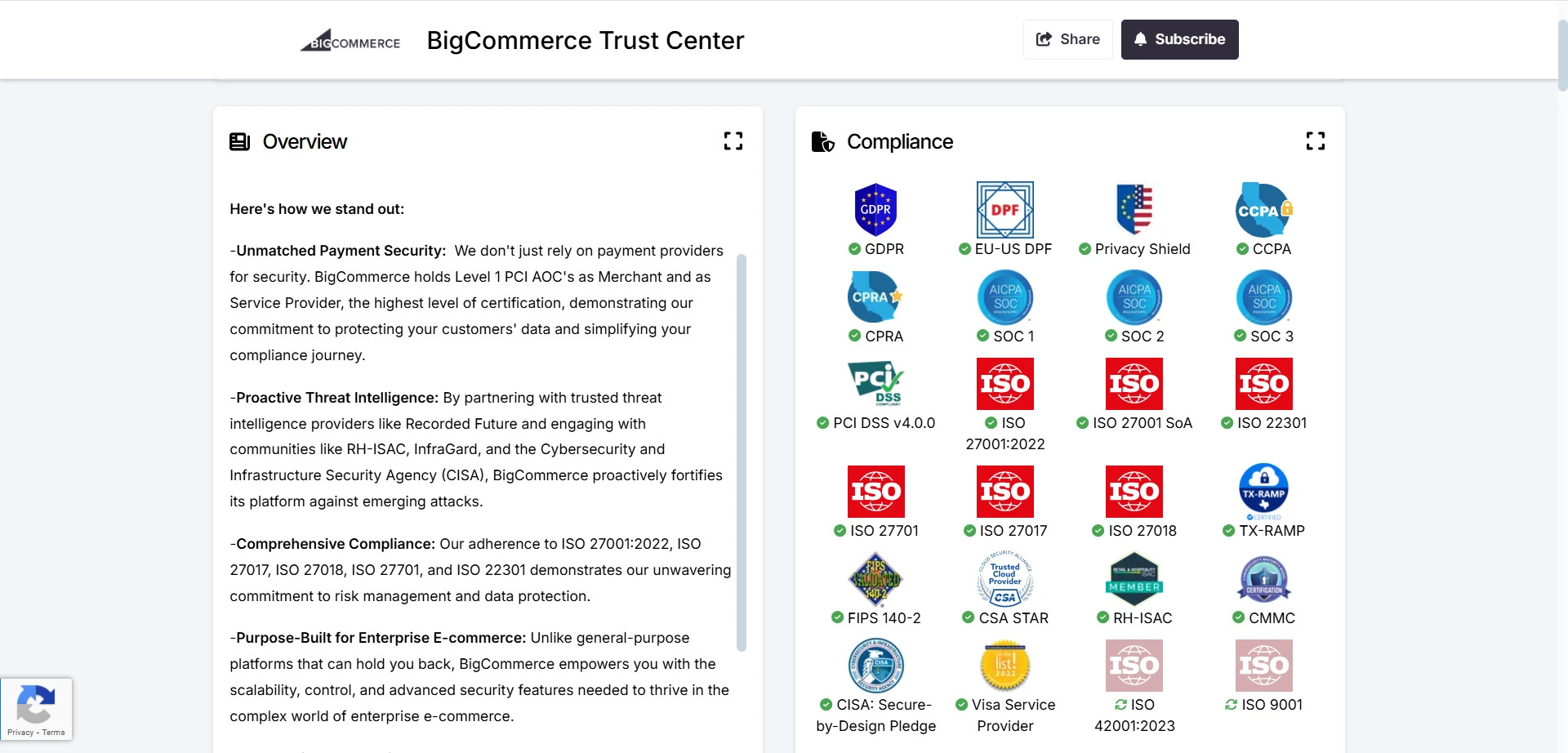
BigCommerce is secure out of the box – a baseline worth reviewing in a BigCommerce vs PrestaShop comparison. To be more specific, BigCommerce’s servers have level 1 PCI DSS certification, offering robust protection against credit card data breaches.
The platform employs a comprehensive security suite, including intrusion detection software, file integrity scanners, multi-layered firewalls, round-the-clock human monitoring, and advanced fraud protection mechanisms – a security depth often cited in an Opencart vs Bigcommerce comparison.
GoDaddy is secure, too with PCI compliance and stuff. But when it comes to fraud protection, GoDaddy leaves the hard work to website owners. GoDaddy offers fraud prevention as well, but as paid service. Hence, it doesn’t even come close to BigCommerce’s security.
#8. Customer Support – BigCommerce Wins
The verdict:
BigCommerce slightly wins regarding customer support. BigCommerce offers round-the-clock live chat and phone support for all plan users, while GoDaddy’s dedicated phone support is limited to specific hours.
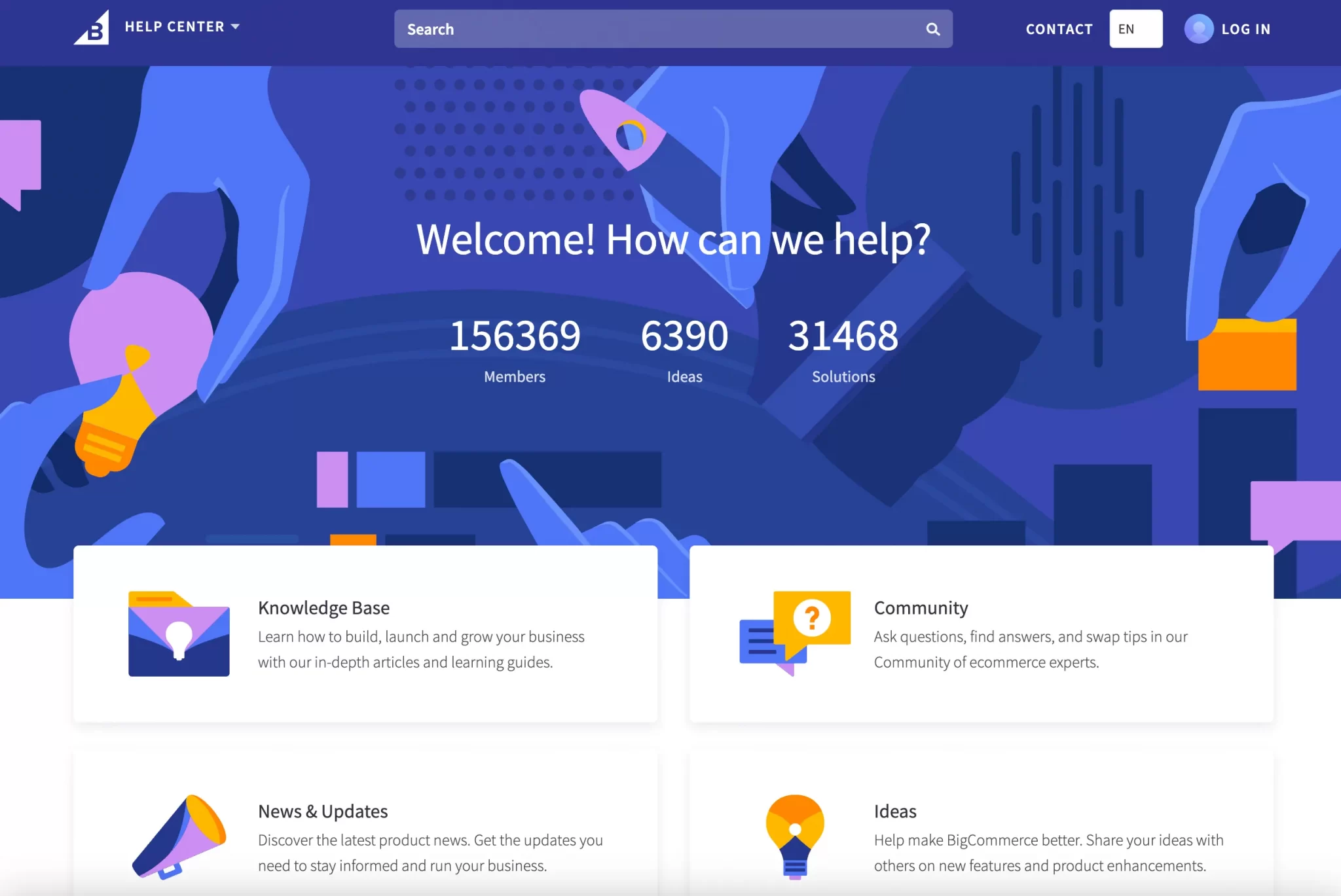
BigCommerce provides free customer support for all plan users, including 24/7 live chat and phone support. And if you’re a self-taught expert, you can also find helpful documents and tutorials in the BigCommerce Help Center – a resource worth comparing in a BigCommerce vs Ecwid review.
If you’re on BigCommerce’s Enterprise plan, you’ll get priority support, which includes a BigCommerce onboarding consultant and quick access to phone support – a tier enterprises also weigh in a BigCommerce vs Salesforce Commerce Cloud comparison.
GoDaddy also does well in this area. They offer chat support all day and night, and dedicated phone support from 9 a.m. to 7 p.m. every day of the week.
In some countries, GoDaddy offers local support. For example, French customers can get help from French-speaking staff, which makes the support experience better.
GoDaddy also offers a comprehensive knowledge base that guides users through common issues and tasks. This allows customers to attempt solving problems independently before reaching out to support staff.
BigCommerce vs GoDaddy – Which Should You Choose?
Now that we have walked you through all 8 aspects of BigCommerce vs GoDaddy, the right choice really comes down to what kind of business you are running and where you plan to take it.
Choose GoDaddy if you:
- Are just starting out and need a simple, affordable website up and running quickly
- Run a service-based or local business that does not rely heavily on eCommerce
- Have a limited budget and want an all-in-one solution for your domain, hosting, and basic online store
- Do not need advanced inventory management, multi-channel selling, or deep third-party integrations
- Prioritize ease of use over feature depth and are not planning to scale significantly
Choose BigCommerce if you:
- Are serious about building and growing a dedicated eCommerce store for the long term
- Need advanced features like multi-channel selling, B2B capabilities, headless commerce, or robust inventory management
- Want a platform that scales with your business without forcing you to switch platforms down the road
- Require a wide ecosystem of third-party apps and integrations to manage your operations efficiently
- Are migrating from another platform and need a reliable, feature-rich destination to land on
Our Methodology – How We Test BigCommerce vs GoDaddy
To give you the most accurate and useful comparison between BigCommerce vs GoDaddy, we did not rely on surface-level observations. Instead, we spent time hands-on with both platforms, tested their core features, and cross-referenced our findings with real user feedback from trusted review platforms like G2 and Trustpilot.
Our evaluation covers 8 key aspects that matter most to eCommerce merchants when choosing a platform:
- Pricing: How much does each platform actually cost, and what do you get for your money?
- Ease of use: How steep is the learning curve for first-time and experienced store owners?
- Templates: How flexible and varied are the design options available?
- eCommerce features: What built-in tools does each platform offer to run and grow an online store?
- Apps & integrations: How well does each platform connect with third-party tools, marketplaces, and business software?
- SEO functions: How well does each platform support your store’s visibility on search engines?
- Security: What protections are in place to keep your store and customer data safe?
- Customer support: How responsive and helpful is each platform when you need assistance?
For each category, we assigned a winner based on which platform delivered more value to the typical eCommerce merchant. Where the gap between BigCommerce vs GoDaddy was close, we made sure to explain the nuance so you can weigh the trade-offs for your own situation.
BigCommerce vs GoDaddy: Final Verdict
Now that we have walked you through all the key aspects of BigCommerce vs GoDaddy, have you figured out which platform will best suit your needs?
To sum up:
- Choose GoDaddy over BigCommerce if you plan to build an affordable, non-eCommerce website with an intuitive website builder.
- Choose BigCommerce over GoDaddy if you want to launch an online store and are serious about scaling it in the long run. BigCommerce’s advanced eCommerce features and scalability won’t let you down. That’s why many have used our BigCommerce migration services to switch from their current platform to BigCommerce.
Don’t forget to check LitExtension’s blog site and LitExtension Resources to get updated with all the latest eCommerce insights.
Frequently Asked Questions
What are the pros and cons of BigCommerce?
BigCommerce is one of the most capable dedicated eCommerce platforms on the market, but it is not without its trade-offs. On the positive side, BigCommerce offers advanced built-in features including multi-channel selling, B2B capabilities, headless commerce support, and over 1,000 third-party integrations, all without charging transaction fees on any plan.
On the downside, BigCommerce comes at a higher price point than most entry-level alternatives, with plans starting at $39/month on a monthly billing cycle. It also imposes annual revenue (GMV) limits on its Standard, Plus, and Pro plans, meaning your account is automatically upgraded once your store crosses those thresholds.
What are the limitations of GoDaddy?
While GoDaddy is a solid choice for simple websites and service-based businesses, it has several limitations that make it less suitable for serious eCommerce. Its built-in selling tools are basic, and the platform does not support digital product sales or native dropshipping. Theme customization is also restricted, which limits your design flexibility from the start.
Is BigCommerce better than GoDaddy?
Yes, for many merchants, BigCommerce is better than GoDaddy. It is purpose-built for eCommerce and offers far more advanced features, better scalability, a stronger app ecosystem, and more robust security out of the box. If your primary goal is to build and grow an online store, BigCommerce is the stronger platform.

