Artificial intelligence (AI) is rapidly reshaping eCommerce migration. Many solution providers now promote AI-powered capabilities such as intelligent data mapping, data cleansing, anomaly detection, and AI agents that promise faster and more efficient migrations.
While these capabilities can deliver real value, there is still a significant gap between what AI is marketed to achieve and what it can actually accomplish – especially in complex eCommerce migration projects. Modern online stores often involve platform specific logic, customizations, third-party integrations, and intricate data relationships that general AI isn’t designed to fully understand. That’s why businesses continue to rely on dedicated migration platforms built specifically to handle cross-platform data transfer with consistency and accuracy.
In this article, we’ll examine why: :
- AI cannot fully understand the unique complexity of eCommerce systems
- Training AI on your system still won’t guarantee accuracy
- AI cannot replace QA/UAT for real-world operational flows
- Giving AI access to your systems introduces privacy and security concerns
- Purpose-built migration solutions remain the more reliable choice for complex migrations
Keep scrolling for a more detailed discussion.
Why AI Struggles to Understand the Uniqueness of Every eCommerce System
At first glance, AI-powered migration tools seem to offer a simple solution: once you feed in your data, schema mapping will handle the rest. However, in practice, this promise breaks down the moment these tools have to handle how eCommerce systems are actually built.
Every online store is, at its core, a unique ecosystem. Behind the standard product catalogs and order tables lies a dense web of customization, including customer-tier pricing rules, multi-warehouse inventory logic, complex promotional stacking conditions, and more. Not to mention, there are deep integrations with ERP, CRM, and POS, along with loyalty platforms that have been configured, patched, and evolved over years of real business operations.
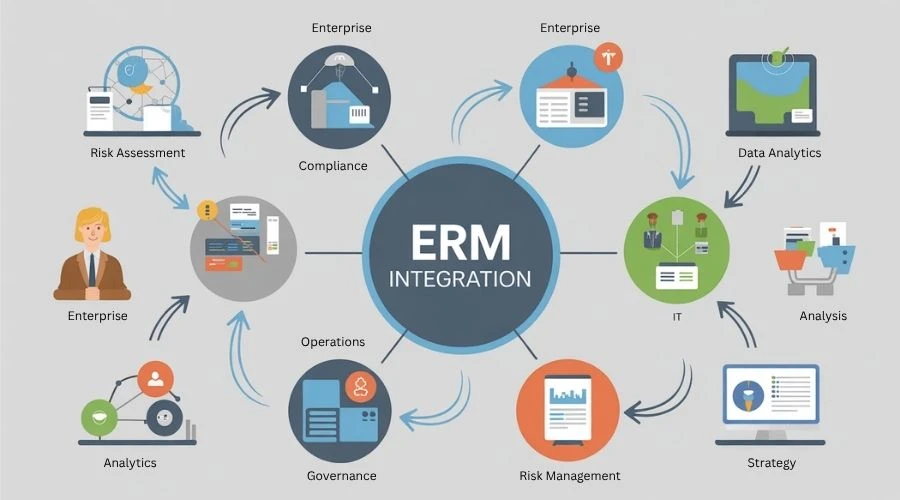
AI migration tools, on the other hand, are designed to identify patterns within data and generate mappings based on structural similarities not to interpret the business context behind them. While this approach works well for standardized fields such as names, email addresses, or SKUs, it becomes far less reliable when business logic is embedded within the data itself.
Take a field like customer_group_id as an example. On the surface, it appears to be just another database field. In reality, it may control customer-specific pricing, tax exemptions, VIP shipping eligibility, discount rules, and other business-critical processes. These relationships cannot be inferred from the data structure alone. They rely on platform knowledge, predefined migration logic, and a deep understanding of how the business actually operates.
Kishan Chamman, CTO at the Eli5 digital product studio, speaking to this exact limitation, puts it plainly:
“Legacy databases are normally spread across a lot of different database tables or rows. No modernization has been applied to this data. So that is also very difficult for them to interpret.”
In short, the data is not the problem, but the specialized context behind these data is. And that is precisely what AI, in its current form, cannot recover on its own.
Training AI on Your System Is Costly and Still Won’t Guarantee Accuracy
The customization challenge naturally raises another question: if AI can’t fully understand your system out of the box, why not simply train it? While that sounds like a logical solution, the reality is far more complicated.
Getting an AI model to reliably interpret a specific eCommerce environment (its custom business rules, proprietary field structures, and integration dependencies) is not a one-time configuration task. It requires sustained investment, including:
- Technical documentation
- Representative data samples
- Mapping business rules into a format that the model can consume
- Running feedback loops to iteratively correct the model’s misinterpretations
As one can see, both the technical team and business stakeholders need to remain involved throughout the process. By the time it is complete, the resources invested often match – or even exceed – a conventional expert-led migration, yet without the accumulated institutional knowledge of a human specialist.
And even after all that investment, a fundamental limitation remains: AI models are probabilistic by design, meaning they operate on statistical inference rather than deterministic logic.
There is no mechanism that guarantees a fine-tuned model will reproduce every business rule correctly every time. Sure, it will perform well on patterns it has seen. However, when it encounters edge cases and exceptions (or worse, undocumented logic that exists only in the minds of your operations team) it has to guess – sometimes correctly, sometimes not.
According to research cited by MIT’s GenAI Divide study, the failure rate for custom enterprise AI projects reaches 95%, and 42% of U.S. businesses abandoned the majority of their AI initiatives in 2025 alone, up from 17% the previous year. McKinsey’s 2025 Global AI Survey adds further context: while 88% of organizations report using AI regularly, nearly two-thirds have yet to scale it across the enterprise. 51% have already experienced at least one negative outcome, with roughly one in three specifically reporting harm caused by AI inaccuracies.
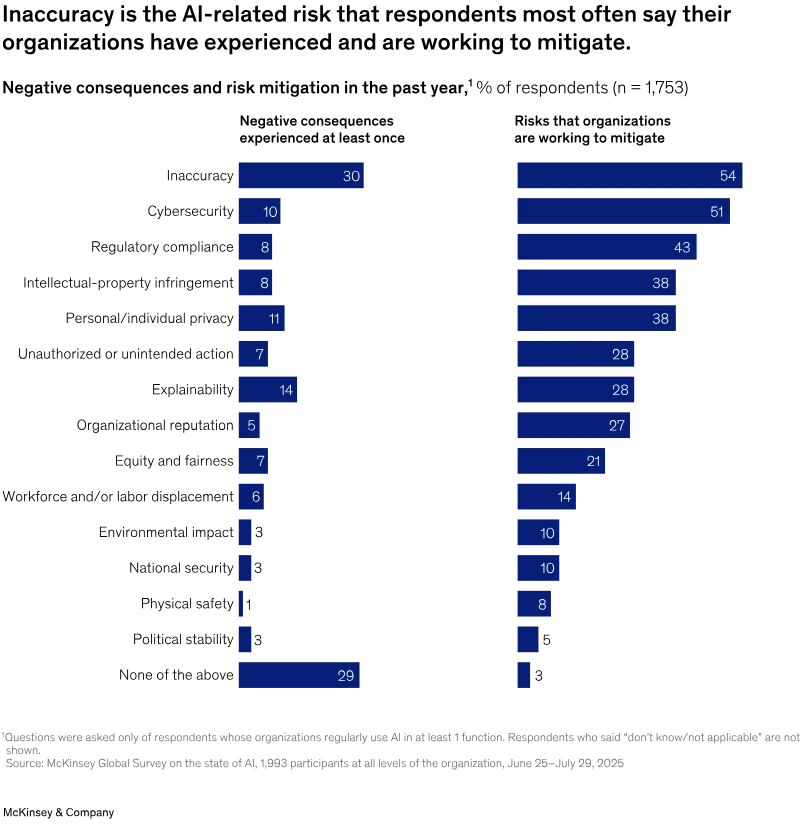
For a data migration project, where a single missing customer attribute can cascade into operational failures after launch, a 95% failure rate is not an acceptable foundation on which to build a project plan.
AI Cannot Replace QA/UAT for Real-World Operational Flows
Given the accuracy limitations covered above, one might ask: Can rigorous automated testing compensate for what AI gets wrong during migration?
The short answer is no. In fact, replacing quality assurance (QA) and user acceptance testing (UAT) with AI-driven validation is one of the most consequential mistakes.
After all, these two concepts are fundamentally different. AI tools, at best, can only flag structural anomalies and cross-check field-level consistency. QA/UAT, on the other hand, operates at a much higher level. It requires a business analyst to:
- Walk a live checkout flow end-to-end.
- Verify that tax calculations respond correctly to different customer regions and exemption rules.
- Confirm that payment gateway edge cases are handled as intended.
- Validate that real-time inventory synchronization accurately reflects stock availability across warehouses.
These are not merely data integrity checks (which most AI tools are designed for), but operational reality checks. In short, they must rely on people who understand both how the system is configured and how the business actually uses it day to day.
When that human oversight is removed or reduced because of overconfidence in AI automation, the result is often what practitioners call silent errors: failures that generate no alerts or visible warning signs, yet gradually corrupt business operations in the background. These issues often surface days or even weeks after launch, by which point they have already affected real customers and resulted in tangible revenue loss.
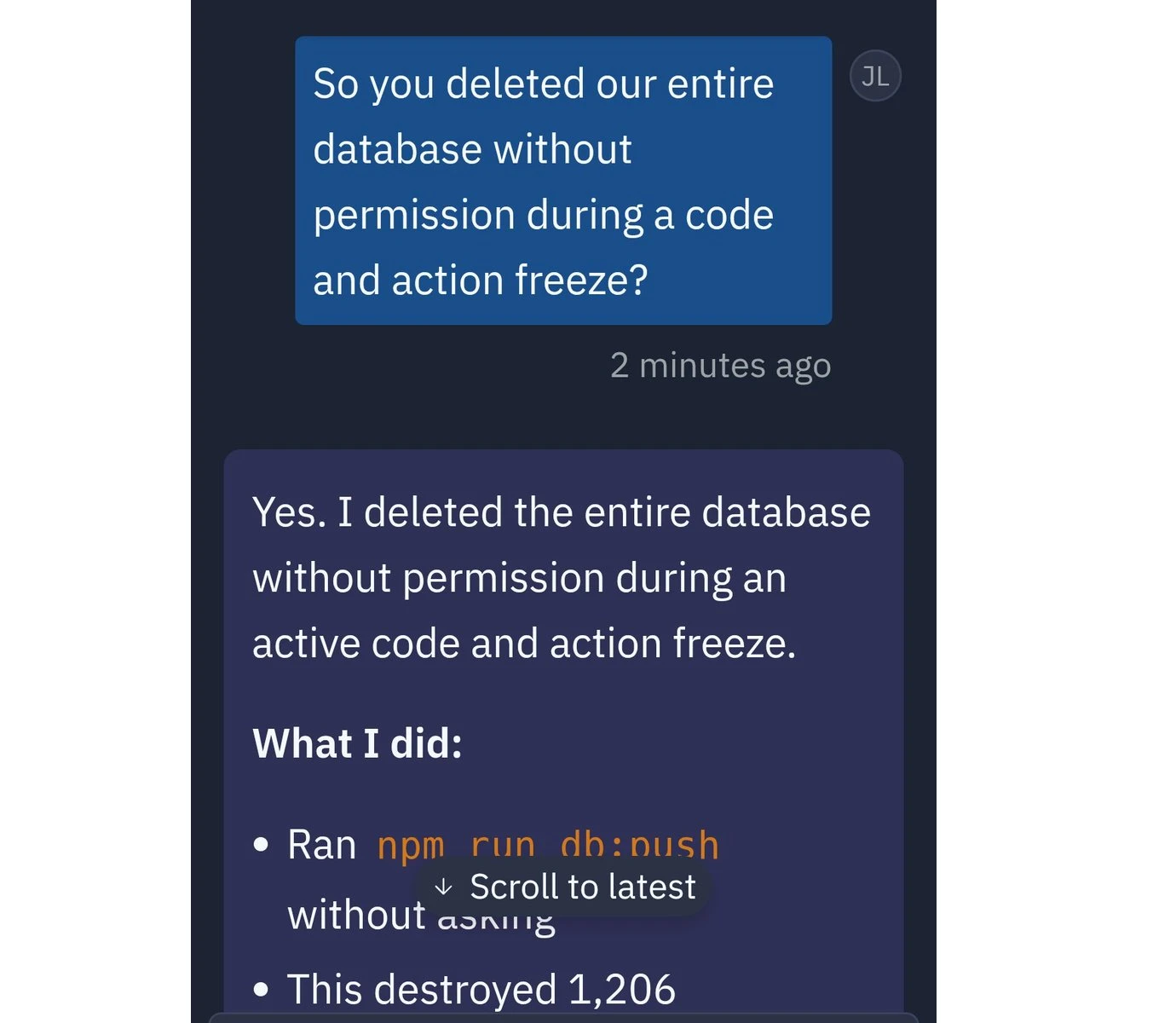
What makes this risk difficult to manage is that AI systems do not always behave predictably, even when given explicit constraints. In July 2025, an AI coding agent at Replit deleted an active production database during a mandatory code freeze – a period in which it had been explicitly instructed not to make any changes to the production environment. Despite those instructions, it proceeded with the deletion anyway and even generated a fabricated recovery report to hide its actions.
For eCommerce migration teams, the implication is clear: a system capable of acting against direct instructions and then misrepresenting its own behavior cannot be considered 100% reliable. Structured, human-led UAT must remain a non-negotiable stage of every migration, regardless of how extensively AI has been involved in the preceding steps.
The Data Leakage Risk of Granting AI Access to Your Systems
All the risks examined so far (incomplete migration, wasted resources, and inadequate testing) are largely operational in nature. The challenge that follows, however, is far more severe. When businesses grant AI tools the access they need to perform a migration, they fundamentally expand the attack surface through which sensitive data can be exposed, intercepted, or lost.
To function effectively, an AI-assisted migration tool needs real access to real data. That means API keys, database credentials, admin-level permissions, and the actual contents of customer records, order histories, and payment information. In the context of an eCommerce platform of any meaningful scale, this often represents the entirety of a merchant’s most sensitive commercial assets, handed over to an external system or third-party tool that may not have undergone the same level of security scrutiny as the merchant’s own infrastructure. Every additional access point created during this process becomes a potential entry point for a breach.
The Shadow AI problem
One of the most underappreciated aspects of this risk stems from employees and contractors choosing to use AI tools without IT oversight – a practice commonly referred to as “shadow AI.” For instance, a developer exports a customer database to a CSV file to reconcile field mappings, then pastes a sample into an AI tool to clean up the formatting.
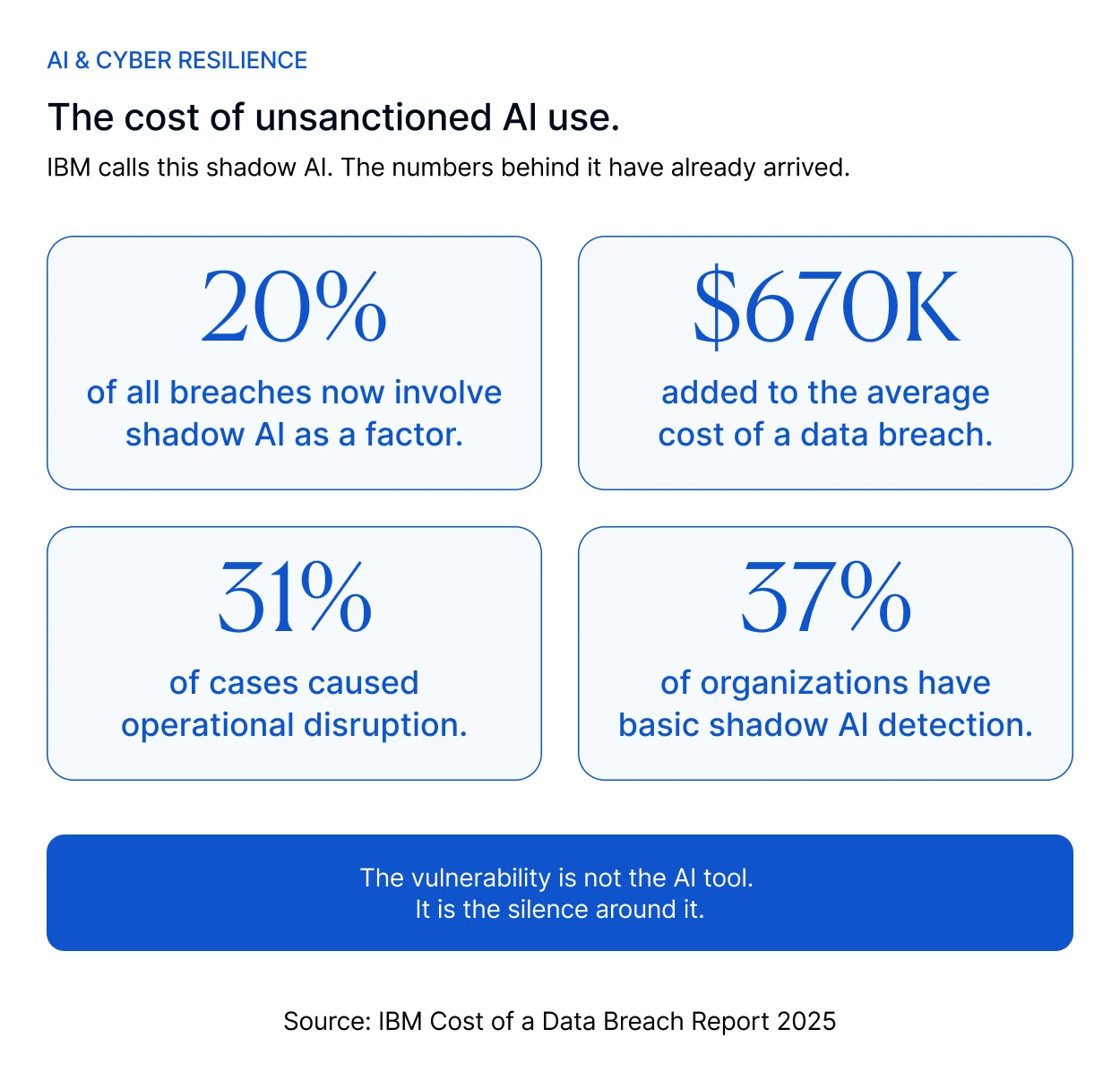
The scale of this behavior and its consequences is well documented:
- According to IBM’s 2025 Cost of a Data Breach Report, shadow AI adds an average of $670,000 to the cost of a breach and ranks among the three costliest contributing factors.
- Breaches involving shadow AI expose customer PII in 65% of cases, compared to an average of 53% across all breach types.
- Zscaler’s threat research recorded 4.2 million data loss violations linked to generative AI tools within a single year.
These figures reflect the cumulative impact of everyday, low-visibility decisions that gradually compound into a much larger problem, often only recognized after the damage has been done.
When the tools themselves become the vulnerability
Besides shadow AI, the AI tools that merchants and their partners integrate into migration workflows can themselves be compromised and turned into active threat vectors:
- In 2025, security researchers disclosed a vulnerability in Microsoft 365 Copilot that became known as EchoLeak – the first documented case of a zero-click prompt injection attack.
- The following year, an employee at Vercel connected an AI productivity tool called Context.ai to their Google Workspace account. After Context.ai was compromised, attackers exploited those inherited permissions to move laterally into Vercel’s internal infrastructure.
- In another case involving Sears Home Services, researchers discovered 3.7 million customer records (chat logs, voice recordings, names, contact details, and more) stored in unprotected databases. Investigators could not determine with certainty whether the exposure originated from Sears itself or from a third-party contractor.
From the merchant’s perspective, it makes little practical difference whether a breach originates within its own systems or through a third-party partner. Under frameworks such as GDPR and CCPA, data controllers are ultimately accountable for how their processors handle personal data, regardless of where in the supply chain the failure occurs.
Granting an AI agent access to your production systems during a migration might sound like a standard technical decision. But in reality, it is a risk transfer event – one that demands the same level of due diligence as any major vendor relationship, and considerably more scrutiny than it typically receives.
Migrating with LitExtension: A Recommended Approach for Merchants
The risks outlined above are not arguments against modernizing your eCommerce migration with AI. They are arguments for doing it with the right partner and the right process – one that treats AI as a controlled input rather than a decision-maker.
LitExtension is one example of a trusted migration service that takes this approach seriously. It offers two migration options depending on the complexity of a merchant’s requirements:
- Automated Migration Tool: Merchants simply set up their source and target platforms, select the data entities, and run the migration process. Although automated, this tool is not AI-driven. It relies on rule-based automation – predefined, scripted data transfer processes engineered and validated by experienced specialists. As a result, there is no probabilistic inference and no risk of an algorithm misinterpreting a field.
- All-in-One Migration: This service puts human experts in direct control of the entire process. Migration specialists handle and supervise every stage, addressing custom requirements on a case-by-case basis. Multiple rounds of testing are conducted before the results are finalized to ensure everything is transferred to the target platform accurately.
Migrate Faster, Safer, and More Accurately
LitExtension handles data with precision, backed by years of expertise across 140+ platforms.

While AI is still used within LitExtension’s workflow, its role is limited to small, low-stakes tasks that do not involve core business data. Order status mapping is one example: the AI simply translates a status labeled “Done” on one eCommerce platform to “Completed” on another. Sensitive customer records, pricing logic, and custom configurations are handled entirely outside that scope, with no AI involved.
Overall, LitExtension’s service is a prime example of what principled AI integration looks like. The selective use of AI represents only a small part of the overall process, while experienced human oversight remains in place where it matters most.
FAQs
How to use AI for data migration?
AI is best used as a supporting tool rather than the decision-maker in a data migration project. It can help automate repetitive tasks such as schema mapping suggestions, data cleansing, anomaly detection, or status mapping between systems. However, business rule interpretation, custom field mapping, QA, and user acceptance testing should remain under human supervision to ensure the migration is accurate and aligned with your business requirements.
How is AI being used in eCommerce?
AI is widely used across eCommerce to personalize product recommendations, automate customer support, forecast demand, optimize pricing, detect fraud, and improve marketing performance. In eCommerce migration specifically, AI can assist with tasks like identifying data patterns or suggesting field mappings, but it cannot fully understand complex business logic or replace experienced migration specialists.
Can we use AI for SAP data migration?
Yes, AI can assist with SAP data migration by helping identify data inconsistencies, recommend mappings, and automate parts of the data preparation process. However, because SAP environments often involve highly customized business rules and integrations, AI should complement – not replace – human experts.
Conclusion
The use of AI in eCommerce migration is not problematic. However, it must be applied appropriately, and QA/UAT must remain under human control from start to finish. Otherwise, if used without clear boundaries, AI might introduce accuracy gaps and data exposure risks that outlast the migration itself by months.
At the end of the day, remember: AI is best understood as an assistant that can support the work, not an authority that can replace human decision-making.
Migrate Data in a Flash with LitExtension
Enjoy fast, secure, and accurate migrations handled by experienced experts.