Choosing between Magento vs Shopify is one of the most consequential platform decisions. At their core, each platform targets different users: Magento (now Adobe Commerce) gives store owners near-unlimited control over a self-hosted infrastructure, while Shopify gives merchants a fully managed, ready-to-run environment that minimizes technical overhead.
In this guide, we’ll put Magento vs Shopify through a thorough comparison across essential features, including:
| Criteria | Magento (Adobe Commerce) | Shopify | Winner |
|---|---|---|---|
| Pricing and Total Cost of Ownership | Free Open Source license, but real-world TCO runs $5,000–$90,000+/year; Adobe Commerce license starts at ~$22,000/year | Basic at $39/mo, Grow at $105/mo, Advanced at $399/mo, Plus from $2,300/mo; predictable costs with no infrastructure surprises | Shopify |
| Infrastructure and Scalability | Self-hosted; performance depends entirely on your hosting setup; Adobe Commerce Cloud offers managed AWS hosting as a paid option | Fully managed hosting with global CDN, automatic scaling, and a 99.99% uptime SLA on Shopify Plus | Shopify |
| Ease of Use | Steep learning curve; developer involvement required for setup, updates, and most day-to-day configuration | Intuitive admin interface; non-technical merchants can launch and manage a full store without writing code | Shopify |
| Product and Inventory | Handles 500,000+ SKUs natively; supports configurable, bundled, grouped, and virtual product types out of the box | Unlimited products on all plans; clean multi-location inventory dashboard; native Shopify POS integration | Magento |
| AI and Automation Features | Adobe Sensei powers product recommendations, Live Search, and demand forecasting; Magento Open Source requires third-party extensions for AI | Shopify Magic on all paid plans; Sidekick AI assistant for real-time store monitoring; Shopify Flow for native automation | Shopify |
| Payment Options and Transaction Fees | No native gateway; integrates any provider via extensions or API; zero platform-level transaction fees on all gateways | Shopify Payments eliminates transaction fees; 100+ third-party providers supported; 0.5%–2.0% fee applies when not using Shopify Payments | Magento |
| Reports and Analytics | Basic admin reporting on Open Source; Adobe Commerce Intelligence adds cohort analysis, LTV tracking, and SQL-level customization | Real-time sales, traffic, and conversion dashboard on all plans; custom report builder on Advanced and Plus | Shopify |
| SEO and Marketing Features | Full URL control, hreflang support, granular technical SEO settings, and a powerful native promotions rule engine | Strong Core Web Vitals out of the box, built-in Shopify Email, abandoned cart recovery, and discount codes on all plans | Shopify |
| Design and Customization | Full code-level control via PHP and XML; unlimited design flexibility; headless commerce via PWA Studio | 100+ themes, drag-and-drop editor via Online Store 2.0, headless via Hydrogen and Oxygen | Magento |
| Apps and Integrations | ~3,700 extensions on Magento Marketplace; full API and direct code access for deep custom integrations | 13,000+ apps in the Shopify App Store with stricter quality standards; REST and GraphQL APIs available | Shopify |
| Security and Support | Merchant responsible for applying security patches and managing PCI compliance on Open Source; dedicated support on Adobe Commerce only | PCI DSS Level 1 compliance fully managed by Shopify; automatic security updates; 24/7 support on all paid plans | Shopify |
In the sections that follow, we will compare Magento vs Shopify in full detail so you can make an informed decision about which platform best fits your business stage, technical resources, and long-term eCommerce goals.
Magento vs Shopify – Pros and Cons
This section gives you a quick overview of Magento vs Shopify, along with the key advantages and drawbacks that come with each one, so you can orient yourself before we go deeper.
Magento pros and cons
Magento is an open-source eCommerce platform first launched in 2008 and acquired by Adobe in 2018. After the acquisition, the platform now comes in two distinct editions: Magento Open Source, which is free to license but self-hosted, and Adobe Commerce, which is a paid enterprise platform with managed cloud hosting, native B2B features, and AI-powered tools via Adobe Sensei.
According to BuiltWith, Magento currently powers approximately 175,000 live websites globally, with notable brands such as Coca-Cola, Ford, and Bulgari running on the platform. To get more expert thoughts and insights on this platform, feel free to take a look at our Magento review.
That said, Magento isn’t a platform without trade-offs. Here is a closer look at where it excels and where it falls short:
| Magento Pros | Magento Cons |
|---|---|
| Highly flexible open-source architecture with full code-level control | Steep learning curve; requires dedicated developer resources for setup and ongoing maintenance |
| Handles complex product catalogs of 500,000+ SKUs natively | Higher total cost of ownership; real-world annual costs range from $5,000 to $90,000+ on Open Source |
| Powerful native B2B features on Adobe Commerce including company accounts, custom pricing, and purchase order workflows | Longer time to launch; complex implementations might take months to finish |
| Supports unlimited multi-store, multi-language, and multi-currency setups from a single admin panel | Merchant is responsible for applying security patches and managing PCI compliance on Open Source |
| Full control over URL structure, technical SEO configuration, and server infrastructure |
Shopify pros and cons
On the flip side, Shopify is a fully hosted SaaS eCommerce platform founded in 2006 and headquartered in Ottawa, Canada. Unlike its Magento vs Shopify counterpart, this platform manages all hosting, security, and infrastructure on the merchant’s behalf, making it the platform of choice for merchants who want to focus on selling rather than server management.

According to BuiltWith, Shopify currently powers approximately 6.7 million live stores worldwide, making it the most widely adopted eCommerce platform on the market. If you want to learn more about this platform, please check out our in-depth analysis of Shopify review.
However, Shopify’s managed approach comes with its own strengths and limitations. Here is what you need to know before committing to the platform:
| Shopify Pros | Shopify Cons |
|---|---|
| Intuitive admin interface; merchants can launch a fully functional store without writing any code | Transaction fees of 0.5% to 2.0% apply when not using Shopify Payments, adding up quickly at scale |
| Fully managed hosting with automatic scaling, global CDN, and a 99.99% uptime SLA on Shopify Plus | Customization ceiling is lower than Magento; deep backend modifications require workarounds or third-party apps |
| 13,000+ apps in the Shopify App Store with consistently maintained, high-quality standards | Limited control over server infrastructure and URL structures compared to self-hosted alternatives |
| PCI DSS Level 1 compliance fully managed by Shopify; automatic security updates on all plans | Advanced B2B features require Shopify Plus, which starts at $2,300/month |
Pricing and Total Cost of Ownership
Our verdict:
Between Magento vs Shopify in terms of pricing, Shopify wins on pricing for the vast majority of merchants in the Magento vs Shopify comparison. Its subscription-based model makes budgeting predictable from day one, while Magento requires a higher total cost of ownership once you factor in hosting, development, and maintenance.
Shopify pricing includes 3 main tiers: Basic at $39/month, Grow at $105/month, and Advanced at $399/month when billed monthly, with a 25% discount available on annual billing. For enterprise merchants, Shopify Plus starts at $2,300/month on a three-year term. All plans include a full online store, hosting, SSL, and 24/7 chat support.
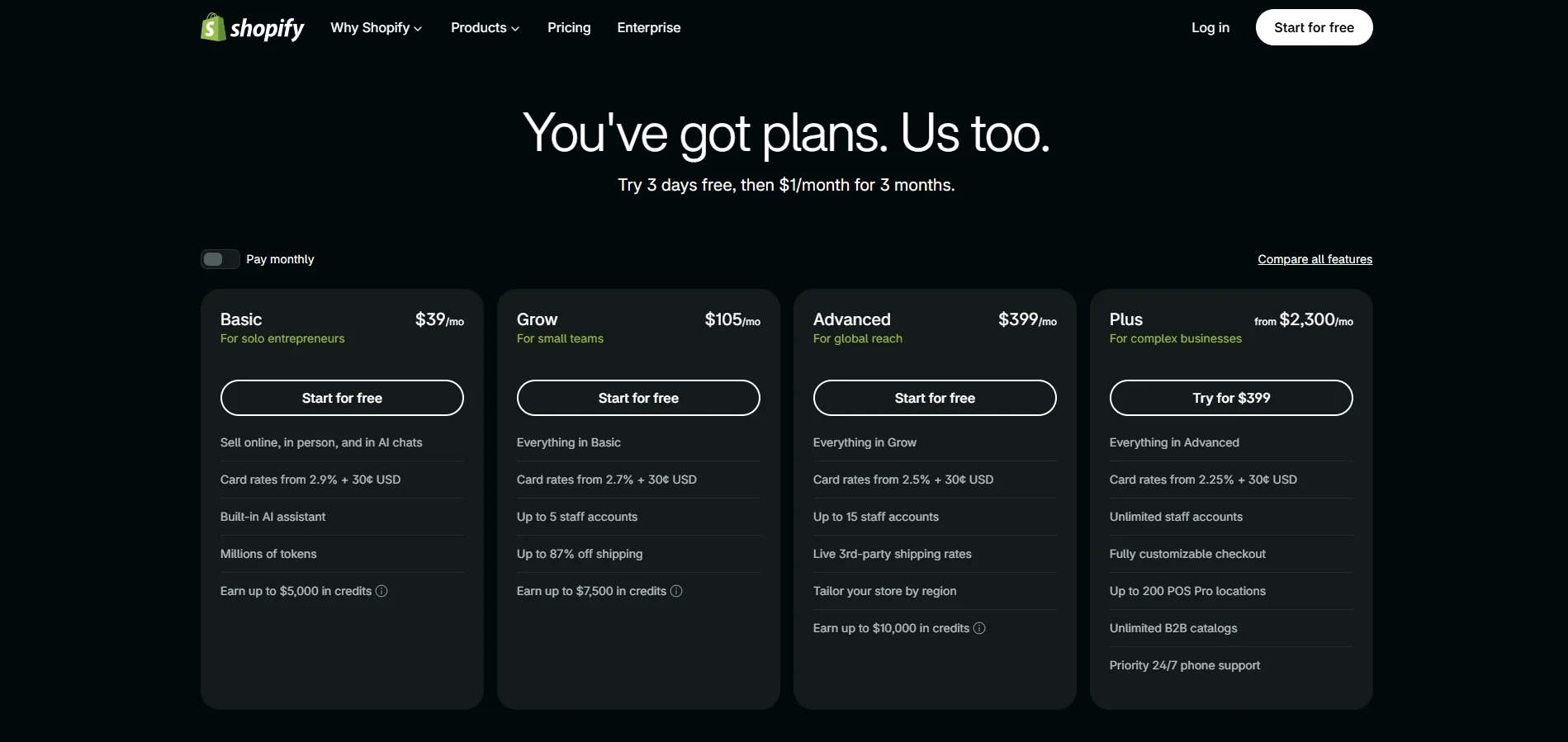
The key variable to watch is transaction fees: using a third-party gateway on Shopify means paying Shopify’s additional transaction fee on top of the gateway’s own rate, at 2% on Basic, 1% on Grow, and 0.6% on Advanced. To eliminate this fee, you’ll need to use Shopify Payments, the native payment processor developed by Shopify.
Meanwhile, Magento pricing structure is more layered. The Open Source edition carries no license fee, but it requires hosting, development, and maintenance investment, with a total cost of ownership ranging from $5,000 to $20,000+ per year depending on store complexity.
For merchants who need enterprise-grade capabilities, Adobe Commerce license fees start at approximately $22,000 per year for stores under $1 million in annual revenue and scale up to $125,000+ per year for enterprise stores, with Adobe Commerce on Cloud starting at approximately $40,000 per year with hosting included.
Infrastructure and Scalability
Our verdict:
Shopify wins for most merchants in the Magento vs Shopify scalability comparison. Its fully managed infrastructure removes all server-side responsibility from the merchant. That said, Magento holds a genuine edge for enterprises that need fine-grained control over their hosting environment or run complex multi-store, multi-region setups.
Shopify handles all infrastructure on the merchant’s behalf. The platform runs on a global CDN with over 330 points of presence across 125+ countries, delivers a 99.99% uptime SLA on Shopify Plus, and scales automatically during traffic spikes without any intervention from the merchant.

In practice, this means a Shopify store can handle a Black Friday surge or a viral product drop without the merchant needing to provision additional server capacity in advance. For most eCommerce businesses, this level of managed reliability is more than sufficient.
On the flip side of the Magento vs Shopify comparison, Magento’s infrastructure takes a different approach. On Magento Open Source, the merchant is fully responsible for choosing a hosting provider, configuring the server stack, managing caching layers such as Varnish and Redis, and scaling capacity when traffic grows. For merchants with in-house DevOps capability, this control is an advantage. For those without, it is a significant operational burden.
Adobe Commerce Cloud closes some of this gap by providing managed AWS hosting with built-in scaling, but that comes bundled with the Commerce license, pushing total costs considerably higher.
Ease of Use
Our verdict:
Shopify wins this category decisively in the Magento vs Shopify comparison. Non-technical merchants can build, launch, and manage a fully functional store without writing a single line of code.
From account creation to a live, functional store, a non-technical merchant can learn to set up a Shopify store quickly. The admin interface organizes every core function, from products and orders to analytics and marketing, into a single, clean left-hand navigation panel.
Shopify Sidekick, the platform’s AI assistant, is also embedded directly in the admin and can answer setup questions, generate content, build custom reports, and recommend optimizations without the merchant leaving the dashboard. For day-to-day operations, marketing teams and business owners can manage everything independently without relying on a developer.

In contrast, Magento is a platform built for developers first and business owners second. The admin panel contains hundreds of configuration options, and even routine tasks such as adjusting tax rules, updating theme layouts, or configuring product attributes might require developer involvement. Learning the Magento tutorial and building a new store from scratch can take weeks, and complex B2B or multi-store implementations often take months.
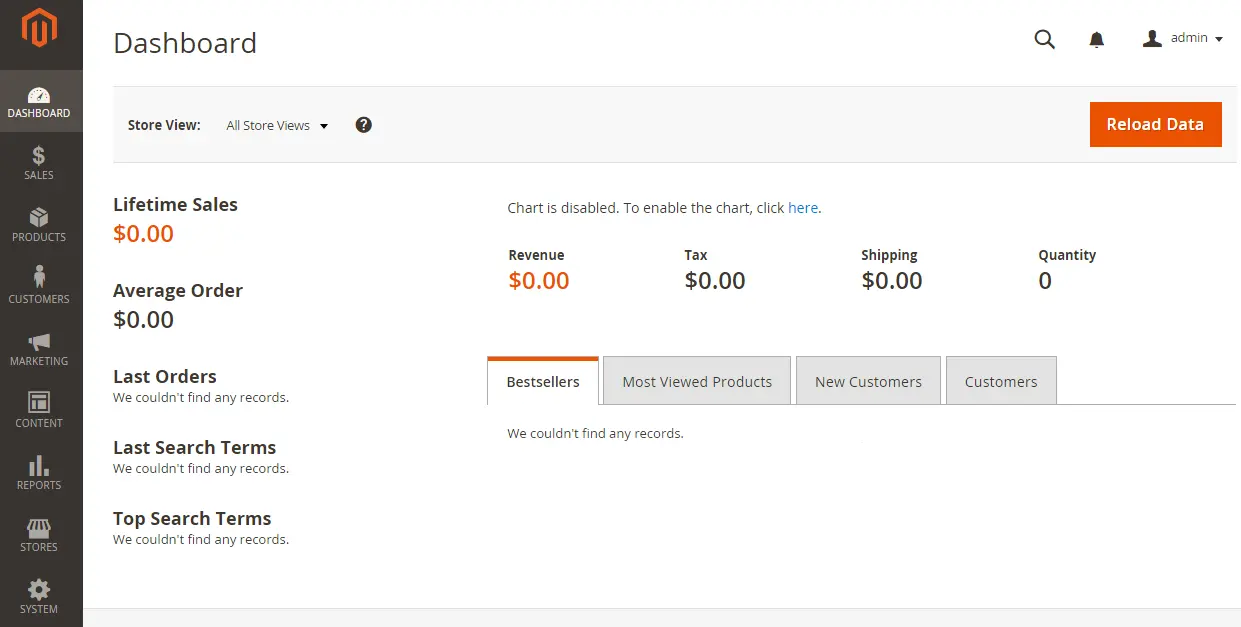
For merchants without an in-house technical team or an agency on retainer, the operational overhead of managing a Magento store day-to-day is substantial. That said, for development teams that know the platform well, Magento’s admin depth enables customization Shopify cannot match.
eCommerce Features and Sales Tools
Both Magento and Shopify are feature-rich platforms, but they take different approaches to eCommerce functions. Shopify bundles most essential tools into its plans, while Magento lets users build and customize it into virtually anything. In this section of our Magento vs Shopify comparison, we’ll break down how each platform performs on the features that matter most for running an eCommerce business day-to-day.
Product and inventory
Our verdict:
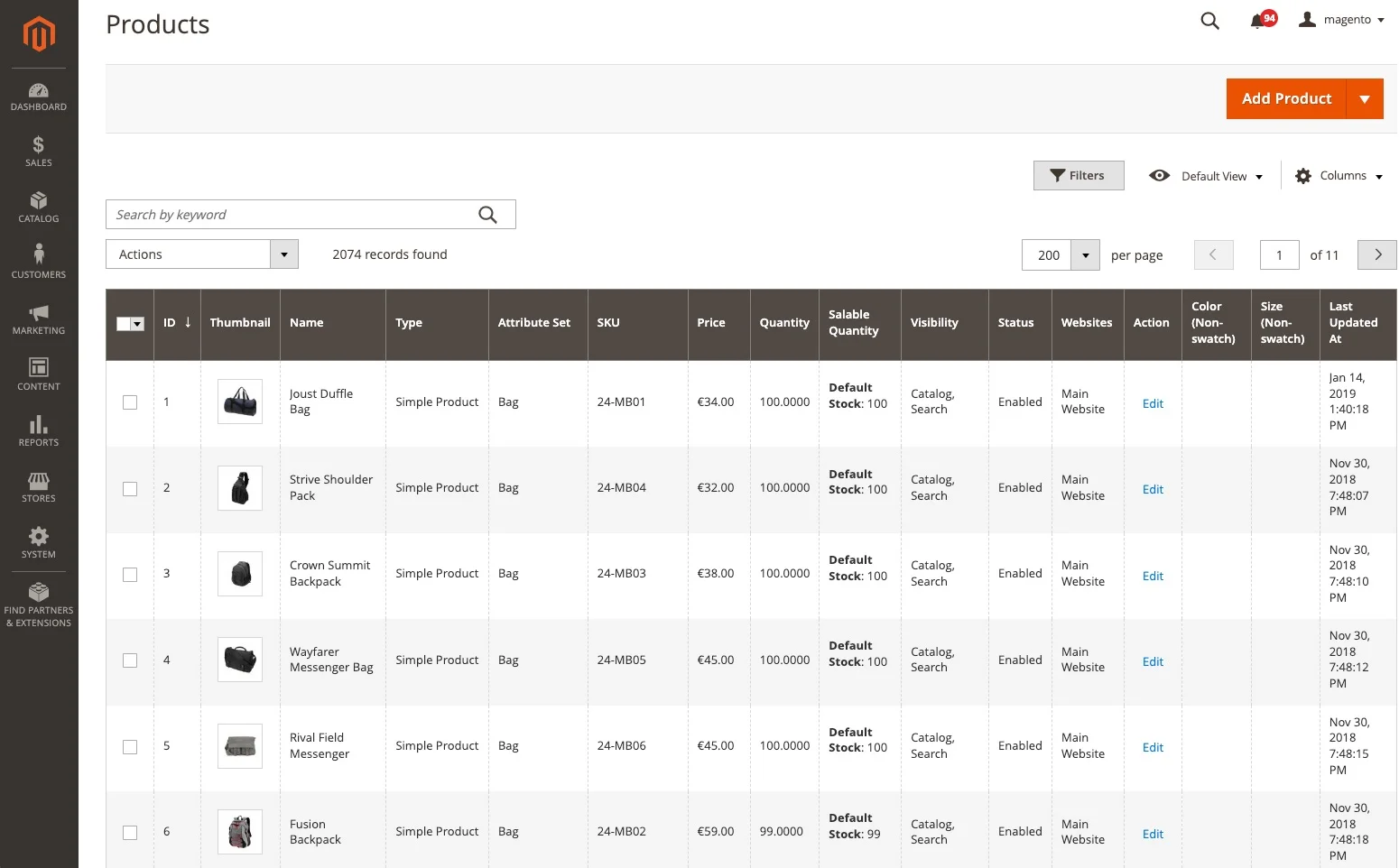
Magento wins in this round of Magento vs Shopify for its native support for complex product types and catalogs exceeding 500,000 SKUs.
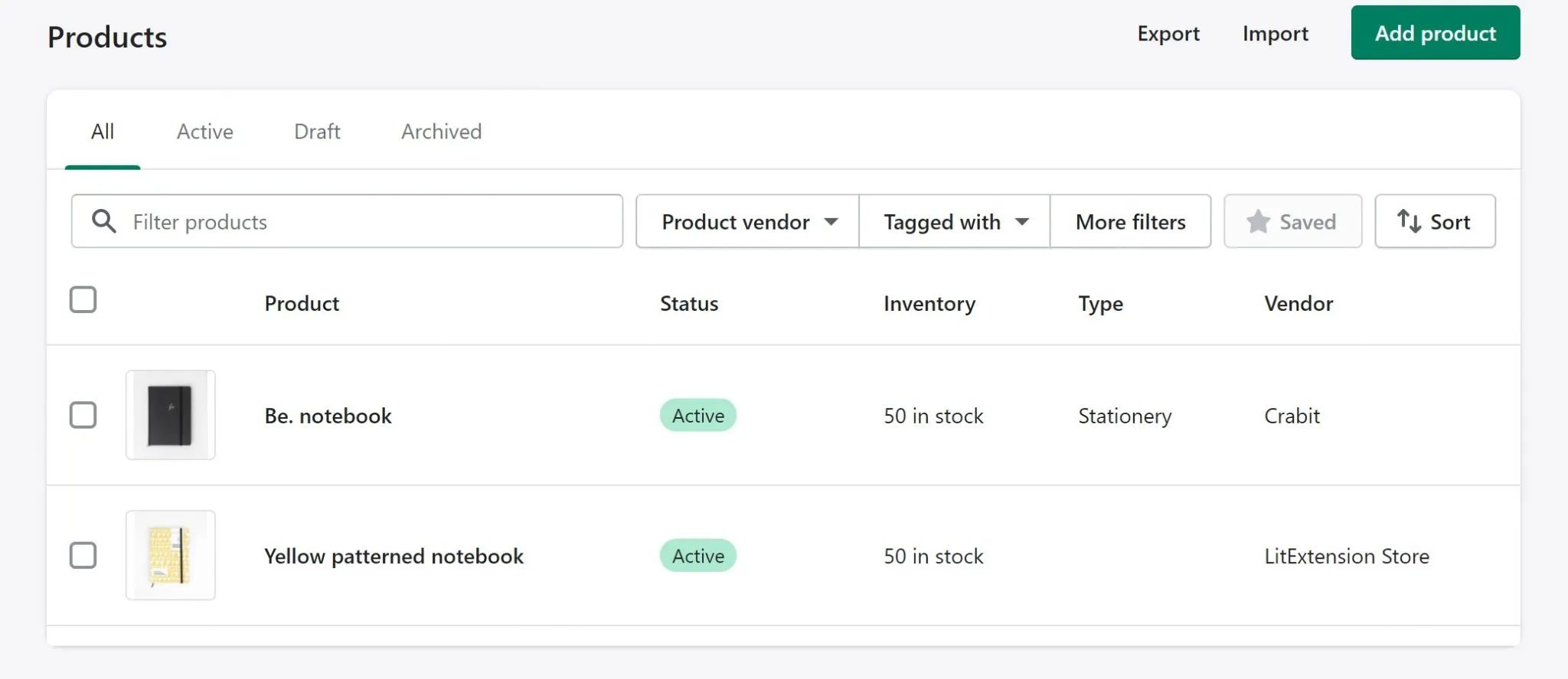
Shopify raised its per-product variant ceiling from 100 to 2,048 in October 2025, which now covers the majority of standard merchant use cases. Shopify inventory dashboard is clean and straightforward, supports multi-location tracking across stores and warehouses, and integrates natively with Shopify POS for merchants who sell both online and in person. For catalogs under 250,000 SKUs without complex configuration requirements, Shopify handles everything well without requiring any custom development.
Magento, in contrast, is built to handle catalogs of serious scale and complexity. It supports configurable, bundled, grouped, and virtual product types natively and manages catalogs of 500,000+ SKUs without database-level performance degradation. Merchants with deeply nested categories, complex product attributes, or multi-warehouse inventory logic will find Magento’s architecture a natural fit.
AI and automation features
Our verdict:
In this part of our Magento vs Shopify comparison, Shopify wins. It makes AI accessible to all merchants out of the box, while Adobe Sensei’s depth remains locked behind the Commerce license and requires significant setup.
Shopify AI has matured significantly into a full operating layer across the admin, offering different toolsets for business owners, including:
- Shopify Magic handles content generation across product descriptions, email copy, blog posts, and image editing.
- Shopify Sidekick functions as a conversational admin assistant that can answer store analytics questions, create discount codes, and build customer segments.
- Shopify Flow automation workflows from plain-language instructions. It is available on all paid plans and allows merchants to set up logic-based automation across their entire store operation.
Meanwhile, Adobe Commerce takes a different approach through Adobe Sensei, its AI and machine learning engine. Sensei powers Live Search, which delivers semantic, intent-aware search results that learn from customer behavior in real time, as well as AI-driven product recommendations. Adobe also introduced Sensei GenAI capabilities for contextual product recommendations and content generation assistance.

However, Adobe Sensei’s depth is reserved exclusively for Adobe Commerce license holders. Magento Open Source merchants will need third-party extensions to access equivalent AI functionality.
Payment options and transaction fees
Our verdict:
Between Magento vs Shopify in this comparison, Magento wins for offering no transaction fees, giving it a meaningful cost advantage for high-volume merchants or those using non-native payment gateways.
Shopify supports 100+ third-party payment providers alongside its own built-in solution, Shopify Payments, which is available in 23 countries. For merchants in supported regions, Shopify Payments is the clear choice: processing rates run from 2.9% + $0.30 on Basic down to 2.4% + $0.30 on Advanced, with no extra Shopify fee on top.
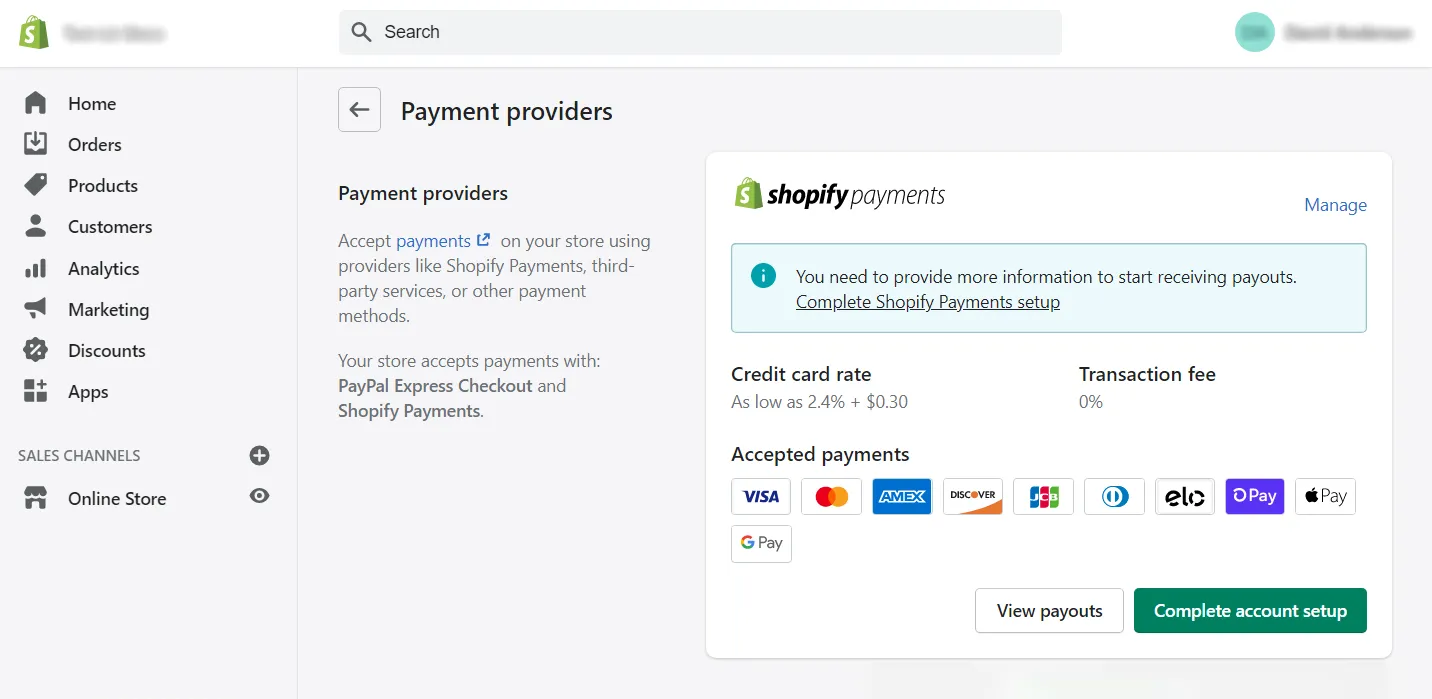
That said, for merchants outside those 23 countries or those who prefer a third-party gateway, Shopify adds a platform transaction fee of 2% on Basic, 1% on Grow, and 0.5% on Advanced, which compounds meaningfully at high volumes.
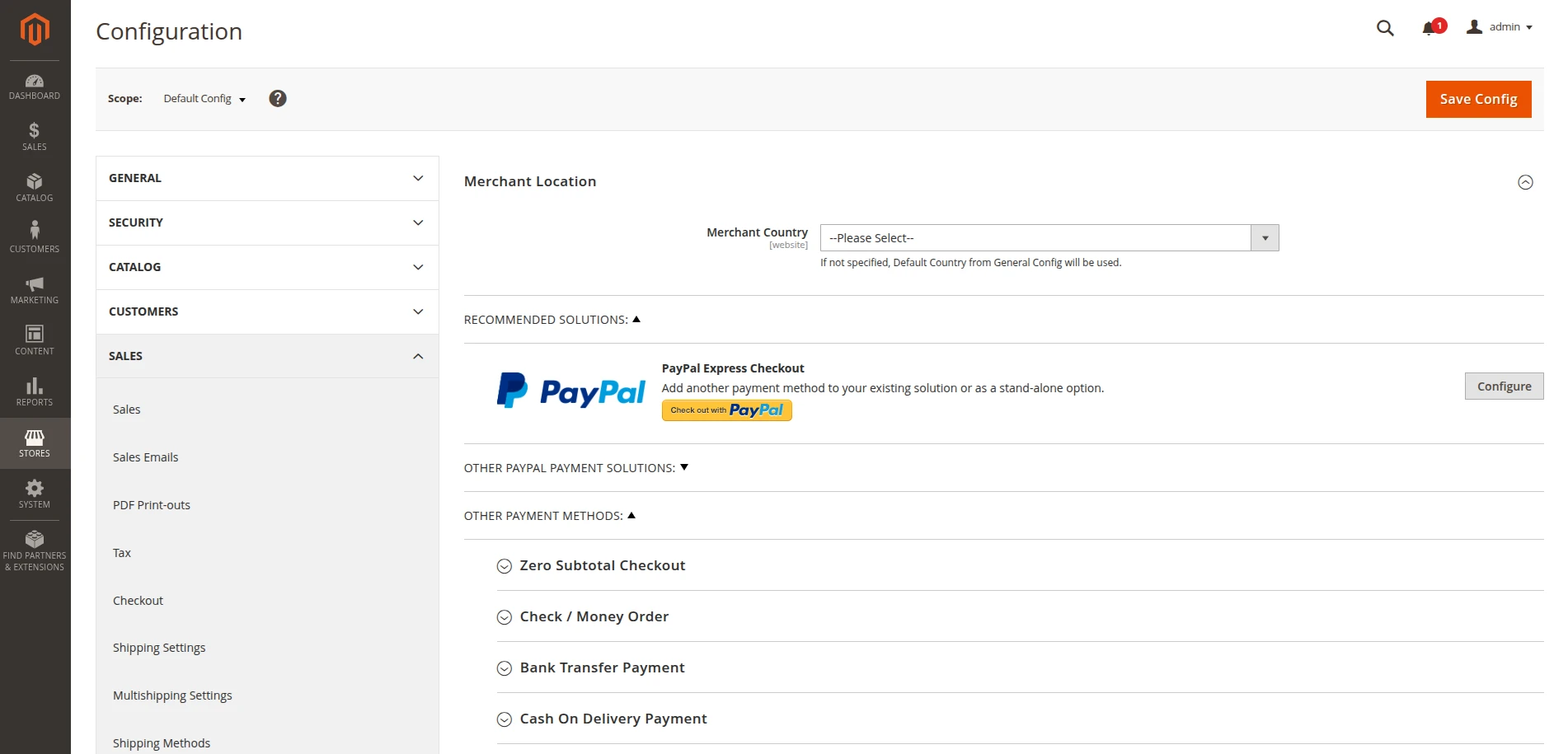
In contrast, Magento has no native payment processor and no platform-level transaction fee on any gateway. It natively integrates Braintree, PayPal, and Authorize.net, and you can add any payment gateway for Magento through an extension or custom API integration. For high-volume merchants processing significant GMV through non-Shopify-Payments gateways, the absence of a platform fee on Magento can represent a meaningful annual saving.
Reports and analytics
Our verdict:
When it comes to Magento vs Shopify in reporting, Shopify wins. Its analytics tools are immediately usable on all plans without technical configuration, making it the more practical choice for most eCommerce merchants.
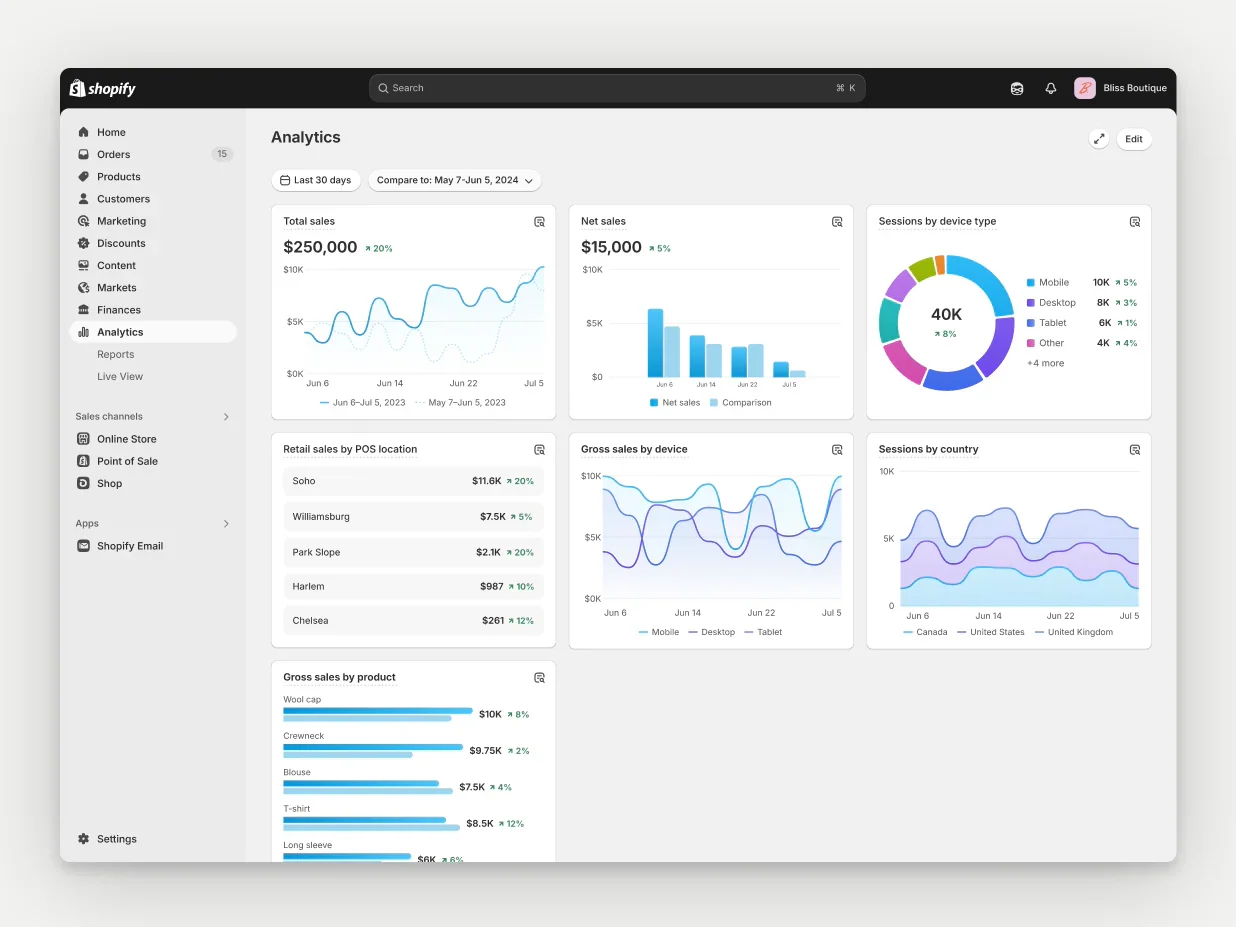
Shopify’s built-in analytics dashboard provides real-time visibility into sales, traffic, conversion rates, and customer behavior on all paid plans, with no setup required. The custom report builder is unlocked on Advanced and Plus plans, and both Google Analytics 4 and Meta Pixel integrate natively. For most merchants, Shopify’s analytics are immediately actionable from day one without any technical configuration.
Magento, on the other hand, comes with basic admin reporting that covers orders, revenue, and customer data but falls short of what growing merchants typically need for decision-making. Adobe Commerce addresses this gap through Commerce Intelligence, formerly known as Magento BI, which offers data warehouse-level analysis, cohort reporting, customer lifetime value tracking, and SQL-level customization for merchants who need to build complex, bespoke reports.
SEO and Marketing Features
SEO Capabilities
Our verdict:
Magento wins the SEO battle in the Magento vs Shopify comparison. Its granular technical control over URL structures, canonical tags, structured data, and multi-store hreflang gives it a clear edge over Shopify.
| SEO Capability | Magento (Adobe Commerce) | Shopify |
|---|---|---|
| URL Structure | Full control over URL patterns for products, categories, and CMS pages; no forced prefixes; custom URL rewrites manageable via admin panel or server-side rules | Fixed URL prefixes enforced by the platform (/products/, /collections/, /blogs/); cannot be removed even on Shopify Plus |
| Metadata | Complete control over meta titles and descriptions at global, category, and product level; supports bulk editing via extensions such as Amasty SEO Toolkit | Page-level meta title and description fields available on all plans; no native bulk editing tool; third-party apps required for bulk updates |
| Canonical Tags | Fully customizable canonical tags at the page level; advanced canonical handling for faceted navigation and layered filters to prevent duplicate content | Automatic canonical tags generated for most pages; limited page-level override capability; relies on apps for granular control |
| XML Sitemap | Fully configurable XML sitemap with granular inclusion and exclusion rules per page type | Auto-generated XML sitemap; limited customization of what is included; updates automatically when content changes |
| Robots.txt | Full robots.txt access and control; merchants can define custom crawl rules for any section of the site | Editable robots.txt available on all plans since 2021, but with more limited override options compared to Magento |
| Redirects | Native URL rewrite tools handle bulk 301 redirects without restriction; suitable for large catalog migrations | Automatic 301 redirects created on URL changes; manual redirect management available in admin; manageable at scale via CSV import |
| Structured Data | Full schema markup customization at the global and page level via templates and code; product, breadcrumb, and review schema configurable without restriction | Schema.org structured data auto-generated via themes for products, FAQs, and breadcrumbs; custom structured data requires manual JSON-LD or third-party apps |
| Multi-Store SEO | Native hreflang support across unlimited store views; separate URL configurations, metadata, and sitemaps per store or region from a single admin | hreflang handled via Shopify Markets; available on all plans but more limited than Magento’s native multi-store architecture at enterprise scale |
| Core Web Vitals | Dependent on hosting and theme implementation; default Luma theme scores 30 to 50 on PageSpeed; Hyvä theme achieves 90+ scores out of the box | Consistently strong Core Web Vitals from managed CDN and optimized themes; Dawn theme delivers high PageSpeed scores with no configuration |
Marketing features
Our verdict:
Shopify wins for its built-in marketing toolkit, which covers the essentials without requiring additional apps or extensions, making it the more practical choice for most eCommerce merchants in the Magento vs Shopify comparison.
Shopify’s built-in marketing toolkit is more immediately useful for most merchants. Shopify Messaging functions as a native email and SMS marketing tool directly within the admin, abandoned cart recovery is available on all paid plans, and discount codes, gift cards, and promotional tools require no third-party apps to set up.
Meanwhile, Magento’s native promotional rule engine is arguably more powerful for complex discount logic and tiered pricing scenarios, but most of its marketing capabilities beyond that require extensions, which add cost and maintenance overhead.
Design and Customization
Our verdict:
Shopify wins for accessibility and out-of-the-box design quality. Magento wins for merchants who need unrestricted, code-level control over their storefront. In the Magento vs Shopify design comparison, the right answer depends entirely on how much technical investment your team is willing and able to make.
Shopify’s design experience is built around speed and accessibility. Its template collections include 24 free and 1,000+ paid options, priced between $180 and $350 as a one-time purchase. All Shopify themes are built on the Online Store 2.0 architecture, which supports a drag-and-drop section editor across every page of the store, allowing non-technical merchants to build and redesign their storefront without writing any code.

For developers who need more control, Shopify’s Liquid templating language enables deep frontend customization, and merchants who need a fully custom frontend can go headless using Hydrogen and Oxygen. The key constraint is that Shopify’s underlying data model, checkout flow, and URL structure remain fixed regardless of the approach taken.
Meanwhile, Magento places no boundaries on design or customization. Developers have full access to the source code, meaning every layer of the storefront can be modified or rebuilt from scratch. The standard for high-performance Magento frontend development is the Hyvä theme framework, which replaces the legacy Luma frontend’s PageSpeed scores of 30 to 50 with a lightweight Tailwind CSS and Alpine.js stack that consistently achieves 90+ on production hardware.

For fully decoupled builds, Magento’s PWA Studio provides a headless React-based path while keeping Adobe Commerce as the backend engine.
Apps and Integrations
Our verdict:
Shopify wins for its significantly larger and more consistently maintained app ecosystem, giving merchants more ready-to-use options across every category in the Magento vs Shopify comparison.
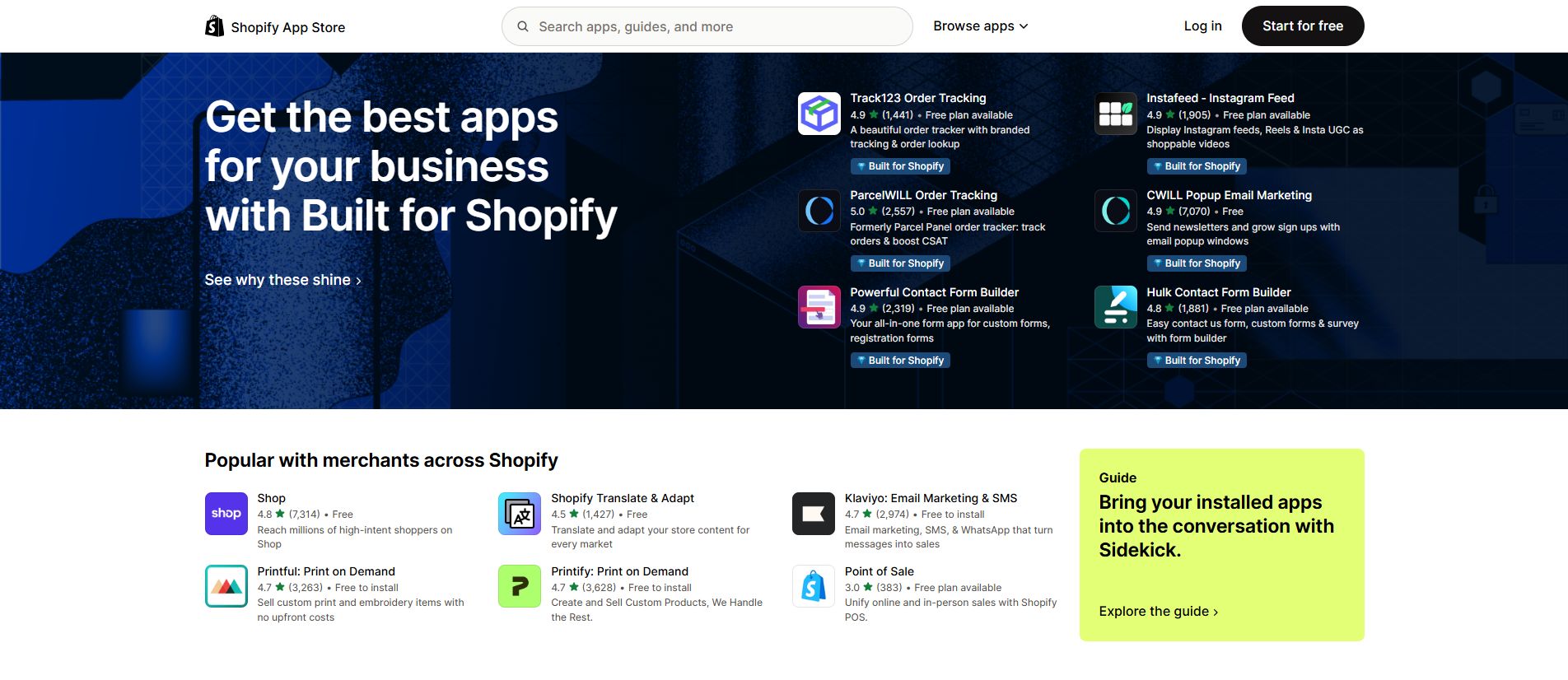
Shopify’s App Store currently lists over 13,000 apps covering every major category. All the best Shopify apps are curated and quality-controlled by the platform itself, and most can be installed and activated in minutes without developer involvement. Both REST and GraphQL APIs are available for merchants who need custom integrations, though API rate limits can constrain very high-volume operations.
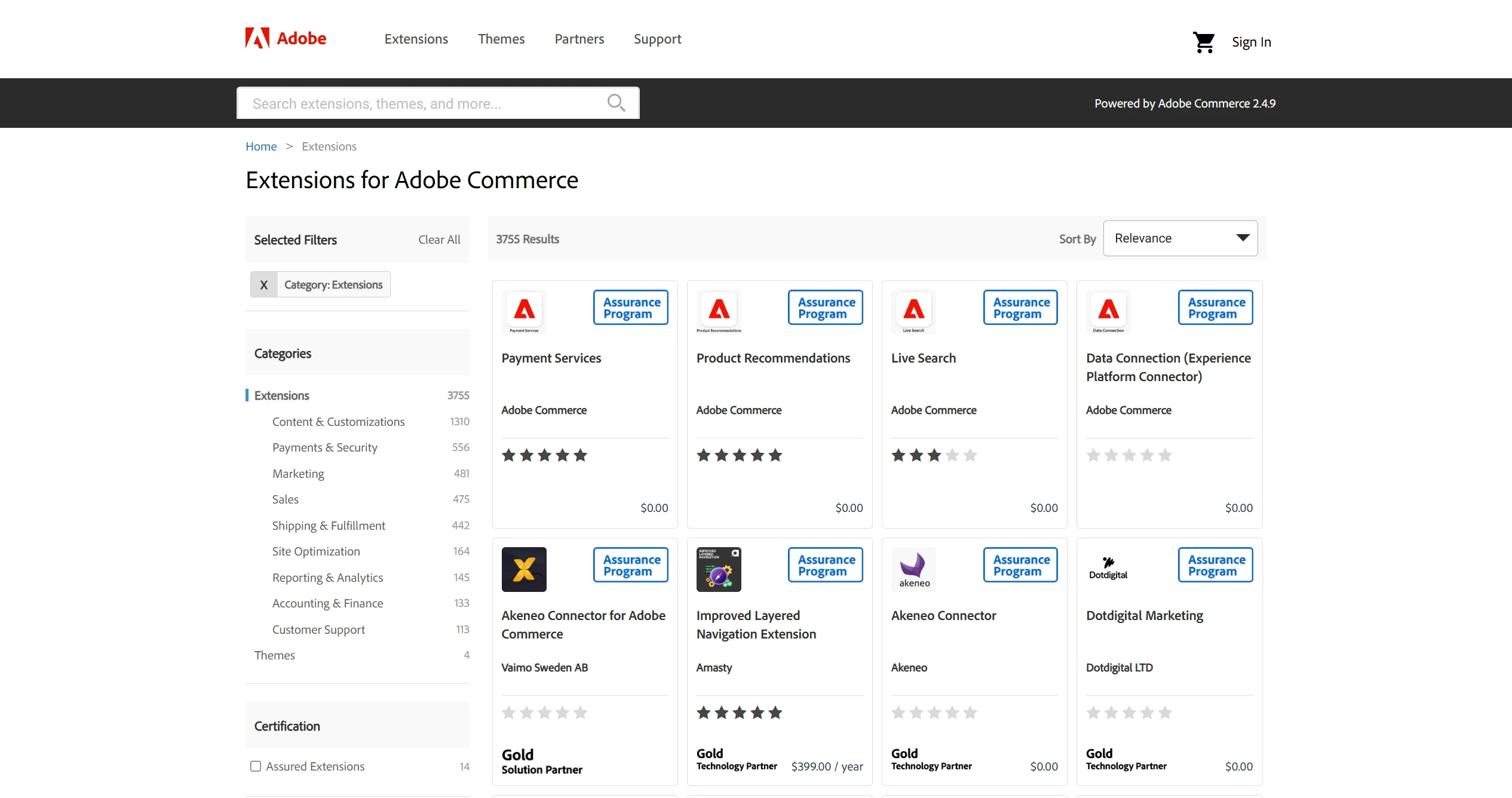
On the other hand, Magento’s Marketplace offers thousands of extensions, with many more available through third-party marketplaces such as Mageplaza and Magezon. That said, the key difference isn’t just volume, but installation complexity. Installation can take hours on Magento due to manual deployment, code merging, and testing requirements. For merchants without a development team, this gap is a meaningful operational barrier.
Security and Support
Our verdict:
Shopify wins in the Magento vs Shopify security and support comparison. Its platform-managed compliance and round-the-clock support on every plan remove a significant operational burden from merchants.
Shopify handles all security on the merchant’s behalf: PCI DSS Level 1 compliance, SSL certificates, DDoS protection, and security updates are all applied by Shopify without any merchant action required. Meanwhile, with Magento, merchants are responsible for meeting the full PCI DSS standard and configuring the security patches themselves.
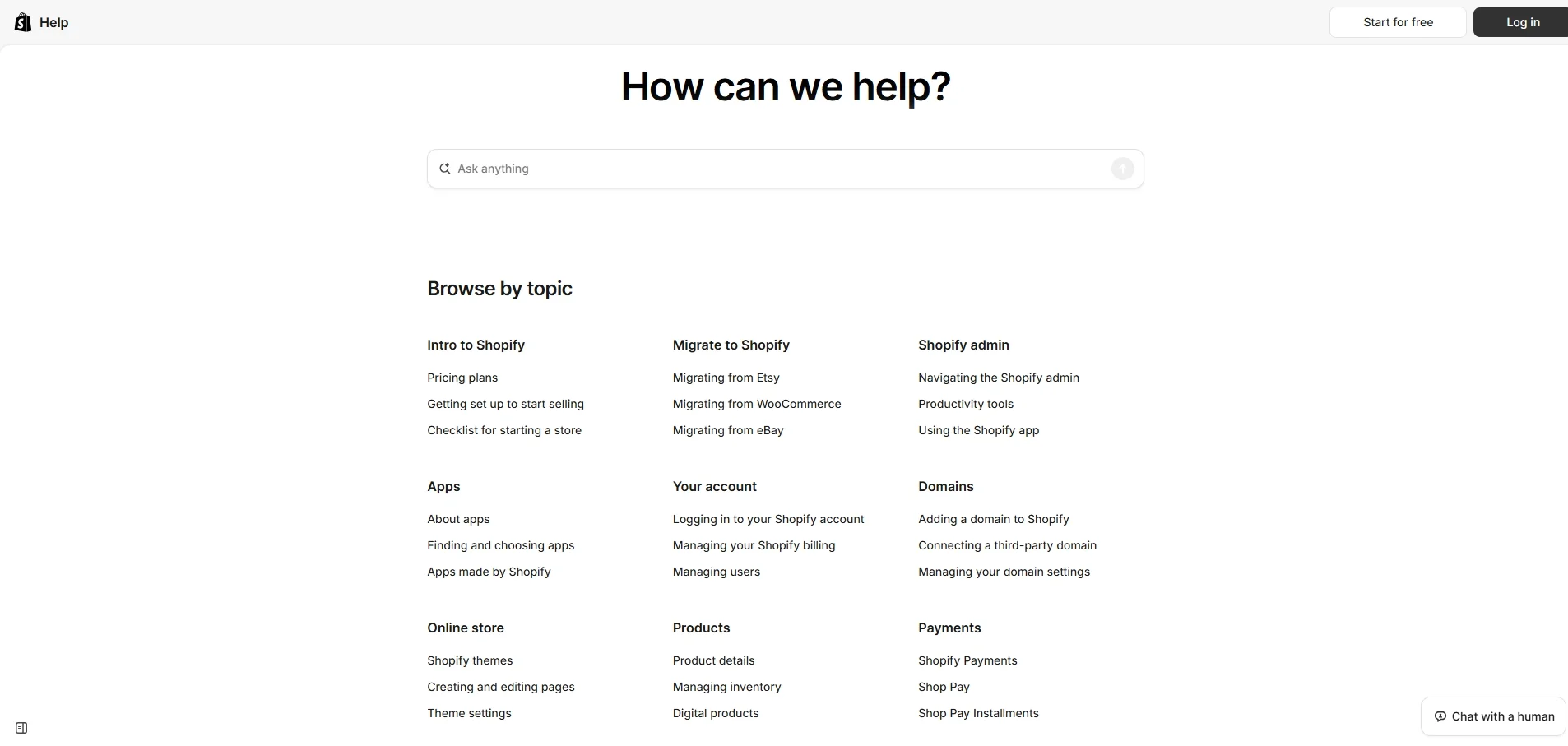
Support-wise, Shopify continues to lead in this Magento vs Shopify comparison. This platform provides 24/7 live chat, email, and phone support on all paid plans, along with an extensive Help Center, community forums, and a large partner and expert ecosystem for merchants who need agency-level assistance.
In contrast, Magento Open Source offers no official support channel; merchants rely on community forums, Magento Stack Exchange, and GitHub issues, or pay for an agency or developer retainer. Adobe Commerce includes dedicated enterprise support, but this is factored into a license cost that starts at approximately $22,000 per year.
Magento vs Shopify – Which Platform Should You Choose
Choosing between Magento vs Shopify comes down to which platform is better for your specific business stage, technical resources, and growth requirements. Based on everything covered in this guide, here is how to make the call.
Choose Shopify if:
- You want to launch quickly and start generating revenue within days rather than months.
- Your team has limited or no in-house developer resources.
- You run a DTC brand, a standard product catalog, or a growing SMB with straightforward eCommerce needs.
- You want predictable monthly costs without the overhead of hosting, security patching, and infrastructure management.
Choose Magento if:
- You run a mid-market or enterprise B2B operation that requires company accounts, custom pricing, purchase order workflows, and multi-tier approval chains.
- Your product catalog exceeds 250,000 SKUs with complex attributes, configurations, or multi-warehouse inventory logic.
- Your business requires checkout logic, pricing rules, or ERP integrations that go beyond what Shopify’s API model can accommodate.
- You have a dedicated development team or agency relationship capable of managing the platform’s operational requirements.
If you have decided to switch platforms, LitExtension makes the migration process significantly easier. As the leading eCommerce migration expert, LitExtension automates the transfer of products, customers, orders, SEO URLs, and store data from Magento to Shopify, or from Shopify to Magento, with no downtime and no data loss. Start with a free demo migration to see exactly how your data transfers before committing to the full move.
Store Migration Made Easy With LitExtension!
LitExtension offers great migration solutions that help you transfer your data from the current eCommerce platform to a new one accurately, painlessly with utmost security.

Magento vs Shopify – FAQs
Is Magento better than Shopify?
Neither platform is universally better. Magento is better for enterprise merchants with complex B2B requirements, large catalogs, and in-house development teams. Shopify is better for the majority of merchants who prioritize ease of use, predictable costs, and managed infrastructure. The right answer depends on your specific business needs and technical resources.
Is Magento free to use?
Magento Open Source carries no license fee, but it is not free to run. Hosting, development, security patching, and extension costs mean real-world annual TCO typically ranges from $30,000 to $90,000 or more. Adobe Commerce, Magento’s enterprise edition, carries an additional license fee starting at approximately $22,000 per year.
Does Shopify charge transaction fees?
Shopify charges additional transaction fees of 2% on Basic, 1% on Grow, and 0.5% on Advanced when using a third-party payment gateway. These fees are waived entirely when using Shopify Payments, which is available in 23 countries.
Which platform is better for large catalogs?
Magento is better for large catalogs. It natively supports catalogs of 500,000+ SKUs with complex product types, deep custom attributes, and multi-warehouse inventory logic. Shopify raised its per-product variant ceiling to 2,048 in October 2025 and handles catalogs well under 50,000 SKUs, but Magento’s database architecture is purpose-built for large-scale catalog management.
Final Words
In conclusion, Shopify has become a powerful, AI-driven, and enterprise-ready platform, making it the right choice for a broader range of merchants. Meanwhile, Magento is more specialized, with its genuine advantages increasingly concentrated in the enterprise and complex B2B segment where its open-source depth and code-level control are truly irreplaceable.
If you have read this far and are still undecided, the most practical next step is to map your specific requirements against the decision criteria in this Magento vs Shopify comparison. And if you have already made your choice and are ready to move platforms, LitExtension is here to make the transition as smooth as possible, whether you are migrating from Magento to Shopify or the other way around.
Last but not least, don’t forget to check out other articles on LitExtension Blogs and Resources to get more eCommerce platform reviews, comparisons, and expert insights.