Shopify agentic commerce allows customers to discover and purchase your products through AI platforms like ChatGPT, Microsoft Copilot, Google AI Mode, Gemini, and Meta. This opens a new sales opportunity, but simply having a Shopify store does not guarantee that your products will appear.
Your store still needs the right setup and product data, which we’ll walk you through in this guide:
- What Shopify agentic commerce is and how it works;
- Which AI platforms currently support it;
- How to prepare and connect your Shopify store;
- The costs and potential additional fees involved.
Keep reading for the details!
What Is Shopify Agentic Commerce?
Shopify Agentic Commerce refers to a new way of shopping in which AI agents can act on a customer’s behalf throughout the buying journey. Instead of simply suggesting products, these agents can interpret a shopper’s needs, search Shopify’s product catalog, compare suitable options, build a cart, initiate checkout, and provide order updates.
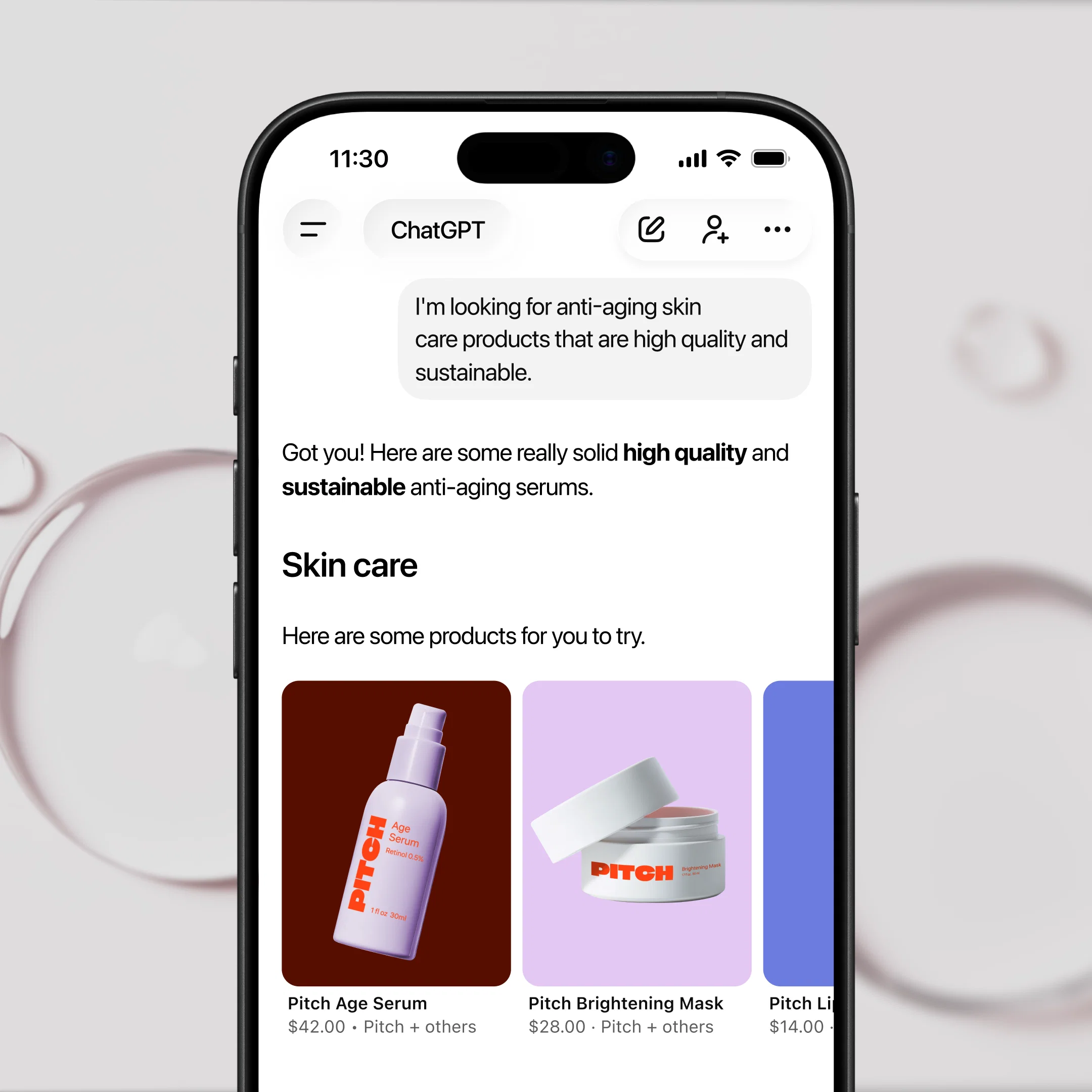
As AI agents take on more of the buying journey, both you and your customers can benefit in several ways:
- More product discovery opportunities: Products can appear in AI-powered conversations beyond conventional search engines and storefront navigation.
- A shorter path to purchase: Shoppers can move from a request to a relevant product and checkout with fewer manual steps.
- Less checkout friction: Keeping more of the shopping journey within the AI experience reduces unnecessary redirects and steps, which may help limit cart abandonment.
- More personalized shopping assistance: AI agents can narrow down options based on the shopper’s preferences, budget, and context.
- Consistent commerce operations: Shopify’s existing catalog, checkout, and order infrastructure continues to support transactions initiated through AI channels.
- Access to emerging sales channels: Merchants can reach customers who increasingly use AI assistants to research products and make purchasing decisions.
By connecting your products with customers who are already expressing clear purchase intent, this technology can also support your broader efforts to increase Shopify sales.
Traditional Online Shopping vs Agentic Commerce
The growing use of AI in eCommerce is changing who performs each shopping task. In traditional online shopping, customers manually browse stores, compare products, and complete checkout. With agentic commerce, an AI agent can handle much of this process based on the customer’s request.
Here’s how the two models differ from each other:
| Aspect | Traditional online shopping | Agentic commerce |
| Starting point | The shopper visits a website or marketplace | The shopper describes what they need to an AI agent |
| Product discovery | Customers browse menus, collections, filters, or search results | The agent searches relevant products across one or multiple stores |
| Product comparison | Customers compare prices, features, and reviews manually | The agent evaluates options based on the shopper’s criteria |
| Personalization | Recommendations depend mainly on store data and browsing behavior | Recommendations respond directly to the shopper’s stated needs and context |
| Cart creation | Customers select variants and add items themselves | The agent can select products and build the cart on their behalf |
| Checkout | Customers enter checkout and complete each step manually | The agent can initiate checkout, hand the shopper off for payment, or complete it directly when authorized |
| Post-purchase support | Customers check emails, account pages, or contact the merchant | The agent can retrieve current order, fulfillment, return, or refund information |
| Merchant touchpoint | The storefront is the primary shopping interface | The transaction may begin and progress within an external AI interface |
This does not mean Shopify storefronts will disappear. They remain important for brand experience, detailed product exploration, and direct customer relationships. However, agentic commerce adds another route to purchase, where an AI assistant can guide or perform actions across the journey, from product discovery to order tracking.
How Agentic Commerce Works on Shopify: The Technology Explained
Several technologies work together behind Shopify agentic commerce. Each one has a different role, from supplying product information to connecting Shopify with external AI shopping channels.
Universal Commerce Protocol (UCP): How It Differs from ACP and MCP
The Universal Commerce Protocol (UCP) provides a common framework that allows AI platforms and commerce systems to work together throughout the shopping journey. It covers capabilities such as product discovery, cart creation, checkout, identity linking, and order management.
Shopify exposes these UCP-defined commerce capabilities through its MCP servers. In this setup, UCP defines the commerce functions, while MCP provides a standardized way for AI agents to access those functions. ACP is a separate commerce protocol commonly associated with AI-powered checkout experiences such as ChatGPT.
Here is a simple comparison between UCP vs ACP vs MCP:
| UCP | ACP | MCP | |
|---|---|---|---|
| Full name | Universal Commerce Protocol | Agentic Commerce Protocol | Model Context Protocol |
| Main purpose | Standardizes the broader commerce journey for AI agents | Connects AI agents with businesses to complete purchases | Connects AI applications with external tools, data, and services |
| Primary scope | Catalog, cart, checkout, identity, and order management | Product discovery, checkout, and payment coordination | General AI integrations beyond commerce |
| Relationship with Shopify | Defines the commerce capabilities supported by Shopify’s agentic infrastructure | May connect Shopify stores with platforms that support ACP | Acts as a technical connection layer for Shopify’s UCP capabilities |
| Simple way to understand it | The rules for the AI shopping journey | The rules for an agent-driven transaction | The connector that lets AI access commerce tools |
UCP should not be confused with OpenAI’s Agentic Commerce Protocol (ACP), which focuses specifically on connecting product and checkout systems with ChatGPT shopping experiences.
Shopify Catalog
Shopify Catalog is the product data source used by agentic storefronts. It gives AI channels access to structured details about eligible products, including titles, descriptions, images, prices, availability, and variants.
For example, when someone asks an AI assistant to find “a waterproof running jacket under $150,” the agent can search Shopify Catalog and match the request with relevant products.
Therefore, product data quality plays an important role in AI visibility. Clear titles, detailed descriptions, accurate categories, and updated pricing help AI agents understand when and where to recommend a product.
Agentic Storefronts
Agentic Storefronts are the AI-powered sales channels where customers can discover and purchase your products, such as ChatGPT, Microsoft Copilot, Google AI Mode, and Gemini.
You can manage available channels from Sales channels > Agentic in your Shopify admin. From there, you can control where your products appear and review information about their visibility and performance.
Within Shopify agentic commerce, Agentic Storefronts provide the customer-facing experience, while Shopify Catalog and Shopify’s checkout infrastructure work behind the scenes. Channel availability may depend on your products, location, payment setup, and the AI platform involved.
Which AI Platforms Support Shopify Agentic Commerce?
Currently, Shopify agentic commerce supports four main AI channels: ChatGPT, Google AI Mode and Gemini, Microsoft Copilot, and Meta. However, product discovery and checkout work differently across these platforms.
| AI platform | How your products appear | How customers check out |
| ChatGPT | ChatGPT can recommend eligible products from Shopify Catalog based on a customer’s request. | Customers complete the purchase through your online store checkout in ChatGPT’s in-app browser or a new browser tab. |
| Google AI Mode and Gemini | Your products can appear in AI-powered Google searches and Gemini recommendations. Product data is supplied through the Google & YouTube sales channel or Google Merchant Center. | Shopify-powered direct checkout may let customers purchase without leaving the AI experience. |
| Microsoft Copilot | Copilot can search Shopify Catalog and recommend relevant products during a conversation. | Customers can use Shopify-powered direct checkout when it is available and activated for your store. |
| Meta | Your products can appear across supported Meta AI experiences after syncing through the Facebook and Instagram by Meta sales channel. | Supported customers can complete their purchases through Shopify-powered direct checkout. |
You can view and manage these platforms from Sales channels > Agentic in your Shopify admin. This area also shows which channels are available to your store and provides performance data such as orders, sales, sessions, and conversions.
If you also want to sell across these AI channels, Shopify can be a strong platform for managing your products, checkout, and orders in one place. Our Shopify migration service can help transfer your essential store data to Shopify accurately and with less manual work.
Shopify Migration Made Easy With LitExtension!
LitExtension offers great migration solutions that help you transfer your data from the current eCommerce platform to Shopify accurately, painlessly with utmost security.
How to Set Up Agentic Commerce on Your Shopify Store
Once you know which AI platforms are available, the next step is preparing your store to sell through them. The setup for Shopify agentic commerce can be completed in six main steps.
Step 1: Confirm your eligibility and store policies
To start with, your store need to meet these basic requirements:
- A Shopify Starter plan or higher, or the Shopify Agentic plan
- Products eligible for Shopify Catalog
- Direct-to-consumer sales, as B2B-only products are excluded
- Sales to customers in the United States
- An account in good standing
For ChatGPT, Microsoft Copilot, and Meta, your store can be based outside the US as long as you sell to US customers. Google AI Mode and Gemini direct checkout currently requires your store to be based in the US and sell to US customers. You can review the latest eligibility requirements for each AI channel because availability may change during rollout.
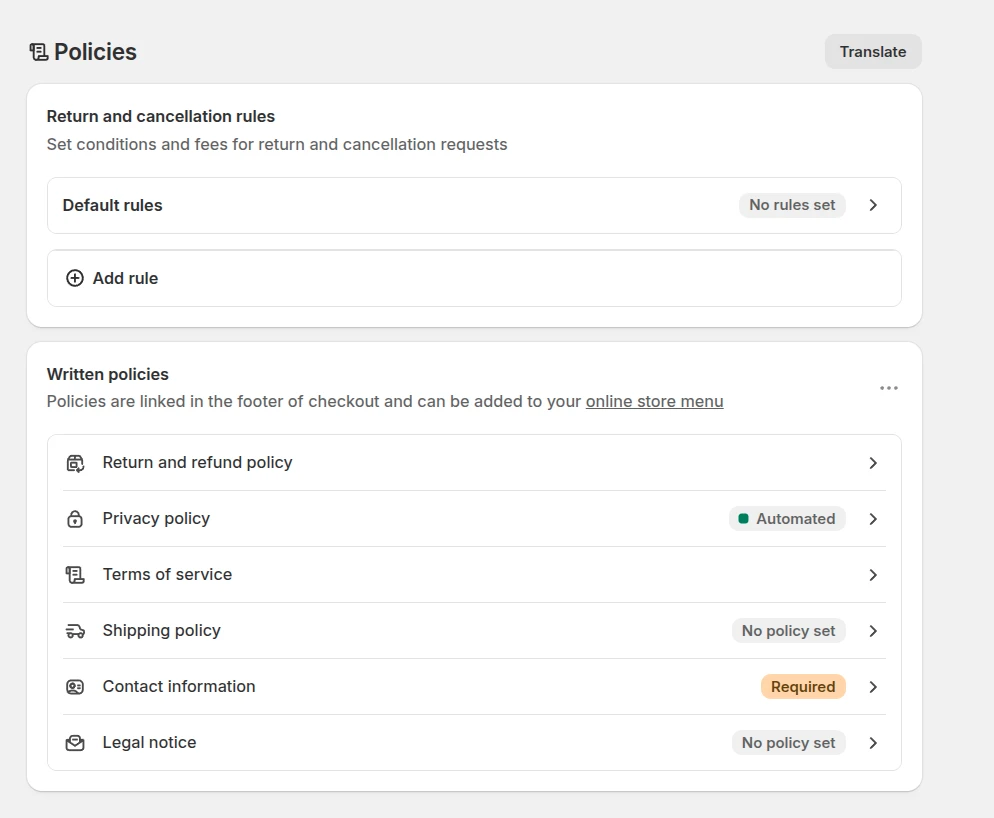
Next, your Terms of service, Privacy policy, and Return and refund policy must also be completed under Settings > Policies.
After that, the Shopify Agentic Storefronts Supplemental Terms of Service must be accepted under Sales channels > Agentic.
Step 2: Prepare your product data for AI shopping
AI platforms use your product information to match items with customer requests. Each eligible product should include:
- A clear title and detailed description
- High-quality images
- Accurate price and inventory
- Product type, vendor, collections, and tags
- Variants and option names
- Barcode, ISBN, UPC, or GTIN when applicable
Well-structured product data also makes it easier for search engines to understand and index your products. You can explore our guide on how to improve Shopify SEO for more ways to increase your store’s visibility.
Step 3: Review your Agentic Storefronts settings
The Sales channels > Agentic section shows which AI channels are available to your store. This area lets you control product data access, review direct checkout availability, check product discoverability, and view catalog recommendations.
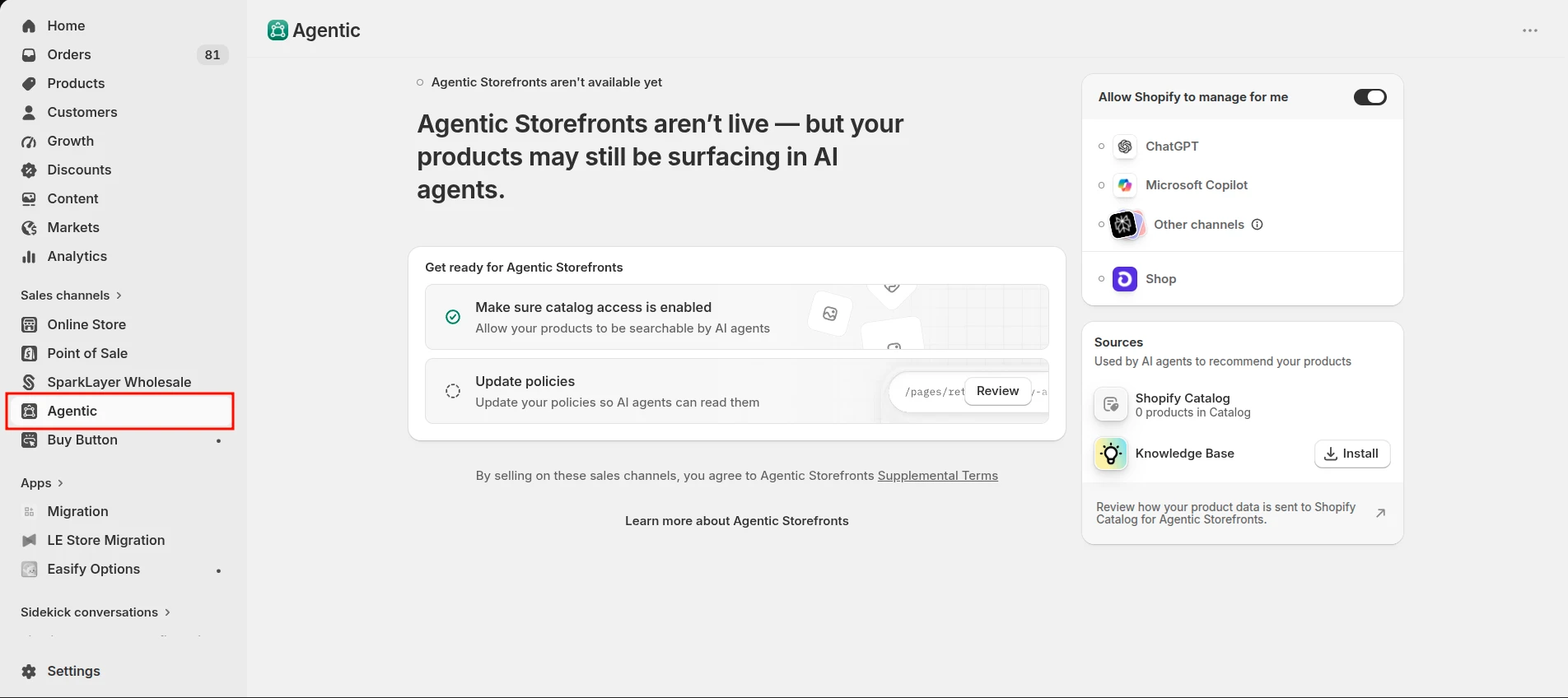
Agentic Storefronts may already be active if your store is eligible, so your existing settings should be checked before any changes are made.
Step 4: Connect your preferred AI channels
Based on the platforms introduced in the previous section, you can choose the channels where you want your products to appear. These Shopify agentic commerce settings are available under Sales channels > Agentic in your Shopify admin.
When Allow Shopify to manage for me is active, Shopify manages product access and direct checkout automatically for eligible channels. For more control, this option can be deactivated, allowing you to configure each channel separately:
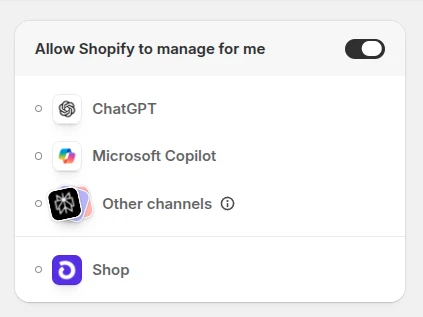
- Shopify Catalog access: Determines whether your product data is shared with the selected channel.
- Direct checkout: Determines whether customers purchase within the AI platform or continue to your online store checkout.
Google AI Mode and Gemini also require a connected Google Merchant Center account, while Meta requires product syncing through the Facebook and Instagram by Meta sales channel.
Step 5: Check your domain and checkout
A verified domain should direct customers to the correct product pages. Your payment, shipping, tax, and inventory settings should also work properly before customers begin purchasing through AI channels.
ChatGPT redirects customers to your online store checkout. Google AI Mode and Gemini, Microsoft Copilot, and Meta may provide Shopify-powered direct checkout when your store and customers are eligible.
Step 6: Monitor and maintain your setup
Once Shopify agentic commerce is active, performance data becomes available under Sales channels > Agentic. You can track sales, orders, online store sessions, conversion rates, and the channel responsible for each order.
Regular reviews of your product information, inventory, pricing, policies, and connected feeds will help keep the data shown across AI platforms accurate. However, eligibility does not guarantee placement because each platform decides which products best match a customer’s request.
How Much Does Shopify Agentic Commerce Cost?
With the setup covered, cost is another important factor to consider. Shopify agentic commerce does not currently require an additional channel fee, but your total expense depends on your existing platform, payment provider, and checkout method.
If you already have a Shopify store
You can use Agentic Storefronts as part of your existing Shopify subscription without paying an additional monthly fee. Your current plan remains the main platform cost.
When a customer places an order through an AI channel, the usual payment charges still apply:
- Shopify Payments processing fees apply when you use Shopify Payments.
- Third-party transaction fees may apply when you use an external payment provider.
These are standard costs for processing an order, not additional fees charged specifically for selling through AI channels. You can check our Shopify pricing guide for a closer look at Shopify’s subscription and payment fees.
If you do not have a Shopify store
Shopify offers an Agentic plan with no monthly subscription fee. This plan lets you add products, configure checkout, receive orders through supported AI channels, and manage those orders from Shopify.
You still pay the applicable payment fee when an order is completed. Optional paid apps or services may create additional expenses, but they are not required to access Agentic Storefronts.
The main limitation is that your Shopify online store remains password-protected. A paid Shopify plan, starting from $29 per month when billed annually, is required if you also want to publish a storefront and accept purchases through its regular online checkout.
In short, your Agentic Storefronts access can cost $0 extra per month if you already use Shopify, while non-Shopify businesses can start with the $0-per-month Agentic plan. The main costs arise only when orders are processed or optional paid services are added.
Shopify Agentic Commerce: FAQs
What is agentic commerce?
Agentic commerce is a shopping model in which AI agents can act on a customer’s behalf. Instead of only recommending products, an AI agent can search catalogs, compare options, create a cart, initiate checkout, and retrieve order updates.
Does my Shopify store automatically show up in ChatGPT?
Eligible products can be shared with ChatGPT automatically through Shopify Catalog, but inclusion does not guarantee that they will appear in every response.
Your store must sell to US customers, meet Shopify Catalog requirements, publish the required policies, and accept the Agentic Storefronts Supplemental Terms. ChatGPT ultimately decides which products best match each query.
How do I start selling through AI channels on Shopify?
Your setup begins under Sales channels > Agentic in the Shopify admin. From there, you can accept the required terms, review product eligibility, select AI channels, and manage Shopify Catalog access or direct checkout. Complete product data and published store policies are also required.
Can I opt out of Agentic Storefronts?
Yes, you can control participation under Sales channels > Agentic. After deactivating Allow Shopify to manage for me, individual channels provide options for disabling Shopify Catalog access or direct checkout.
However, removing Catalog access does not prevent an AI platform from finding public product pages through regular web crawling. Shopify also notes that stopping data sharing through Shopify Catalog can take up to seven days.
Is Shopify Agentic Commerce free?
Shopify agentic commerce has no separate channel fee. Agentic Storefronts are included with eligible Shopify subscriptions, while the Shopify Agentic plan costs $0 per month for stores operating on other platforms. Standard payment processing, third-party transaction, app, and development costs may still apply.
Key Takeaways
To sum up, Shopify agentic commerce gives your products more opportunities to reach customers across AI shopping channels. With complete product data, clear store policies, and the right channel settings, you can prepare your store for this emerging way of selling.
If you plan to move your store to Shopify and take advantage of its wider eCommerce ecosystem, LitExtension can help transfer your products, customers, orders, and other essential data accurately while reducing manual work. Contact us for a free consultation now!
For more practical guidance on setting up and growing your store, you can explore our other Shopify blogs.