
In recent years, building a professional online store has become significantly easier for both experienced sellers and complete beginners, thanks to user-friendly platforms like Volusion vs GoDaddy.
Nevertheless, despite their similar reputations, both platforms are actually built with very different priorities in mind. To help you decide which platform best matches your needs, we will break them down across key criteria:
- eCommerce features
- Ease of use
- Website builder & templates
- Hosting quality
- Apps & integrations
- SEO & marketing
- Security & support
- Pricing
Let’s get started!
Volusion vs GoDaddy: Quick Verdict
Overall, GoDaddy is the better choice for most small businesses and entrepreneurs who want an affordable all-in-one platform with fast setup and minimal technical complexity.
Nevertheless, Volusion remains a strong option for merchants who prioritize long-term eCommerce scalability and operational control, as seen in the table below:
Criterion | Volusion | GoDaddy | Winner |
Ecommerce Features | Advanced eCommerce-focused infrastructure with stronger operational tools | Simpler eCommerce functionality for smaller stores | Volusion |
Ease of Use | More complex backend with a steeper learning curve | Extremely beginner-friendly with AI-assisted setup | GoDaddy |
Website Builder & Templates | Functional but relatively dated templates | Modern templates with faster setup experience | GoDaddy |
Hosting Quality | Reliable eCommerce hosting environment | Massive hosting infrastructure and bundled ecosystem | GoDaddy |
Apps & Integrations | Stronger API access and backend integrations | Simpler but more limited integration ecosystem | Volusion |
SEO & Marketing | Better SEO flexibility and eCommerce optimization | Stronger all-in-one marketing ecosystem | Tie |
Security & Support | eCommerce-focused security tools | Broader support ecosystem and 24/7 assistance | GoDaddy |
Pricing | Better for scaling eCommerce operations | More affordable and flexible for beginners | GoDaddy |
Overall | Best for growing eCommerce operations | Best for simplicity and accessibility | GoDaddy |
Volusion vs GoDaddy: Pros & Cons
Volusion is built primarily for eCommerce businesses that need stronger operational control. Its infrastructure focuses heavily on inventory management, fulfillment workflows, integrations, and backend scalability rather than on visual website building simplicity.
That said, the platform’s eCommerce-first approach also creates a steeper learning curve and a less modern user experience compared to newer website builders:
Volusion Pros | Volusion Cons |
- Strong eCommerce-focused infrastructure | - Interface feels more dated than modern competitors |
Meanwhile, GoDaddy combines website building, hosting, marketing, domain management, and eCommerce inside one centralized ecosystem, which makes it appealing for beginners and small businesses. Still, keep in mind that its simplified approach also means less flexibility and fewer advanced eCommerce capabilities for scaling businesses.
GoDaddy Pros | GoDaddy Cons |
- Extremely beginner-friendly interface | - Limited eCommerce scalability |
eCommerce Features (Volusion Wins)
The Verdict
Volusion is built specifically for managing and scaling online stores rather than simply adding eCommerce to a website builder. GoDaddy, on the other hand, can be limiting for stores with larger catalogs or more complex operations.
Below, we’ll break down how both Volusion vs GoDaddy compare across inventory management, payment processing, and shipping capabilities:
Inventory management (Volusion wins)
Volusion provides a much more scalable inventory system designed for dedicated eCommerce businesses. Its product limit varies by plan, starting at 100 products on the Personal plan and becoming unlimited on the Business and Prime plans.
In addition, Volusion also includes advanced operational tools, such as:
- Bulk order processing
- Import/export functions
- Inventory syncing
- Integrations with third-party warehouse management systems (WMS) and fulfillment platforms.
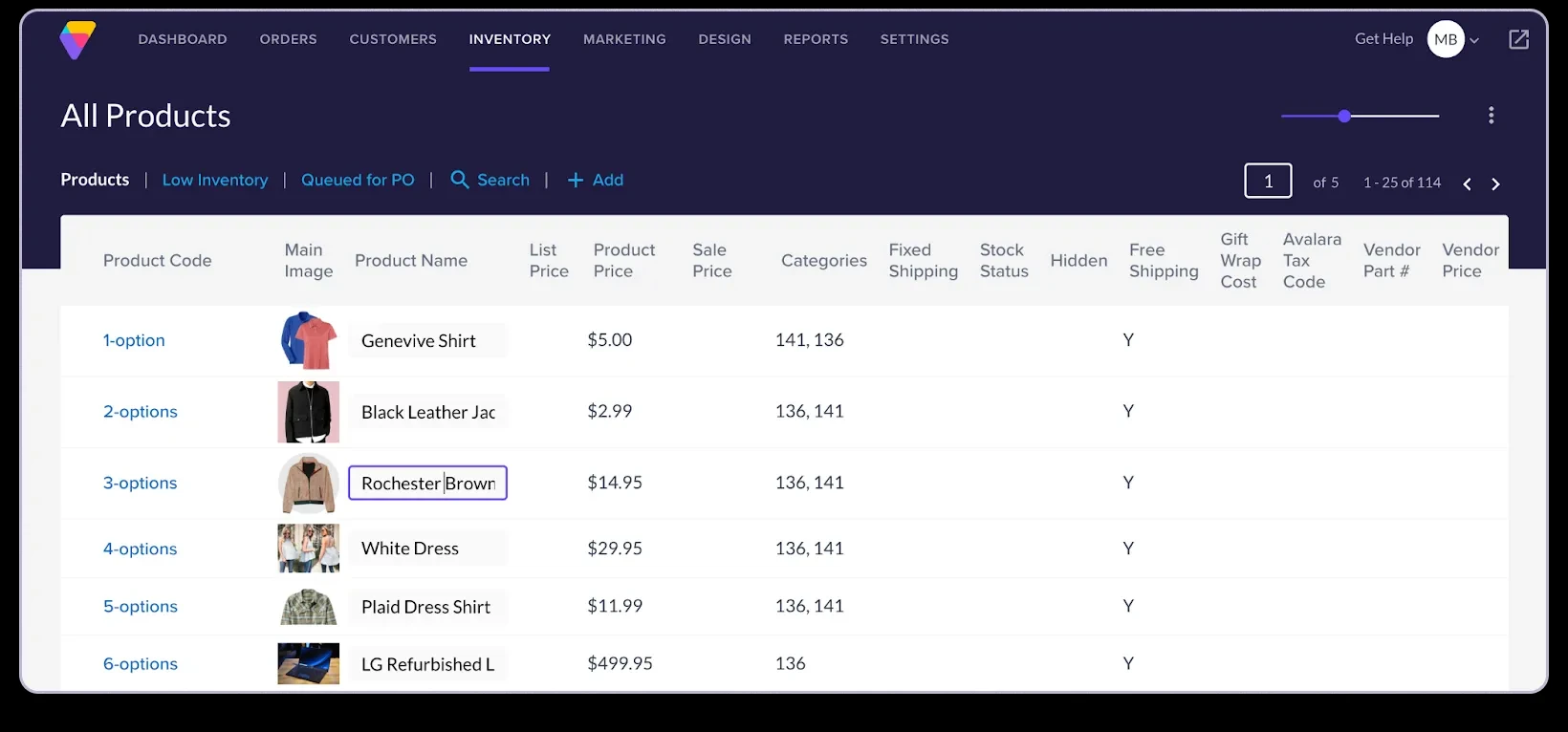
Higher-tier plans also support multiple staff accounts, ranging from 1 account on Personal to 15 accounts on Business plans.
GoDaddy, by comparison, focuses more on simplicity. Its Commerce plan supports up to 5,000 product listings, which is sufficient for many small-to-medium businesses. The platform also supports real-time inventory syncing across marketplaces such as Amazon, Etsy, and eBay, helping merchants prevent overselling across channels.
However, GoDaddy imposes stricter product variation limits. Stores can only have up to three options per product and up to 100 choices across the store. While this improves storefront simplicity and performance, it can become restrictive for merchants selling highly customizable products.
Payment (A tie)
Volusion supports multiple payment gateways and provides built-in eCommerce payment functionality through Volusion Payments.
The platform also allows integrations with third-party processors on higher-tier plans, giving merchants more flexibility in how they manage transactions. In addition, Volusion does not charge extra platform transaction fees according to multiple reviews and pricing breakdowns.
That said, Volusion’s payment ecosystem feels more traditional and less streamlined than newer all-in-one commerce platforms. Payment setup is generally more operationally focused and may require additional configuration depending on the merchant’s preferred gateway.
Meanwhile, GoDaddy performs particularly well in this category because of its tightly integrated payment ecosystem. Merchants can use GoDaddy Payments directly within the platform, with publicly listed transaction fees of 2.7% + 30¢ per online transaction and next-business-day payouts.
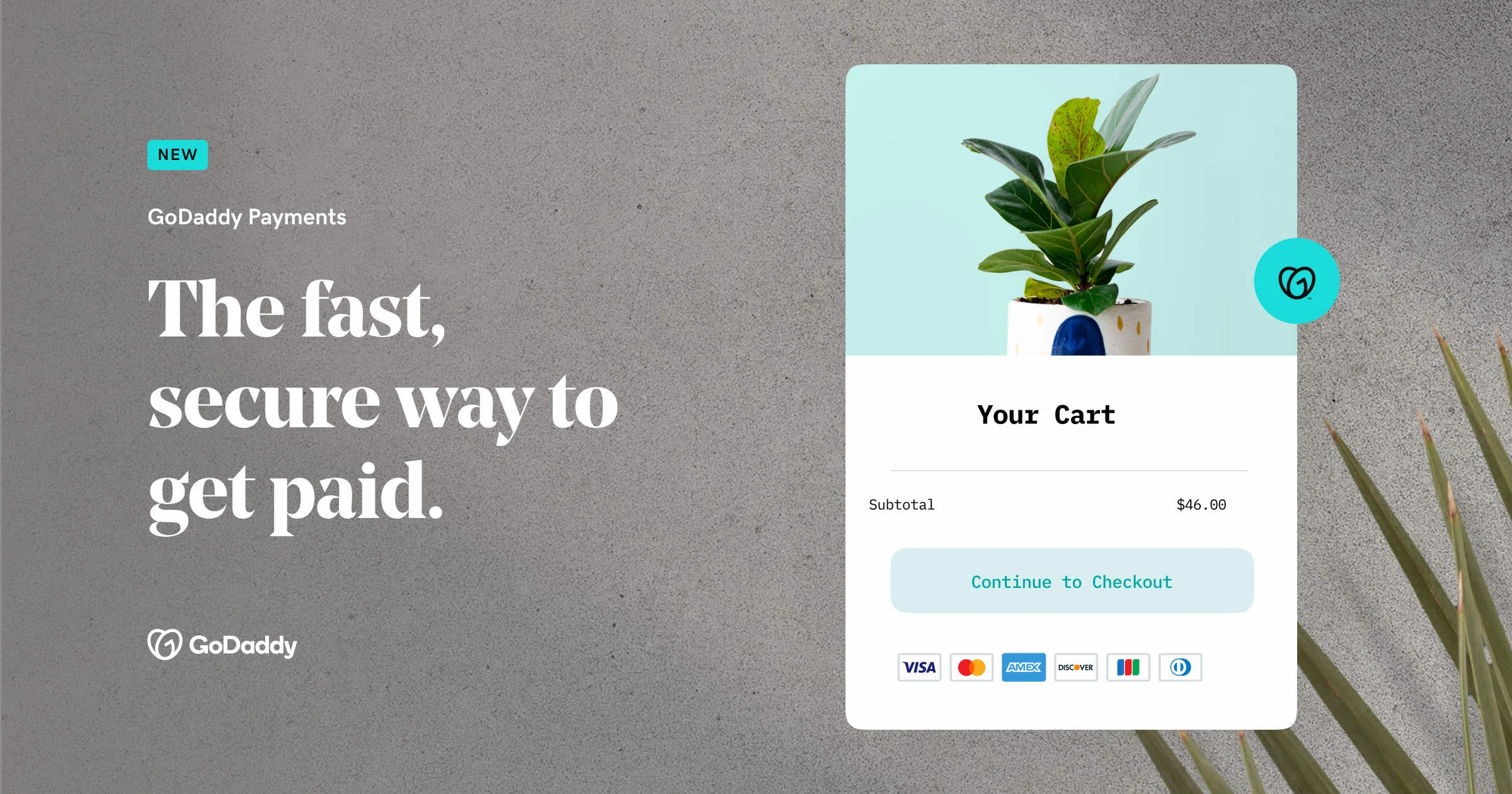
Plus, GoDaddy also supports several major payment methods and processors, including Stripe, PayPal, Square, Apple Pay, and Google Pay.
Shipping (Volusion wins)
Overall, Volusion has a stronger shipping and fulfillment infrastructure. The platform integrates with advanced shipping and logistics tools such as ShipStation and warehouse management systems, which allows merchants to automate order processing, inventory allocation, shipment confirmation, and fulfillment workflows. These integrations make Volusion much better suited for scaling logistics-heavy eCommerce operations.
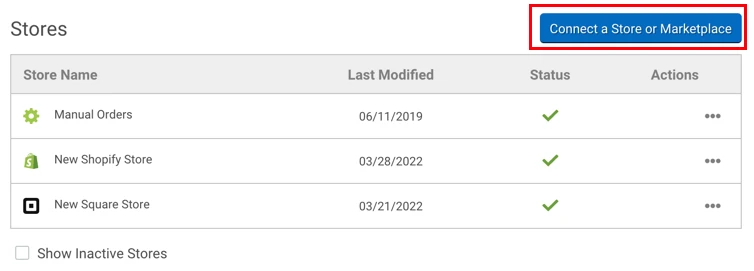
Similarly, GoDaddy supports core eCommerce shipping features such as flat-rate shipping, weight-based shipping, and marketplace order syncing through its centralized dashboard. Inventory and order data automatically sync across sales channels, which helps smaller merchants manage fulfillment more efficiently.
Nevertheless, most of these shipping tools are designed primarily for simplicity rather than enterprise-level logistics management. At the end of the day, GoDaddy still lacks the deeper fulfillment ecosystem and advanced operational flexibility that larger eCommerce businesses may eventually require.
Ease of Use (GoDaddy wins)
The Verdict
GoDaddy wins this category because its entire platform is designed around simplicity, fast onboarding, and a minimal learning curve. Its AI-assisted setup, beginner-friendly editor, and streamlined dashboard allow users to launch a functional online store in under an hour.
Volusion, while more powerful operationally, has a steeper learning curve due to its more commerce-focused backend and broader eCommerce management tools. Let’s look at how Volusion vs GoDaddy approach onboarding, usability, and day-to-day store management.
Volusion’s ease of use
Volusion’s interface is designed primarily for eCommerce management. The platform includes a more operational backend with tools for inventory control, fulfillment management, order processing, and reporting.

Similarly, its dashboard structure is more commerce-centric and less visually guided than that of modern AI-powered website builders. Features such as bulk order processing, CRM tools, abandoned cart reporting, and advanced shipping integrations add complexity that may overwhelm first-time store owners.
GoDaddy’s ease of use
On the contrary, GoDaddy is one of the most beginner-friendly eCommerce website builders currently available.
The platform heavily emphasizes speed and simplicity through AI-assisted onboarding, guided setup flows, and a clean section-based editor. According to our testing, a professional-looking eCommerce site could be built in under an hour, while a basic store setup took approximately 15 minutes.
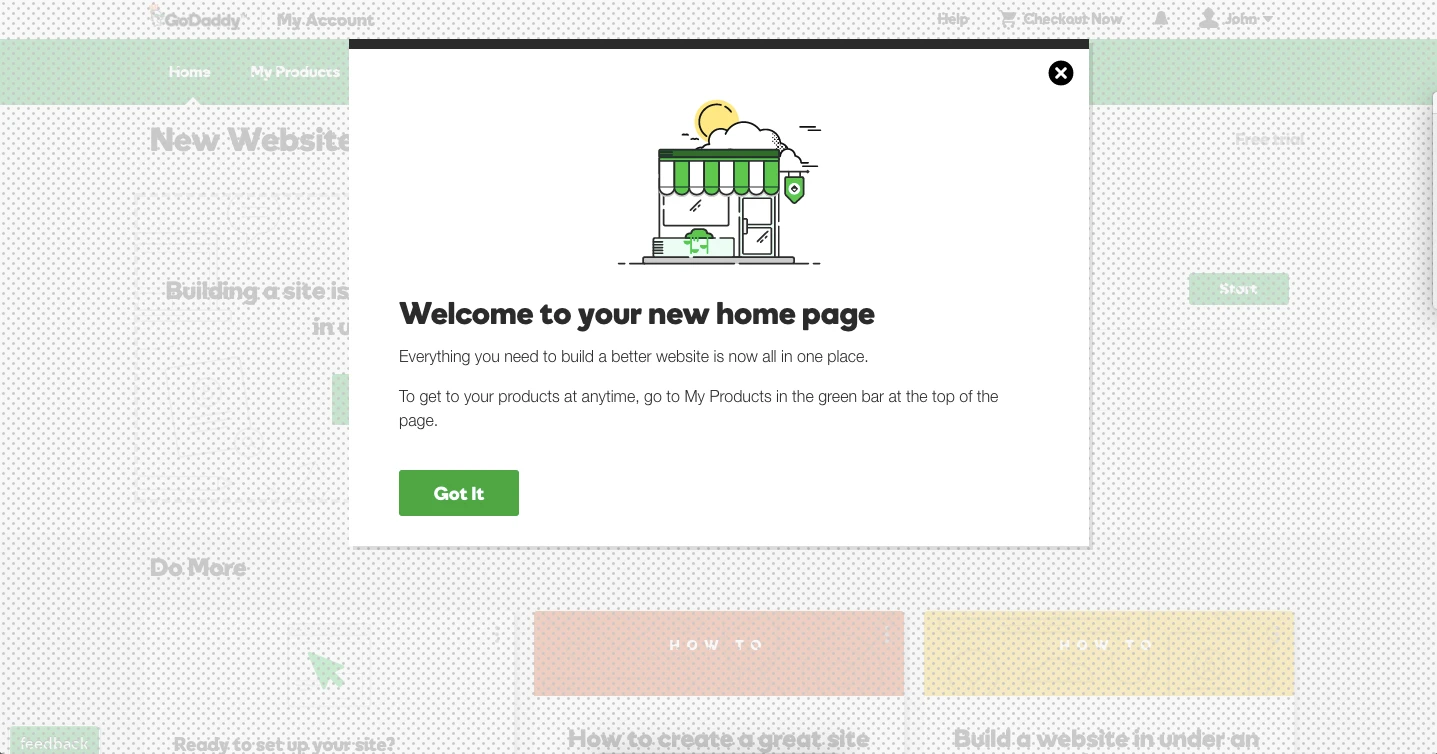
Furthermore, the platform also centralizes inventory management, payments, marketplace syncing, customer communication, and marketing tools inside a single dashboard. However, keep in mind that GoDaddy’s simplified approach does come with limitations. The section-based editor offers less creative flexibility than more advanced eCommerce platforms, and some customization options are intentionally restricted to maintain ease of use.
Ready to Migrate to a New Platform?
LitExtension provides a well-optimized All-in-One migration service for your data transfer!

Website Builder & Templates (GoDaddy wins)
The Verdict
GoDaddy offers a larger template library and a faster website setup. While Volusion still performs well for merchants who prioritize an eCommerce-focused storefront structure, its templates feel more dated.
Keep scrolling for a further Volusion vs GoDaddy comparison when it comes to template libraries and customization flexibility:
Volusion’s website builder & templates
Overall, Volusion’s templates are responsive and optimized for online selling, but the platform does not publicly advertise a large template library(fewer than 50). That’s why multiple merchants and development agencies describe Volusion’s theme selection as relatively limited compared to modern website builders like Shopify, Wix, or Squarespace.

Where Volusion performs better is in an eCommerce-oriented storefront structure. The platform provides stronger control over product layouts, navigation organization, and storefront management, which makes it more suitable for merchants prioritizing eCommerce functionality over visual simplicity. The platform also supports customization through HTML, CSS, and site editing tools to give experienced users more control over storefront adjustments.
GoDaddy’s website builder & templates
Meanwhile, GoDaddy officially offers more than 200 templates, much more than Volusion’s modest 50.
And as mentioned earlier, one of GoDaddy’s biggest advantages is its AI-assisted onboarding system. After answering a few business-related questions, users receive an automatically generated starter website, significantly reducing setup time. Its section-based editor is also streamlined, allowing users to modify layouts, images, and content without needing technical knowledge.

In short, GoDaddy’s templates and editing tools are modern, mobile-responsive, and optimized for small business websites. While layout customization and design control are still limited, GoDaddy delivers a solid website-building experience overall.
Hosting Quality (GoDaddy Wins)
The Verdict
GoDaddy has a massive infrastructure scale, along with a bundled hosting ecosystem and a long-standing reputation in the hosting industry. Since all paid plans include hosting and SSL certificates, they give merchants a more complete, all-in-one environment with fewer setup requirements.
Volusion still provides a reliable hosted eCommerce infrastructure, but its ecosystem is smaller, as seen in the Volusion vs GoDaddy’s breakdown below:
Volusion’s hosting quality
Volusion operates as a fully hosted SaaS eCommerce platform, meaning merchants do not need to purchase separate hosting or manually manage servers, updates, or maintenance. Hosting, platform security, and software updates are all included directly within the subscription plans.
Because Volusion is built specifically for eCommerce, its infrastructure is optimized around online store operations such as product management, order processing, and storefront performance. As a result, merchants can focus more on selling rather than on technical maintenance.
However, compared to larger hosting providers, Volusion’s infrastructure ecosystem is relatively limited. Unlike GoDaddy, the company is not a large-scale web hosting provider with a massive global hosting network or a broad hosting product ecosystem.
GoDaddy’s hosting quality
Contrary to Volusion, GoDaddy benefits from one of the largest hosting infrastructures in the world. Officially, the company serves more than 21 million customers and manages over 84 million domain names globally, which gives it significantly greater infrastructure scale than Volusion.
All paid website builder and eCommerce plans include:
- Web hosting
- SSL certificates
- Security infrastructure
- Domain connection tools
As you can see, this bundled ecosystem simplifies setup and reduces the need for third-party hosting services or additional technical configuration.
Another major advantage is GoDaddy’s long-standing experience in the hosting industry. Beyond eCommerce, the company also provides:
- Shared hosting
- VPS hosting
- Dedicated servers
- Domain management
- Email hosting
This broader hosting ecosystem gives GoDaddy stronger infrastructure maturity and operational scale overall, though you should still keep in mind that GoDaddy’s hosting environment is designed more for accessibility and convenience than advanced eCommerce optimization. In the future, highly technical or enterprise-level merchants may eventually prefer more specialized eCommerce hosting solutions.
Apps & Integrations (Volusion Wins)
The Verdict
Volusion’s ecosystem is built much more heavily around operational eCommerce scalability. Plus, in addition to supporting direct integrations, Volusion also provides REST API access and supports ERP, CRM, warehouse management, accounting, and fulfillment integrations.
While GoDaddy’s integrations are easier to set up and manage, the ecosystem is noticeably lighter and less customizable for merchants needing deeper backend connectivity. Let’s look at the difference between Volusion vs GoDaddy further:
Volusion’s apps & integrations
Officially, the platform promotes about 84 apps, including Stripe, PayPal, Amazon, ShipStation, Avalara, and Venmo. Most of these apps focus heavily on payments, fulfillment, shipping, tax automation, and multichannel commerce rather than purely marketing-oriented plugins.
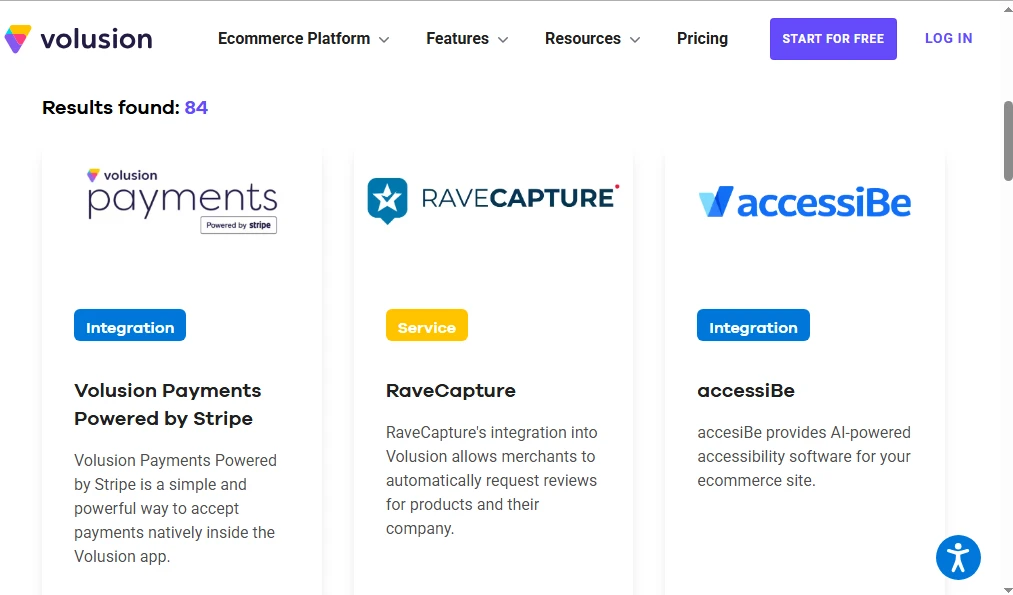
Another one of Volusion’s biggest strengths is its broader integration flexibility. Since the platform supports REST API access (alongside direct partner integrations and middleware connections), merchants can connect their stores with ERP systems, CRM software, warehouse management systems (WMS), accounting platforms, shipping automation tools, and third-party fulfillment services. Compared to GoDaddy’s simpler ecosystem, this creates significantly more operational freedom for businesses managing complex eCommerce infrastructures.
GoDaddy’s apps & integrations
Unlike Volusion, GoDaddy does not have a dedicated, official app or extension store.
Nevertheless, it does support several essential eCommerce and business integrations, including PayPal, Stripe, Square, Amazon, Etsy, eBay, Facebook, and Instagram. These integrations are built directly into GoDaddy’s ecosystem, which makes it easier for small businesses to manage multichannel selling and social commerce without extensive setup.
In addition, payment integrations, social media tools, appointment scheduling, and GoDaddy Studio content features are all centralized inside a simplified dashboard. The platform also supports inventory syncing across marketplaces such as Amazon, Etsy, and eBay, which helps smaller merchants avoid overselling while simplifying multichannel management.

SEO & Marketing (A Tie)
The Verdict
Volusion performs better for SEO because it gives merchants greater control over eCommerce optimization. However, GoDaddy delivers the stronger marketing ecosystem overall thanks to its integrated email marketing, social media tools, GoDaddy Studio content features, and AI-assisted business functionality.
In the section below, we’ll examine how Volusion vs GoDaddy compare across SEO flexibility, marketing tools, and usability.
Volusion’s SEO & Marketing
Volusion includes several built-in eCommerce SEO tools designed to give merchants greater optimization flexibility.
Officially, the platform promotes built-in SEO management, customizable URLs, editable metadata, and eCommerce-focused storefront optimization tools. Together, these features allow merchants to optimize product pages and storefront hierarchy more effectively for search engines. Plus, compared to GoDaddy’s more simplified SEO environment, Volusion also gives merchants greater flexibility over how indexed pages are organized and optimized, which can significantly improve long-term eCommerce SEO performance.

Regarding marketing, Volusion offers built-in functionality including newsletters, CRM tools, Marketing 360 services, and eCommerce-focused growth features. Still, it’s worth noting that its ecosystem is designed more around operational eCommerce marketing than social media content creation or small-business promotion. As a result, its marketing ecosystem feels more traditional and less modern than GoDaddy’s broader all-in-one business tools.
GoDaddy’s SEO & Marketing
On the other hand, GoDaddy focuses heavily on accessibility and ease of use in both SEO and marketing management.
The platform includes beginner-oriented SEO tools directly inside its website builder, including guided SEO setup, SEO Wizard tools, automatic mobile optimization, and AI-assisted website generation. Together, these features simplify optimization for users, even those with limited technical SEO experience. However, compared to Volusion, the platform provides less advanced control over SEO structure, URL customization, and storefront organization.
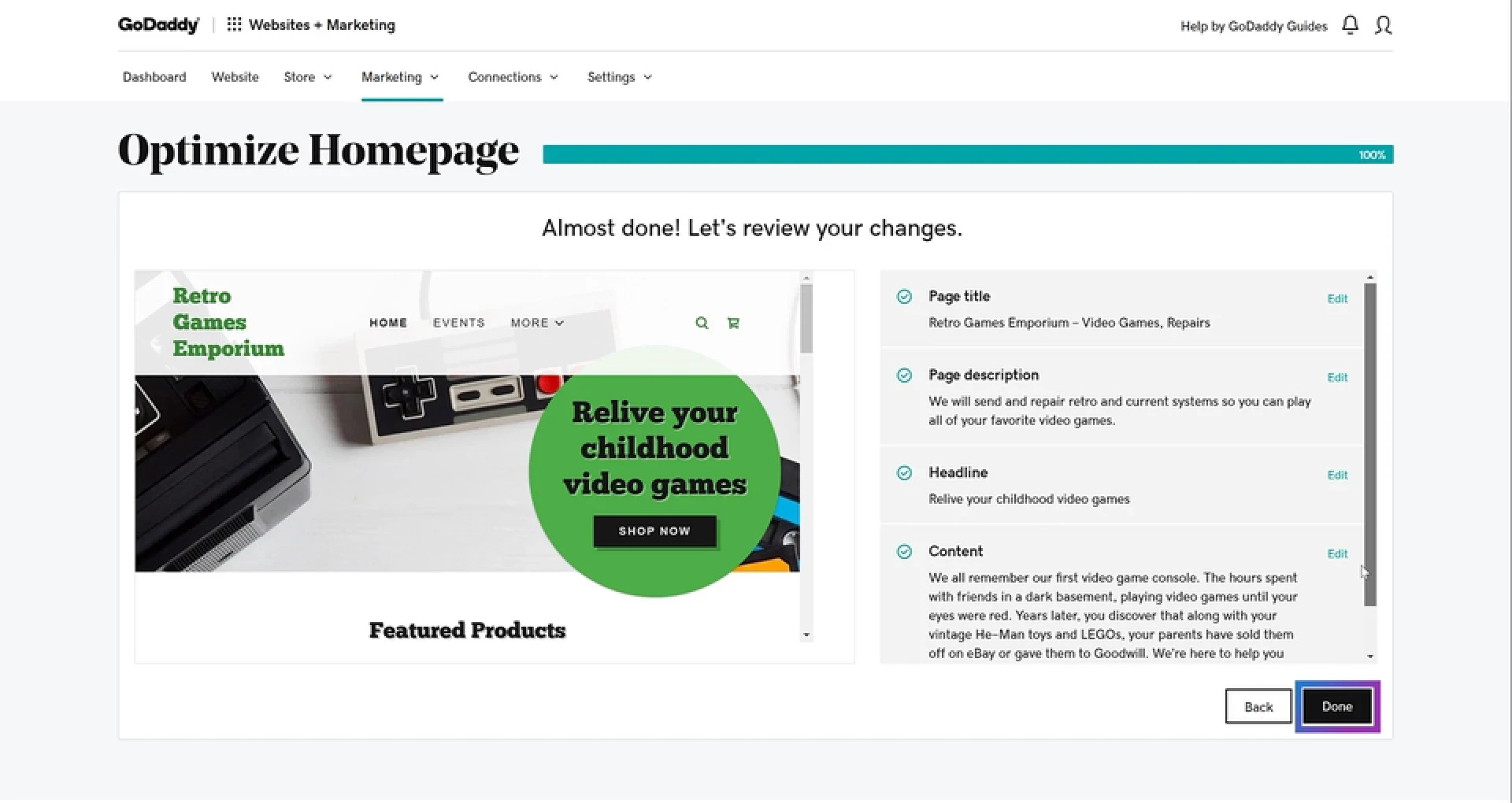
In compensation, where GoDaddy performs particularly well is marketing integration. The platform combines eCommerce functionality with email marketing, social media management, customer messaging, appointment scheduling, and GoDaddy Studio content tools inside one centralized workflow. As a result, campaign management and content creation are quite streamlined and easy to moderate, even for beginners.
Security & Support (GoDaddy wins)
The Verdict
GoDaddy combines strong built-in security protections with a broader and more accessible customer support ecosystem. The platform includes SSL certificates, PCI-compliant payment processing, secure managed hosting, and 24/7 support channels.
You can see how Volusion vs GoDaddy handle security management, technical support, and customer assistance here:
Volusion’s security & support
As discussed before, Volusion operates as a fully hosted eCommerce platform with built-in security protections specifically designed for online selling. Hence, the platform includes SSL certificates, PCI-compliant infrastructure, secure hosted environments, and fraud protection tools for transaction processing, payment processing, order management, reliability, and more.
Regarding support, Volusion provides multiple direct support channels, including phone support, live chat, email support, onboarding assistance, and help center documentation. Still, since the platform has a much smaller community presence than GoDaddy, keep in mind that users have fewer external learning resources available overall.
GoDaddy’s security & support
GoDaddy includes several built-in security protections across its eCommerce and website builder plans, including SSL certificates, PCI-compliant payment processing, secure managed hosting, and domain security protections. These features are integrated directly into the platform’s managed environment, which helps smaller businesses reduce technical setup complexity while maintaining secure operations.
Furthermore, one of GoDaddy’s biggest advantages is the breadth of its support ecosystem. The platform provides 24/7 phone support, along with live chat, help center documentation, tutorials, community forums, and social support channels. This system creates a significantly broad self-help environment, especially for beginners needing troubleshooting guidance.
A minor downside, however, is that GoDaddy’s support quality can occasionally feel inconsistent due to its larger scale and broader audience. Additionally, while the platform provides strong general hosting and website security, its infrastructure is much less eCommerce-specific than Volusion’s.
Pricing (GoDaddy wins)
The Verdict
GoDaddy offers a significantly more flexible ecosystem with lower entry pricing, broader service customization, and separate pricing structures for email, hosting, marketing, and eCommerce tools.
Volusion, however, still delivers strong value for merchants focused specifically on scaling eCommerce operations. You can look through our Volusion vs GoDaddy breakdown here:
Volusion’s pricing
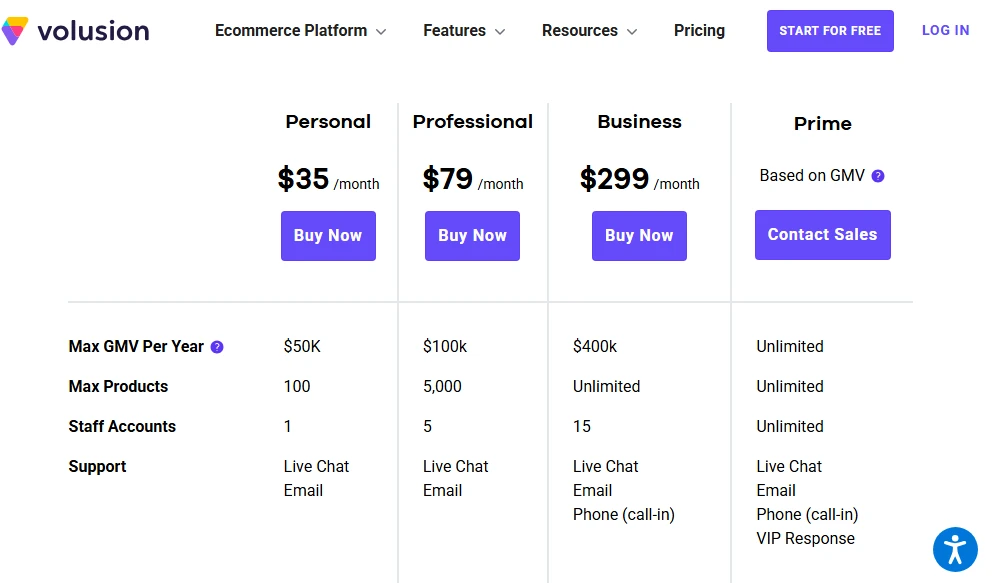
Volusion structures its pricing around eCommerce scalability. In short, each plan unlocks more operational capacity and advanced commerce functionality as businesses grow:
- Personal ($35/month): Supports up to 100 products and $50K annual GMV, while including core eCommerce features.
- Professional ($79/month): Expands limits to 5,000 products and $100K annual GMV, adding more advanced operational tools such as API access and batch order processing.
- Business ($299/month): Removes product limits entirely and increases annual GMV support to $400K.
- Prime (custom pricing): Targets enterprise merchants with unlimited products, unlimited staff accounts, VIP support, and dedicated account management for high-volume eCommerce operations.
Overall, Volusion’s pricing is more expensive than GoDaddy’s, but the platform includes significantly more eCommerce-focused functionality directly inside its core plans.
GoDaddy pricing
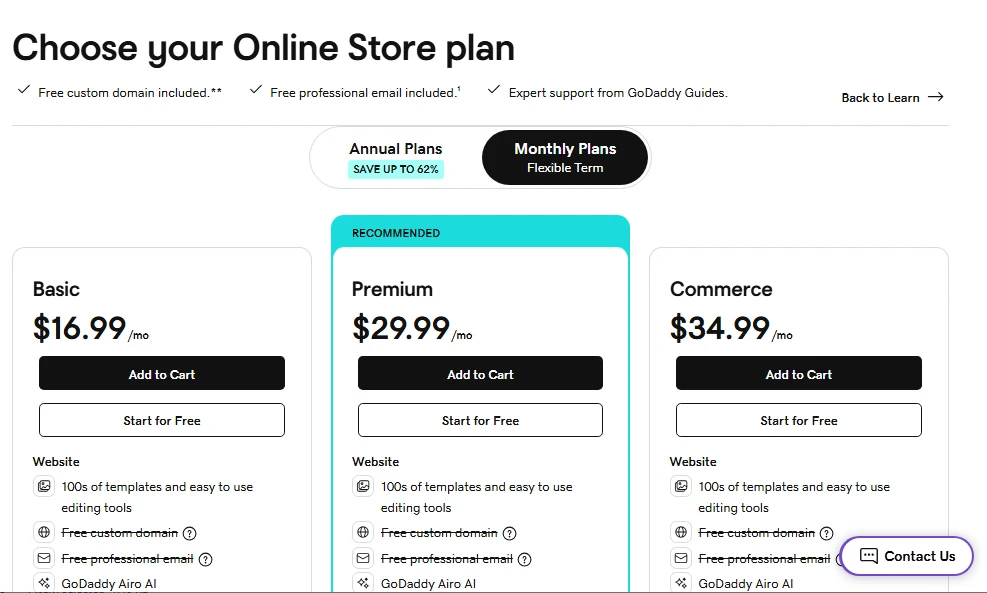
On the other hand, GoDaddy takes a much more flexible and beginner-friendly pricing approach by separating website building, eCommerce, hosting, email, and business tools into modular services.
For example, for Website Builder, GoDaddy offers three plans:
- Basic ($16.99/month): Includes AI-powered website tools, hundreds of templates, social posting functionality, and basic marketing tools.
- Premium ($29.99/month): Focuses more heavily on marketing by adding appointment bookings, unlimited ads, and 25,000 monthly email marketing sends.
- Commerce ($34.99/month): Adds eCommerce functionality, including unlimited product listings, marketplace selling tools, shoppable social posts, and 100,000 monthly email marketing sends, with 0% platform transaction fees.
Meanwhile, the platform also separates additional services into standalone plans. For instance, Professional Email (starting at $1.99/user/month) provides business email hosting with storage upgrades and optional Microsoft 365 integration for growing businesses. Or hosting services (starting from $5.99/month) include shared hosting, Managed WordPress Hosting, and VPS Hosting, depending on the level of performance and server control needed.
Want a bundled business package instead of purchasing each service separately? GoDaddy has that covered as well with three options:
- Starter Domain Bundle ($2.99/month): Combines a domain name, professional email, domain protection, and 24/7 support for businesses getting online quickly.
- Essentials Domain Bundle ($10.02/month): Adds SEO tools, social posting, appointment scheduling, and stronger marketing functionality for growing brands.
- Ecommerce Domain Bundle ($21.02/month): Adds marketplace selling, inventory syncing, and eCommerce tools for businesses wanting a more scalable online store setup.
Compared to Volusion, GoDaddy’s ecosystem is significantly more flexible and affordable for smaller businesses. However, you should still keep in mind that many advanced eCommerce features are spread across separate services and bundles rather than deeply integrated into the core platform itself.
Volusion vs GoDaddy: Which One is Suitable for You?
Overall, Volusion is the better choice if your primary focus is building and scaling a dedicated eCommerce business.
In particular, Volusion works well for merchants who already understand eCommerce operations and need a platform capable of supporting more advanced workflows. While the learning curve is steeper, the platform offers stronger scalability once the business begins growing beyond basic storefront management.
GoDaddy, on the other hand, is ideal for beginners, entrepreneurs, and small businesses that prioritize simplicity and fast setup.
The platform makes it incredibly easy to launch a professional-looking website and online store. Its AI-assisted onboarding, centralized dashboard, and built-in marketing tools also help users get online quickly while managing everything inside one ecosystem. And for smaller stores, service businesses, creators, or local brands that do not require highly advanced eCommerce infrastructure, GoDaddy delivers a more approachable and cost-effective solution overall.
In short:
- Choose Volusion if you prioritize eCommerce scalability and operational control.
- Choose GoDaddy if you prioritize ease of use, affordability, and fast business setup.
Volusion vs GoDaddy: FAQ
Is there a better option than GoDaddy?
Yes. If your priority is eCommerce scalability, platforms like Shopify or Wix are generally stronger overall. However, GoDaddy still remains one of the easiest and most affordable platforms for beginners launching a simple business website quickly.
Is Shopify better than Volusion?
For most modern eCommerce businesses, yes. Shopify offers a larger app ecosystem, stronger scalability, better international selling tools, and a more modern user experience than Volusion. That said, Volusion can still work well for merchants who prioritize operational eCommerce management and simpler backend workflows.
What are the disadvantages of GoDaddy?
GoDaddy’s biggest weakness is limited eCommerce flexibility. Compared to platforms like Shopify or Wix, it offers fewer customization options, a smaller integration ecosystem, and less advanced inventory and operational management. While it excels in simplicity and fast setup, growing businesses may eventually outgrow its eCommerce capabilities.
Which is cheaper, Wix or GoDaddy?
Overall, GoDaddy is usually cheaper upfront. GoDaddy plans commonly start around $9.99/month, while Wix pricing typically starts around $17/month for premium plans. However, Wix generally includes more advanced design and eCommerce features, so the better value depends on your business needs.
Our Methodology
To create this unbiased Volusion vs GoDaddy comparison, we evaluated both platforms across the areas that matter most to real eCommerce businesses:
Step 1: Evaluating core eCommerce capabilities
First, we examined each platform’s eCommerce infrastructure, including inventory management, payment flexibility, shipping tools, product management, and operational scalability.
Our goal was to determine which platform better supports real online selling scenarios, from small beginner stores to more complex eCommerce operations. We also considered how well each platform handles backend workflows, fulfillment management, and long-term scalability.
Step 2: Testing user experience and website building
Next, we compared how easy each platform is to use for non-technical users. This process included evaluating onboarding flows, dashboard organization, website setup speed, template quality, customization flexibility, and overall usability.
In addition, our team also looked closely at how beginner-friendly each platform feels during daily management tasks such as editing pages, managing products, configuring payments, and handling orders. Since many users launching an online store have limited technical experience, usability played a major role in our evaluation.
Step 3: Comparing ecosystem value and long-term flexibility
Finally, our team analyzed the broader ecosystem surrounding each platform, including integrations, hosting infrastructure, marketing tools, security, customer support, and pricing structure.
For the latter, instead of evaluating pricing alone, we focused on overall value for different business types. This approach helped us determine which platform delivers better long-term flexibility for growing eCommerce brands and which one offers a better entry point for beginners or smaller businesses.

