
Shopware is an eCommerce solution that’s been getting a lot of attention from businesses of all sizes. When looking into Shopware, it’s super important to understand Shopware pricing to make the best decision for your business that fits your goals and budget.
In this article, LitExtension will dive deep into Shopware’s pricing structure, exploring the different editions available, their costs, and the value they provide. So, by the end of this article, you will clearly understand:
- Shopware open-source pricing;
- Shopware commercial plans;
- Comparison of Shopware pricing and other platforms.
Let’s get started.
How Much Does Shopware Cost?
Shopware offers three commercial plans: Rise, Evolve, and Beyond that scale with your business and start at approximately €600 per month. Alternatively, you can use the open-source Community Edition for free, though you must cover your own development and self-hosting costs, which typically range from $20 to $200 or more per month.
Relevant reading: Shopware Review – Key Features Analysis
Let’s go into the details:
Shopware Core (Open-Source)
Shopware offers a free Community Edition, which serves as the foundation of the platform. However, while the license itself is free, you should account for:
- Hosting infrastructure (self-hosted)
- Development and setup costs
- Maintenance and updates (handled by your team)
Shopware Commercial Plans (Cloud & PaaS)
Shopware provides three main paid plans designed for different business scales:
- Rise: Starts at around €600/month (roughly $690), suitable for small to mid-sized businesses.
- Evolve: Starts from €2,400/month (roughly $2,700) based on business requirements and GMV.
- Beyond: Enterprise-level plan with fully customized pricing.
Note that modern Shopware pricing is typically based on Gross Merchandise Value (GMV) and specific business needs, meaning costs scale as your business grows. These plans include:
- Hosting (Cloud or PaaS)
- Ongoing updates and maintenance
- Built-in features (B2B tools, AI, advanced search, etc.)
- Professional support
Hosting Costs (if Self-Hosted)
If you use the Community Edition or self-hosted setup, the price typically ranges from $20 to $200+ per month. Note that it can increase significantly with traffic and scaling needs.
Shopware Pricing for Community Edition
Community Edition is the foundational open-source version of Shopware. The Professional Edition and Enterprise Edition of Shopware offer additional features that expand on the functionality of the standard Community Edition.
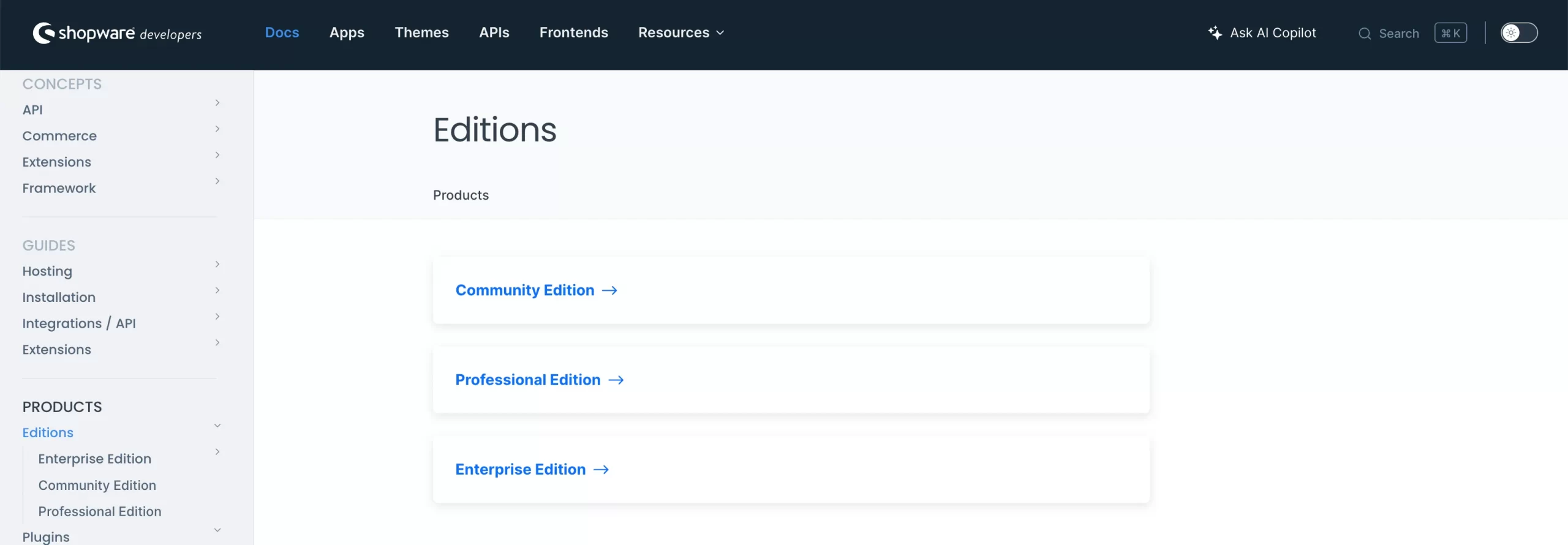
The Community Edition is perfect for those who value flexibility and have the technical skills to manage and customize their eCommerce platform. It’s a great starting point for businesses that want to test Shopware’s capabilities without financial commitment.
Cost: Free
Key features:
- Open-source codebase
- API-first approach
- Admin API for efficient bulk operations
- Store API for customer-facing applications
- Data Abstraction Layer (DAL)
- Rule Builder
- Extensible Architecture
- Shopping experiences (CMS) and basic eCommerce features
Need Help To Migrate to Shopware?
LitExtension provides a well-optimized All-in-One migration service for your data transfer!

Shopware Commercial Plans
With these Shopware pricing plans, you can decide on SaaS, PaaS, or Self-hosted.
Both Shopware SaaS and Shopware PaaS are cloud-based eCommerce solutions that aim to enable you to focus on your business while Shopware manages the hosting. Shopware Cloud provides all the necessary tools for efficiently building your online store. While SaaS and PaaS offer similar benefits, PaaS differentiates itself by offering maximum customizability, performance monitoring, and development tools.
Additionally, if you have an experienced developer team and require complete control over your IT infrastructure, self-hosting may be a suitable choice for your business.
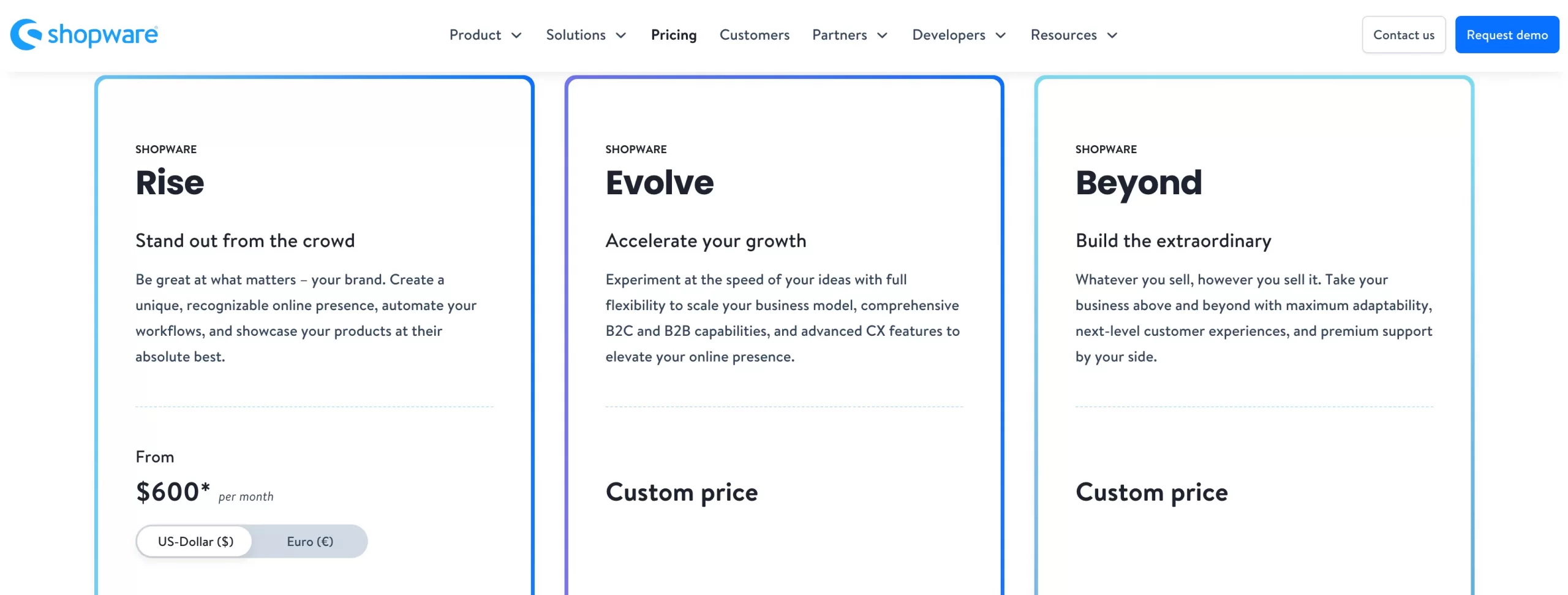
*Note: Paid Shopware price plans are based on your gross merchandise value (GMV) and individual factors.
#1 Rise Plan
The Rise Plan is perfect for businesses that want to focus on growth without worrying about technical maintenance. It provides a balance of features and support at a reasonable cost.
Cost: Starting at $600 per month (billed annually)
Features:
- All Community Edition features
- Cloud hosting
- 3D capabilities
- AI Copilot
- Basic B2B capabilities (Gross/net price display)
- Unlimited sales channels
- Professional support
- Updates and patch-releases
Ideal for: Merchants in the B2C or D2C segments who are starting their online journey or have a smaller product catalog.
#2 Evolve Plan
The Evolve Plan caters to businesses that are scaling rapidly and require more advanced features to manage their growing operations efficiently.
Cost: Custom pricing (contact Shopware for a quote)
Features:
- All Rise Plan features
- Advanced B2B capabilities (Enhanced roles and permissions management & Quote management)
- Advanced Customer experience & Marketing (Advanced Search & Form Builder)
- Enhanced performance features
- Priority support
Ideal for: Merchants with various business models, including B2B, B2C, and D2C, who need more advanced features and scalability.
#3 Beyond Plan
The Beyond Plan is designed for businesses that need the highest level of customization, support, and scalability. It’s ideal for large enterprises that require a tailor-made eCommerce solution.
Cost: Custom pricing (contact Shopware for a quote)
Features:
- All Evolve Plan features
- Enterprise-grade support
- Advanced customization options
- Dedicated account manager
- Full support for inventory & order management (Multi-inventory & Subscriptions)
- Early access to new features
Ideal for: Sophisticated or international players with complex requirements who need maximum scalability, performance, and customization.
Our Recommendation for Choosing the Right Shopware Plan / Edition
Choosing the right Shopware edition depends on various factors and scenarios as said above. From my experience working with Shopware, first, you should consider the following factors of Shopware pricing:
- What are your current business size and projected growth plans?
- How skilled is your team in managing an eCommerce platform?
- What’s your budget for an eCommerce solution, initially and in the long term?
- What essential features does your business need?
- How crucial is a unique online store for your brand?
- How much professional support do you anticipate needing from the platform provider?
As you fully answer all those questions, we will have some recommendations based on your business type:
- Small startups: Begin with the Community Edition if you have technical resources, or consider the Rise Plan for a more managed solution.
- Growing mid-sized businesses: The Evolve Plan offers a good balance of features and support for expanding operations.
- Large enterprises: The Beyond Plan provides the customization and support necessary for complex, high-volume operations.
- B2B businesses: Opt for at least the Evolve Plan to access advanced B2B features.
Additional Shopware Fees
Beyond the base platform costs, Shopware also includes several additional fees that can significantly increase your total cost of ownership. These expenses vary depending on whether you choose a self-hosted (Community Edition) or a cloud-based plan (Rise, Evolve, Beyond), as well as your business scale and technical requirements.
Transaction fees
Unlike platforms such as Shopify, Shopware itself does not charge mandatory transaction fees. However, you will still incur fees from your chosen payment providers.
These typically include:
- Payment gateways like Stripe, PayPal, or Klarna
- Fees ranging from ~2% to 3.5% per transaction, depending on provider and region
While Shopware gives you flexibility in choosing providers, these costs can add up quickly at scale. For high-volume stores, negotiating better rates with payment providers becomes essential.
Development costs
Shopware is known for its flexibility, but that flexibility often comes with development overhead. Typical costs include:
- Custom feature development
- Third-party integrations (ERP, CRM, PIM, etc.)
- Store setup and architecture
Developer rates usually range from $50 to $150+ per hour, and complex projects can easily reach $10,000–$50,000+. Plus, for businesses without an in-house tech team, working with a Shopware agency becomes a recurring investment rather than a one-time cost.
Hosting and domain
If you’re using the Community Edition or opting for self-hosted infrastructure:
- Hosting: typically $20 to $200+ per month, depending on performance needs
- Domain: around $10 to $20/year
As your store scales, hosting costs will increase due to higher traffic, larger database sizes, and increased performance requirements. Enterprise-level hosting setups (e.g., cloud infrastructure like AWS) can significantly exceed these estimates.
On the other hand, for cloud plans (Rise, Evolve, Beyond), hosting is included. Nevertheless, you’re effectively paying for it within your subscription.
Apps and extensions
Shopware’s ecosystem relies heavily on plugins to extend functionality. While Shopware includes many built-in features, you may still need plugins for:
- SEO enhancements
- Marketing automation
- Advanced analytics
- Payment and shipping integrations
Individual plugins for these typically cost $50 to $500; premium or enterprise-grade extensions, on the other hand, can exceed $1,000. And just like with hosting and domains, plugin subscriptions and renewals can become a recurring expense over time.
Maintenance and ongoing support
Lastly, running a Shopware store is not a one-time setup but actually requires continuous maintenance. Your store will need:
- Core updates and security patches
- Bug fixes and performance optimization
- Monitoring and technical support
- Estimated costs for freelance or in-house maintenance range from $500 to $2,000+/month. Agency retainers can request even higher depending on SLA and support level.
Note: For cloud plans, some maintenance is handled by Shopware. Nevertheless, custom features and integrations still require ongoing support.
Shopware Pricing in Comparison with Other Platforms
Shopware | Magento | WooCommerce | Shopify | |
Base Cost | Free (Community Edition) | Free (Open Source) | Free | Paid plans ($39–$399/month) |
Enterprise Pricing | Lower-cost paid plans | $22,000+/year | No fixed enterprise tier (cost varies with plugins & hosting) | Shopify Plus (higher-tier, custom pricing) |
Hosting | Required (for free version) | Required | Required | Included (hosted solution) |
Ease of Use | Moderate, more user-friendly than Magento | Complex, steep learning curve | Easy (especially for WordPress users) | Very easy, beginner-friendly |
Features | Strong built-in features | Very robust but complex | Depends on plugins | Strong out-of-the-box features |
Customization | Highly flexible | Highly customizable | Flexible via plugins | Limited compared to open-source platforms |
Plugins/Extensions | Moderate ecosystem | Large ecosystem | Very large ecosystem | App store available (paid apps common) |
Scalability | High (good for growing businesses) | Very high (enterprise-level) | Limited at large scale | Good, but can get costly at scale |
B2B Capabilities | Strong native B2B features | Strong (enterprise-focused) | Requires plugins | Limited built-in B2B |
Cost-effectiveness | Best for SMB → scaling businesses | Expensive, suited for large enterprises | Cheap to start, costs grow over time | Cost-effective for small/simple stores |
Best For | Growing & complex businesses needing flexibility | Large enterprises with complex requirements | Small businesses & WordPress users | Beginners & simple online stores |
#1 Shopware vs Magento
Magento is an open-source eCommerce solution like Shopware that offers both open-source and enterprise solutions:
- Open-source: Both Shopware Community Edition and Magento Open Source are free but require significant technical expertise to set up and maintain.
- Enterprise solutions: Magento Commerce (now part of Adobe Commerce) typically starts at a higher price point than Shopware’s paid plans, often $22,000+ per year.
- Features: Both platforms offer robust features, but Magento is known for its complexity and steeper learning curve.
- Scalability: Both platforms scale well, but Magento may have an edge for very large, complex enterprises.
Cost-effectiveness: For small to medium-sized businesses, Shopware’s paid plans often provide better value due to lower entry costs and included hosting.
#2 Shopware vs WooCommerce
WooCommerce is a popular eCommerce plugin for WordPress:
- Base cost: WooCommerce is free, similar to Shopware’s Community Edition.
- Hosting: Both require separate hosting if the free versions are used.
- Plugins: WooCommerce has a larger ecosystem of plugins, but costs can add up quickly.
- Scalability: Shopware generally offers better performance and scalability for larger stores.
Cost-effectiveness: WooCommerce can be more economical for small businesses, but Shopware often provides better value as businesses grow due to its built-in features and scalability.
#3 Shopware vs Shopify
Shopify is a popular hosted eCommerce solution:
- Pricing model: Shopify uses a tiered pricing model ($39, $105, $399 per month) plus transaction fees, while Shopware’s paid plans are higher but more inclusive.
- Customization: Shopware offers more flexibility and customization options crucial for unique business requirements.
- B2B capabilities: Shopware has stronger native B2B features, especially in higher-tier plans.
Cost-effectiveness: Shopify can be more cost-effective for small, straightforward online stores. However, Shopware often provides better value for businesses with complex needs or those prioritizing customization and scalability.
FAQs about Shopware Pricing
What is Shopware 6?
Shopware 6 is the latest version of the Shopware eCommerce platform, offering a modern and flexible architecture, improved user experience, and enhanced performance. It's designed to help businesses of all sizes create and manage powerful online stores.
Is Shopware 6 free?
Is shopware free? Yes, Shopware 6 pricing is free via the Community Edition. The Community Edition is the open-source, MIT-licensed core of Shopware, which is available for free download and use.
What is the cost of using the Community Edition?
The Community Edition itself is free. However, you'll need to factor in costs for hosting, potential plugin purchases, and technical maintenance.
How does Shopware's pricing compare to competitors?
Shopware's pricing is generally competitive, especially for businesses requiring customization and scalability. It may be higher than some basic solutions but often offers better value for growing businesses.
Is the investment in Shopware worth it for small businesses?
For small businesses with unique needs or growth ambitions, Shopware can be a worthwhile investment. The Community Edition or Rise Plan can provide a solid foundation without overwhelming costs.
What is the cost of using Shopware SaaS, PaaS, and self-hosted?
Shopware SaaS is available at the same price as self-hosted, offering excellent value for your investment. Since Shopware PaaS is tailored to your specific needs, you may need to contact Shopware for personalized pricing.
Final Words
Shopware offers diverse pricing options for businesses of all sizes, from small startups to large enterprises. When considering Shopware pricing, it’s essential to look beyond the base costs and consider the total cost of ownership, including potential expenses for hosting, customization, and additional features.
While Shopware may have a higher entry point than some competitors, its value proposition often becomes clear as businesses grow and require more advanced capabilities. Ultimately, the right choice depends on your specific business needs, and I encourage you to assess your requirements carefully and consider your choice’s long-term implications.
If you’re considering moving to Shopware, LitExtension can support migrating to Shopware from 140+ eCommerce platforms. Don’t forget that we have resources on many other platforms and a vibrant community of eCommerce gurus to help you gain further insights.

