Choosing between the best Shopify SEO apps gets easier when you know what your store needs most. Some focus on automating everyday tasks, while others offer more control over content or structured data. We’ve grouped our picks below so you can quickly compare their strengths, pricing, and Shopify App Store ratings before exploring the full reviews.
| App | Best for | Monthly pricing | Shopify App Store rating |
| TinySEO | Image-heavy catalogues | Free; $14–$49 | 5.0/5 |
| SearchPie | Store-wide SEO checks and guided fixes | Free; $39–$99 | 4.9/5 |
| Avada | Page speed and on-page SEO | Free; $34.95–$99 | 4.9/5 |
| Booster | Automated SEO maintenance | Free; $39–$69 | 4.8/5 |
| Tapita | Technical SEO troubleshooting | Free; $9.99–$49.99 base price | 5.0/5 |
| Smart SEO | Multilingual SEO and structured data | Free; $14.99–$49.99 | 5.0/5 |
| StoreSEO | Guided product optimisation | Free; $14.99–$249.99 | 5.0/5 |
| SEOWILL | Content planning and AI blog creation | Free; $29.99–$59.99 | 4.8/5 |
| SEO King | Affordable bulk optimisation | Free; $9.99–$16.99 | 4.7/5 |
| SEO Manager | Metadata and redirect management | $9–$59 | 4.6/5 |
| Plug In SEO | Guided audits and keyword research | $29.99–$79.99 | 4.6/5 |
| Yoast SEO | Content optimisation and readability | $19–$45 | 4.3/5 |
| Webrex Schema | Free product schema with paid upgrades | Free; $9.99–$29.99 | 4.9/5 |
| Schema Plus | Schema setup and conflict resolution | $10.99–$34.99 | 5.0/5 |
| Ilana’s JSON-LD for SEO | Ongoing schema monitoring and specialist support | $33.25 equivalent, billed at $399/year | 4.9/5 |
Let’s get started!
Best All-in-One Shopify SEO Apps
The best Shopify SEO apps bring everyday tasks into one place, from metadata and image optimisation to technical checks. The options below cover those essentials, but each has a different strength depending on how you manage your store.
1. TinySEO
Rating: 5.0/5 from 2,560 reviews.
Pricing: Free plan available | $14–$49/month | 7-day free trial.
Best for: Image-heavy stores that need SEO and speed optimisation in one app.
TinySEO is a good fit if your store has plenty of product images and you’re spending too much time keeping them optimised. It handles image compression alongside routine SEO tasks, so there’s less to update by hand as your catalogue grows. That makes it one of the best Shopify SEO apps to consider for image-heavy stores.
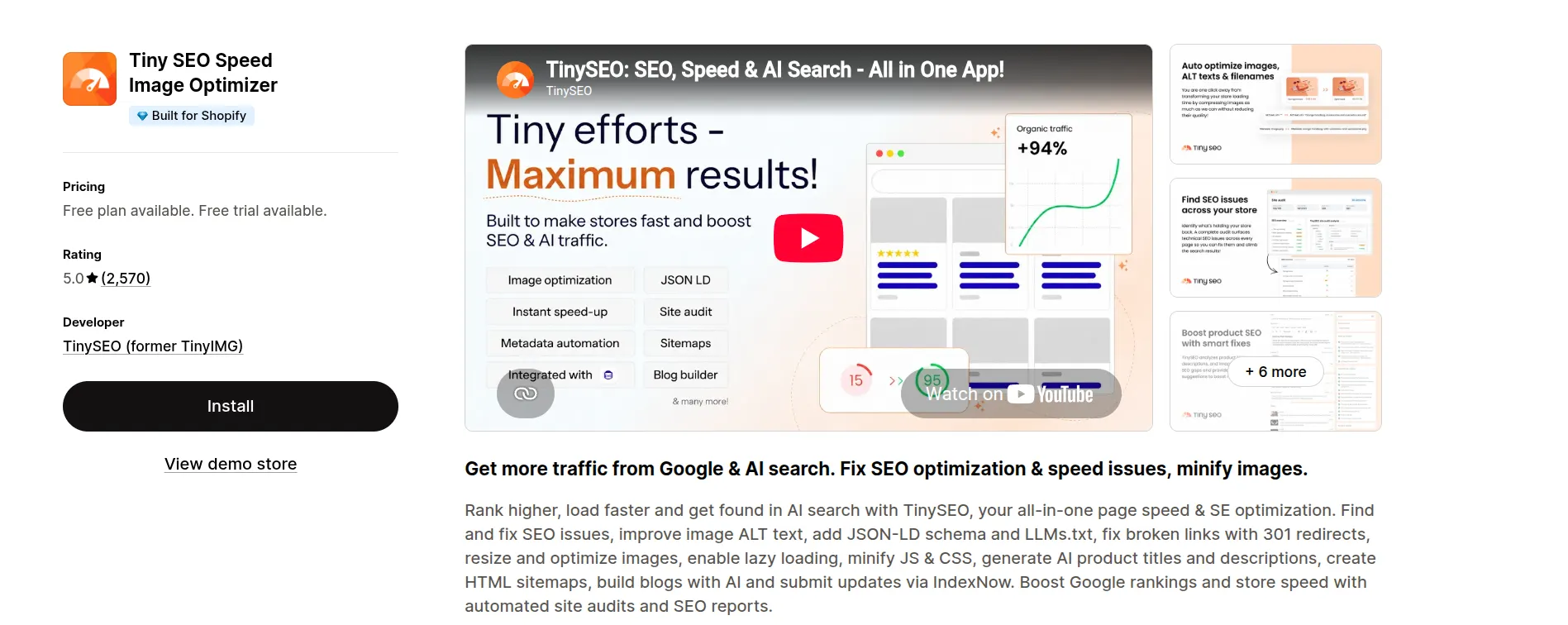
Its value does depend on the plan you choose. The free version covers basic image optimisation, but Advanced offers more complete SEO maintenance at $23/month. You’ll need that tier for automated metadata and broken-link management. For a store that regularly adds products, this is a sensible starting point, though extra image charges can increase the monthly bill once you exceed your allowance.
Key features:
- Automatic image compression and resizing, with ALT text and filename optimisation.
- Lazy loading, asset preloading, and CSS/JavaScript minification.
- Site audits with automated fixes for supported SEO issues.
- JSON-LD structured data, including shipping and return policy details.
- Broken-link detection and 301 redirect management.
- AI-generated SEO metadata and blog content.
2. SearchPie
Rating: 4.9/5 from 2,450 reviews.
Pricing: Free plan available | $39–$99/month | 7-day free trial.
Best for: SEO beginners who want ongoing guidance alongside automated tools.
Missing meta tags, broken links, and other SEO issues can pile up without you noticing. SearchPie helps you find these gaps across your store and work through them from one dashboard, so you spend less time checking individual pages.
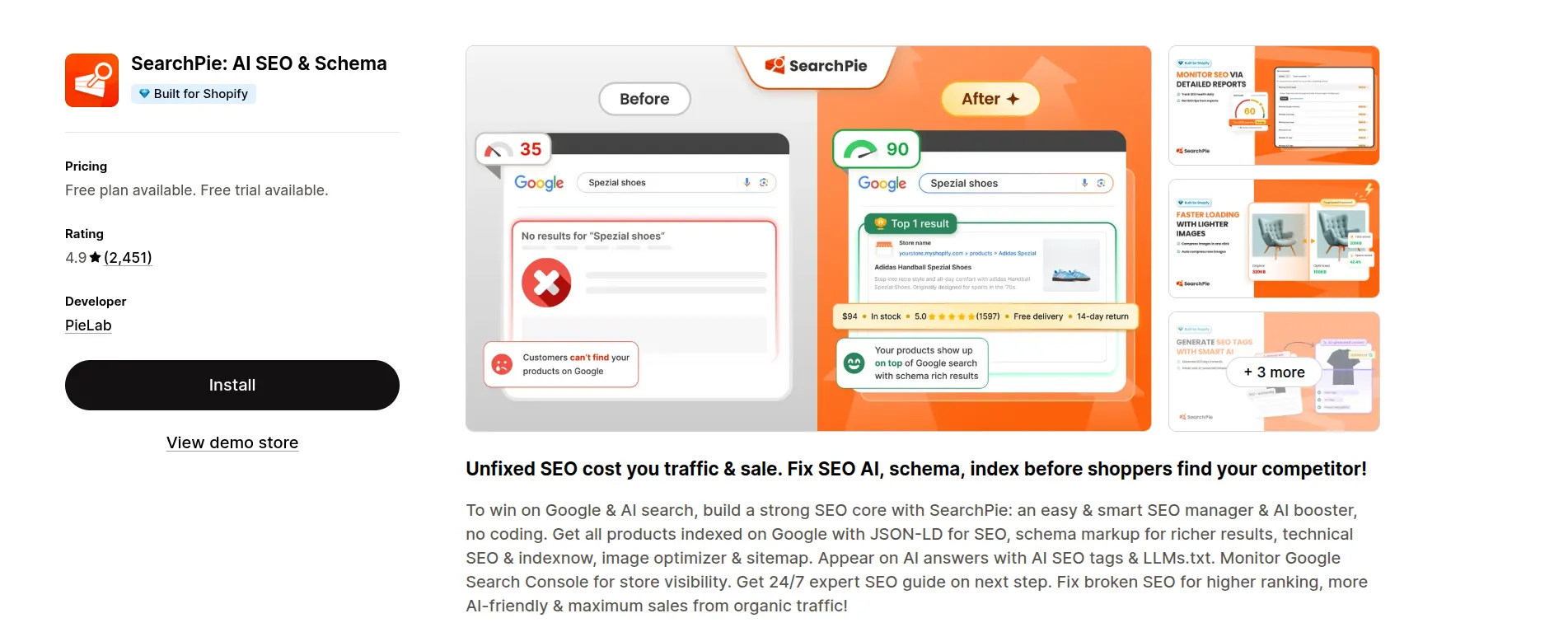
This makes it useful when your store needs an SEO clean-up but you’re unsure where to start. Automated fixes reduce the manual work, and the support team can help with issues you don’t feel comfortable handling yourself.
Key features:
- SEO health monitoring with audit reports and AI-readiness checks.
- Bulk meta tag and ALT text updates using templates or AI.
- Store and breadcrumb schema, with product and FAQ schema on paid plans.
- Image compression, CSS minification, and instant loading.
- JavaScript minification and image lazy loading on paid plans.
- Automatic broken-link detection and fixes on paid plans.
- Keyword research and tracking on the Enterprise plan.
3. Avada AI SEO Image Optimizer
Rating: 4.9/5 from 4,687 reviews.
Pricing: Free plan available | $34.95–$99/month | 7-day free trial.
Best for: Stores that want page speed improvements alongside on-page SEO tools.
For a broader SEO clean-up, Avada combines on-page checks, technical SEO, image optimisation, and speed tools in one app. Its appeal is being able to work on search visibility and page performance together, rather than adding another tool each time you find a different issue.
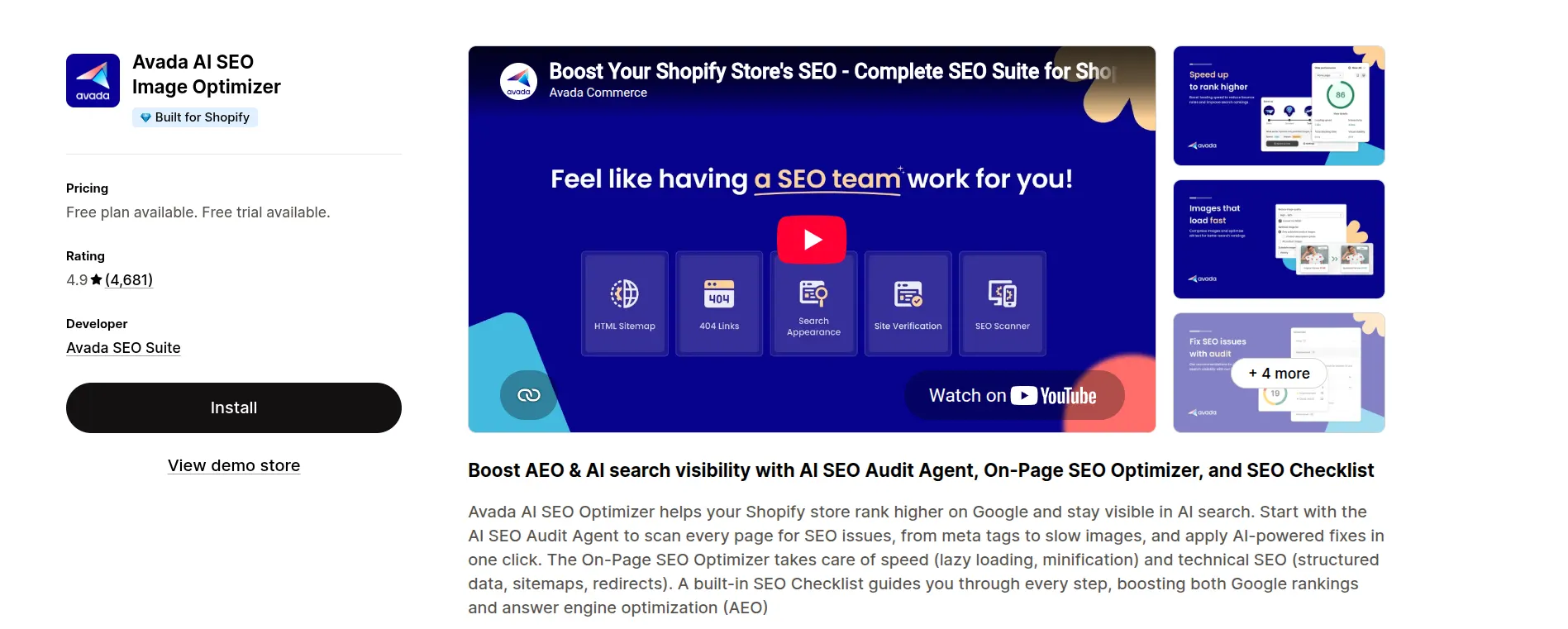
We’d recommend it for growing stores with plenty of updates to get through. The Pro plan’s unlimited image optimisation and on-page audits make it easier to keep new and existing product pages in shape. apps.shopify.com
Key features:
- Bulk image compression and resizing, with AI-generated ALT text.
- Page speed tools, including lazy loading and tiered speed boosters.
- On-page SEO audits with checklists for individual pages.
- Meta tag templates and Google structured data.
- Broken-link management and URL optimisation on paid plans.
- XML sitemap generation and a robots.txt editor on paid plans.
- An AI on-page audit agent on Enterprise.
4. Booster AI SEO + AEO Optimizer
Rating: 4.8/5 from 5,481 reviews.
Pricing: Free plan available | $39–$69/month | 14-day free trial.
Best for: Store owners who want routine SEO checks and fixes to run automatically.
With Booster, the main draw is how much SEO upkeep you can put on autopilot. It covers metadata, structured data, broken links, and image optimisation, with paid Auto Pilot tools handling supported checks and fixes in the background. If regular maintenance keeps slipping down your to-do list, it’s worth considering among the best Shopify SEO apps.
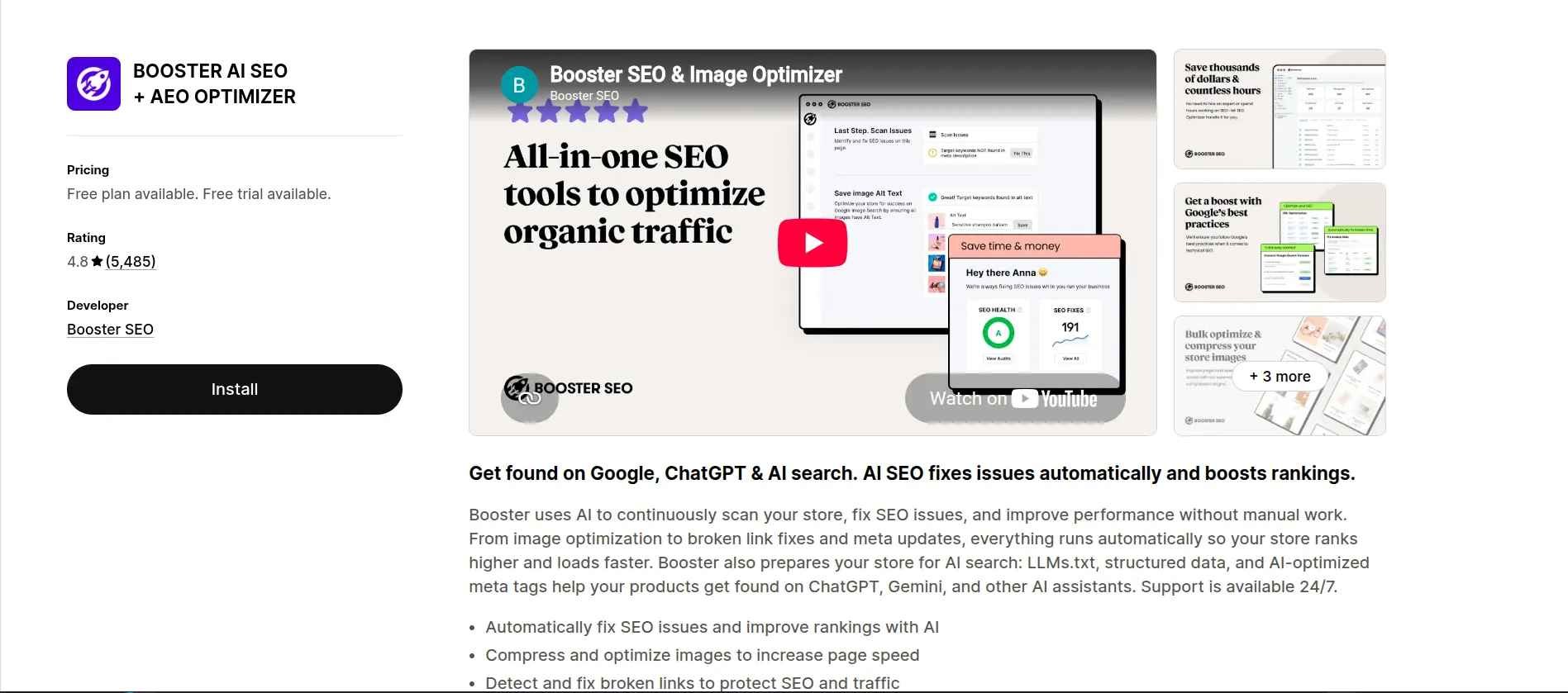
The plan split matters here. Pro includes the core SEO automation, but image compression requires Premium at $69/month. We see the strongest value in its ongoing maintenance, especially for stores that change frequently and would otherwise need regular manual checks.
Key features
- Automatic SEO monitoring and supported fixes through Auto Pilot on paid plans.
- Custom templates for meta titles, descriptions, and image ALT text.
- Automatic broken-link detection and fixes on paid plans.
- Google structured data and automated sitemap submission.
- LLMs.txt and AI-oriented metadata tools.
- Image compression with a 5GB monthly storage allowance on Premium.
- Google Search Console reporting with 365-day metrics on Premium.
5. Tapita AI SEO Optimizer
Rating: 5.0/5 from 2,634 reviews.
Pricing: Free plan available | $9.99–$49.99/month base pricing; Shopify plan surcharges apply.
Best for: Stores that need help resolving technical SEO and Google Search Console issues.
When SEO warnings go beyond a missing title or description, Tapita offers tools and hands-on help to work through them. It covers audits, metadata, structured data, images, and speed, but its technical support gives that broad toolkit more value. You have help available when a problem needs investigation rather than a quick dashboard fix.
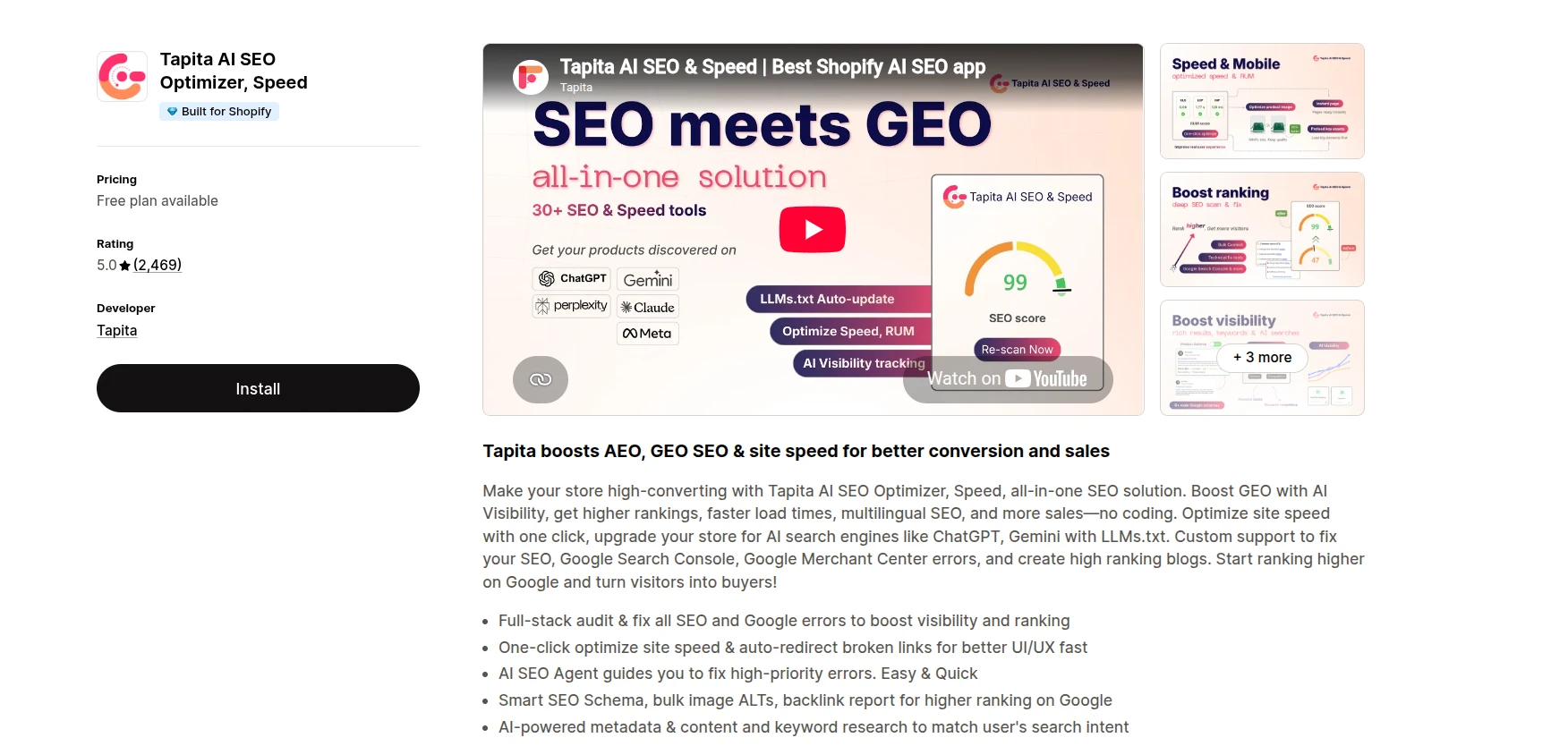
For us, that makes Tapita worth considering when you want to clean up an existing store but don’t have a developer handling SEO. Just check the full subscription cost first. Its advertised prices increase depending on your Shopify plan, and additional audit pages or AI credits can cost extra.
Key features:
- Unlimited on-page SEO audits, plus site audit coverage that varies by plan.
- Essential JSON-LD schemas on the free plan.
- Bulk and AI-generated metadata.
- Image compression, with automatic optimisation on paid plans.
- Bulk image ALT text and filename updates.
- Broken-link detection and automatic redirects on paid plans.
- Regular speed optimisation and real-user monitoring on Premium.
6. Smart SEO
Rating: 5.0/5 from 960 reviews.
Pricing: Free plan available | $14.99–$49.99/month | 7-day free trial.
Best for: Multilingual stores that need structured data alongside everyday SEO tools.
For international stores, Smart SEO is worth a closer look. Alongside metadata, image optimisation, audits, and broken-link checks, its Business plan adds multilingual support. This gives you broader SEO coverage without leaving the needs of different language versions out of the picture.
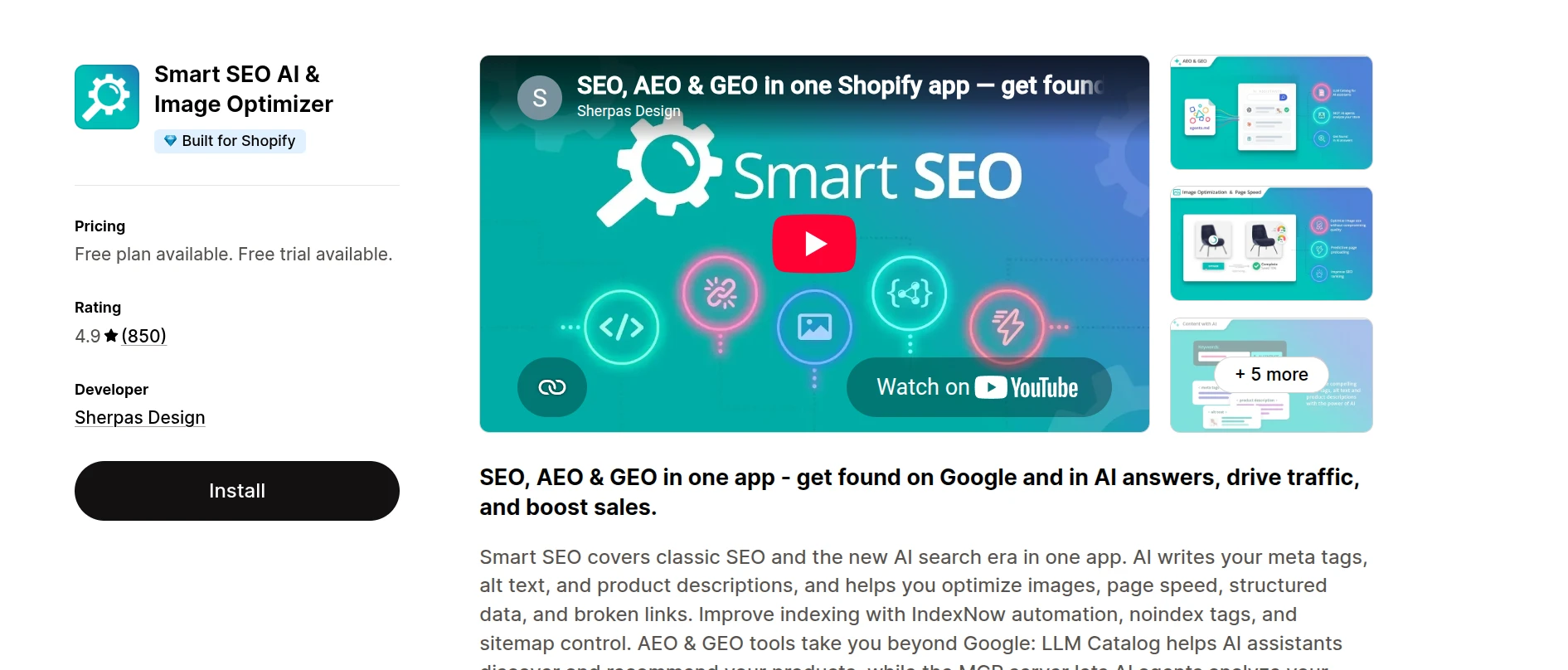
Its handling of structured data adds to the appeal. Having product information and reviews represented correctly can get complicated when themes and apps add overlapping markup. Smart SEO’s support team can help investigate those conflicts, making it a useful option when you want everyday optimisation tools with help available for more technical schema problems.
Key features:
- Bulk meta tag and ALT text optimisation on paid plans.
- JSON-LD structured data from the Pro plan.
- Multilingual support from the Business plan.
- Image compression, with AI filename optimisation on Business and above.
- Automatic SEO audits with page allowances that vary by plan.
- Broken-link checks and 404 visitor-hit detection, with link automation on Premium.
- Google Search Console integration, IndexNow, and LLMs.txt catalogues on paid plans.
7. StoreSEO
Rating: 5.0/5 from 773 reviews.
Pricing: Free plan available | $14.99–$249.99/month for listed paid plans | 7-day free trial.
Best for: Merchants who want guided product optimisation and connected SEO reporting.
If you prefer working through SEO one product at a time, StoreSEO gives you a manageable starting point. Product scores and guided suggestions help you see what needs attention, with image tools, schema, and sitemaps covering the wider setup. You can also connect Google Analytics and Search Console to keep performance data alongside your optimisation work.
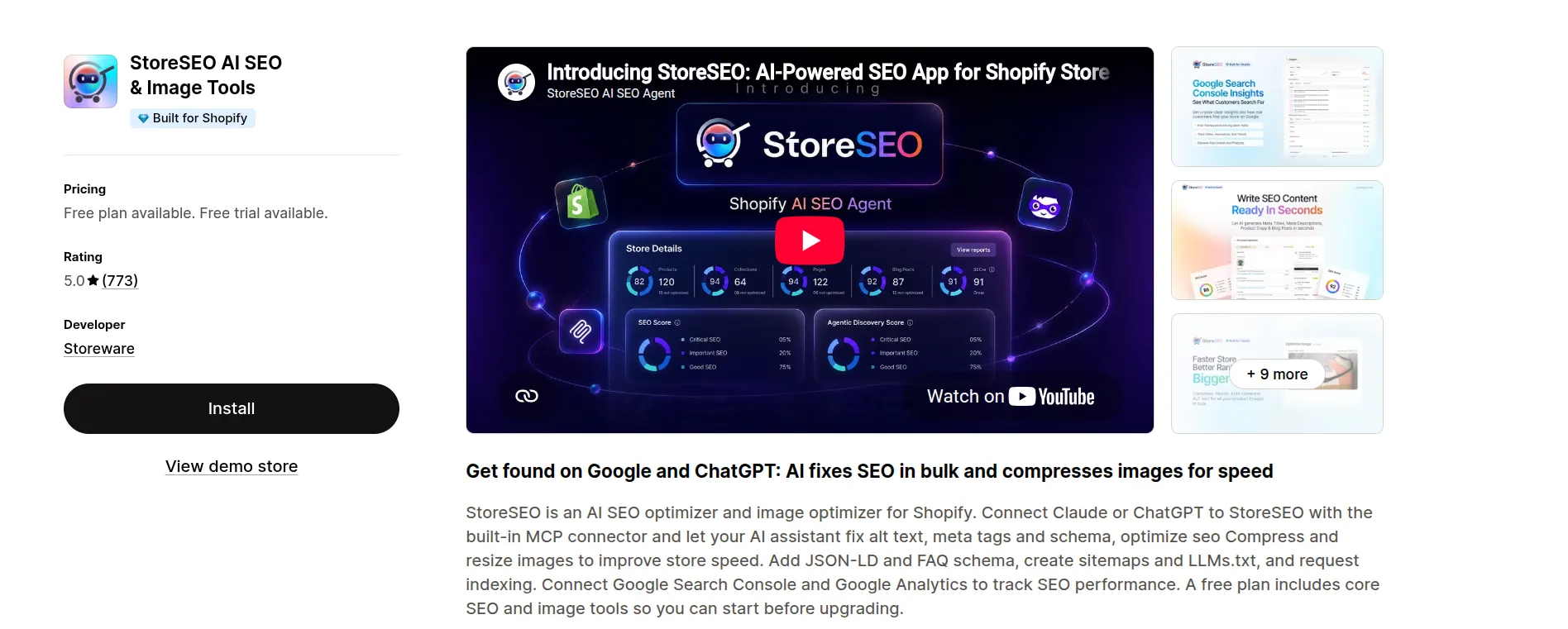
We see it as a useful fit for smaller catalogues where you want to give individual pages more attention. Product allowances become an important consideration as you grow, though. Lite covers 100 products and Essential covers 250, so check your catalogue size before choosing a subscription.
Key features:
- Product SEO scores with recommendations for page improvements.
- AI-generated content and metadata previews before publishing.
- Image compression, resizing, and bulk ALT text generation.
- JSON-LD and FAQ schema.
- Automatic sitemap submission and indexing requests on paid plans.
- Google Analytics and Search Console integrations on paid plans.
- A built-in MCP connector for working through compatible AI assistants.
8. SEOWILL
Rating: 4.8/5 from 1,809 reviews.
Pricing: Free plan available | $29.99–$59.99/month | 7-day free trial.
Best for: Stores that want content planning and creation alongside SEO maintenance.
Beyond keeping existing pages in shape, SEOWILL helps you develop new content. Keyword planning and AI blog tools sit alongside audits, image compression, structured data, and broken-link fixes. If blogging is part of your growth plan, SEOWILL deserves a look alongside the best Shopify SEO apps. You can plan new articles and maintain your store’s SEO without switching between separate tools.
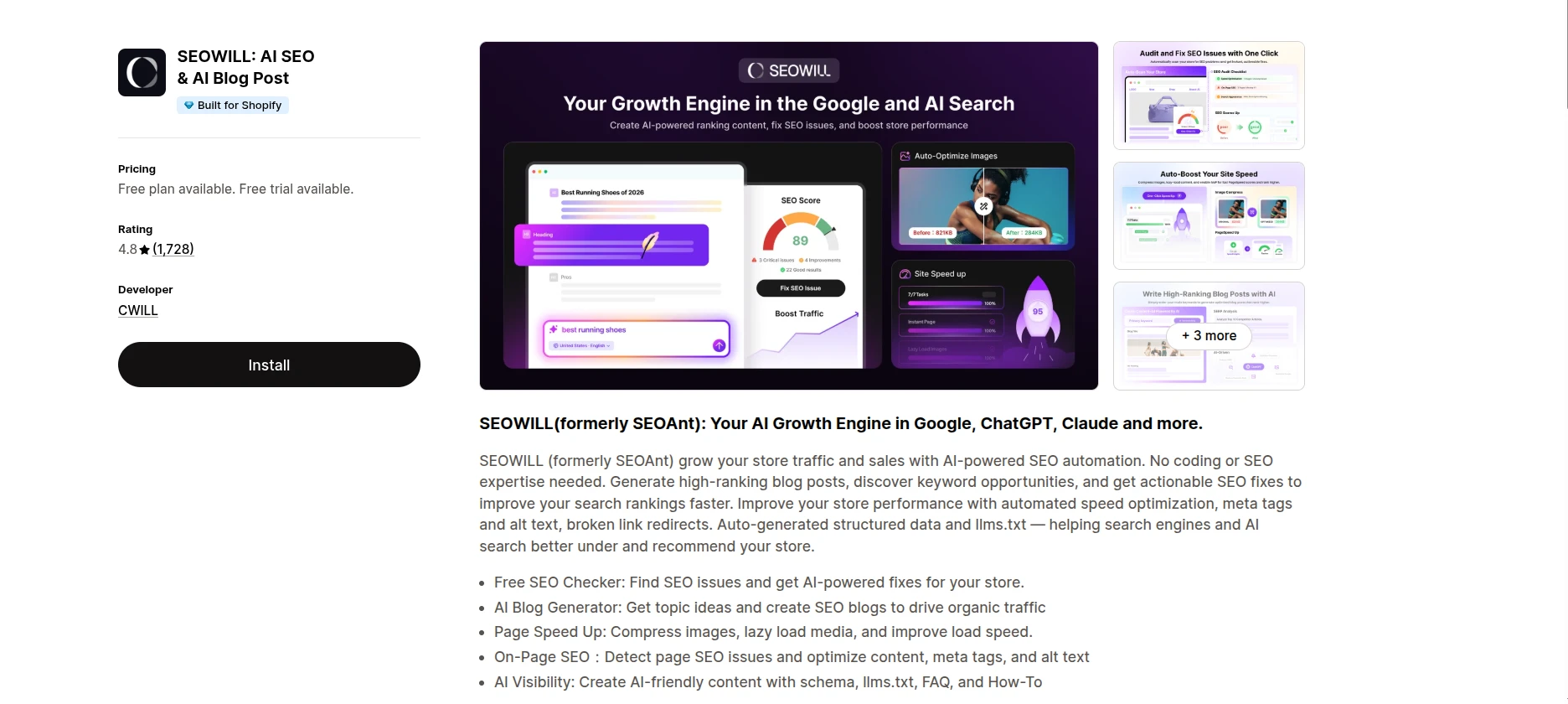
This makes it worth considering if blogging is part of your SEO strategy and you need help getting drafts started. Premium adds competitor analysis and AI internal linking, giving you more ways to develop that work. The content tools use credits, so your publishing volume will help determine which plan makes sense.
Key features
- Full-site SEO and GEO audits, plus individual page checks.
- A keyword content planner and AI blog generator.
- AI content optimisation with plan-based credit allowances.
- Automatic and bulk meta tag editing on paid plans.
- Image compression, with 2,000 images per month on Pro and 6,000 on Premium.
- Structured data and automatic broken-link redirects on paid plans.
- Competitor analysis and AI internal linking on Premium.
9. SEO King
Rating: 4.7/5 from 542 reviews.
Pricing: Free plan available | $9.99–$16.99/month for listed paid plans.
Best for: Larger catalogues that need affordable bulk SEO editing.
At a relatively low monthly price, SEO King offers plenty of room for catalogue-wide updates. Its paid plans combine bulk content and image tools with technical SEO and search analytics. For us, that balance of coverage and cost earns it a place among the best Shopify SEO apps for larger catalogues on a tighter budget.
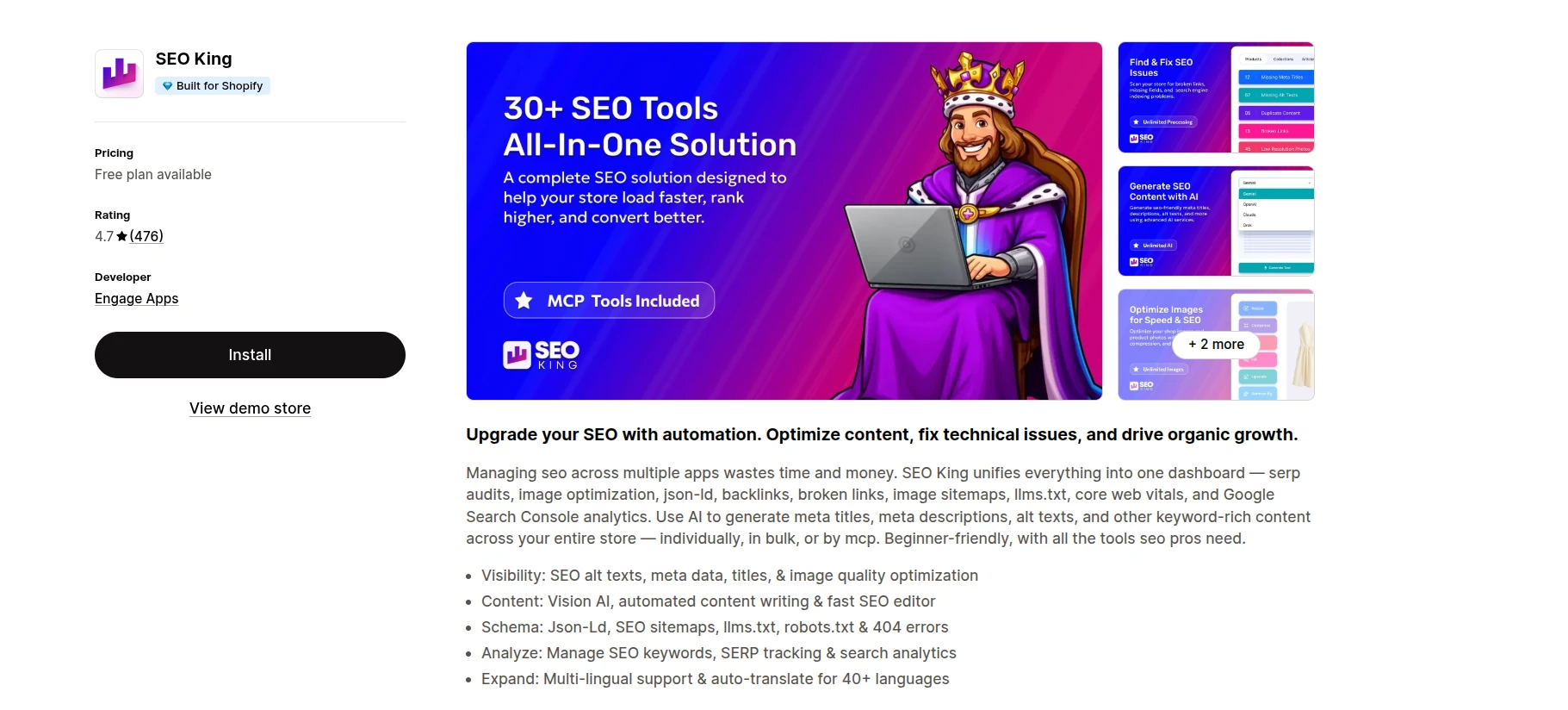
The listed paid tiers provide the same broad feature access, with pricing based on page capacity. That makes choosing a plan fairly straightforward as your store grows. Some premium AI services, including translation and image upscaling, cost extra, so factor those in if they’re central to how you’ll use the app.
Key features:
- Bulk AI generation for meta titles, descriptions, ALT text, and other store content.
- Bulk image optimisation and filename updates.
- Automatic updates and a fast SEO editor on paid plans.
- Advanced JSON-LD schemas.
- Sitemap tools, plus robots.txt and llms.txt management.
- Broken-link checks and SEO issue scanning.
- Keyword analysis, SERP tracking, and Google Search Console analytics.
If these SEO apps have you considering Shopify for your business, our Shopify migration service can help you bring your existing store data across.
Need Help to Migrate Your Store to Shopify?
LitExtension Automated Migration Tool transfers products, customers, and orders
from 140+ platforms to Shopify – fast, accurate, and hassle-free.
Best Shopify SEO Apps for Audits and On-Page Control
Beyond the all-in-one tools above, some of the best Shopify SEO apps give you more control over specific tasks. The following options help you dig into audit findings, manage on-page settings, and refine your content with clearer guidance.
10. SEO Manager
Rating: 4.6/5 from 487 reviews on the main listing.
Pricing: $9–$59/month | 7-day free trial.
Best for: Stores that need closer control over metadata and redirects.
As products sell out and pages change, SEO Manager helps you keep the SEO details organised. It earns its place among the best Shopify SEO apps through practical metadata and redirect controls, especially for stores with frequently changing catalogues.
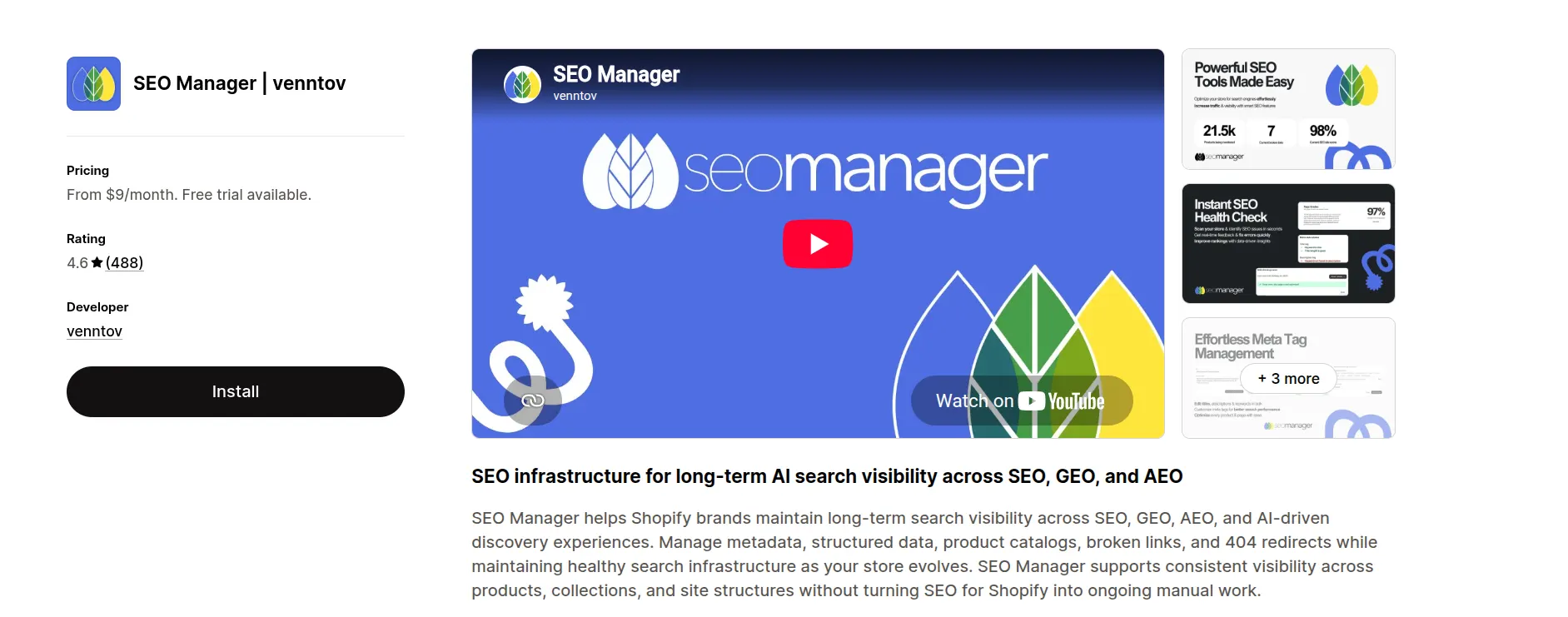
We see its strongest value in that ongoing upkeep. The in-app guidance and tutorials make technical tasks more approachable, even if SEO isn’t your main job. Starter covers monitoring, but Essential is the more relevant option when you need advanced meta tag control and redirect management.
Key features:
- SEO monitoring and page scoring.
- Google search result previews.
- Structured data testing.
- Missing-page and broken-link tracking.
- Advanced meta tag controls on Essential and above.
- Out-of-stock redirects and broken-link management on Essential and above.
- AI-assisted broken-link management and HTML sitemaps on Professional.
11. Plug In SEO
Rating: 4.6/5 from 673 reviews.
Pricing: $29.99–$79.99/month | 7-day free trial.
Best for: Merchants who want actionable audits alongside keyword research.
An audit is more useful when you know what to do with the findings. Plug In SEO pairs page-level checks with clear fix instructions, making it one of the best Shopify SEO apps for merchants who want to work through issues themselves. Keyword research also helps you improve each page’s targeting as you resolve its errors.
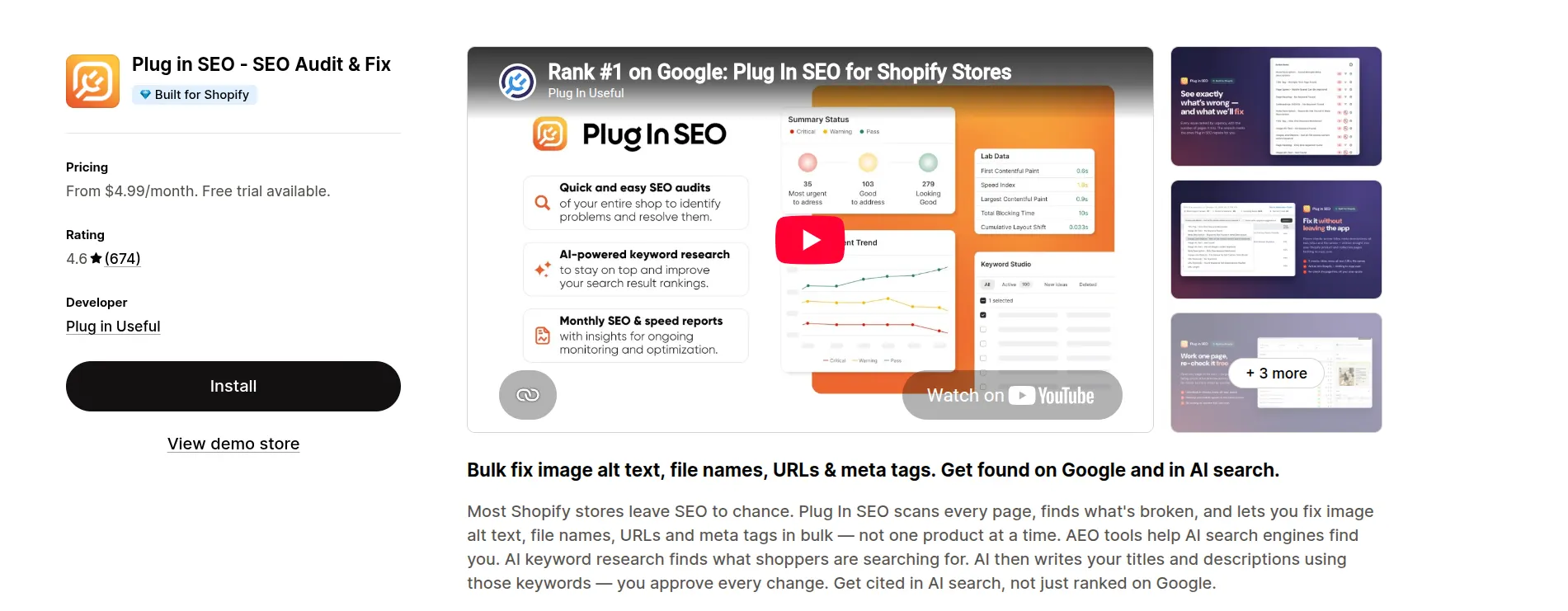
This makes it a good fit if you want to manage SEO yourself and understand the work along the way. Its guided approach gives you a clearer path through an audit, rather than just a score to improve. Page limits matter, though: Lite scans up to 200 pages, while Standard increases that allowance to 2,000.
Key features:
- SEO audits for missing tags, structured data issues, and other page problems.
- Step-by-step fix guidance with page rechecks.
- Keyword Studio with AI keyword research, search trends, and analytics.
- Bulk editing for metadata, ALT text, filenames, and URLs.
- AI-generated titles and descriptions with approval before publishing.
- JSON-LD structured data tools.
- Broken-link detection with one-click redirects.
12. Yoast SEO
Rating: 4.3/5 from 176 reviews.
Pricing: $19–$45/month | 14-day free trial.
Best for: Stores that want practical guidance on content optimisation and readability.
For improving the writing on your pages, Yoast SEO brings a more editorial approach. You choose a focus keyphrase, then use its SEO and readability feedback to refine the content. That makes it especially useful when your product descriptions or blog posts need more attention than a quick metadata update.
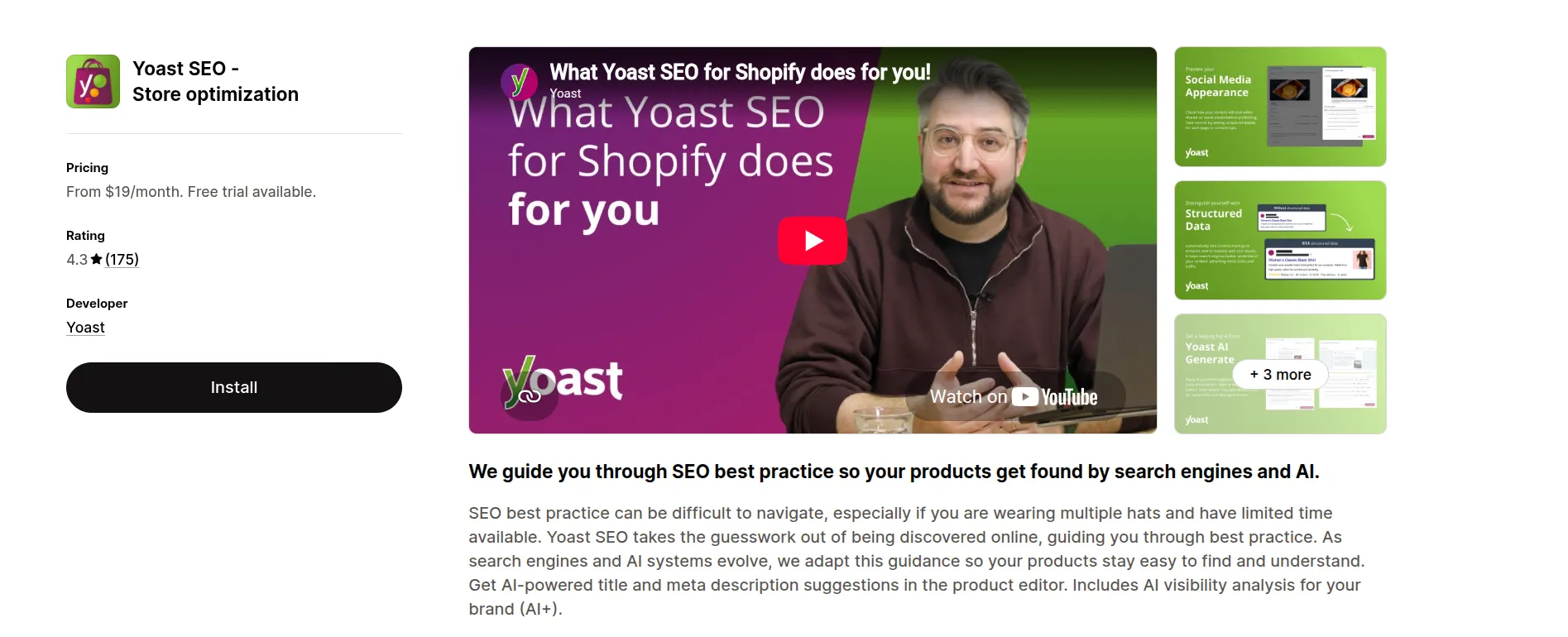
We’d include it for merchants who want to build a repeatable content review process. You still make the writing decisions, but the suggestions give you a framework to work through before publishing. Its technical SEO and structured data tools support that work, so the app covers more than copy alone.
Key features:
- SEO analysis based on a selected focus keyphrase.
- Readability checks for page content.
- AI-generated SEO title and meta description suggestions.
- An overview of products that need optimisation.
- Automatically added structured data.
- Bulk editing through import and export.
- AI visibility, sentiment, and competitor analysis on AI+.
Best Shopify Schema Apps
After audits and on-page updates, structured data is another area worth checking. Some of the best Shopify SEO apps specialise in schema, helping search engines understand your products, reviews, and business details. The following tools handle that setup and help you work through markup issues, though rich results are never guaranteed.
13. Webrex Schema
Rating: 4.9/5 from 846 reviews.
Pricing: Free plan available | $9.99–$29.99/month for listed paid plans | 14-day free trial.
Best for: Stores that want to start with free product schema and expand their coverage later.
For a low-cost starting point, Webrex Schema covers more than you might expect. Its free plan includes unlimited product schema and updates the markup as product details change. That makes it useful if your immediate goal is to get basic structured data in place without committing to another subscription.
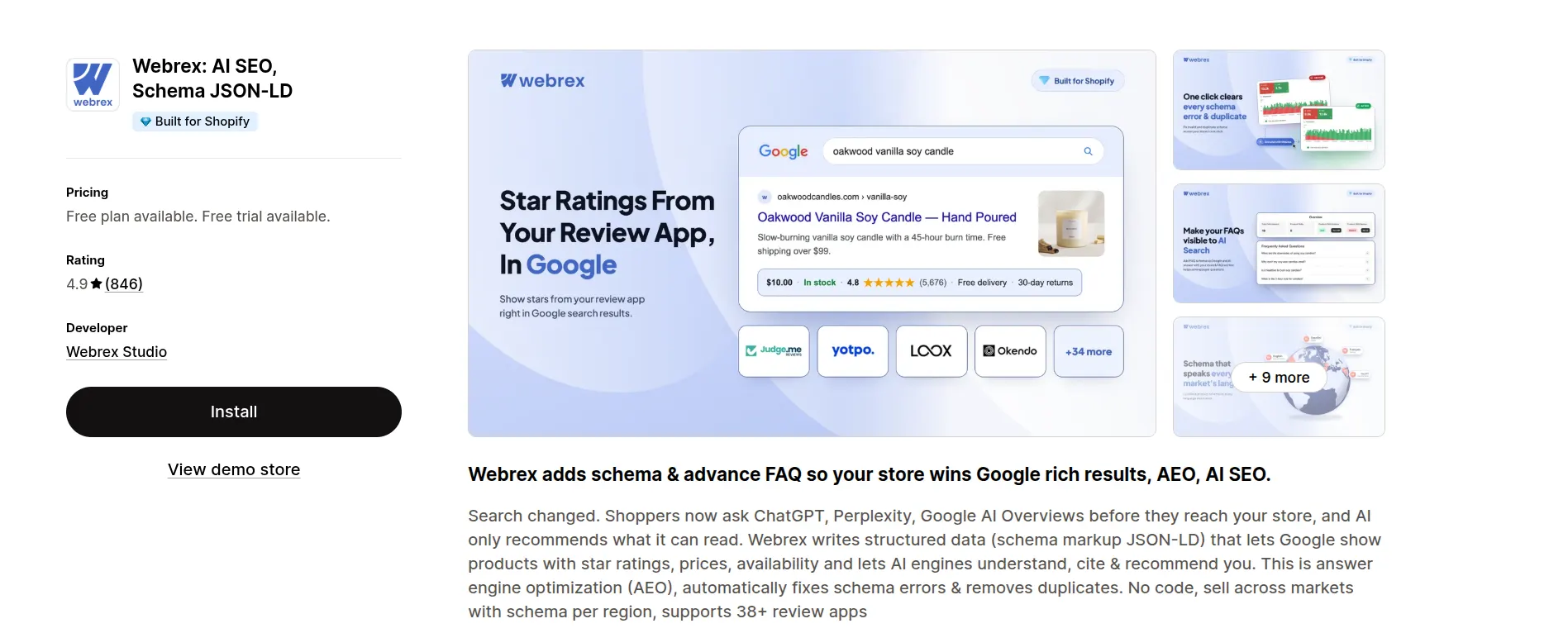
The paid tiers become more relevant when you need review integrations or help cleaning up existing markup. We like having that upgrade path, but the distinction matters: duplicate-schema removal and done-for-you error fixes sit on Pro. Choose based on the problem you need to solve, rather than assuming the entry plan covers every schema issue.
Key features:
- Automatic product schema with variant details such as size and colour.
- Organisation, local business, breadcrumb, article, and blog schema on the free plan.
- Review schema integrations with Judge.me, Loox, and other supported apps on Growth.
- Shipping and return policy markup with country allowances that vary by plan.
- Recipe, video, and additional page schemas on Growth.
- Duplicate-schema detection and removal on Pro.
- Schema error audits, assisted fixes, and rich-result monitoring on Pro.
14. Schema Plus
Rating: 5.0/5 from 594 reviews.
Pricing: $10.99–$34.99/month | 14-day free trial.
Best for: Stores that need help resolving missing, incorrect, or conflicting schema.
When structured data errors keep appearing despite your existing setup, Schema Plus is worth a closer look. It focuses on getting the markup right and resolving conflicts, with onboarding support to help check the implementation. That specialist approach earns it a place among the best Shopify SEO apps for merchants who need more than simply adding another block of schema.
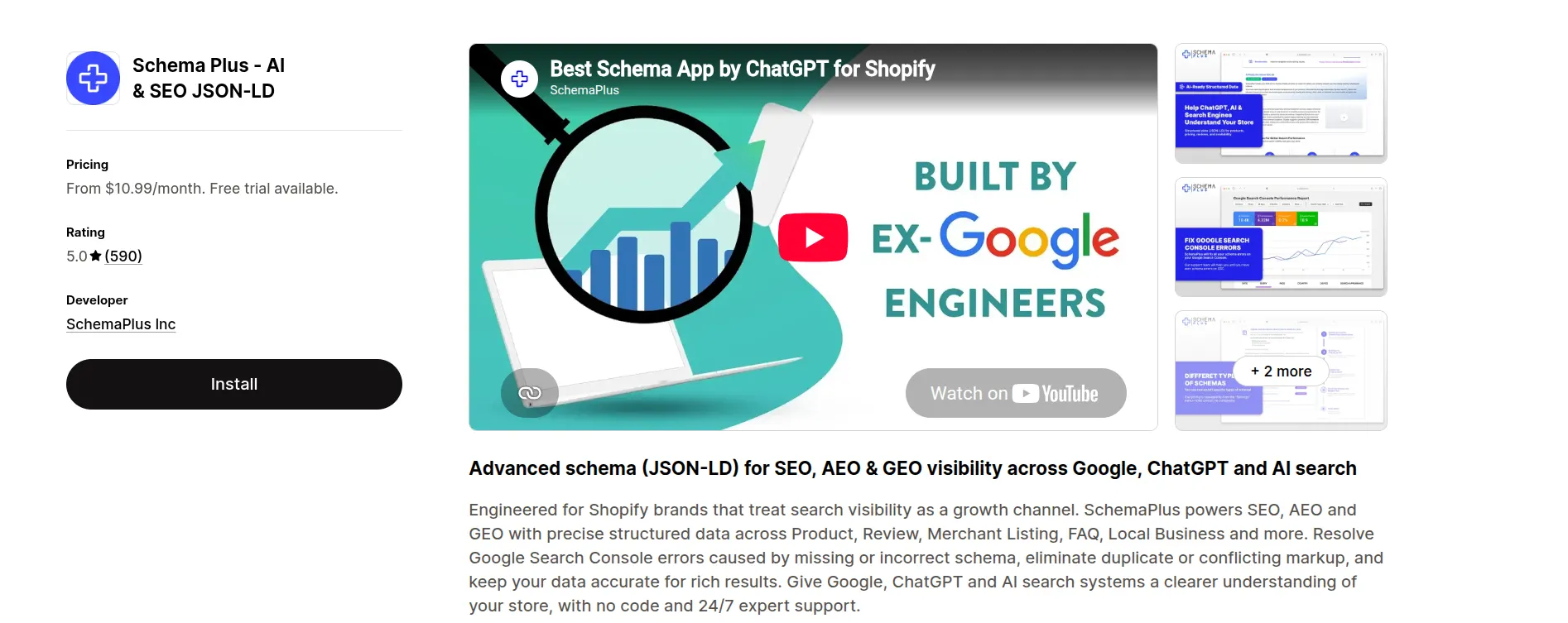
We’d consider Schema Plus when getting the setup right matters more than having extra SEO tools. The hands-on help is useful for sorting out conflicting markup from your theme and review apps. The Lite plan feels restrictive, though, with coverage for only five products. Most stores will need a higher tier, and unlimited product and review schema costs $34.99/month.
Key features:
- Product and review schema with coverage limits based on your plan.
- Integrations with review apps including Judge.me, Loox, Okendo, and Yotpo.
- Organisation, collection, blog, and breadcrumb schemas on Essential and above.
- Merchant listing, shipping, and return policy markup on Premium.
- Local business, video, recipe, and FAQ schemas on Premium.
- Google Search Console performance reports on Premium.
- Setup calls and 24/7 chat and email support across paid plans.
15. Ilana’s JSON-LD for SEO
Rating: 4.9/5 from 440 reviews.
Pricing: $399/year, equivalent to $33.25/month, billed annually | 7-day free trial.
Best for: Stores that want ongoing schema monitoring and support for more complex product details.
Rather than stopping at installation, Ilana’s JSON-LD for SEO includes a structured data audit and ongoing rich-result monitoring. That continued attention is its strongest draw. Among the best Shopify SEO apps in this section, it suits merchants who want someone keeping an eye on the results after the initial setup.
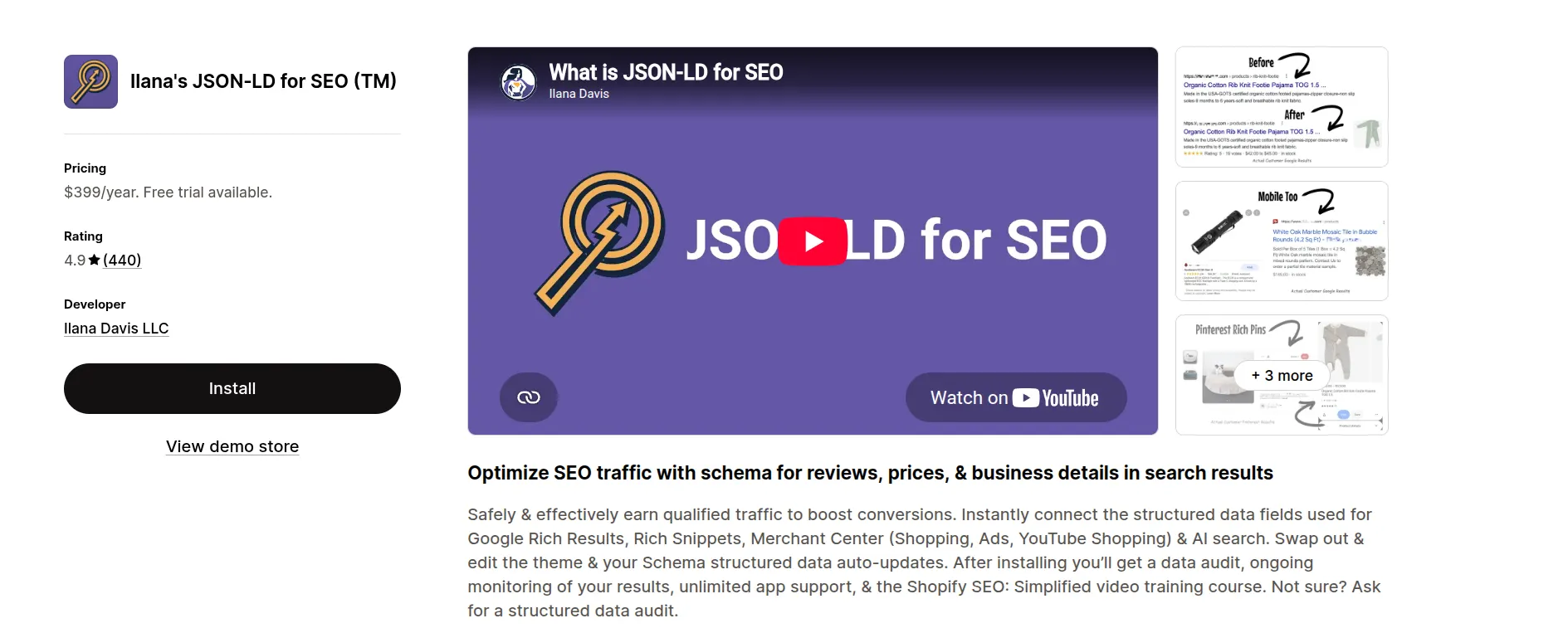
It also accommodates details that a basic setup may need help representing, including subscriptions, preorders, and product condition. We see the value here for stores with more involved requirements or owners who prefer continuing specialist support. The annual payment is a bigger upfront commitment, so it makes most sense when you’ll use that service throughout the year.
Key features:
- Structured data for products, reviews, articles, breadcrumbs, and other supported content.
- Integrations with more than 20 review apps.
- Customisable markup for preorders, subscriptions, product condition, and minimum quantities.
- Structured data fields compatible with Google Merchant Center.
- Automatic schema updates when you change or edit your theme.
- A structured data audit and ongoing rich-result monitoring.
- Unlimited app support and access to the Shopify SEO: Simplified video course.
Additional Shopify SEO Tools You Should Consider
Even the best Shopify SEO apps only cover part of the work. External tools give you a wider view of search performance, competitors, and technical issues. You can use them alongside your chosen app to decide what to improve and track the results.
- Google Search Console shows which queries and pages bring traffic from Google. It’s a useful starting point for checking indexing issues and finding pages that get impressions but few clicks.
- Ahrefs helps you explore competitors’ ranking keywords, top pages, and backlinks. We’d use it to find content gaps and link opportunities relevant to your store.
- Semrush combines keyword research with position tracking, making it useful for planning content and following your target keywords. Its overlap with Ahrefs means you can usually start with one of the two.
- Screaming Frog SEO Spider crawls your store for broken links, redirect chains, and missing or duplicate metadata. It’s particularly handy for migration checks, with free crawls covering up to 500 URLs.
- Google PageSpeed Insights checks mobile and desktop performance and highlights areas to improve. Its diagnostics help you investigate slow pages beyond simply looking at a speed score.
How We Chose and Ranked These Shopify SEO Apps
To compare the best Shopify SEO apps, we use five criteria with different weights. Our research draws on official feature lists, pricing, and recurring feedback from Shopify merchants.
- SEO features and category fit (30%). We look at how well each app addresses the needs of its category, from everyday optimisation to specialist schema work.
- Merchant feedback (25%). We consider recurring strengths and concerns across reviews, rather than relying on star ratings alone.
- Value for money (20%). We check what each plan includes, along with usage limits, paid upgrades, and additional charges.
- Ease of use (15%). Clear instructions and manageable workflows matter, especially for merchants handling SEO themselves.
- Customer support (10%). We review feedback on response times, technical knowledge, and help resolving issues.
Each app is assessed within its category, so a schema specialist doesn’t lose points for lacking image compression. These weights guide our editorial assessment, which is based on published information and merchant feedback rather than hands-on testing of every app.
Shopify SEO Apps: FAQs
What are the best Shopify apps for SEO/AEO and AI Visibility?
TinySEO, SearchPie, and SEOWILL are worth considering for broad SEO coverage with AI-search features. For structured data specifically, Webrex, Schema Plus, and Ilana’s JSON-LD for SEO offer more focused support. Choose based on the work your store needs, rather than AI visibility claims alone.
Does Shopify have built-in SEO?
Yes. Shopify automatically generates canonical tags, sitemap.xml, and robots.txt files. You can also edit page titles, meta descriptions, URLs, and image ALT text. SEO apps build on these basics with tools such as bulk editing, audits, and more advanced automation.
Do Shopify SEO apps slow down my store?
They can, depending on how much code they load on your storefront. Apps that add scripts or other assets may affect performance, especially when several run together. Check your store’s performance before and after installation using Shopify’s web performance reports.
Can an SEO app get my store into ChatGPT or Google AI Overviews?
No app can guarantee inclusion in ChatGPT or Google AI Overviews. SEO tools can improve your content and technical setup, but placement still depends on each platform. Google also confirms that AI Overviews require no special schema beyond its existing SEO guidance. developers.google.com For a closer look at Shopify’s approach to AI shopping channels, read our guide to Shopify Agentic Storefronts.
How many SEO apps should I install?
We recommend starting with one main SEO app. Add a specialist tool only when it fills a clear gap, such as advanced schema support. Before combining apps, check whether they both control metadata, redirects, or structured data, and disable overlapping functions to reduce the chance of conflicts.
Final Verdict: Which Shopify SEO App Should You Choose?
After reviewing the options, we found that the best Shopify SEO apps depend on what your business needs most. Here are the names we’d shortlist for each priority:
- Image-heavy catalogues: TinySEO
- Automated SEO maintenance: Booster
- Content planning and creation: SEOWILL
- Guided audits and keyword research: Plug In SEO
- On-page content optimisation: Yoast SEO
- Specialist schema support: Schema Plus
If you’re planning a move to Shopify, our Shopify migration service can help you transfer your store data and prepare for the next stage. You can also explore our Shopify blog posts for practical guides on setting up, managing, and growing your store.