While Salesforce Commerce Cloud (or now Agentforce Commerce) offers robust features for enterprises, this platform might not be the perfect fit for everyone. That's why many businesses are seeking Salesforce Commerce Cloud alternatives that deliver better value for their online stores.
In this guide, we will examine 10 proven Salesforce Commerce Cloud alternatives, including:
- Shopify Plus
- BigCommerce Enterprise
- Adobe Commerce
- commercetools
- SAP Commerce Cloud
- Swell
- Elastic Path
- NetSuite
- Sana Commerce Cloud
- Virto Commerce
By the end, you will know which options deserve a place on your shortlist, and you will have a simple checklist to evaluate your next platform with confidence. Let's get going!
10 Best Salesforce Commerce Cloud Alternatives to Consider
Before diving into the details, here's a quick overview of the best Salesforce Commerce Cloud alternatives. Each option comes with its pros, cons, and ideal use cases, so you can quickly compare them before deciding which platforms deserve a deeper look.
Platform | Pros | Cons | Best for |
Shopify Plus | - Intuitive admin panel that enables rapid changes - Vast app ecosystem for added functionalit | - Limited deep back-end customization - Themes and checkout flow have some design constraints | Fast-growing businesses and established enterprises seeking scalability and ease of use |
BigCommerce Enterprise | - Enterprise Robust API framework with powerful headless support - Predictable pricing subscription with no transaction fees | - Steeper learning curve for custom development - Some limitations in complex product management | Scaling brands and retailers seeking flexible customization, reliability, and cost efficiency |
Adobe Commerce | - Open-source foundation enabling unlimited customization - Advanced B2B and B2C capabilities in one platform | - Requires dedicated development resources and technical expertise - Steep learning curve and complex implementation process | Large enterprises with dedicated development teams seeking maximum customization and deep integration capabilities |
commercetools | - True composable architecture with extensive API coverage - Cloud-native infrastructure on AWS and Google Cloud Platform | - Steeper learning curve requiring experienced development teams - Higher initial setup costs compared to out-of-the-box solutions | Large-scale retailers with dedicated development resources seeking maximum flexibility and composable architecture |
SAP Commerce Cloud | - Deep SAP ecosystem integration for end-to-end business processes - Advanced B2B capabilities with contract and quote management | - Complex implementation requiring specialized SAP expertise - Higher total cost of ownership including licensing and maintenance | Large enterprises already using SAP systems, seeking deep ERP integration and complex B2B capabilities |
Swell | - True API-first headless architecture built for modern commerce - Native subscription engine with flexible billing intervals | - Requires technical resources for custom frontend development - Less suitable for businesses needing pre-built templates | Fast-growing D2C brands seeking modern headless architecture, native subscription capabilities, and predictable pricing |
Elastic Path | - Unlimited catalogs and sophisticated price book management - True API-first composable commerce architecture | - Requires dedicated development resources for customization - Smaller partner ecosystem compared to established platforms | Mid-market to enterprise B2B companies seeking unlimited customization, sophisticated pricing capabilities, and composable architecture |
NetSuite | - Seamless ERP and commerce integration in one platform - Real-time visibility across financials, inventory, and orders | - Longer implementation timelines due to ERP complexity - Steeper learning curve compared to standalone platform | Mid-sized to large enterprises seeking unified commerce and ERP functions |
Sana Commerce Cloud | - Seamless real-time ERP integration with Microsoft Dynamics and SAP - B2B-focused features including self-service portals and account hierarchies | - Limited to businesses using Microsoft Dynamics or SAP ERP systems - Complex pricing customizations can be expensive to implement | B2B manufacturers, distributors, and wholesalers using Microsoft Dynamics or SAP ERP systems |
Virto Commerce | - Open-source architecture with full code access and customization - Built-in PIM and OMS without third-party dependencies | - Requires experienced development team for setup and maintenance - Smaller partner ecosystem compared to enterprise platforms; | Mid-sized to enterprise B2B companies with dedicated development resources seeking open-source flexibility and built-in PIM/OMS capabilities |
1. Shopify Plus
Shopify Plus stands as one of the most powerful Salesforce Commerce Cloud alternatives, designed specifically for high-volume enterprises requiring scalability, customization, and ease of use. This platform provides merchants with a cloud-based, fully managed eCommerce platform that streamlines store operations while reducing dependence on technical maintenance.
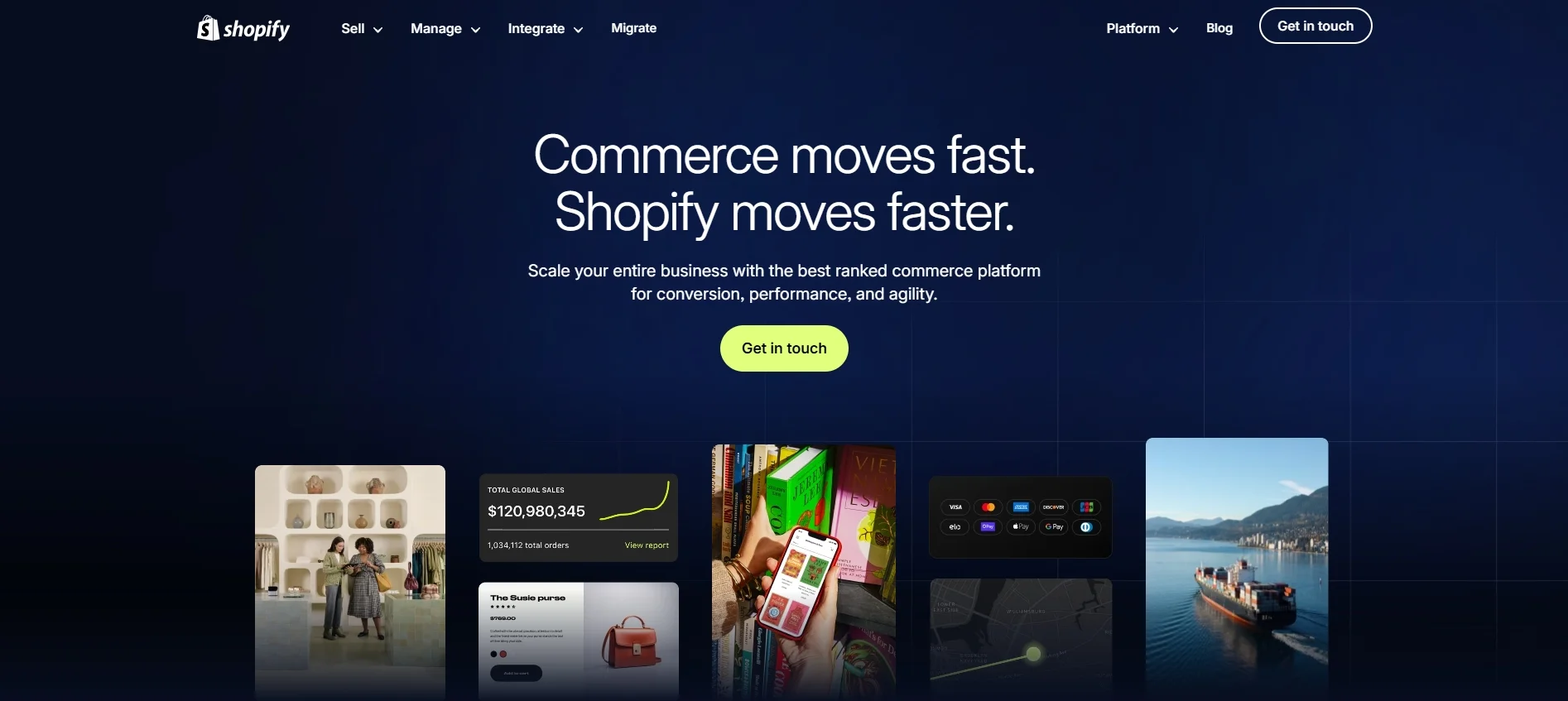
Additionally, this platform also equips businesses with powerful Shopify Plus features to launch quickly, integrate with multiple sales channels, and access enterprise-grade tools with less complexity than Salesforce Commerce Cloud. For more expert insights on how this platform performs, please check out our Shopify Plus review here.
Why Shopify Plus is among the best Salesforce Commerce Cloud alternatives:
- Offer a more user-friendly backend and simplify store management.
- Provide faster deployment, allowing brands to go live quickly.
- Offer flexible integrations, including native connections to social commerce, marketplaces, and key apps through Shopify’s vast app ecosystem.
Now, let's weigh the key advantages and limitations of Shopify Plus.
Pros | Cons |
- Intuitive admin panel that enables rapid changes and simplified management. - Reliable and fast cloud hosting. - Vast app ecosystem for added functionality. - 24/7 dedicated Plus support and account management. | - Limited deep back-end customization compared to Salesforce Commerce Cloud. - May require third-party apps for advanced enterprise needs. - Less control over core code and infrastructure. |
Best for: High-growth B2C and D2C brands that want a hosted enterprise solution with fast time-to-market and a huge app ecosystem.
2. BigCommerce Enterprise
BigCommerce Enterprise is a comprehensive and flexible eCommerce platform often recognized as one of the top Salesforce Commerce Cloud alternatives. The platform provides a fully hosted SaaS environment designed to handle high-traffic enterprise stores while maintaining fast performance and reliable uptime.
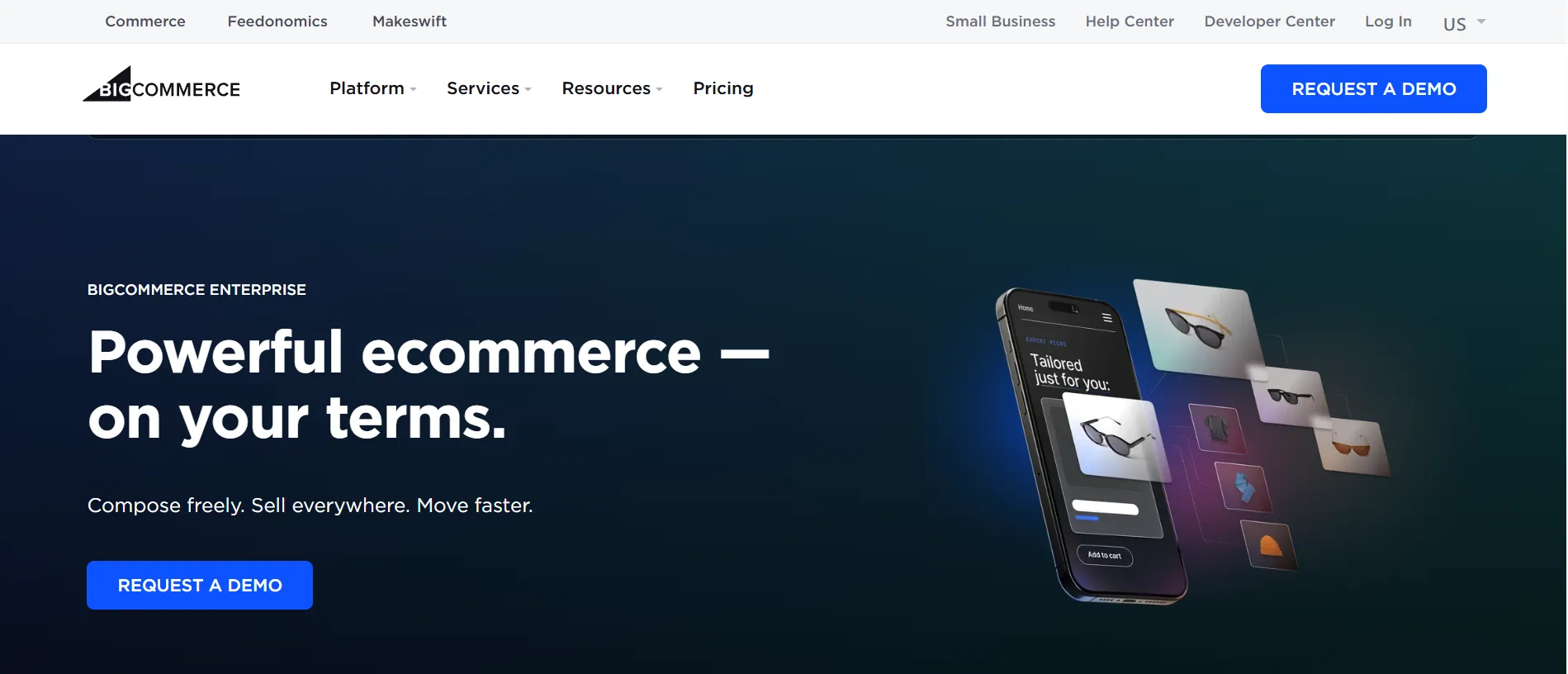
BigCommerce Enterprise empowers businesses to scale globally, manage multiple storefronts, and streamline operations with open APIs and built-in integrations. Compared to Salesforce Commerce Cloud, BigCommerce Enterprise offers a simpler setup, more transparent costs, and faster deployment times.
Why BigCommerce Enterprise is among the best Salesforce Commerce Cloud alternatives:
- Enable seamless customization through flexible API-driven architecture.
- Deliver consistent uptime and faster load times on a secure, hosted infrastructure.
- Eliminate transaction fees and provide more predictable total costs.
Let's take a look at BigCommerce Enterprise strengths and limitations before deciding:
Pros | Cons |
- Robust API framework with powerful headless support. - Predictable pricing and no transaction fees. - Fast, scalable cloud infrastructure. - Advanced multi-channel and cross-border commerce tools. | - Steeper learning curve for custom development. - Fewer third-party extensions compared to larger ecosystems. - Fewer built-in marketing automation features. |
Best for: Mid-market and enterprise brands that need built-in B2B features, multi-storefront support, and strong flexibility without fully committing to a composable stack from day one.
3. Adobe Commerce
Adobe Commerce (formerly Magento Commerce) is an enterprise-focused eCommerce platform that offers deep flexibility, rich native features, and support for both B2B and B2C selling. It provides a modular, extensible architecture and a vast ecosystem of extensions, allowing enterprises to tailor every layer of the buying journey in ways that many other Salesforce Commerce Cloud alternatives cannot match.
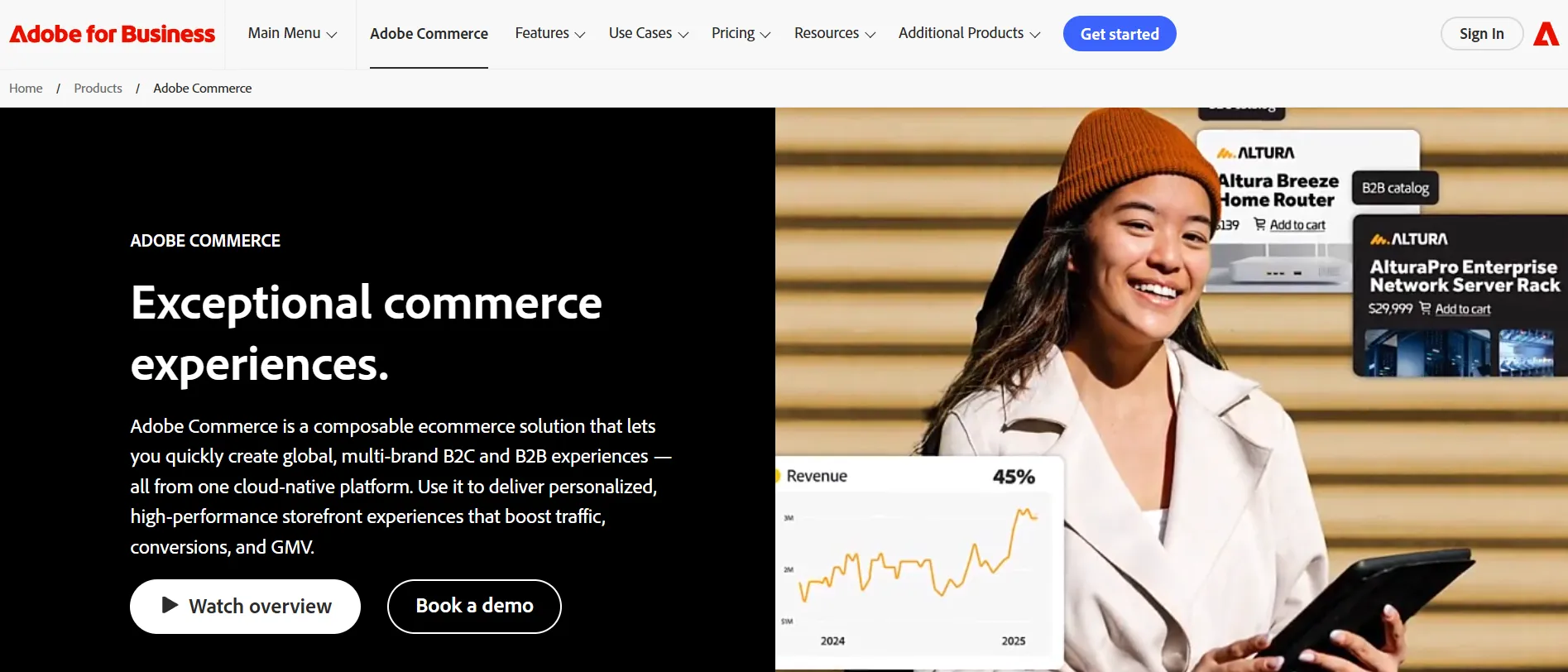
On top of that, this platform also connects tightly with Adobe Experience Cloud products, enabling brands to unify content, personalization, and analytics across channels. For this reason, Adobe Commerce is being trusted by over 3,000 store owners across the world (according to BuiltWith).
Why Adobe Commerce is among the best Salesforce Commerce Cloud alternatives:
- Offer unlimited customization through its open-source foundation.
- Support truly unlimited product variants and complex catalog structures that Salesforce Commerce Cloud struggles to handle efficiently.
- Enable complete control over hosting, data, and infrastructure for businesses with strict compliance requirements.
Best for: Enterprises that need deep customization, advanced B2B features, and full control over their commerce stack, supported by a strong global partner network.
4. commercetools
Coming up next on our list of the best Salesforce Commerce Cloud alternatives is commercetools. This platform positions itself as a pure headless and API-first platform, so your developers can build exactly the experiences your business needs. Since commercetools focuses on MACH principles (Microservices, API-first, Cloud-native, Headless), your team can connect commerce functions to any front end or service.
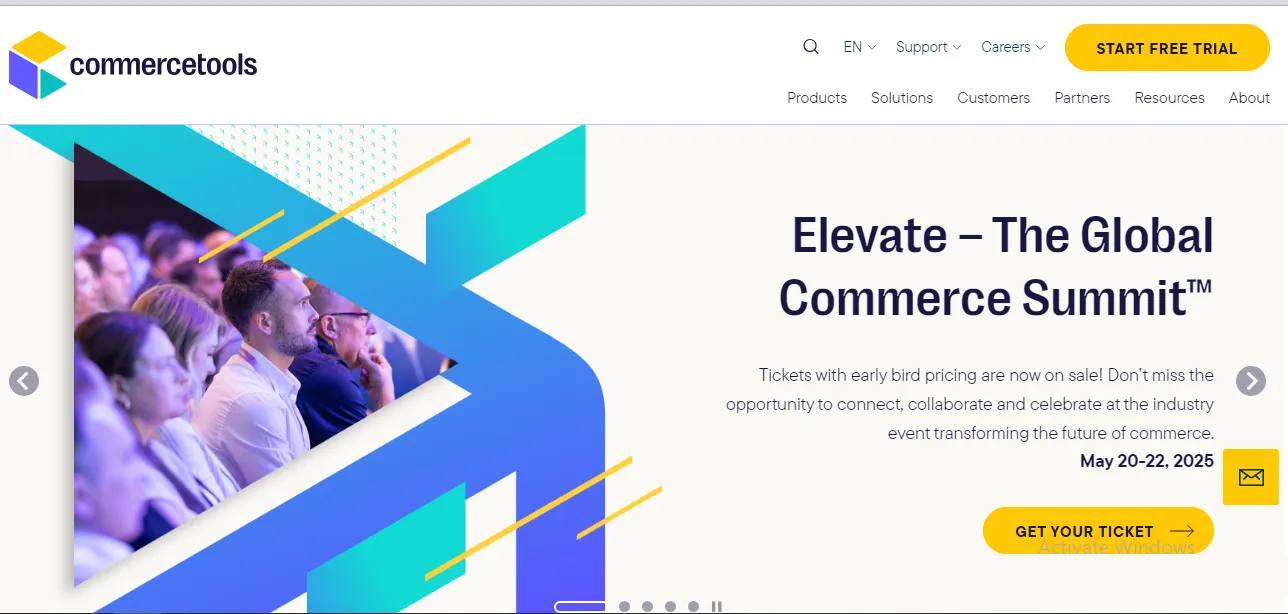
Many global brands choose commercetools when they want to move away from monolithic systems and design a modular stack that scales across regions and channels. As a result, commercetools often appeals to digital leaders and CTOs wanting to modernize their entire architecture, not just swap one platform for another.
Why commercetools is among the best Salesforce Commerce Cloud alternatives:
- Offer true headless, API-first architecture for unlimited front-end flexibility.
- Enable faster innovation through microservices that can be updated independently.
- Provide scalable infrastructure capable of handling millions of SKUs without performance degradation.
Overall, commercetools comes with clear strengths and trade-offs, so you should review these pros and cons before moving forward.
Pros | Cons |
- True composable architecture with extensive API coverage - Cloud-native infrastructure on AWS and Google Cloud Platform - Modular pricing model offering cost efficiency - Supports unlimited SKUs in Premium Edition | - Steeper learning curve requiring experienced development teams - Relies heavily on third-party integrations for marketing features - Higher initial setup costs compared to out-of-the-box solutions - Fewer pre-configured settings for beginners |
Best for: Enterprises that want a modern, composable commerce stack with headless APIs, strong scalability, and maximum architectural flexibility.
5. SAP Commerce Cloud
SAP Commerce Cloud focuses on organizations that already run a big part of their business on SAP and want commerce to plug into that same backbone. The platform is built to handle dense product catalogs, layered pricing models, and long B2B buying cycles, so it fits companies with intricate sales structures.
In addition, SAP Commerce Cloud supports multi-country, multi-language, and multi-brand setups, which helps global enterprises keep control across many markets. Because of this strong enterprise orientation, SAP Commerce Cloud often sits on the shortlist of Salesforce Commerce Cloud alternatives for companies that prioritize deep ERP integration and process consistency over rapid, lightweight experimentation.
Why it is among the best Salesforce Commerce Cloud alternatives:
- Provide seamless native integration with SAP ERP systems for real-time inventory and order management.
- Deliver advanced B2B functionality, including contract pricing, quote management, and complex approval workflows.
- Support sophisticated product information management with multi-dimensional attribute handling.
Before choosing this platform, let's first weigh its pros and cons.
Pros | Cons |
- Deep SAP ecosystem integration for end-to-end business processes. - Advanced B2B capabilities with contract and quote management. - Robust product content management and catalog capabilities. - Powerful order orchestration and fulfillment management. | - Complex implementation requiring specialized SAP expertise. - Higher total cost of ownership, including licensing and maintenance. - Steeper learning curve for administrators and developers. - Longer implementation timelines compared to SaaS alternatives. |
Best for: Large enterprises, especially in B2B and manufacturing, that need deep integration with SAP systems and complex commerce processes under one umbrella.
6. Swell
If you want to experiment with unique commerce experiences, Swell can get on your list of the best Salesforce Commerce Cloud alternatives to consider. This platform provides a headless, API-first architecture, so your developers can build custom storefronts, apps, or marketplaces on top of a single backend.
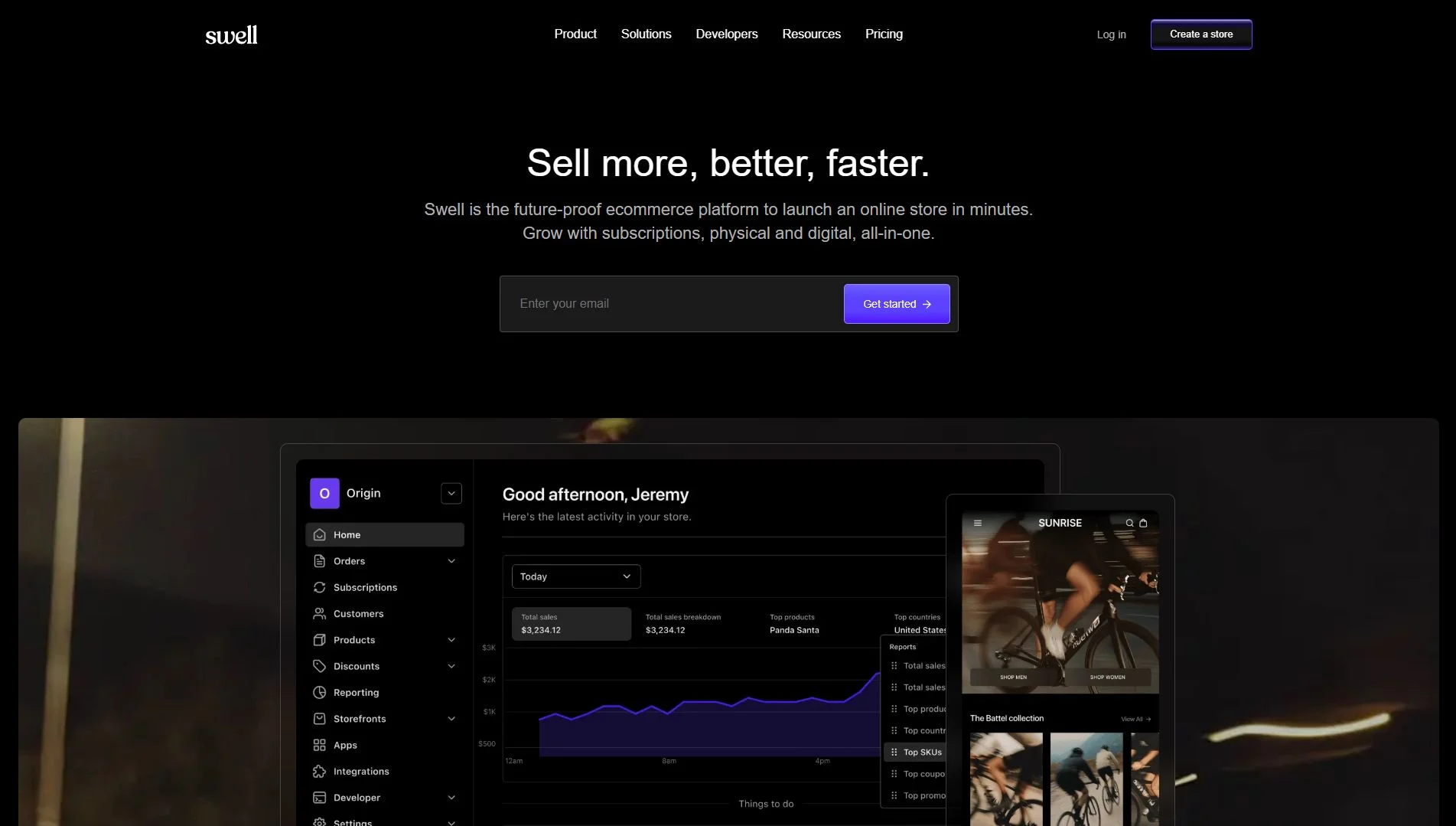
In addition, Swell supports subscriptions, memberships, and other recurring revenue models out of the box, which helps digital-first brands test new offers quickly.
Why it is among the best Salesforce Commerce Cloud alternatives:
- Offer native subscription billing with flexible intervals and customer self-service portals without custom development.
- Deliver full API-first architecture with GraphQL and REST access at every pricing tier.
- Provides unlimited product variants and custom attributes across all plans.
Now, let's see the major strengths and potential drawbacks that Swell might have.
Pros | Cons |
- True API-first headless architecture built for modern commerce - Native subscription engine with flexible billing intervals - Built-in marketplace capabilities with multi-vendor support | - Smaller app ecosystem compared to Shopify Plus or BigCommerce - Requires technical resources for custom frontend development - Less suitable for businesses needing pre-built templates |
Best for: Large enterprises, especially B2B, manufacturing, and distribution brands that need tight alignment between commerce, ERP, and complex back-office processes.
7. Elastic Path
Elastic Path focuses on brands that outgrow traditional storefront-led platforms and need commerce to sit behind many digital touchpoints. The platform offers a headless, API-first architecture, so your developers can connect commerce to websites, apps, kiosks, or any custom interface.
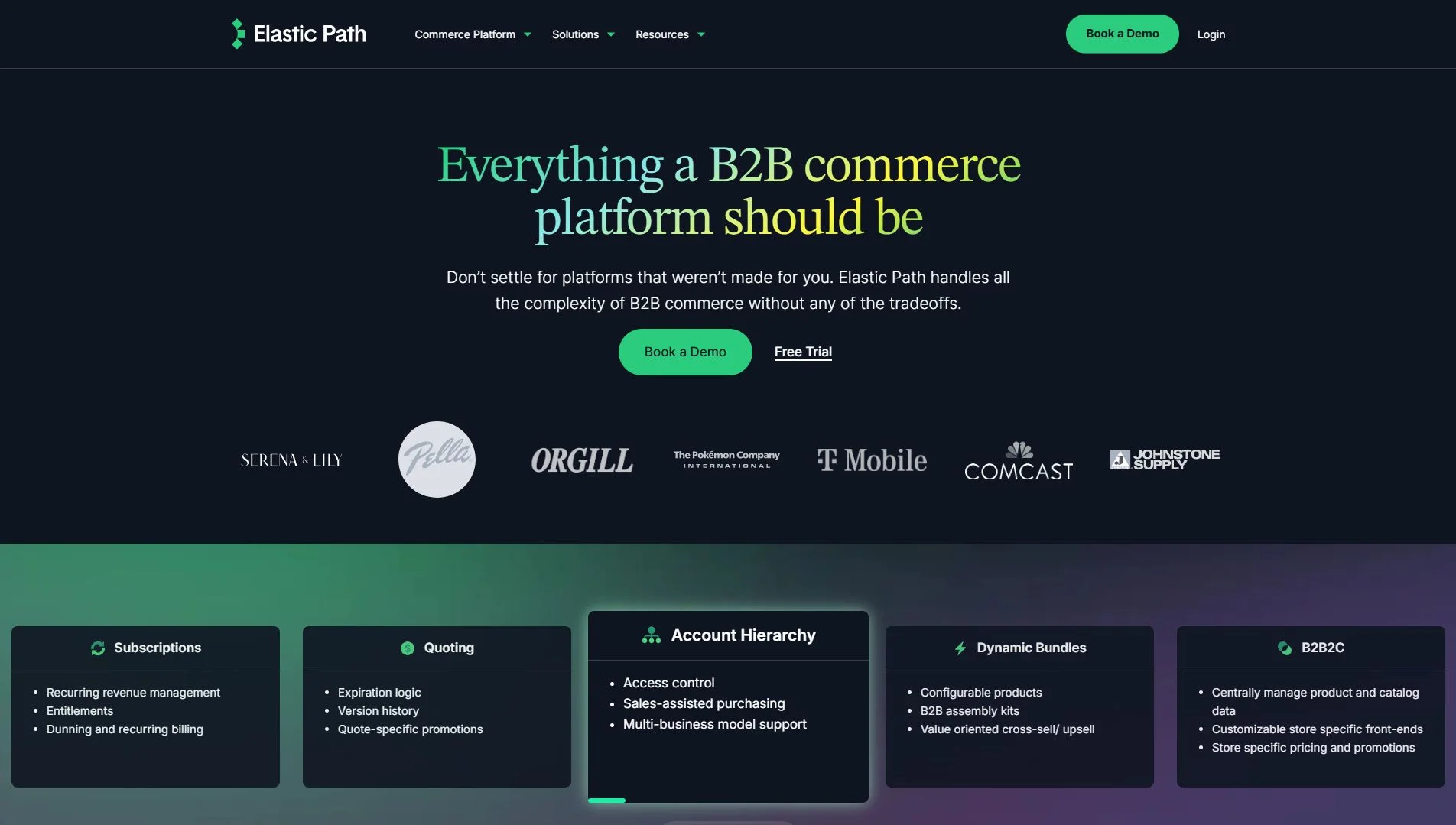
Additionally, Elastic Path places a strong emphasis on product and pricing flexibility, which helps B2B, subscription, and multi-brand businesses handle complex use cases. Many digital leaders evaluate Elastic Path alongside other Salesforce Commerce Cloud alternatives when they want a modular, future-proof stack instead of a single monolithic suite.
Why it's among the best Salesforce Commerce Cloud alternatives:
- Offer unlimited catalogs and price books for tailored buying experiences at a massive scale.
- Provide true composable architecture, allowing businesses to select and integrate best-of-breed solutions.
- Delivers sophisticated B2B capabilities, including account hierarchies, quote management, and contract pricing.
Overall, Elastic Path delivers powerful flexibility and composable options, yet it also demands the right internal skills and partners to succeed.
Pros | Cons |
- Unlimited catalogs and sophisticated price book management - True API-first composable commerce architecture - Advanced B2B features with account hierarchies and contract pricing - AI-powered tools for faster content creation and deployment | - Higher entry costs starting at $50,000+ annually - Longer implementation timelines of 3-12+ months - Requires dedicated development resources for customization - Smaller partner ecosystem compared to established platforms |
Best for: Enterprises that want composable commerce with strong catalog flexibility, complex pricing support, and the freedom to plug commerce into any front end or experience.
8. NetSuite
NetSuite SuiteCommerce is a unified commerce and ERP platform that stands out among Salesforce Commerce Cloud alternatives. It provides both B2B and B2C ecommerce capabilities within a single cloud platform, enabling businesses to manage their entire operation without juggling multiple systems.
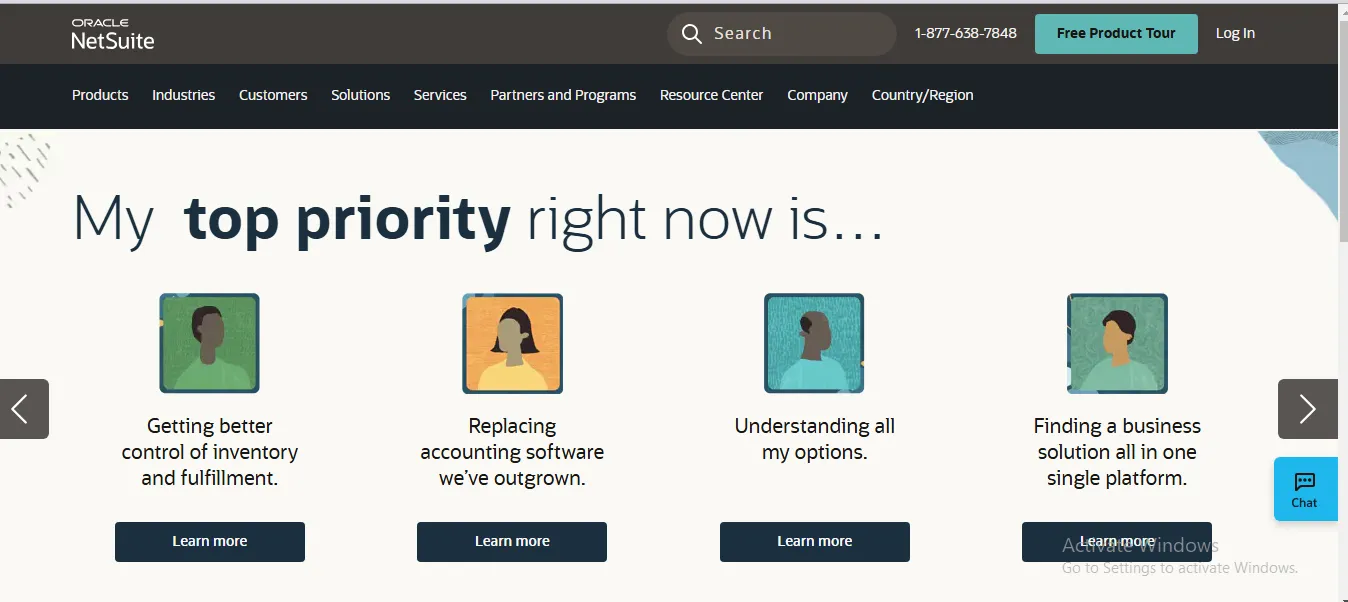
In short, NetSuite also empowers companies to deliver personalized shopping experiences while maintaining real-time visibility across customer data, inventory levels, financial transactions, and fulfillment operations.
Why it's among the best Salesforce Commerce Cloud alternatives:
- Provide native ERP integration, eliminating the need for middleware or custom connectors between commerce and financials.
- Offers real-time synchronization of inventory, orders, and customer data across all channels and business systems.
- Delivers comprehensive B2B capabilities, including quote management, account hierarchies, and negotiated pricing without custom development.
Overall, NetSuite delivers strong back-office integration, yet it also introduces trade-offs in front-end flexibility and implementation effort.
Pros | Cons |
- Seamless ERP and commerce integration in one platform - Real-time visibility across financials, inventory, and orders - Advanced B2B and B2C capabilities in single solution - Unified customer view across sales, service, and finance | - Longer implementation timelines due to ERP complexity - Higher base subscription costs starting at $999/month - Steeper learning curve compared to standalone commerce platforms - Less extensive app marketplace than Shopify or BigCommerce |
Best for: Mid-market and enterprise companies that want eCommerce, ERP, inventory, and finance inside one fully integrated cloud platform.
9. Sana Commerce Cloud
Sana Commerce Cloud has made it in the shortlist of the best Salesforce Commerce Cloud alternatives for companies that build their operations around an ERP, especially manufacturers, wholesalers, and distributors. The platform connects directly to systems like Microsoft Dynamics and SAP, so your web store can display live pricing, stock levels, and customer-specific terms without complex data syncs.
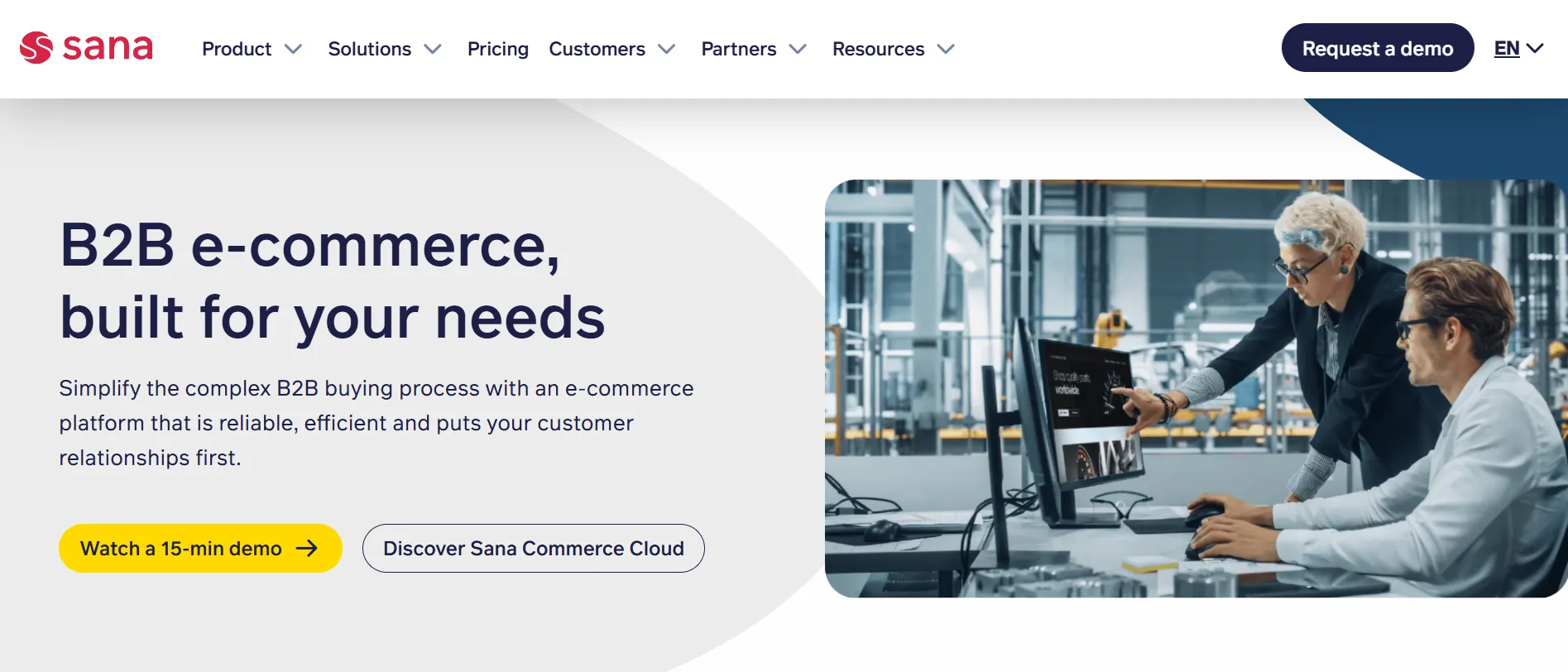
As a result, your online channel becomes a true self-service portal for buyers, and your internal teams spend less time fixing orders or updating spreadsheets.
Why it's among the best Salesforce Commerce Cloud alternatives:
- Provide real-time, native ERP integration with Microsoft Dynamics and SAP without middleware requirements.
- Use default ERP pricing logic automatically, ensuring complex pricing rules flow directly to the webstore.
- Deliver B2B-specific features, including multi-account hierarchies, negotiated pricing, and customer-specific catalogs out-of-the-box.
Overall, Sana Commerce Cloud offers strong value for ERP-centric B2B companies, yet it also comes with limitations that you should review carefully.
Pros | Cons |
- Seamless real-time ERP integration with Microsoft Dynamics and SAP - B2B-focused features, including self-service portals and account hierarchies - Uses native ERP pricing logic without custom development | - Limited to businesses using Microsoft Dynamics or SAP ERP systems - Complex pricing customizations can be expensive to implement - Smaller ecosystem compared to broader ecommerce platforms |
Best for: B2B companies that run on Microsoft Dynamics or SAP ERPs and want an eCommerce platform that stays tightly integrated with their back-office systems.
10. Virto Commerce
Virto Commerce is an open-source, cloud-native B2B ecommerce platform recognized as one of the most developer-friendly Salesforce Commerce Cloud alternatives. This platform provides a modular, API-first architecture built specifically for complex B2B operations, including multi-vendor marketplaces, e-procurement solutions, and sophisticated enterprise commerce scenarios.
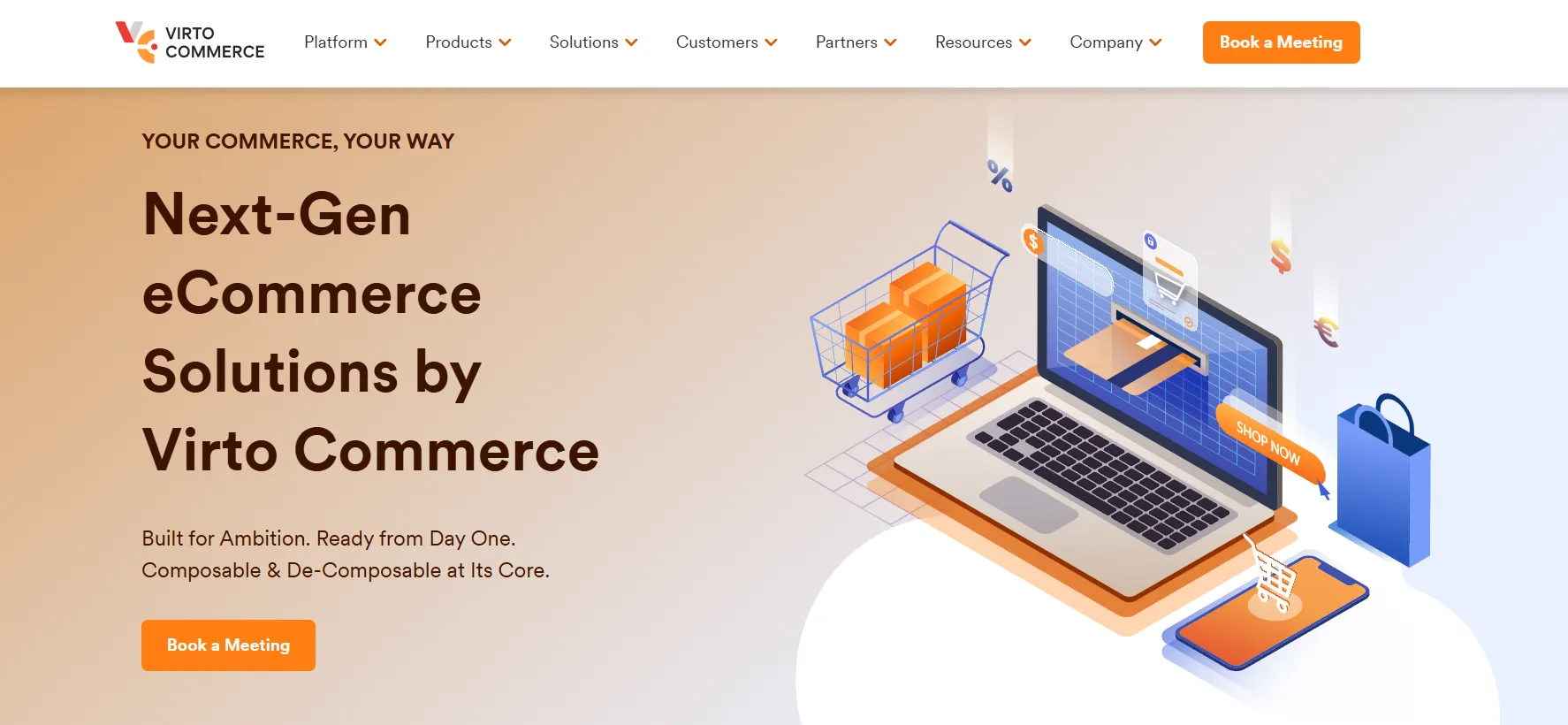
On top of that, its Atomic Architecture™ framework allows businesses to compose tailored commerce experiences without the constraints of monolithic systems or restrictive SaaS platforms.
Why it's among the best Salesforce Commerce Cloud alternatives:
- Provides open-source flexibility with full access to source code for unlimited customization beyond Salesforce Commerce Cloud's closed ecosystem.
- Offers built-in PIM and OMS capabilities, eliminating expensive third-party integrations required by Salesforce Commerce Cloud.
- Supports true multi-cloud deployment across AWS, Azure, and Google Cloud Platform without platform restrictions.
Now, let's take a look at Virto Commerce's pros and cons before deciding:
Pros | Cons |
- Open-source architecture with full code access and customization - Built-in PIM and OMS without third-party dependencies - Multi-cloud support and vendor lock-in prevention | - Requires experienced development team for setup and maintenance - Smaller partner ecosystem compared to enterprise platforms - Less out-of-the-box functionality requiring custom development |
Best for: Mid-market and enterprise B2B companies that need a highly extensible, modular .NET-based platform with strong support for complex catalogs and custom business logic.
What To Look for In A Salesforce Commerce Cloud Alternative
When you compare Salesforce Commerce Cloud alternatives, your team should focus on a few core factors instead of just features on paper. This way, your business can match each platform to real needs, not only to marketing claims.
So here's a checklist of what to look for in an alternative to SFCC.
- Business model and use cases: Your business should confirm that the platform fits your main model, such as B2C, B2B, or D2C. In addition, your team should check support for your specific use cases, like subscriptions, marketplaces, or multi-brand setups.
- Total cost of ownership: Your finance team should look beyond license fees and include implementation, extensions, and long-term development.
- Scalability and reliability: Your technical team should review how the platform handles traffic spikes, global traffic, and large order volumes. Also, check for uptime guarantees, performance SLAs, and any limits on API usage.
- Architecture and flexibility: Your developers should decide if you need a traditional, headless, or fully composable architecture. Additionally, don't forget to verify how easily the platform connects with ERP, CRM, POS, CMS, and other core systems.
- Out-of-the-box features vs add-ons: List which features must work out of the box and which areas can be expanded via apps, custom code, and third-party services without adding risk.
- Support and vendor reliability: Your team should review support channels, response times, and escalation paths for critical incidents.
If your team applies these criteria consistently, your shortlist of Salesforce Commerce Cloud alternatives will match both your growth ambitions and your internal capabilities, instead of just looking good on a feature matrix.
Salesforce Commerce Cloud – FAQs
What are the limitations of Salesforce Commerce Cloud?
Salesforce Commerce Cloud offers strong enterprise capabilities, but the platform also comes with clear limitations, such as:
- High licensing and implementation costs
- Long project timelines and slow release cycles
- Heavy partner and developer dependence
- Complex customization and maintenance efforts
What are the best Salesforce Commerce Cloud alternatives?
The best Salesforce Commerce Cloud alternatives depend on your size and complexity, but the outstanding names include:
1. Shopify Plus
2. BigCommerce Enterprise
3. Adobe Commerce
4. commercetools
5. SAP Commerce Cloud
6. Swell
7. Elastic Path
8. NetSuite
9. Sana Commerce Cloud
10. Virto Commerce
Is Shopify Plus good for B2B businesses?
Yes, Shopify Plus can serve many modern B2B brands well, because the platform offers company accounts, price lists, and a strong app ecosystem.
Final Verdict
To conclude, there isn't an absolute answer for the best Salesforce Commerce Cloud alternatives; it all depends on business model, internal skills, and long-term roadmap. Your team needs to decide if you care more about faster time-to-market, deeper B2B features, composable flexibility, or tight ERP integration.
Now that you have a clear view of the main Salesforce Commerce Cloud alternatives and a checklist to compare them, you can build a focused shortlist and move confidently toward your next platform decision. And if you like this article, don't forget to check out our LitExtension Resources and Blogs for more expert insights and reviews.