
If you are exploring eCommerce platforms, you may have come across nopCommerce, a free, open-source solution designed for building highly customizable online stores. In this guide, our detailed nopCommerce reviews examine its costs, features, usability, and limitations to help you decide whether it fits your business.
Key takeaways from our nopCommerce reviews:
- nopCommerce is free to use, but hosting, development, plugins, and maintenance can increase the total cost.
- It offers strong product management, B2B, multi-store, and multi-vendor features for complex businesses.
- Its open-source architecture provides excellent design and integration flexibility.
- Daily store management is relatively straightforward, but setup and advanced customization require technical expertise.
- It is best suited to growing businesses with access to developers or an experienced technical team.
Let’s take a closer look at what the platform offers!
Is nopCommerce Worth the Investment?
Yes, nopCommerce can be a worthwhile investment if you have the technical resources to make the most of it. It gives growing businesses plenty of room to customize, scale, and manage complex setups. However, beginners may find the initial setup and ongoing maintenance challenging without support from an experienced developer.
This view is also reflected in public nopCommerce reviews. The platform scores 4.5/5 from 106 reviews on G2 and 4.7/5 from 106 reviews on Software Advice.
My overall experience with nopCommerce as a .NET Developer is very positive. I got used to it very fast and it’s very fast to see the NopCommerce core team always working with latest technology for performance, scalability, cloud-native and so on.
Sanam P.
Here’s a quick conclusion on nopCommerce pros and cons to give you a clear picture of this platform.
Pros | Cons |
- Free to install and use - Is highly customizable - Supports multi-store and multi-vendor - Offers good SEO and marketing tools - Has full control over your data | - Requires remarkable technical skills to set up & manage - Offers a less diverse plugin ecosystem than other competitors - Does not include hosting |
From our experience, we would recommend nopCommerce for:
- Developers or tech-savvy business owners who want full control over their store.
- Medium to large businesses looking for a scalable, customizable platform.
- Companies with complex selling needs, such as multi-vendor or multi-store setups.
Our verdict: nopCommerce is a strong choice for businesses that need flexibility and have technical support, while beginners may feel more comfortable with a fully hosted platform.
What Is nopCommerce?
nopCommerce is a free, open-source eCommerce platform built on ASP.NET Core and commonly paired with Microsoft SQL Server. Unlike hosted solutions such as Shopify, nopCommerce is self-hosted, so you are responsible for choosing a hosting provider, setting up the store, and handling ongoing maintenance. In return, you get greater control over your store’s code, data, and functionality.
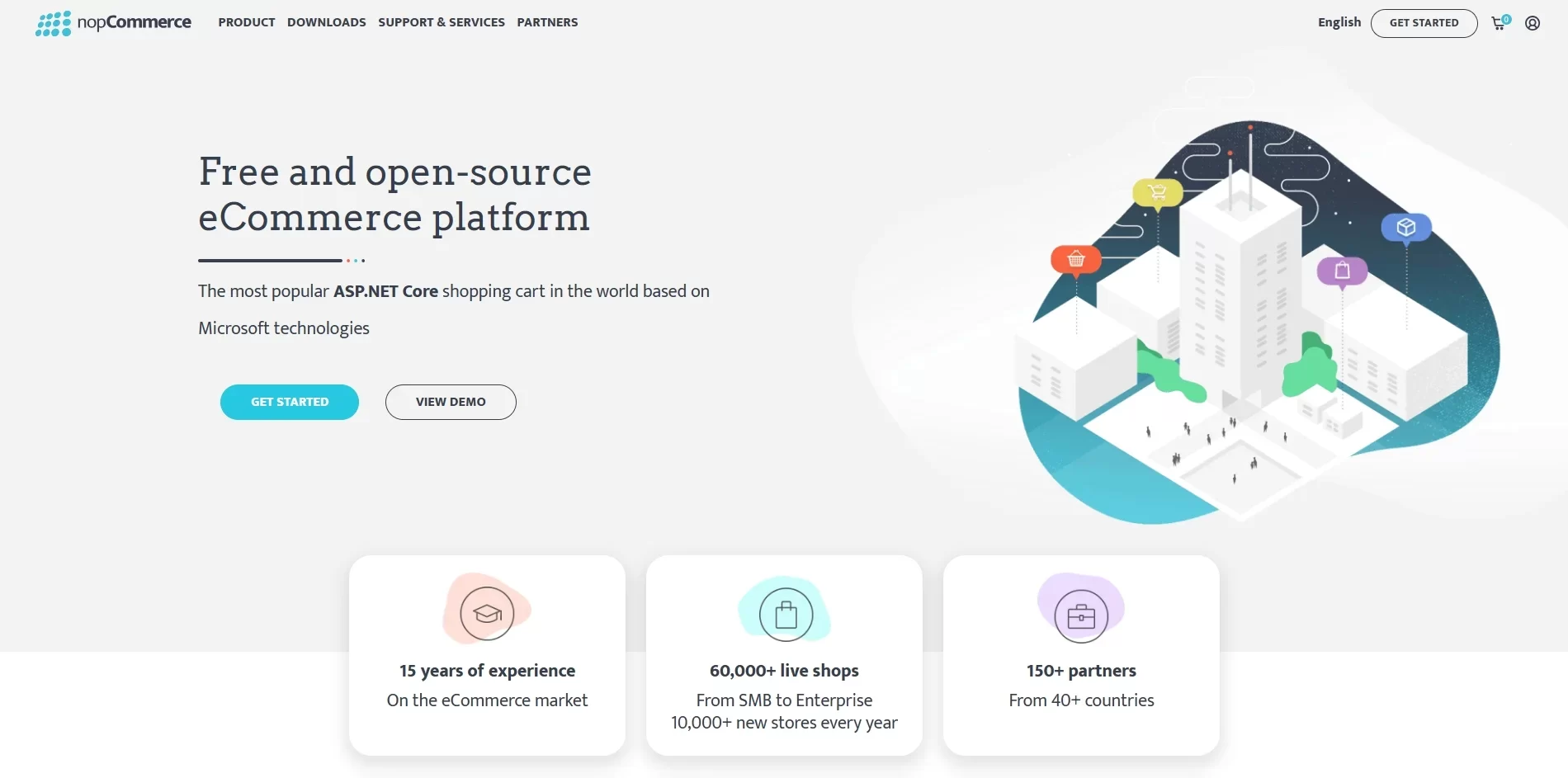
The current version is nopCommerce 4.90.6, released on July 8, 2026. It runs on .NET 9, while the latest minor release mainly addresses bugs and remains compatible with plugins and themes created for version 4.90. It introduces several features aimed at larger, more complex stores:
- AI-powered content tools: Generate product descriptions, optimize SEO elements, and translate content into multiple languages.
- B2B quoting workflows: Let buyers request quotes and allow your team to review, manage, and respond to them.
- Improved store navigation: Build mega menus to help shoppers browse large product catalogs more easily.
- Automotive product filtering: Use Year–Make–Model filtering to help customers find compatible vehicle parts.
- Better accessibility: Updated storefront pages help businesses meet European Accessibility Act requirements.
Together, these updates show how nopCommerce continues to evolve for both B2C and complex B2B stores. In the following sections, our nopCommerce reviews will take a closer look at all key aspects of the platform to help you decide whether it fits your business.
How Much Does nopCommerce Cost
One of the biggest advantages of nopCommerce is that it is completely free to download and use. Since it’s an open-source platform, there are no license fees or monthly subscription costs to get started. This makes it a cost-effective option for businesses that want to own and control their eCommerce solution without ongoing platform charges.
However, while the core software is free, there are other costs to consider:
Cost area | Estimated cost | Notes |
Software license | $0 | The core nopCommerce software is open-source |
Hosting | $10–$150/month | Depends on store traffic, server resources, security, and hosting type |
Development and setup | $500–$5,000+ (one-time or hourly) | Varies widely based on design, customization, and integrations |
Themes and plugins | $0–$2,500+ | Many extensions are free, while advanced official integrations can cost significantly more |
Premium Support | $499 for 3 months or $999 for 1 year | Optional support packages purchased as a one-time payment rather than an automatic subscription |
Copyright Removal Key | $500 for one site or $1,500 for multiple sites | The wildcard option covers multiple installations |
Maintenance and updates | Varies (in-house or external) | May require an in-house developer or external nopCommerce agency |
In conclusion, while nopCommerce itself is free, the total cost of ownership (TCO) depends on your technical setup and business needs. As a general estimate, we suggest the following price ranges:
- Small stores: Around $1,000–$5,000 for a basic setup with limited customization.
- Mid-sized stores: Around $10,000–$30,000 for custom design, integrations, and more advanced functionality.
- B2B or complex stores: Often $30,000–$100,000+ for quotation workflows, ERP or CRM integrations, multi-store setups, and ongoing development.
Ease of Use
Based on our nopCommerce reviews, the platform has a noticeable learning curve, especially during setup. Since it is a self-hosted platform, you’ll need to:
- Find a compatible hosting provider that supports ASP.NET Core and Microsoft SQL Server.
- Download the nopCommerce files and upload them to your server.
- Create and configure a database.
- Complete the installation using a web-based setup wizard.
Although these steps are manageable for developers, they can feel overwhelming for users without technical experience. There’s no built-in one-click install unless your hosting provider offers it. Therefore, unless you’re comfortable working with server files and configurations, you may need help from a developer or IT team.
Once your store is running, however, daily management is much easier. The admin dashboard organizes products, orders, customers, marketing, and reports into clear menus. Routine tasks such as adding products, updating inventory, and creating discounts can generally be handled without coding.
Advanced changes are a different story. Customizing the storefront, modifying the checkout, or configuring complex plugins may still require technical expertise.
Themes and Design Flexibility
To be continue, let’s look at how much control the platform gives you over your storefront design. nopCommerce is highly flexible, but advanced customization usually requires coding skills.
The platform includes a responsive default theme that works well but may feel too basic for a distinctive brand. For more options, the official nopCommerce marketplace currently lists 87 free and commercial themes, with many paid options priced between $50 and $250.
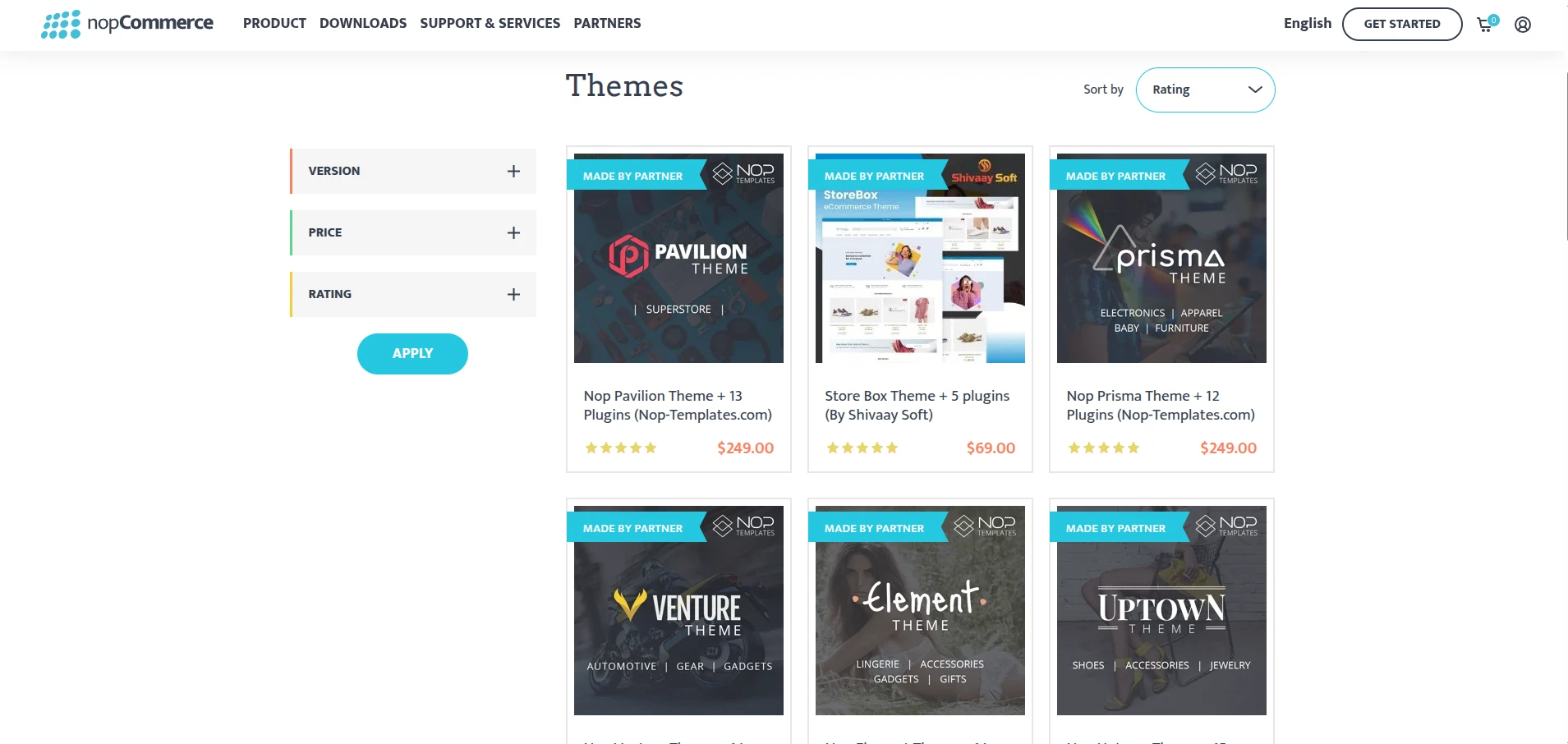
Unlike hosted platforms, nopCommerce does not have a built-in drag-and-drop editor. Instead, developers can access and modify layouts, CSS, and scripts to create a fully customized storefront. Its widget zones also make it easier to add content and functionality to specific page areas without changing the core code.
eCommerce Features
One of the strongest aspects highlighted in many nopCommerce reviews is its rich set of built-in eCommerce features. Different from other platforms that rely heavily on third-party apps, nopCommerce includes a wide range of tools right out of the box. Let’s explore the core eCommerce capabilities in more detail below.
Product management
nopCommerce can handle everything from small product ranges to large, complex catalogs. You can create unlimited products and organize them using categories, subcategories, manufacturers, and tags.
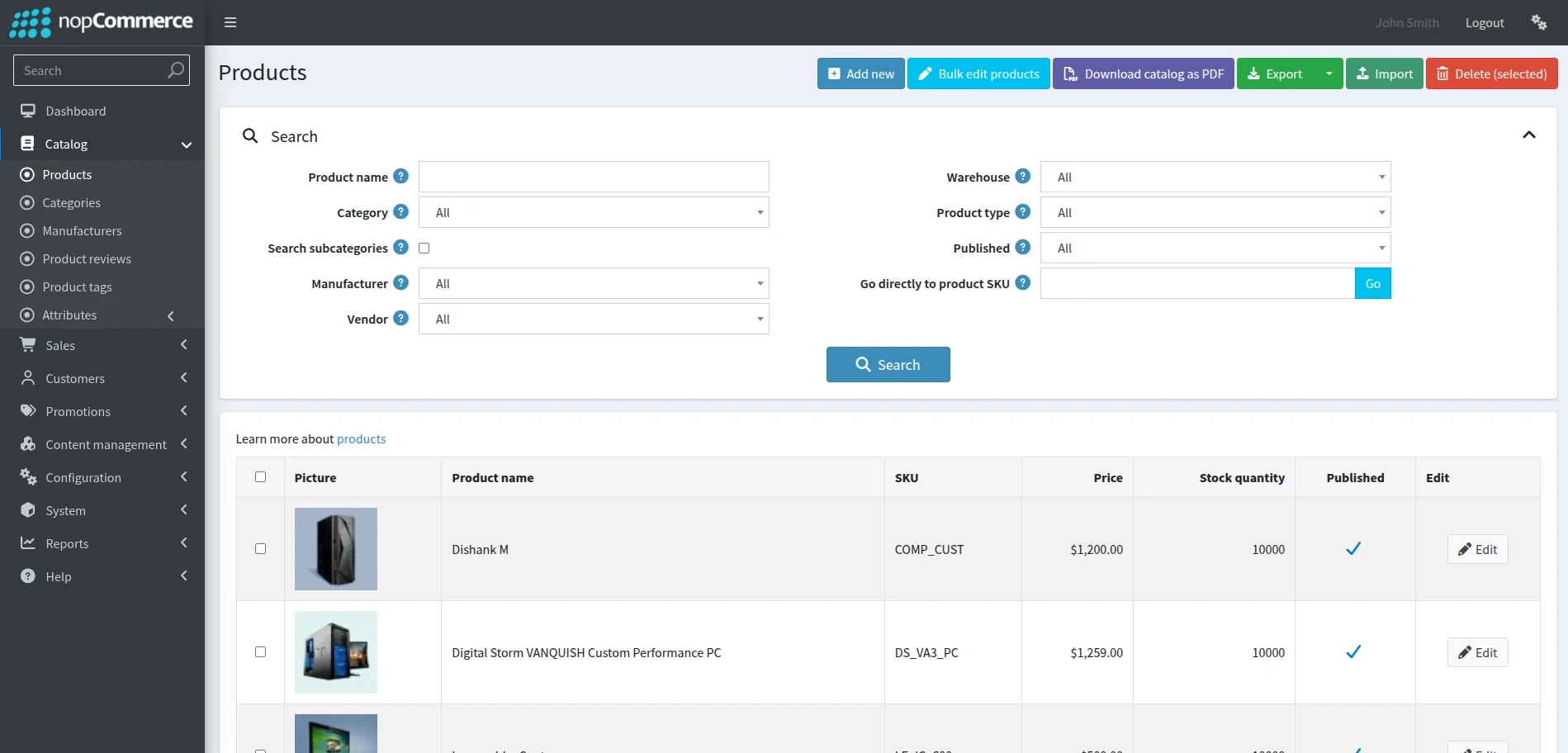
For products with multiple options, attributes and combinations allow you to manage variations in price, stock, images, and availability. The platform also supports:
- Physical, digital, rental, and recurring products
- Multiple product images and downloadable files
- Real-time inventory tracking and low-stock alerts
- Backorders, pre-orders, and scheduled publishing
- Related products, cross-sells, and tiered pricing
- SEO-friendly URLs, meta titles, and descriptions
- Product visibility based on customer roles or stores
Tax and payment
nopCommerce provides flexible tax settings based on country, state, postal code, product category, or customer role. It also supports tax-exempt customers, tax on shipping, and EU VAT validation.
For payments, you can connect the store with popular providers such as PayPal, Stripe, Authorize.Net, Square, 2Checkout, and Klarna through built-in methods or extensions. Manual options like cash on delivery, bank transfer, and purchase orders are also available.
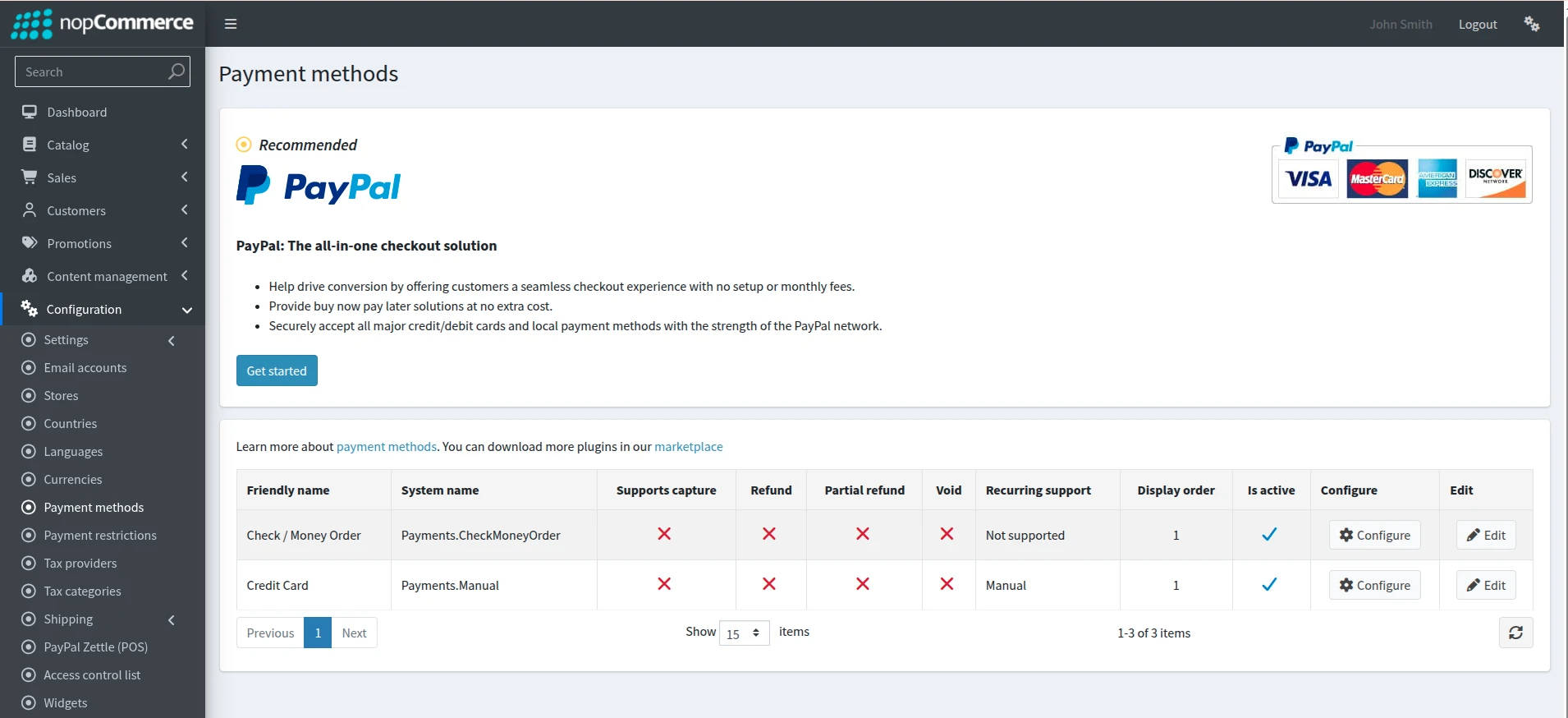
Payments can be authorized, captured, refunded, or voided from the admin area, depending on the selected provider.
Multi-store and multi-vendor selling
Multi-store and multi-vendor functionality is one of the strongest areas highlighted in our nopCommerce reviews.
With multi-store support, you can run several storefronts from one installation and admin dashboard. Each store can have its own domain, theme, catalog, language, currency, pricing, and configuration. This works particularly well for businesses managing multiple brands, regions, or B2B and B2C channels.
The multi-vendor feature lets third-party sellers manage their products and view relevant orders through restricted admin access. Store owners can approve vendors and products, assign permissions, configure commissions, and access vendor reports.
However, advanced marketplace functions such as automated payouts may require additional plugins or custom development.
Shipping and delivery
nopCommerce supports a broad range of shipping setups, from simple flat rates to more advanced rules based on order value, weight, destination, or product.
You can configure:
- Free-shipping thresholds
- In-store or local pickup
- Multiple warehouses
- Estimated delivery dates
- Shipping discounts and surcharges
- Product-level shipping restrictions
Integrations with carriers such as UPS, USPS, FedEx, and DHL can provide live rates and shipment tracking, although availability may depend on the plugin and operating region.
B2B capabilities
Last but not least, nopCommerce also provides useful features for businesses selling to wholesalers, distributors, and corporate buyers. Its role-based system allows you to create different experiences for each customer group, including:
- Customer-specific or role-based pricing
- Tiered pricing and volume discounts
- Tax-exempt customer accounts
- Purchase orders and manual payment methods
- Request for Quote workflows
- Product and content visibility by customer role
- Multi-store setups for separate B2B and B2C channels
- Recurring orders and downloadable invoices
The Request for Quote feature is especially useful for negotiated or high-value orders, allowing business buyers to submit quote requests before completing their purchases. However, more advanced needs, such as approval hierarchies, company accounts, credit limits, or ERP integration, may require plugins or custom development.
nopCommerce Migration Made Easy With LitExtension!
LitExtension offers great migration solutions that help you transfer your data from the current eCommerce platform to a new one accurately, painlessly with utmost security.
Marketing & SEO Functions
Coming up next on our nopCommerce reviews is how it helps merchants attract visitors, rank in search results, and convert customers. Fortunately, nopCommerce offers a strong set of marketing and SEO features right out of the box, giving users a solid foundation to grow their business without relying on dozens of third-party apps.
nopCommerce is designed with search engine optimization in mind. From the moment you start building your store, you have access to key SEO tools that help improve your site’s rankings on Google and other search engines. Features include:
- Search engine-friendly URLs that you can customize per product, category, and page.
- Editable meta titles, descriptions, and keywords for better click-through rates.
- Canonical URLs to avoid duplicate content penalties.
- Auto-generated sitemaps (XML and HTML) to support faster indexing.
- Breadcrumb navigation for easier site crawling.
- Schema markup support via plugins for enhanced search result visibility.
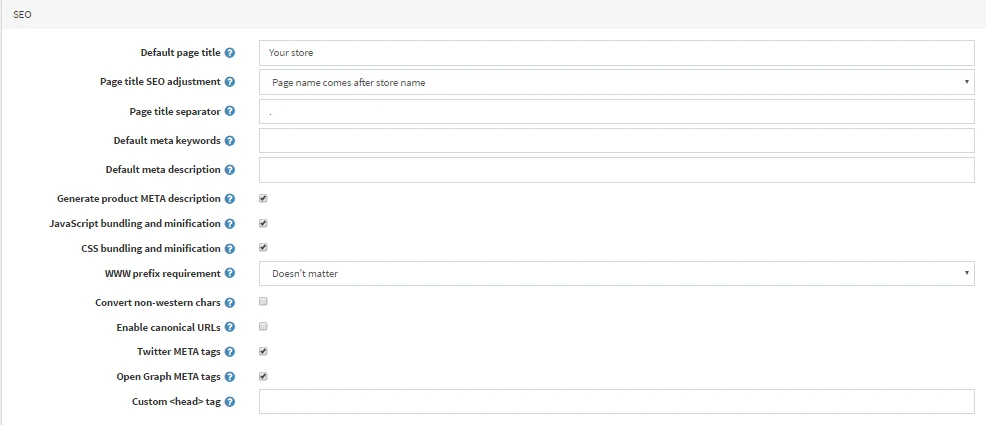
nopCommerce 4.90 also adds AI-assisted SEO tools. You can generate product descriptions and fill empty SEO meta fields based on existing product information, keywords, language, and tone of voice. Existing manually written metadata will not be overwritten.
Beyond search visibility, nopCommerce also includes several built-in marketing tools to help merchants turn that traffic into sales and encourage repeat purchases. These features cover common promotional and customer-retention needs, so you can run essential campaigns without depending too heavily on third-party extensions:
- Discounts and coupons: Create flexible promotions by product, customer role, or order total. You can set expiration dates, usage limits, and even stack discounts.
- Gift cards: Sell virtual gift cards that customers can redeem at checkout.
- Reward points system: Encourage repeat purchases by letting customers earn points with each order.
- Product reviews and ratings: Build trust and social proof by allowing customers to leave feedback on products.
- Email newsletter integration: Collect customer emails and connect to tools like Mailchimp for campaigns.
- Affiliate marketing program: Track referral traffic and offer commissions to partners who promote your store.
These tools help drive conversions, build loyalty, and create new revenue streams, all within the core nopCommerce environment.
Apps & Integrations
Built-in features can only take an online store so far, especially when payments, fulfillment, marketing, and back-office systems all need to work together. In this area, nopCommerce provides a fairly broad ecosystem, with 965 listings currently available on its official extension marketplace.
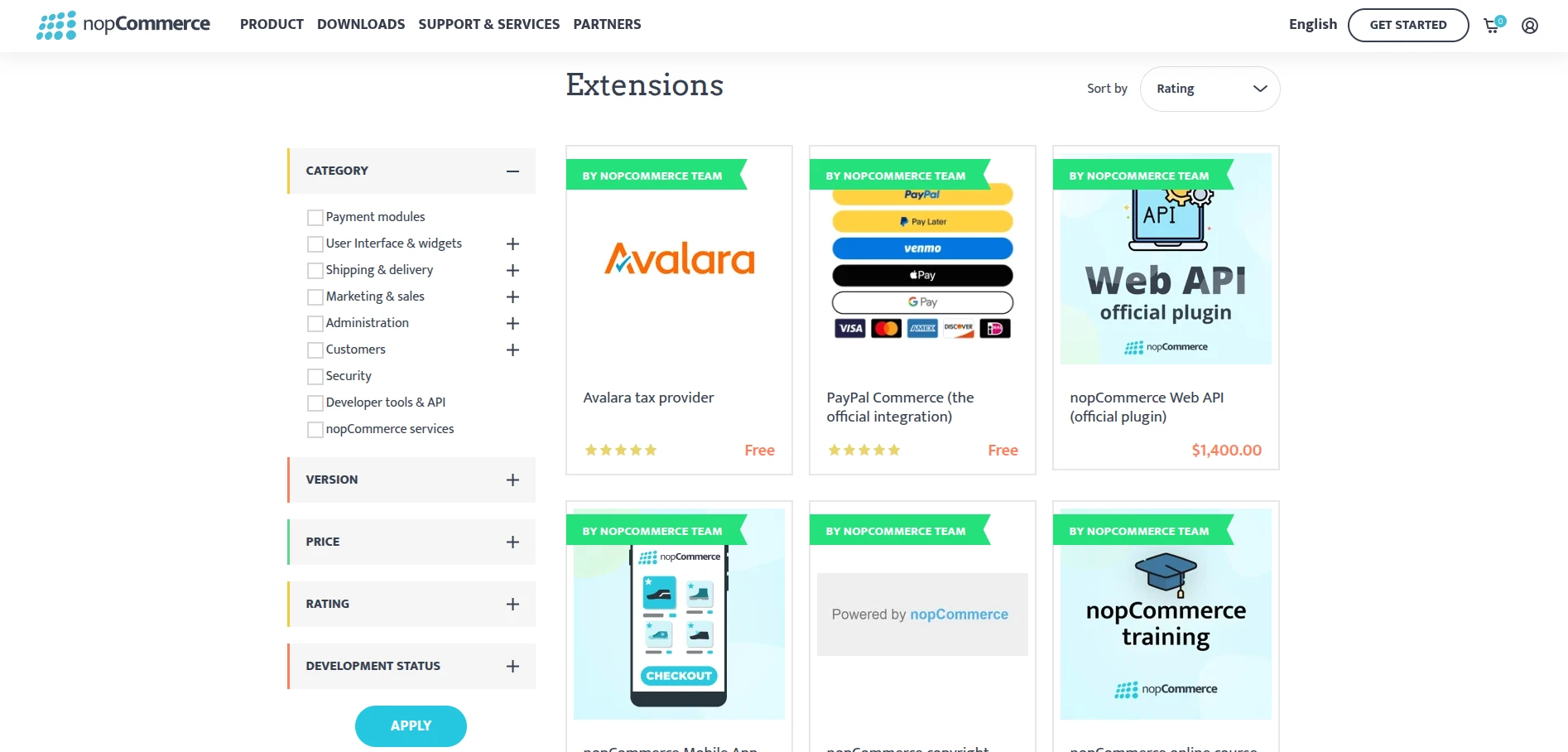
You can find extensions across categories such as payments, discounts and promotions, shipping and delivery, and search and navigation. Popular integrations include PayPal, Stripe, UPS, ShipStation, Mailchimp, Google Analytics, Avalara, and Elasticsearch.
When a ready-made plugin is unavailable, nopCommerce’s plugin-based architecture and API allow developers to build custom connections with ERP, CRM, POS, inventory, or other business systems. However, its official Web API is a separate paid plugin, and more complex integrations will likely require development support.
Support
Next on our nopCommerce reviews today is its support. Fortunately, this platform provides self-service support through its detailed documentation and active community forum. These resources cover everything from store setup and configuration to customization and plugin development, although some discussions can be technical for beginners.
For direct help from the nopCommerce team, Premium Support is available at a one-time cost of $499 for three months or $999 for one year. It includes assistance with platform-related issues and bug fixes, but not custom development.
Security
nopCommerce is built with security in mind and follows modern development best practices. Key security features include:
- PCI-DSS compliance support: While nopCommerce itself is not PCI-certified, it includes the tools and guidance to help your store meet PCI standards.
- HTTPS/SSL support: All pages, including checkout and login, can be secured with SSL certificates.
- Data encryption: Sensitive customer and payment information is encrypted using secure algorithms.
- GDPR tools: Features for cookie consent, privacy policy management, and data export/delete requests help your store comply with data privacy laws.
- Role-based access control: You can define user roles and limit backend access to only what’s necessary.
- Security patches and updates: The nopCommerce team actively maintains the platform, releasing fixes and improvements with each new version.
It’s also worth noting that because nopCommerce is self-hosted, overall security depends in part on your hosting provider, server setup, and regular maintenance. That’s why many nopCommerce reviews suggest using trusted hosting partners and staying up to date with the latest releases to minimize vulnerabilities.
Our Methodology: How We Test nopCommerce
Before publishing our reviews on nopCommerce, we take a hands-on approach to testing the platform, just like a business owner or developer would when launching a real online store. Our goal is simple: to understand what it’s like to use nopCommerce in the real world and to give you a clear picture of what to expect.
To begin, we set up a fresh nopCommerce store using both the free open-source version and the nopCommerce Cloud option. We go through the same process any user would, installing the platform, choosing a theme, adding products, setting up payments and shipping, and exploring the admin dashboard. This approach helps us understand how easy (or challenging) it is to get started, especially if you don’t have a developer on hand.
Then, instead of just listing features, we test how well they actually work:
- How fast is the setup?
- Can you manage products without technical skills?
- Is the checkout experience smooth?
- What happens when you want to add a plugin or edit your theme?
We evaluate each section of the platform based on practical use, not just technical specs. We also pay attention to how it performs over time, not just during the initial setup.
In addition to our testing, we analyze real nopCommerce reviews from store owners, developers, and agencies. This helps us spot recurring issues, strengths, and insights that only come from long-term use. We weigh these experiences alongside our own to ensure a balanced, well-informed view.
nopCommerce Reviews – FAQs
What is the difference between Magento and nopCommerce?
Both are open-source, self-hosted eCommerce platforms. nopCommerce is built on ASP.NET Core, while Magento uses PHP. Magento has a larger enterprise ecosystem, whereas nopCommerce is often a better fit for Microsoft-based businesses seeking built-in multi-store, multi-vendor, and B2B capabilities.
For a closer look at their pricing, features, ease of use, and scalability, read our detailed nopCommerce vs Magento comparison.
Is nopCommerce good for beginners?
nopCommerce is manageable for daily tasks once the store is running, but installation and advanced customization require technical knowledge. Beginners without access to a developer may find a hosted platform like Shopify or Wix easier to use.
Is nopCommerce free?
Yes. The core nopCommerce software is free and open-source, with no required license or monthly subscription. However, you still need to budget for hosting, development, themes, plugins, maintenance, and optional support.
Does nopCommerce have AI features?
Yes. nopCommerce 4.90 includes AI tools for generating product descriptions, SEO metadata, and translations. These features can speed up content creation, although they require configuration with a supported AI provider.
Do I have to pay to remove “Powered by nopCommerce”?
Yes. Removing the “Powered by nopCommerce” notice requires a Copyright Removal Key, priced at $500 for one website or $1,500 for multiple websites under the wildcard option. Otherwise, you can keep the notice at no cost.
Is nopCommerce still actively maintained?
Yes. nopCommerce remains actively developed, with regular releases, bug fixes, security improvements, and new features. Version 4.90.6, released in July 2026, runs on .NET 9 and confirms the platform’s continued development.
Final Verdict
And that brings us to the end of our nopCommerce reviews. To conclude, nopCommerce is a powerful eCommerce platform best suited for businesses with technical resources or access to developer support. It stands out for being open-source, feature-rich, and highly customizable, making it a strong option for those who want full control over their online store without ongoing licensing fees.
For mid-sized businesses, agencies, or enterprises looking for a flexible platform built on ASP.NET, nopCommerce is an excellent choice. It’s also ideal for companies already using Microsoft technologies who want a cohesive, integrated solution. However, for those seeking a plug-and-play platform with minimal setup, more user-friendly design tools, and a larger plugin ecosystem, you might prefer hosted options like Shopify, BigCommerce, or Wix.
If you like this article, please check out other articles on our LitExtension website for more expert tips and insights.

