In recent years, despite their technical demands, open-source eCommerce platforms are still gaining strong momentum due to the high level of scalability and ownership they offer. And among them, Odoo vs Magento undoubtedly stand out as two of the most powerful and widely adopted solutions.
However, though both are open-source at their core, they are still built on fundamentally different principles. This distinction raises two important questions: Which solution is actually better for your eCommerce needs, and does it make sense to use both rather than choosing just one?
No worries; we can help you answer those. In this article, we’ll compare Odoo Commerce vs Magento across 8 criteria, including:
- Ease of use
- Customization
- eCommerce features
- Integrations & extensions
- SEO & marketing
- Security
- Customer support
- Pricing
Odoo vs Magento: A Quick Overview
Before we go into the detailed, criterion-by-criterion comparison, let's first understand what Odoo and Magento fundamentally are.
Understanding Odoo
Odoo is an open-source, modular ERP platform that combines eCommerce with a full suite of business applications, including CRM, accounting, inventory, manufacturing, HR, and marketing. Rather than positioning eCommerce as a standalone storefront, Odoo treats it as one component within a broader operational system.
As of recent estimates, Odoo reports over 180,000 users worldwide (according to BuiltWith), ranging from small startups to multinational enterprises.
Odoo Pros | Odoo Cons |
Unified ERP + eCommerce in one backend | Frontend performance is not its primary design focus |
Strong native inventory, accounting, and logistics | Large-scale storefront optimization requires extra effort |
Easier onboarding for non-technical users | Less specialized for complex promotional engines |
Lower total cost of ownership | Smaller ecosystem for advanced headless commerce |
Predictable vendor support via Odoo SA | Custom storefront UX often needs developer input |
Understanding Magento
Magento, now officially branded as Adobe Commerce for its enterprise edition, is a dedicated eCommerce platform built for scalability. It powers 153,000 stores globally (according to BuiltWith) and is particularly popular among mid-market and enterprise merchants with large catalogs, international operations, and advanced pricing or promotion requirements.
Magento Pros | Magento Cons |
Deep, granular customization at every layer | Requires strong technical expertise |
Superior support for headless and PWA commerce | Higher setup and maintenance costs |
Advanced catalog and pricing rule engines | Core operations depend on external systems |
Strong SEO control for large catalogs | Fragmented stack increases integration complexity |
Enterprise-grade security processes | Admin UX is less beginner-friendly |
Odoo vs Magento: Which Is Better?
From our research, Odoo is the better platform for the majority of operations-driven eCommerce businesses. We strongly recommend this one if you seek to integrate eCommerce tightly with inventory, accounting, shipping, and internal workflows, all under one system and one vendor.
On the other hand, Magento is still a great choice for businesses that require extreme customization, headless architectures, and enterprise-grade storefront scalability, though at the cost of higher complexity and expense. We have summarized each platform's respective strengths as follows:
Criterion | Odoo | Magento | Winner |
Ease of use | Guided onboarding, unified UI | Steep learning curve | Odoo |
Customization | Fast, business-process focused | Deep, code-level control | Magento |
eCommerce features | Native ERP-grade inventory, shipping, payments, and fulfillment workflows tightly integrated with accounting and operations | Powerful checkout, catalog, and pricing engines, but relies on external ERP/WMS for inventory, shipping, and fulfillment | Odoo |
Integrations & extensions | 60,000+ business modules | ~3,700 commerce extensions | Odoo |
SEO & marketing | Solid native + integrated marketing | Advanced SEO via extensions | Tie |
Security | Strong framework, module-dependent | Enterprise patching & WAFs | Magento |
Customer support | Centralized vendor support | Enterprise-only official support | Odoo |
Pricing | $9 to $13/month/user plus other fees | High and unpredictable TCO | Odoo |
If you want to understand why each platform wins or loses in specific areas, keep reading for our detailed Magento vs Odoo breakdown.
Ease of use (Odoo wins)
Quick verdict: Despite being open-source, Odoo still caters to non-technical business users from the ground up, thanks to features such as guided onboarding, unified interface, and low-code configuration tools.
Magento, by contrast, prioritizes control and scalability over approachability, which makes it harder to onboard and manage without certain technical expertise. Let's have a closer look at Odoo vs Magento in the section below:
Odoo’s ease of use
Overall, Odoo approaches ease of use as a core design principle.
From the moment a user logs in, the platform actively guides them through onboarding. Each installed app (Sales, Inventory, Accounting, eCommerce) comes with contextual setup steps that explain what needs to be configured, in what order, and for what purpose. As a result, it eliminates much of the trial-and-error that typically slows down ERP or eCommerce adoption.
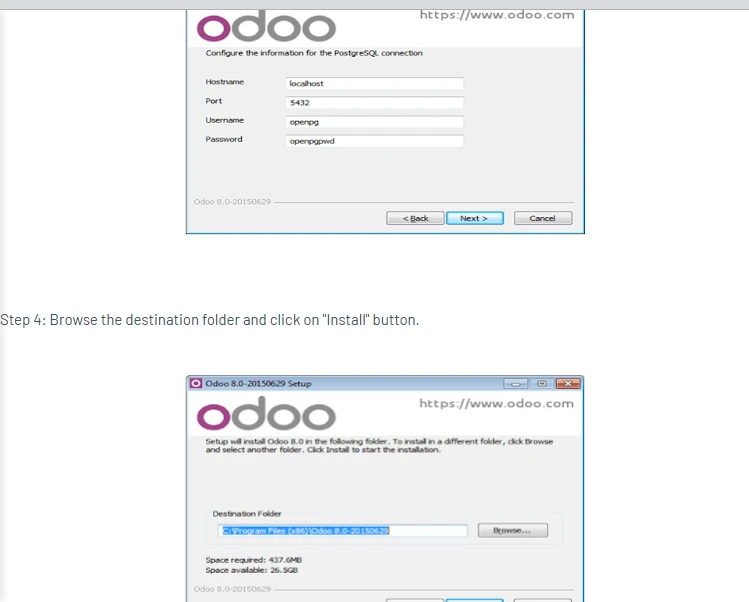
In addition, one of Odoo’s biggest advantages is its single, unified backend, which means all apps share the same database, UI patterns, and interaction logic. Once a user understands how records, filters, kanban views, and form views work in one module, they can navigate almost any other module without relearning the system.
Magento’s ease of use
On the other hand, onboarding with Magento is rarely a purely admin-level task. In fact, installation and initial setup typically involve configuring server environments, dependency management, cron jobs, indexing processes, and search services. These steps are outside the comfort zone of most non-technical users and usually require developers or DevOps engineers.
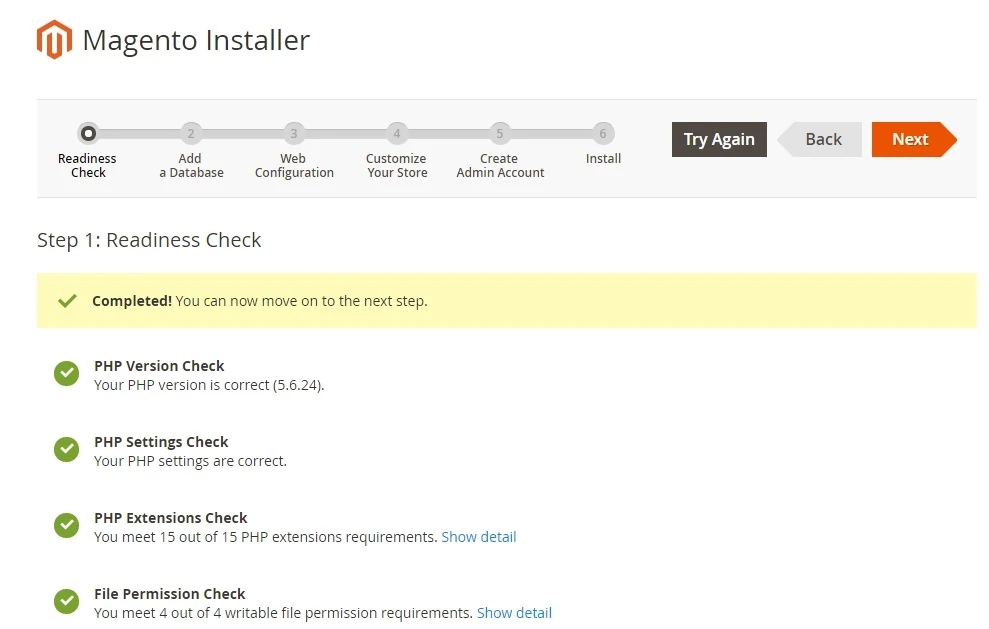
Not to mention, even after the system is running, Magento’s admin interface assumes a strong understanding of eCommerce mechanics. Specifically, sections like catalog rules, price rules, reindexing, caching layers, and search configuration are exposed directly to the admin. Though this is valuable for experienced store managers, it can be overwhelming for new users who are still learning how the platform works.
Customization (Magento wins)
Quick verdict: Magento provides deeper, more granular control over eCommerce behavior, data models, and frontend architecture. Its modular system, extensive extension ecosystem, and support for headless commerce allow businesses to build highly tailored storefronts.
Of course, Odoo is still a flexible open-source solution, but its customization model is broader and less specialized for complex eCommerce scenarios. You can learn more about the differences between Odoo vs Magento here:
Odoo’s customization capabilities
Odoo’s customization strength lies in accessibility and speed. Through Odoo Studio, business users can modify the system without touching code (e.g., adding custom fields, changing form layouts, creating automated actions, and adjusting workflows). For many businesses, this covers a large percentage of real-world customization needs.
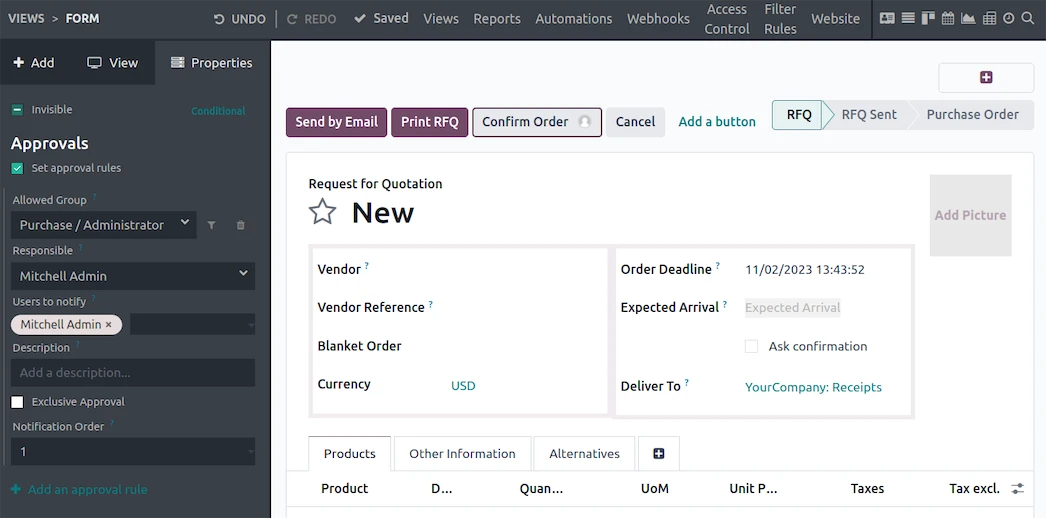
In addition, for deeper customization, Odoo supports custom modules written in Python, using its ORM and XML-based view system. Developers can extend models, override business logic, and integrate external systems in a structured way. And as mentioned, since all Odoo apps share the same architecture, custom logic can span sales, inventory, accounting, eCommerce, etc. quite seamlessly.
However, keep in mind that this strength is also a limitation: Odoo’s customization framework is designed around business processes, not high-performance storefront behavior.
In short, though it can support custom pricing logic, checkout changes, or frontend adjustments, these are not its primary focus. Hence, for large catalogs or complex promotional engines, you likely need to consider more advanced workarounds.
Magento’s customization capabilities
On the contrary, Magento is built with customization as a first-class concept. Its modular architecture allows developers to override or extend nearly every part of the system using custom modules, dependency injection, events, and observers. As a result, it's possible to implement highly specific business rules, advanced pricing structures, and unique checkout experiences.
Most importantly, beyond traditional customization, Magento supports headless commerce through APIs and GraphQL.
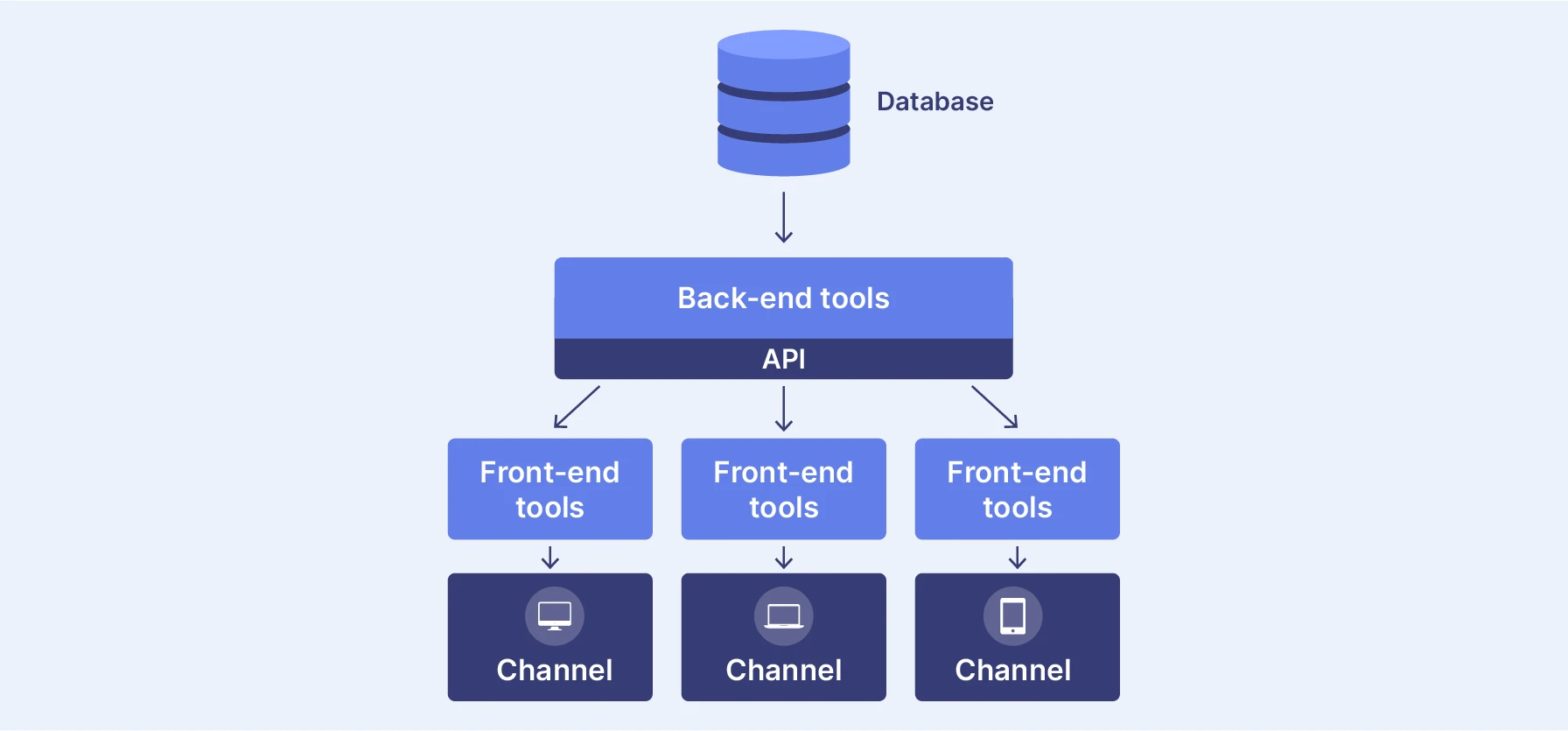
Specifically, businesses candecouple the frontend entirely and build custom PWAs, mobile apps, or omnichannel experiences while keeping Magento as the transaction engine. However, keep in mind that the trade-off is complexity, meaning Magento customization almost always requires experienced developers, careful testing, and ongoing maintenance.
eCommerce Features (Odoo wins)
Quick verdict: Odoo wins on core eCommerce features because it delivers inventory, payments, and shipping as deeply integrated, operational systems rather than isolated storefront functions.
Magento is extremely strong at checkout flexibility and ecosystem breadth, but most advanced commerce operations require external extensions or third-party systems. This Odoo vs Magento difference becomes most visible when you look closely at how each platform handles inventory, payments, and shipping in real business workflows:
Inventory management (Odoo wins)
Odoo’s inventory management is fundamentally ERP-grade. It natively supports multiple warehouses and multiple stock locations per warehouse, along with put-away rules that automatically route products to specific shelves or zones. Different location types (internal, input, output, production) allow businesses to model physical warehouse layouts accurately rather than flattening everything into a single stock pool.
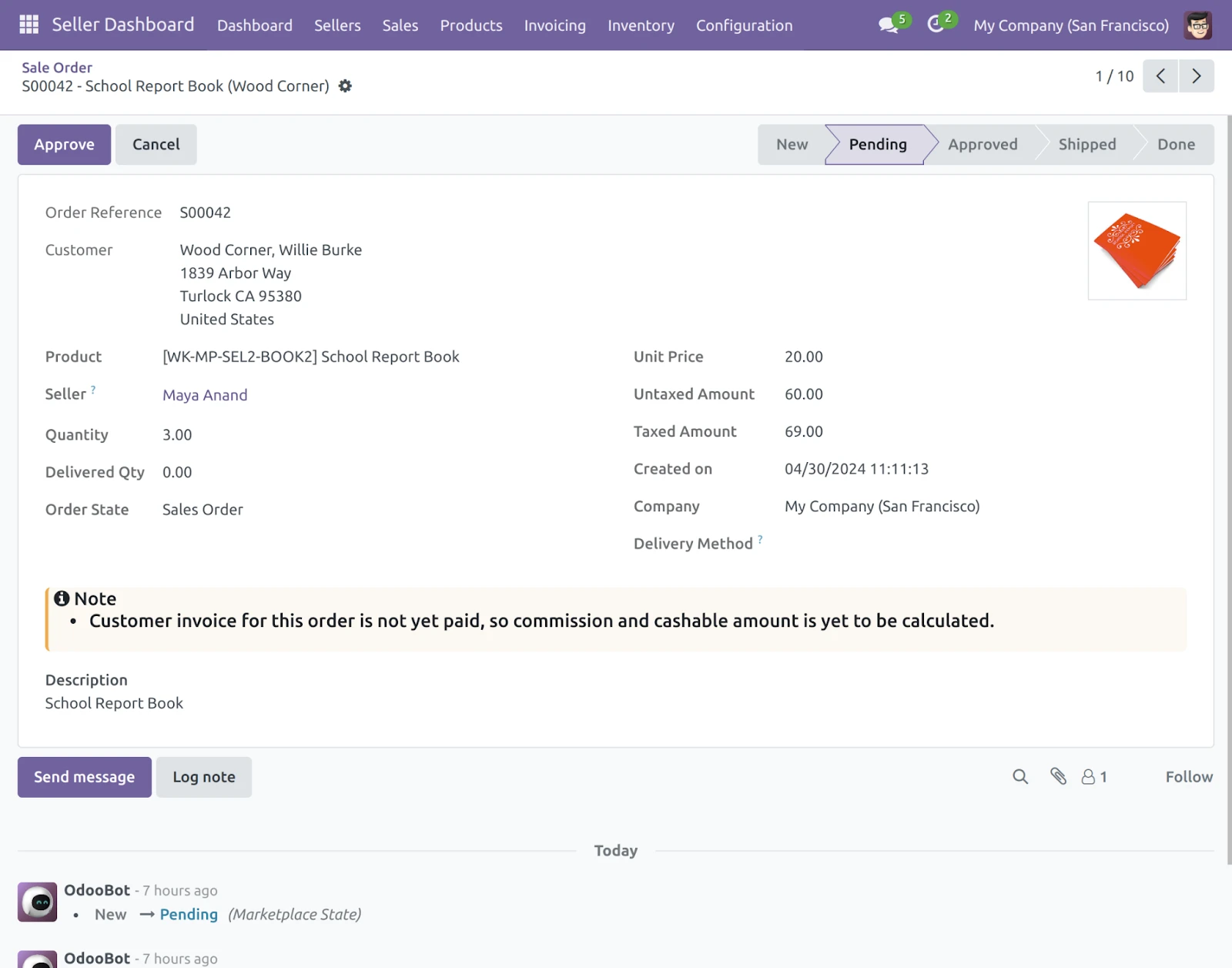
In terms of scale, Odoo does not impose hard product limits. Enterprise deployments routinely handle hundreds of thousands of SKUs, backed by PostgreSQL. Performance at that scale depends on hosting and tuning, but the architecture itself is built for ERP-level catalogs.
Magento, by contrast, focuses on Multi-Source Inventory (MSI), which tracks quantities across sources for fulfillment but lacks native valuation, routing automation, batch/lot tracking, expiry handling, or manufacturing linkage. Hence, for serious inventory operations, Magento almost always relies on an external ERP or WMS.
Payment (A tie)
Natively and via official connectors, Odoo supports major global gateways such as PayPal, Stripe, Authorize.Net, Adyen, Mollie, WorldPay, Cybersource, and Razorpay, alongside offline methods like bank transfers and manual payments. Additional gateways can be added via the Odoo Apps marketplace or community (OCA) modules.
Though Odoo does not publish a single official number, marketplace data indicates ~100+ payment-related modules covering regional gateways and niche providers. Plus, Ooo’s payment architecture is built around “payment acquirers” that plug directly into the checkout flow. Many gateways also support tokenization, recurring payments, and subscription billing (notably via Stripe and Adyen), but keep in mind that advanced features may require extra configuration or third-party modules.
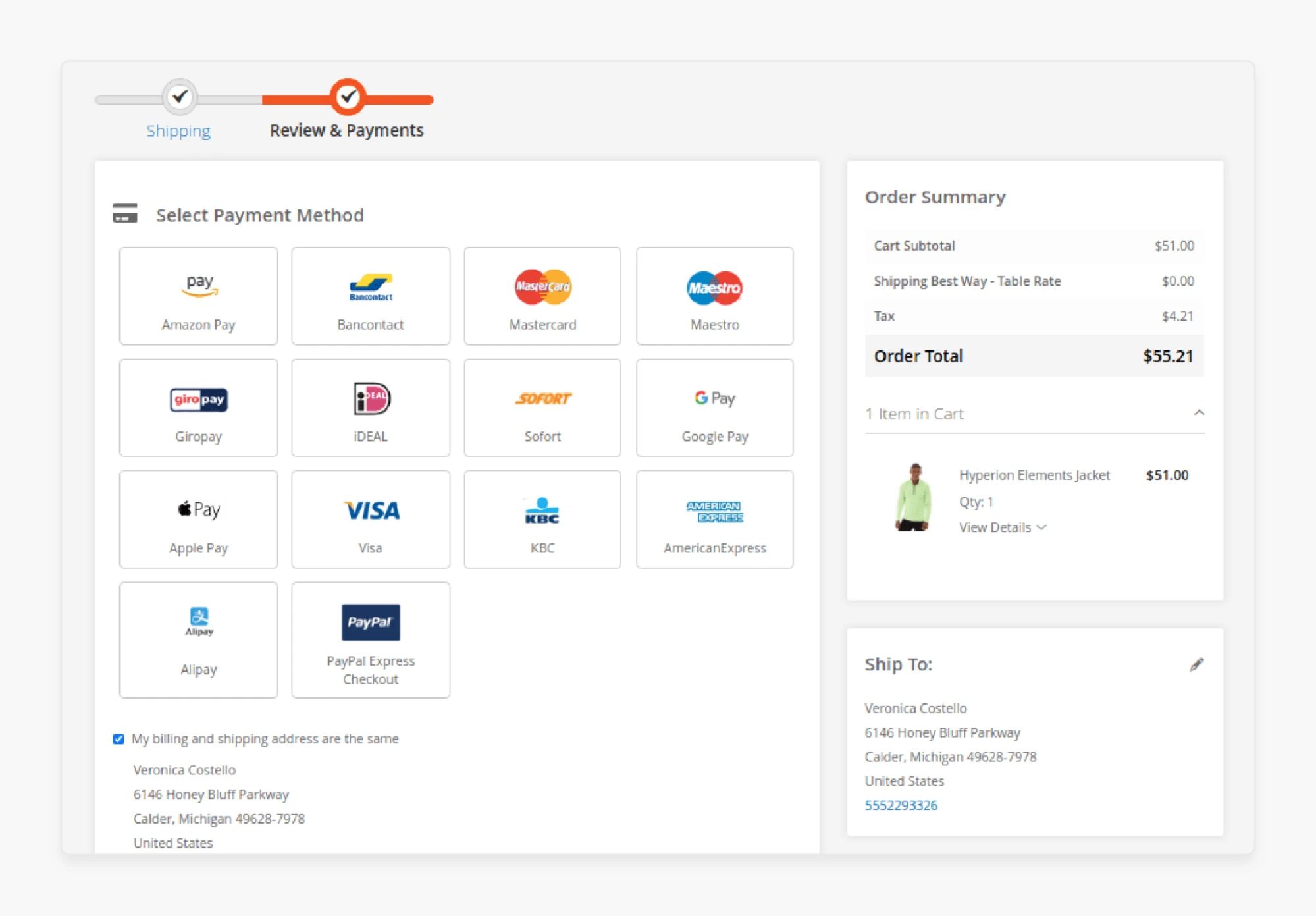
Likewise, Magento also supports multiple native integrations (PayPal, Braintree, Authorize.Net, CyberSource, Amazon Pay, Klarna in some regions, WorldPay, Sofort) and is backed by a massive Marketplace ecosystem. Estimates based on Marketplace listings show 300+ payment gateway extensions, covering global and regional providers, Apple Pay, Google Pay, BNPL services, and even crypto processors.
Not to mention, Magento even offers deeper configurability for large enterprises with more complex needs. Examples include hosted vs direct API payments, vault/tokenization, partial authorizations, multi-currency and multi-store payment rules, and payment methods per website or store view.
Shipping (Odoo wins)
Shipping is where Odoo’s ERP roots give it a decisive advantage.
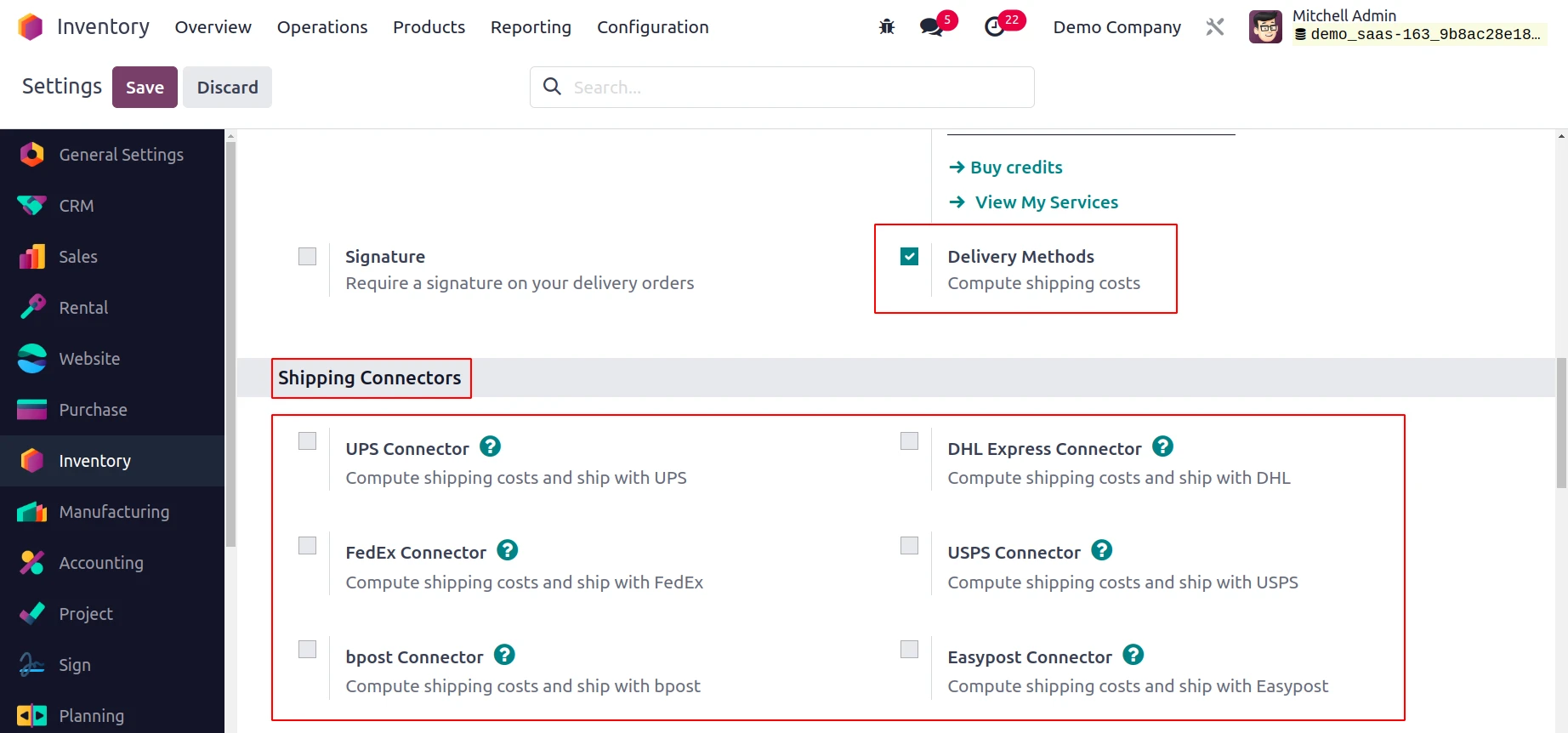
Odoo’s shipping capabilities are part of a single flow spanning sales → inventory → shipping → accounting, which allows businesses to manage fulfillment end-to-end without external tools. Through official and community modules, Odoo integrates with 60+ carriers, including UPS, FedEx, DHL, USPS, Royal Mail, DPD, GLS, Purolator, Correios, and others, with support for multiple service levels when carriers expose them via API.
Meanwhile, Magento’s shipping features are far more storefront-centric. Out of the box, it supports flat rates, table rates, free shipping rules, and address validation. These are more than enough for checkout calculations, but not for warehouse operations.
And even with the help of extensions, Magento does not naturally provide pick/pack/ship workflows, barcode operations, advanced multi-warehouse routing, or built-in returns management. As a result, Magento is usually paired with an ERP or WMS for fulfillment, with Magento acting as the storefront rather than the logistics engine.
Integrations & Extensions (Odoo wins)
Quick verdict: Odoo offers a vastly larger and more practical ecosystem in terms of sheer volume, functional coverage, and business-process depth.
Magento’s ecosystem, though strong, remains mostly storefront-centric. Let's compare Odoo vs Magento's ecosystem size and integration rules here:
Odoo’s integrations & extensions
Odoo has one of the largest extension ecosystems in the open-source business software space.
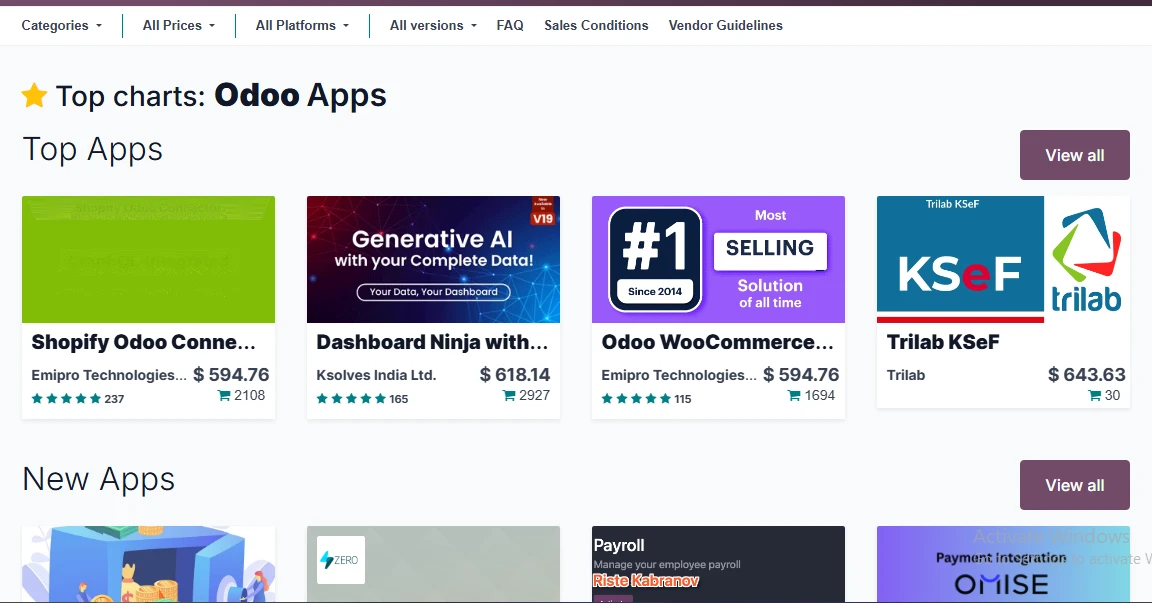
On the official Odoo Apps marketplace, searches across supported versions return over 60,000 modules (community and partner-developed). These modules cover not just eCommerce, but accounting, taxation, inventory, manufacturing, HR, POS, CRM, email marketing, and country-specific compliance.
And from a technical standpoint, Odoo exposes data via XML-RPC and REST-style APIs, but most businesses never touch these directly. Modules are installed, configured, and updated through the UI, which makes integration accessible even to some non-developers. This is also why Odoo’s ecosystem scales well for operations-heavy businesses.
Magento’s integrations & extensions
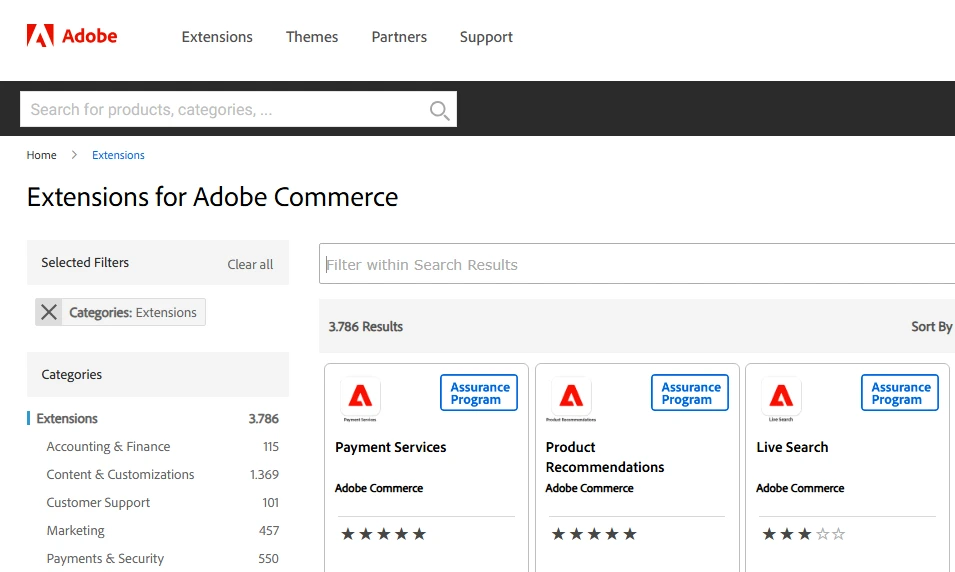
Magento relies primarily on the Adobe Commerce Marketplace, which lists roughly 3,700 extensions. They are heavily concentrated on eCommerce use cases: payments, checkout, search, SEO, promotions, analytics, and headless storefronts.
Nevertheless, some of Magento’s integration models are explicitly code-first. Extensions are installed via Composer, must match Magento core versions, and often require server-level configuration. Though it provides deep control, this process also introduces friction, such as version conflicts, upgrade risks, and higher maintenance overhead.
SEO & Marketing (A tie)
Quick verdict: Both Odoo vs Magento offer deeper, storefront-level control, support enterprise-scale catalog optimization, and are backed by a mature ecosystem of specialized SEO extensions.
Let's learn more about what they offer here:
Odoo’s SEO & marketing capabilities
Odoo includes built-in SEO tools in its Website module, including:
- Editable meta titles and descriptions
- Canonical URLs
- Sitemap generation
- Basic on-page SEO controls.
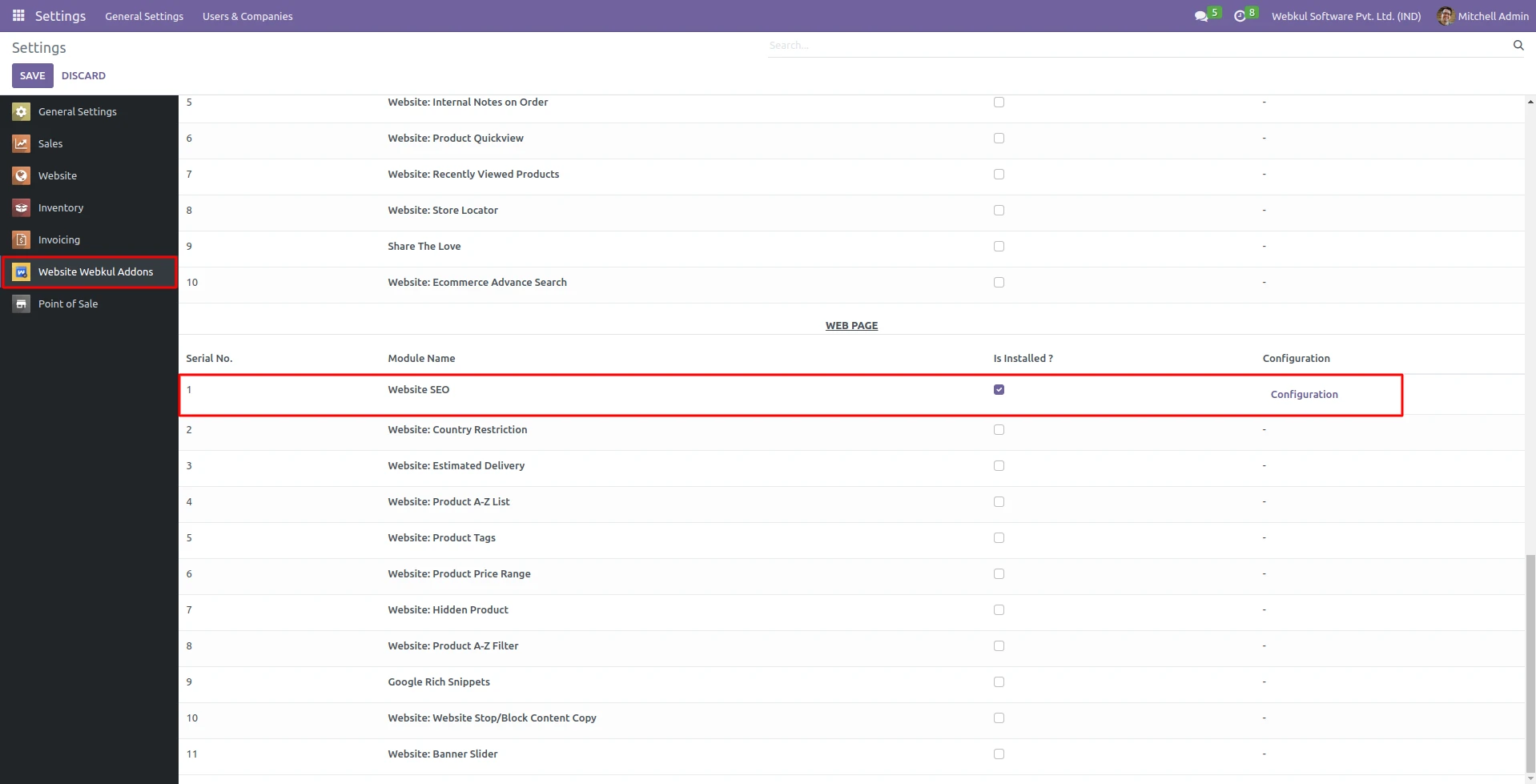
All of these are accessible directly in the page editor. Though rather simple, they are friendly and easy to use for non-technical users.
Better yet, on the marketing side, Odoo is very strong. Email Marketing and Marketing Automation are native modules, fully integrated with CRM, sales orders, and inventory. Similarly, campaigns can be triggered by concrete business events (such as a completed purchase or a lead stage change) without third-party platforms. This makes Odoo highly effective for integrated marketing workflows, especially for small to mid-sized businesses that want everything in one system.
Magento’s SEO & marketing capabilities
Overall, Magento is designed for large catalogs and competitive SEO environments.
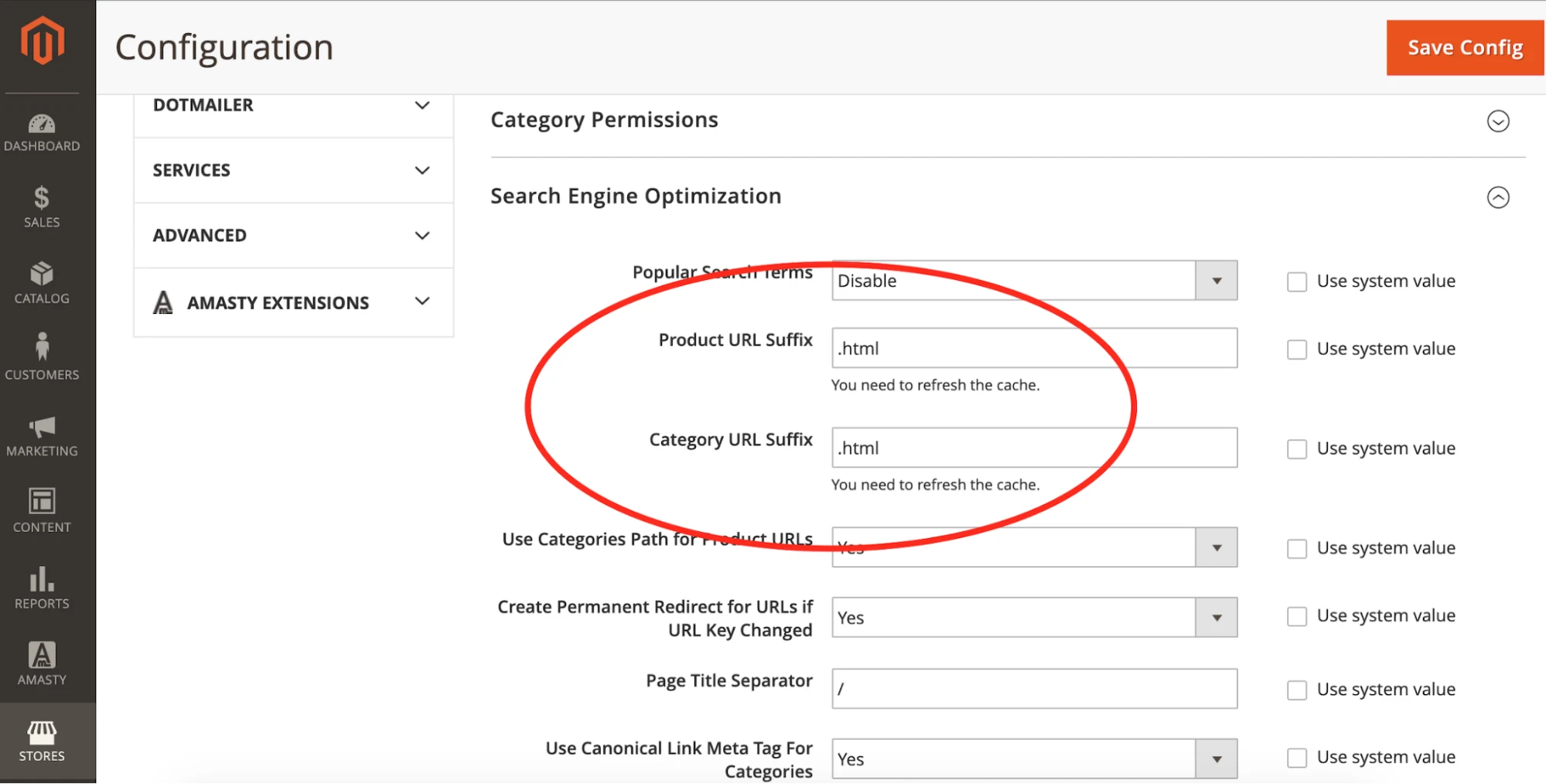
You will find that it provides granular control over URL rewrites, category hierarchies, product attributes, layered navigation, and index behavior, all of which are critical features for stores managing thousands (or tens of thousands) of SKUs. Not to mention, it also benefits from a robust ecosystem of SEO extensions: rich snippet generators, advanced canonical logic, faceted navigation SEO tools, and product feed optimizers. These tools are widely used by agencies and enterprise merchants.
From a marketing perspective, Magento integrates deeply with enterprise marketing platforms and supports headless and PWA architectures, as mentioned earlier. As a result, it enables advanced strategies such as server-side rendering, custom content delivery, and omnichannel marketing, all of which go beyond the native tools.
Security (Magento wins, with higher operational cost)
Quick verdict: Magento offers enterprise-grade patching processes, formal security bulletins, and cloud-level protections.
However, this advantage comes with higher operational demands. On the contrary, Odoo is secure by design for many common vulnerabilities, but its security posture depends heavily on module quality and configuration discipline.
Odoo’s security model
Odoo’s framework includes built-in protections against common web vulnerabilities. Its ORM mitigates SQL injection, templating reduces XSS risks, and access control is enforced via record rules and user groups.
In addition, Odoo maintains a responsible disclosure program and publishes security advisories. However, the ecosystem’s sheer size (tens of thousands of community modules) creates variability in code quality. That's why poorly maintained third-party modules are a common risk factor.
Likewise, for users on Odoo Cloud, additional platform-level protections reduce exposure but are not 100% foolproof. Self-hosted deployments, therefore, still rely on administrators to patch both core and third-party modules promptly.
Magento’s security model
Needless to say, Magento is a frequent target of attacks due to its prevalence among high-revenue stores.
Fortunately, Adobe responds with a structured security bulletin program and regular patches. Recent history includes critical vulnerabilities (CVSS scores above 9.0) that were actively exploited in the wild, clear evidence of both the platform’s attractiveness to attackers and the importance of timely patching.
And though Magento’s ecosystem also introduces risk through third-party extensions like Odoo's, Adobe’s Marketplace includes vetting and assurance programs to mitigate this issue. So, when combined with WAFs, hardened hosting, and disciplined patch management, Magento can easily meet enterprise security requirements.
Note: The only trade-off is cost and complexity. Magento security is powerful, but it demands mature DevOps practices.
Customer Support (Odoo wins)
Quick verdict: Odoo offers a more predictable, centralized, and accessible support model that covers both ERP and eCommerce under one vendor.
Magento’s support can be very strong at the enterprise level, but it is sometimes fragmented, expensive, and even largely unavailable. This section will break down the Odoo vs Magento difference in more detail:
Odoo’s customer support
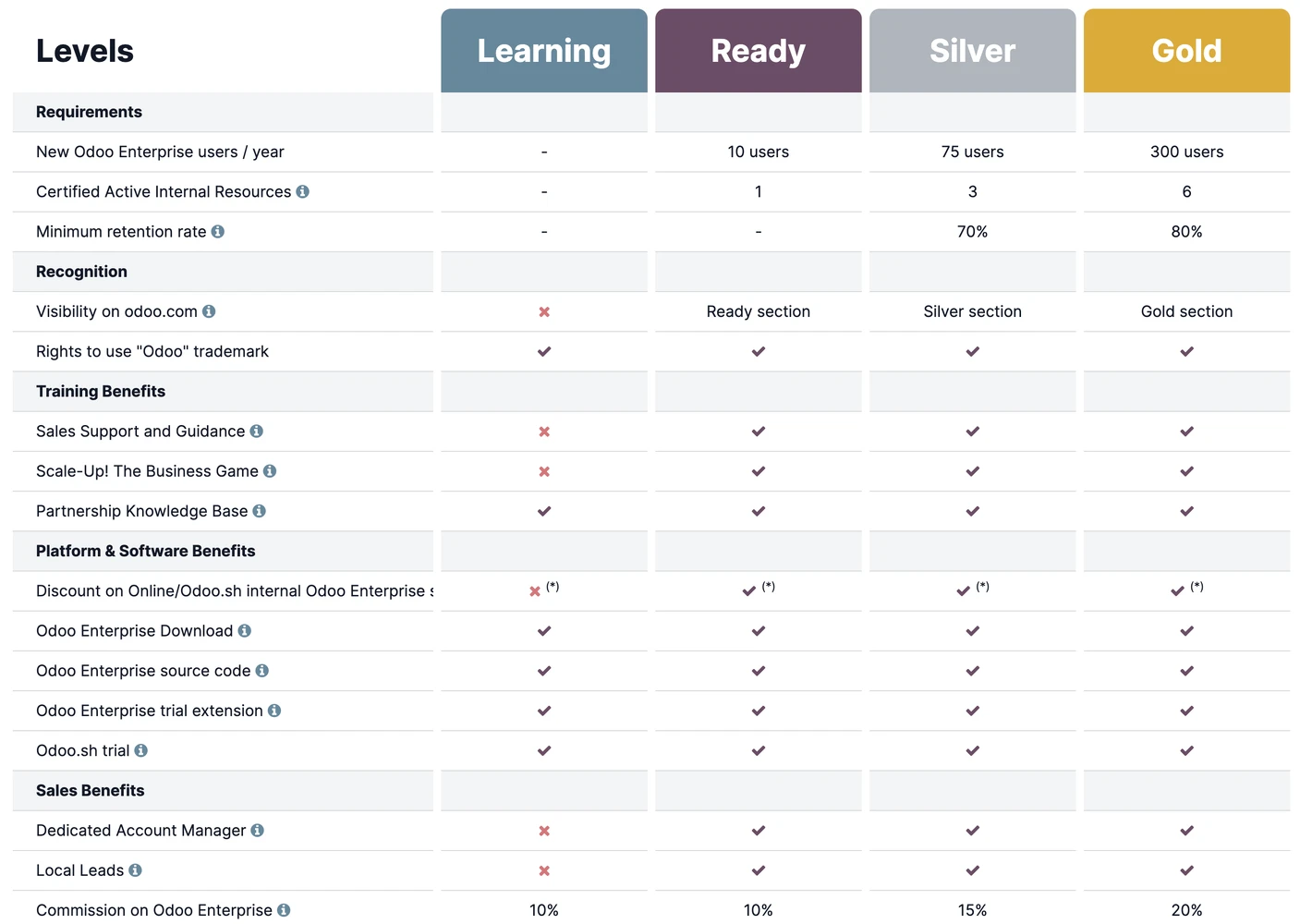
Odoo provides a clearly tiered and standardized support structure, which is one of its biggest advantages over most open-source platforms.
- For Odoo Community (free), there is no official vendor support. Users rely on documentation, forums, and community contributions. This is typical for open-source software and not where Odoo’s strength lies.
- The real value appears with Odoo Enterprise and Odoo Online (SaaS). These paid plans include official support directly from Odoo SA, covering bug reports, functional issues, and system guidance. Support applies across the entire platform (CRM, sales, inventory, accounting, website, and eCommerce) because they all belong to the same system.
In addition, Odoo also has a global certified partner network, in which many partners provide fixed-price monthly support retainers, implementation services, training, etc. In practice, this gives businesses two layers of help: vendor support for core issues and partner support for customization and operations.
Magento’s customer support
For Magento Open Source, there is no official support from Adobe at all. Just like with Odoo Community, users must rely entirely on community forums, documentation, or third-party agencies.
Meanwhile, official vendor support only exists for Adobe Commerce (formerly Magento Commerce). Enterprise customers receive access to Adobe’s support portal, security advisories, and ticket-based technical support. At higher contract levels, this can include account managers and escalation paths.
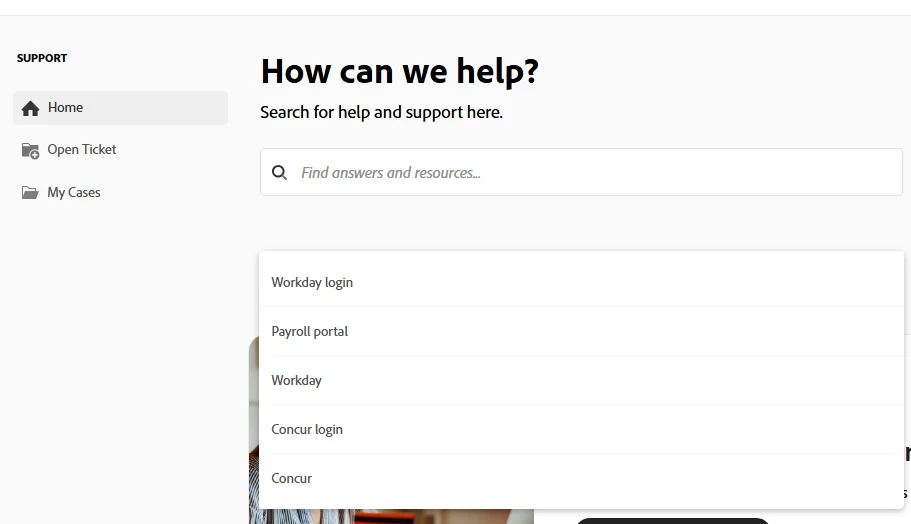
However, note that this support is not modular or lightweight. It is tied to large enterprise contracts that bundle licensing, cloud hosting, and support together. For many mid-sized merchants, the cost of entry might be too high to justify.
Pricing (Odoo wins)
Quick verdict: Odoo wins decisively on pricing due to its transparent, modular pricing model and significantly lower total cost of ownership.
Meanwhile, Magento, especially Adobe Commerce, is substantially more expensive and often financially viable only for larger enterprises:
Odoo pricing
Odoo pricing is based on per-user subscriptions plus selected apps, with optional hosting.
Typical published pricing ranges:
- Subscription of $9 to $13/month per user, depending on plan
- Additional apps may add $10 to 30 per month
- Hosting is included for Odoo Online or optional for self-hosted setups
As a result, the total annual software cost is often in the range of $6,000–$15,000 per year for small to mid-sized businesses (at least 10 users).
Magento pricing
On the other hand, Magento pricing depends entirely on editions.
For example, the software license of Magento Open Source is entirely free. Yet, the real costs usually include:
- Hosting: $200–$2,000+ per month
- Development & maintenance: $1,000–$10,000+ per month
- Paid extensions: $50–$1,000+ each
So, in practice, even mid-sized Magento Open Source stores frequently exceed $60,000–$150,000 per year in total operating cost.
Meanwhile, for Adobe Commerce, license pricing is revenue-based and non-public. However, industry reports commonly cite:
- $40,000–$50,000+ per year as entry level
- $100,000–$250,000+ per year for larger merchants
Not to mention, Magento’s pricing model assumes that Magento is only one component in a larger, best-of-breed stack, which further increases overall spend.
Can You Use Both Odoo and Magento?
Yes, it is entirely possible to use Odoo and Magento together, and many businesses already do. In this setup, Magento typically acts as the storefront and checkout engine; Odoo, on the other hand, functions as the ERP system handling inventory, accounting, fulfillment, and internal operations.
The primary advantage of this approach is that businesses can leverage Magento’s powerful storefront capabilities while still benefiting from Odoo’s ERP-grade backend. This benefit is especially attractive for companies that outgrow Magento’s native inventory or financial tools but are not ready to abandon its frontend flexibility.
However, keep in mind that this architecture also introduces trade-offs since integration usually requires middleware or custom connectors, and data synchronization must be carefully managed. Order mismatches, stock sync delays, and higher maintenance overhead are also extremely common risks if the integration is not implemented correctly.
Odoo vs Magento: FAQs
What is the disadvantage of using Odoo?
Odoo's main cons include hidden costs for professional implementation. Though affordable initially, costs might escalate with added apps and user licenses if you do not plan your store setup carefully.
Is Magento a dying platform?
No, Magento is not a "dying" platform. Rather, it is a maturing, enterprise-focused solution that is losing smaller users to SaaS competitors like Shopify, but remains dominant for complex, high-volume, and B2B businesses.
What major companies use Odoo?
Major companies that use Odoo for business management, manufacturing, and operations include Toyota, Danone, Sodexo, and the World Wide Fund for Nature (WWF).
Why is Odoo so popular?
Odoo is highly popular because it offers a modern, intuitive, and, crucially, a highly modular all-in-one ERP system at an affordable price point.
Final Words
Choosing between Odoo vs Magento ultimately depends on how central eCommerce is to your overall business architecture.
Odoo is the right choice for businesses that want an all-in-one system where eCommerce, inventory, accounting, and operations live together in a single platform. Hence, we recommend it to small to mid-sized companies, operationally complex businesses, and organizations that value efficiency, cost control, and ease of use over extreme storefront customization.
Magento, on the other hand, is best suited for large enterprises, high-growth brands, and technically advanced teams that require full control over storefront behavior, performance, and omnichannel experiences. If your business treats eCommerce as a specialized, high-performance channel rather than part of a unified ERP, Magento remains a powerful (though expensive) option.
In short:
- Choose Odoo if you want to run daily operations (stock, fulfillment, finance) without relying on external ERP or WMS.
- Choose Magento if your priority is deep storefront customization, and you already have (or plan to use) separate ERP, WMS, and accounting systems to handle operations.