Starting an eCommerce business might be a popular way to generate profit, but not everyone can afford the upfront costs or ongoing expenses.
That’s why many creators and entrepreneurs consider platforms with a more accessible pricing model, such as Sellfy vs Gumroad.
But between the two of them, which one is actually better for your needs? No worries; we’ve got you covered! In this article, we’ll break down Sellfy vs Gumroad across key criteria, including:
Let’s begin.
An Overview of Sellfy vs Gumroad
Sellfy pros & cons
Sellfy is an all-in-one eCommerce platform designed for creators who want to sell digital products, physical goods, subscriptions, and print-on-demand items from a single storefront. Unlike marketplace-driven tools, Sellfy operates on a store-based model, meaning every user builds a branded online shop with its own structure, product catalog, and customer database.
As of recent estimates, Sellfy serves 1,400+ creators globally (BuiltWith), particularly in niches like digital downloads, design assets, online courses, and creator merchandise.
Pros | Cons |
- Structured store system with product catalog and order management | - Limited advanced customization (no deep theme control) |
Gumroad pros & cons
On the other hand, Gumroad is a creator-focused selling platform built around simplicity. Instead of requiring users to set up a full storefront, Gumroad allows you to create a product, upload content, and start selling almost instantly through direct links or embedded checkouts.
This makes it fundamentally different from Sellfy. Gumroad is not a store builder but rather a transaction-first platform, optimized for quick launches and direct-to-audience sales. It has grown significantly over the years and is estimated to serve 10,800 creators worldwide (BuiltWith), with a strong presence in the indie creator economy.
Pros | Cons |
- Extremely easy to use with near-instant setup | - No structured inventory or product catalog system |
Sellfy vs Gumroad: Which Is Better?
Sellfy is the better platform overall, as it wins the majority of critical categories in this comparison, especially in areas that directly impact long-term growth, such as sales features, customization, SEO, marketing, support, and pricing scalability.
On the other hand, while Gumroad excels in ease of use and integrations, its strengths are primarily centered around simplicity and quick selling, as you can see in our recap table:
Criterion | Sellfy | Gumroad | Winner |
Sales Features | Structured catalog, upsells, POD, order management | Minimal system, no inventory or fulfillment | Sellfy |
Ease of Use | Beginner-friendly but requires store setup | Extremely simple, instant selling | Gumroad |
Customization | No-code storefront customization | Very limited design control | Sellfy |
Integrations | Limited, no API, relies on Zapier | Strong API + webhooks | Gumroad |
SEO & Marketing | Store-based SEO + built-in marketing tools | Minimal SEO, basic marketing | Sellfy |
Security | Solid but relies on third-party payments | All-in-one payments, tax, licensing | Gumroad |
Support | Reliable, faster response | More self-service, slower replies | Sellfy |
Pricing | Subscription, 0% transaction fee | No monthly fee, high per-sale fees | Sellfy |
To understand why each platform wins in these areas and how it impacts your business in practice, keep reading the detailed comparison below.
Sales Features (Sellfy wins)
The Verdict
Sellfy takes the lead by providing a complete sales infrastructure, from structured product management and order handling to built-in upselling tools. Gumroad, in contrast, is much more minimal.
To understand exactly where this gap comes from, let's break down the core sales features of Sellfy vs Gumroad in detail.
Inventory management
Overall, Sellfy approaches inventory management as part of a store-based system, even if it remains relatively lightweight compared to full-scale eCommerce platforms.
Inside its dashboard, products are organized into a structured catalog that supports digital downloads, physical goods, subscriptions, and print-on-demand items. Each product is tied to pricing, customer data, and order tracking, which creates a clear lifecycle from purchase to fulfillment. Plus, aside from payment records, orders also include customer information, status tracking (and, in the case of print-on-demand, automated fulfillment updates), which gives merchants a centralized place to manage sales activity, even if advanced features like multi-store setups or warehouse-level inventory tracking are not available.
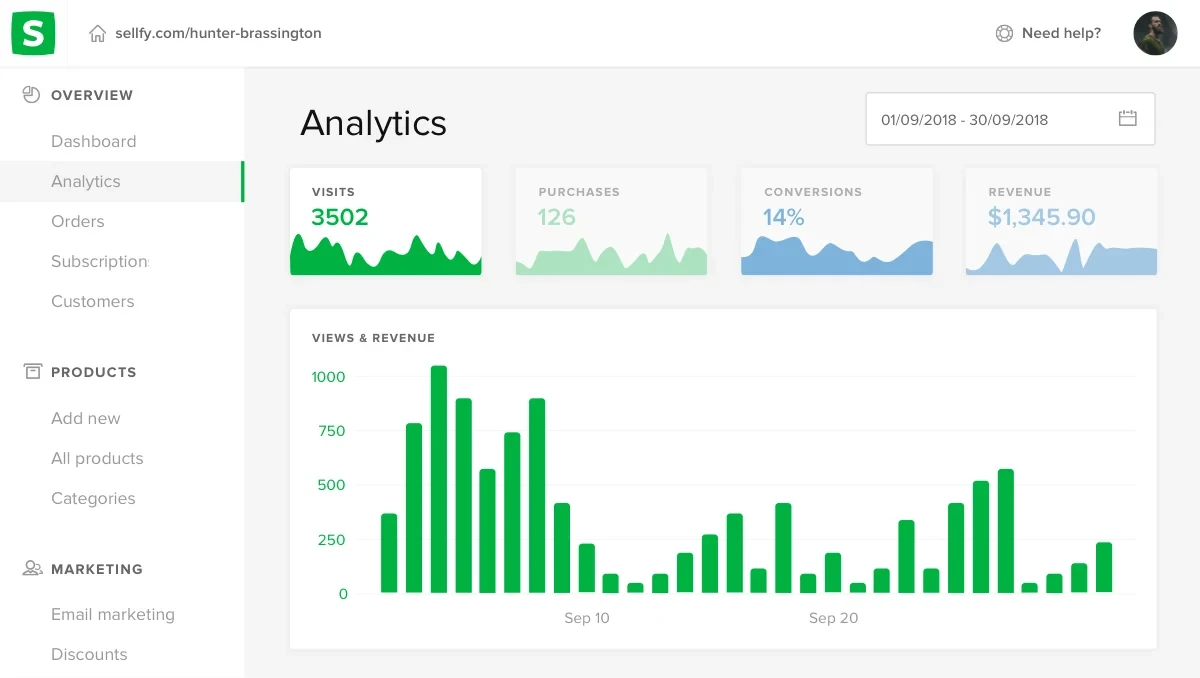
Gumroad, on the other hand, does not truly offer inventory management. Its product system is built around attaching files or access to a checkout flow, rather than maintaining a structured catalog. There are no product variants, stock tracking, or fulfillment workflows. Likewise, orders are essentially transaction records tied to digital delivery, without any operational layer behind them.
This design makes Gumroad extremely easy to use, but it also means it cannot support businesses that need to manage physical products, track inventory, or scale product operations. Hence, we can say Sellfy clearly provides a more capable and structured solution in this area.
Upselling features
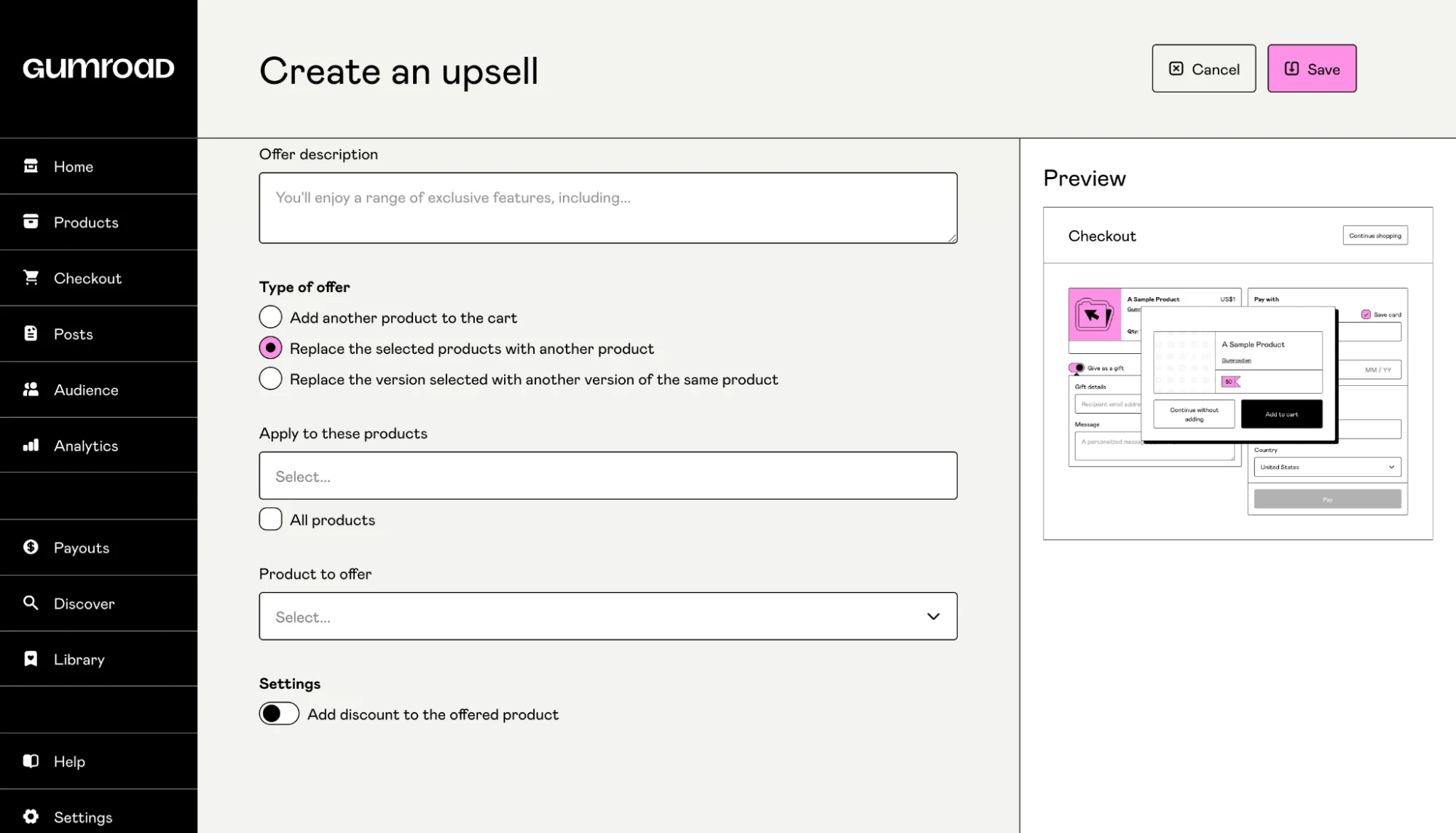
From our observation, Sellfy is designed with conversion optimization in mind, and this is most evident in its upselling capabilities. The platform includes native tools that allow merchants to present additional offers directly within the purchase flow. For example, you can configure in-cart upsell prompts that suggest complementary products at the exact moment a customer is about to check out.
Beyond that, Sellfy supports discount codes with time limits, promotional campaigns, and basic email marketing tied to customer purchase history. These features work together to create a cohesive upsell system that operates both during and after the transaction. Even though it is not as advanced as enterprise-level funnel builders, it still provides a meaningful way to increase average order value without relying on external tools.
By contrast, Gumroad's approach is far more limited. Sure, it does offer a simple upsell option within the checkout flow, but the functionality stops there. Since there is no broader funnel logic or built-in tools for testing or optimizing conversion paths, most sellers end up relying on manual workarounds such as product bundles or external marketing funnels to achieve similar results.
Print on demand
Print-on-demand is another area where Sellfy demonstrates a clear structural advantage.
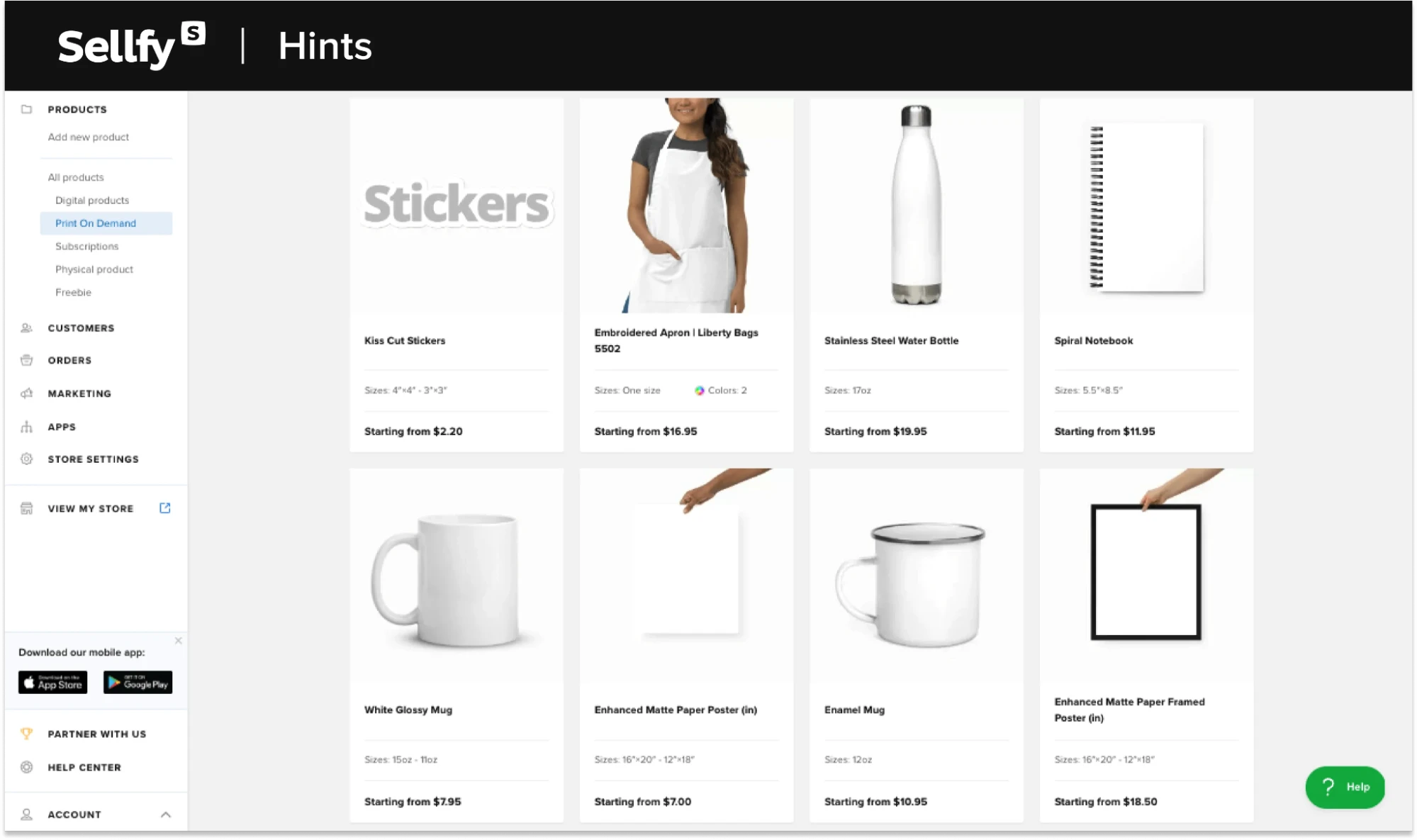
The platform includes a fully integrated POD system that allows merchants to create products such as apparel, mugs, or posters directly in the dashboard. Once a design is uploaded, Sellfy automatically generates product mockups and connects the item to its fulfillment pipeline.
Furthermore, when an order is placed, the process is fully automated: the product is printed, packaged, and shipped without manual intervention or third-party integrations. That's why Sellfy is a true all-in-one solution for creators who want to sell merchandise alongside digital products, without managing logistics themselves.
On the contrary, Gumroad does not provide any native print-on-demand functionality. To sell physical merchandise, users must integrate external services such as Printful or handle fulfillment manually. In simple terms, Gumroad is only a front-end sales tool, with fulfillment handled elsewhere.
Ease of Use (Gumroad wins)
The Verdict
Gumroad removes nearly all setup friction and lets users start selling in minutes without building a store or configuring a backend. Meanwhile, Sellfy is also beginner-friendly, but it introduces a store-based workflow, which requires a few extra steps.
The Sellfy vs Gumroad breakdown below will discuss how this difference plays out in practice:
Sellfy ease of use
Generally, Sellfy offers a clean, intuitive interface built on a store-first system.
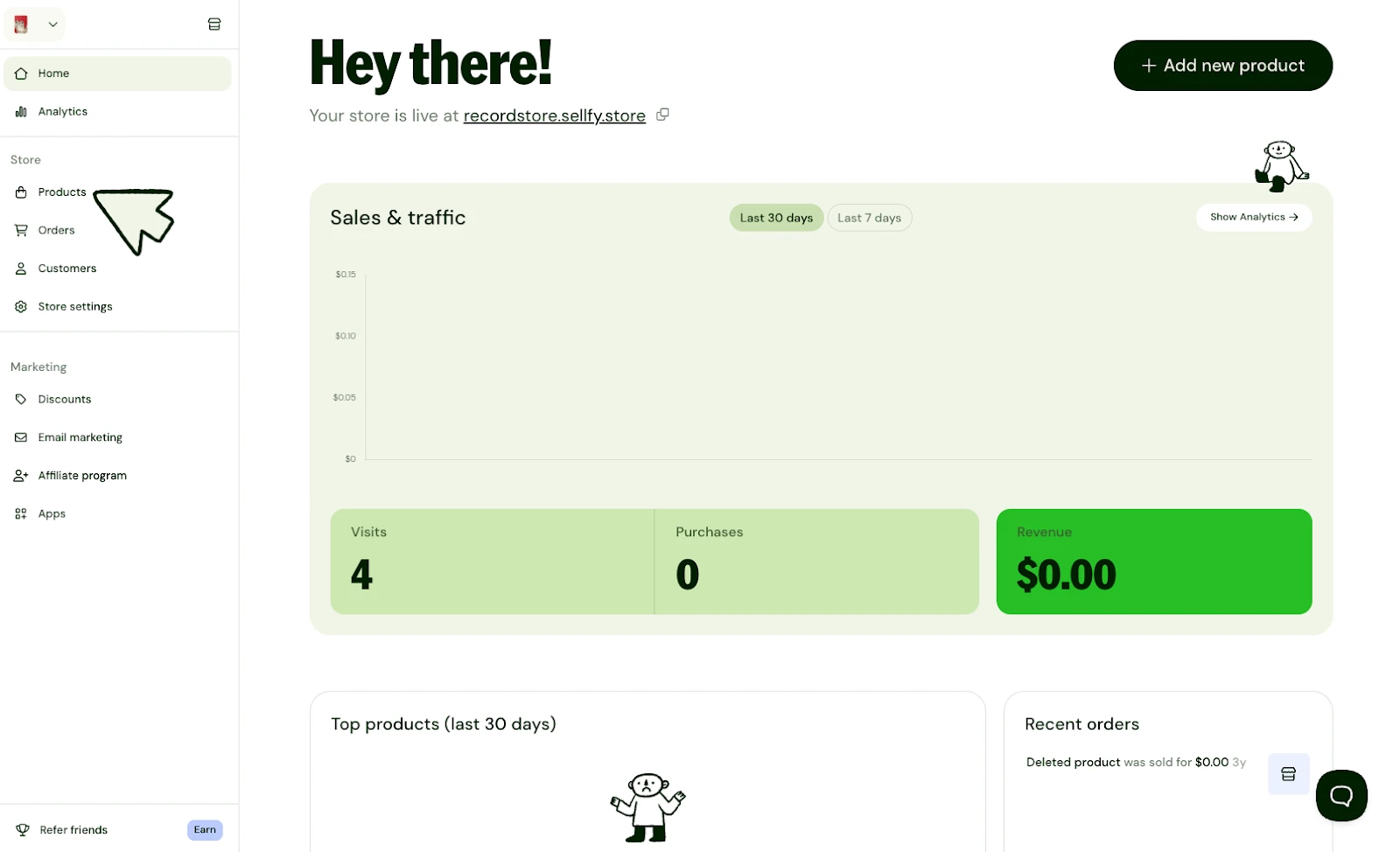
When signing up, users are required to set up a store name and domain before adding products. From there, the dashboard is organized into clear modules such as Products, Orders, Customers, and Marketing, which is quite easy to understand once you are familiar with basic eCommerce workflows. Simply put, this structured approach is beneficial for long-term management because everything is logically grouped and easy to locate.
Gumroad ease of use
Gumroad is built for immediacy, which is why it stands out in this category.
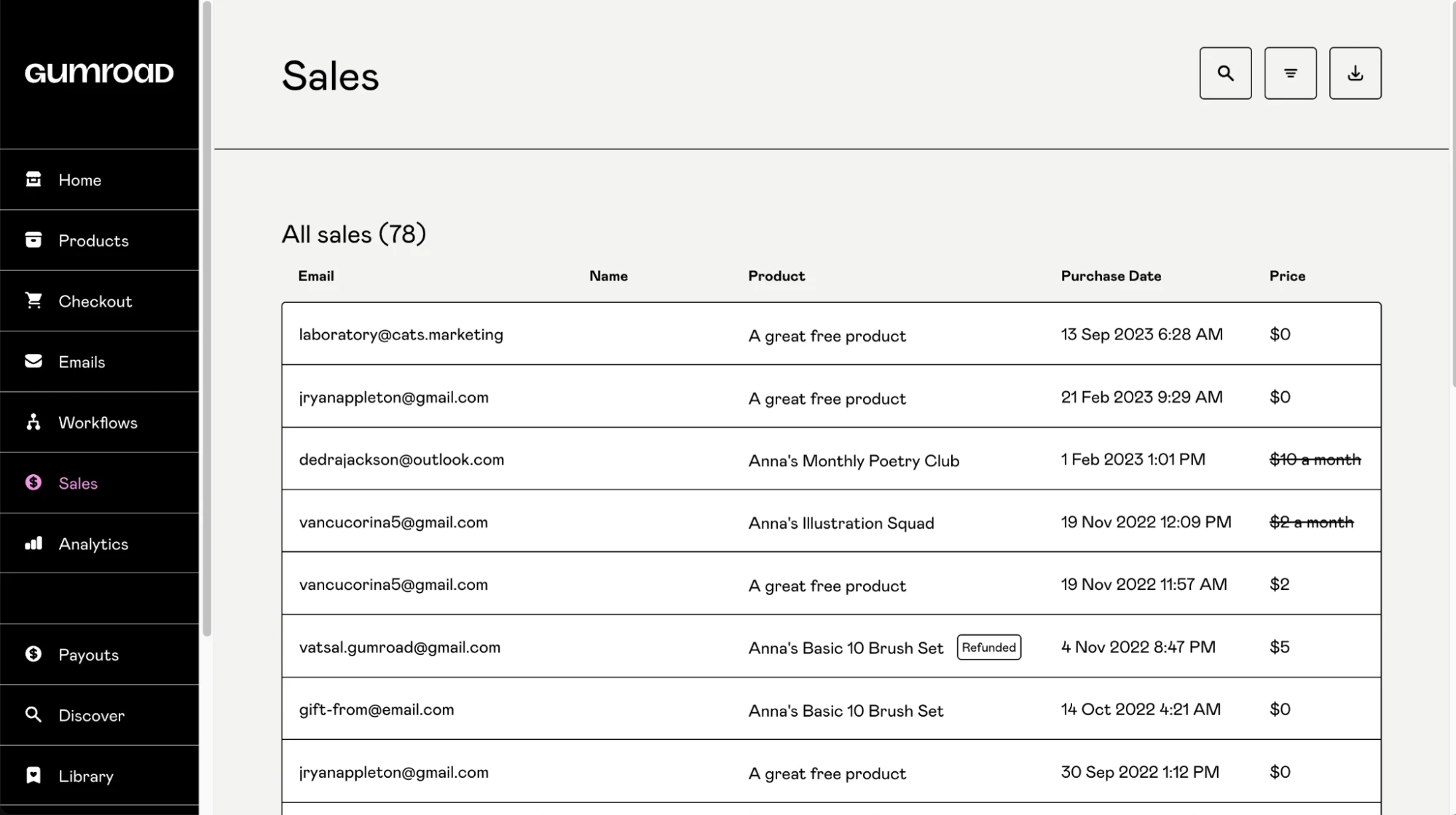
There is no requirement to set up a store or configure a backend. After signing up, users can immediately create a product, upload a file, set a price, and start selling! The streamlined flow significantly reduces launch time and eliminates the need to learn the system's structure.
Similarly, the dashboard follows a flat, minimal design with only a few core sections, such as Products, Sales, Audience, and Analytics. As a result, navigation is very straightforward and easy to grasp, even for non-technical users.
Of course, keep in mind that this simplicity comes with trade-offs. As product catalogs grow, the lack of structure can make management less efficient, and the platform also offers fewer tools for organizing or scaling operations.
Customization (Sellfy wins)
The Verdict
Sellfy wins in customization because it provides more control over the storefront experience, allowing users to adjust layout, branding, and presentation without needing code. While it is not as flexible as advanced eCommerce platforms, it still offers more visual control than Gumroad.
Gumroad, by contrast, focuses on simplicity and distribution rather than design. Let's look at how Sellfy vs Gumroad handles customization in practice.
Sellfy customization
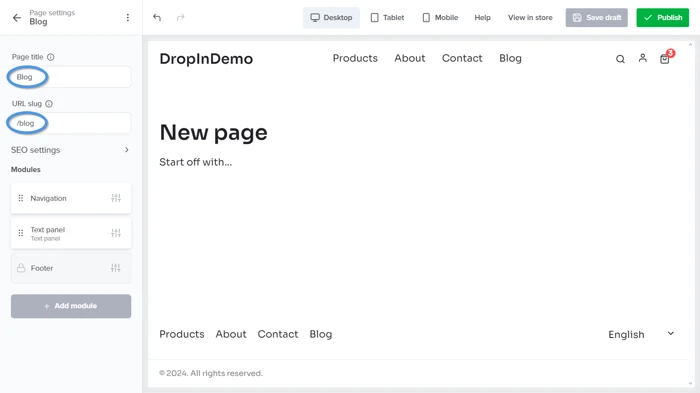
Sellfy provides a no-code customization system that allows users to modify the look and feel of their storefront. Merchants can adjust elements such as colors, typography, layout sections, and overall branding using preset options. In addition to storefront customization, Sellfy also allows basic configuration of product pages, including descriptions, media, and pricing presentation.
However, so far, the platform does not support deep customization, meaning there's no advanced template system that lets you fully redesign the user experience. As a result, while Sellfy offers more control than Gumroad, it still operates within a preset-driven framework that limits flexibility for advanced users.
Gumroad customization
With Gumroad, users can adjust basic elements such as product descriptions, cover images, and a simple profile page. Nevertheless, the overall layout and structure remain fixed. You will find neither a theme system nor a visual builder, which keeps the platform simple but restricts branding options.
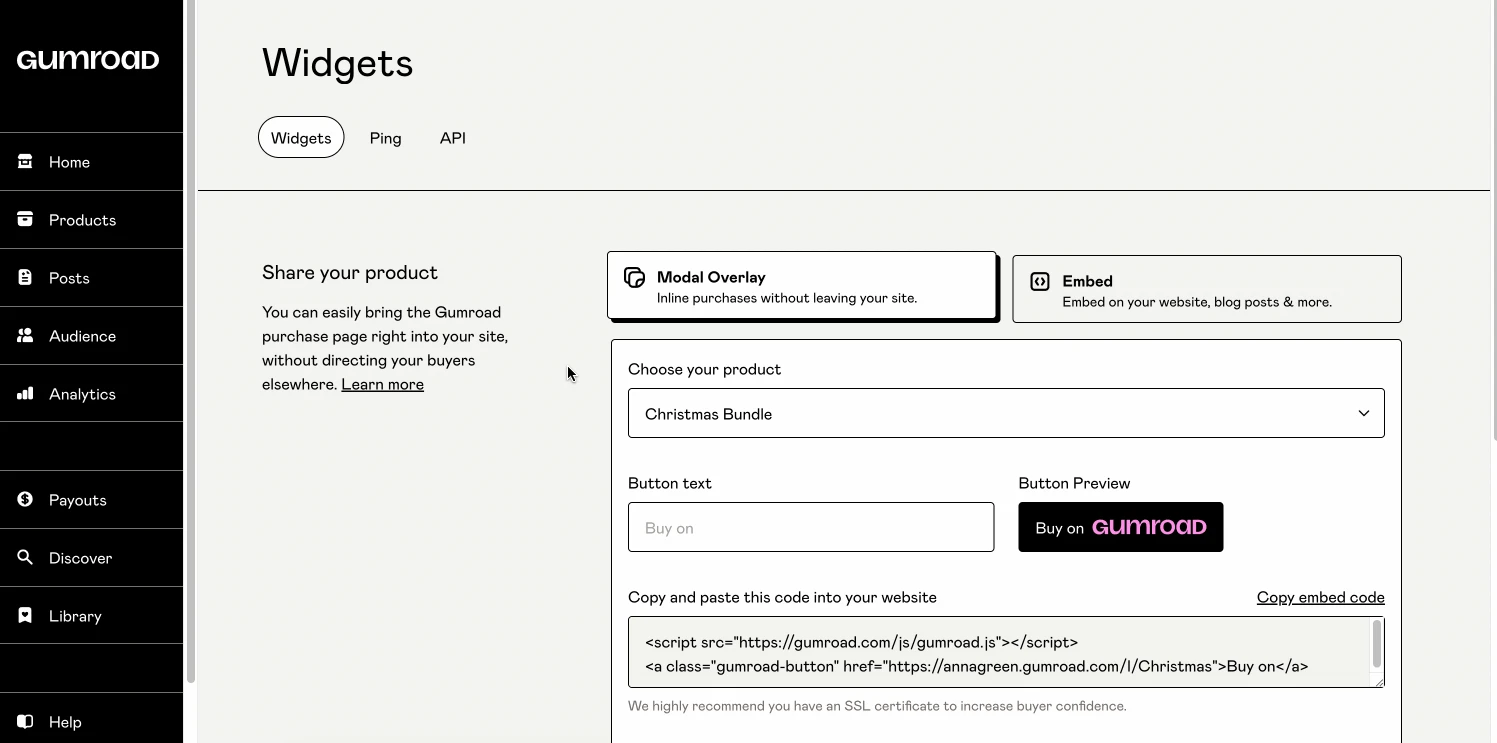
On another note, where Gumroad stands out is in its distribution flexibility rather than visual customization. For instance, products can be sold via direct links, embedded checkouts, or integrated into external websites. Additionally, Gumroad offers an API and webhooks that allow developers to build custom workflows or connect external systems (which we will discuss further). These tools make it more flexible from a technical standpoint, even though its native design customization is still limited.
Integrations (Gumroad wins)
The Verdict
While neither platform has a true app store, Gumroad's support for APIs and webhooks gives it a clear advantage in extensibility. Sellfy, on the other hand, relies more on built-in features.
Here's how their integration ecosystems compare in detail.
Sellfy integrations
Sellfy operates as a closed system with a limited set of native integrations. It supports essential tools such as Google Analytics, Facebook Pixel, and email marketing services like Mailchimp, as well as payment processors such as Stripe and PayPal.
Since Sellfy has no dedicated app store or plugin marketplace, users cannot browse or install additional extensions directly within the platform. To extend functionality, you must rely on third-party automation tools such as Zapier, which can connect you to 8,000+ external applications.

Gumroad integrations
Like Sellfy, Gumroad also does not offer an app store. Fortunately, unlike Sellfy (which does not provide full API endpoints), Gumroad offers a decent REST API and webhook system that enables developers to integrate with external tools, automate workflows, and build custom solutions.
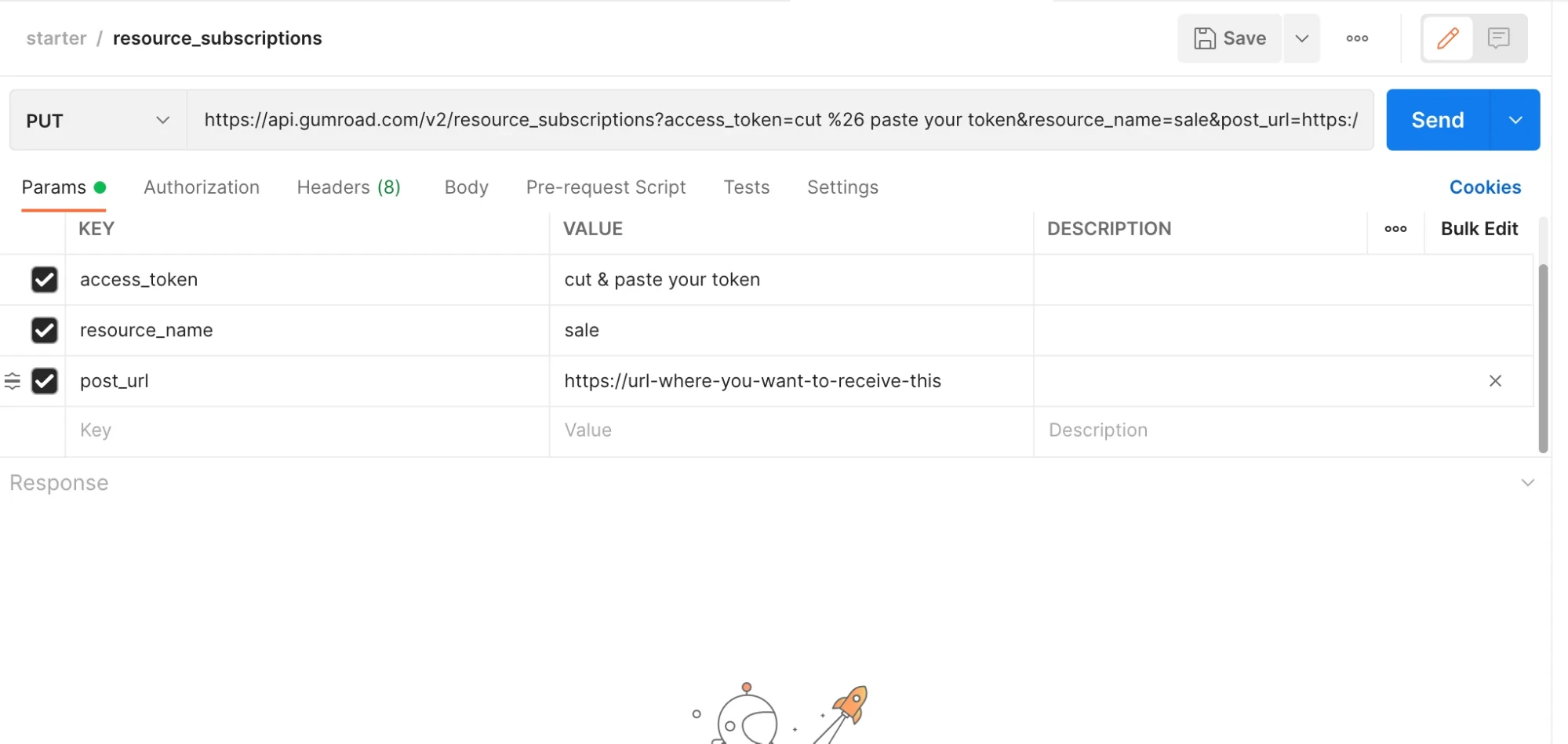
Plus, as mentioned earlier, Gumroad also supports embedding its checkout into external websites and platforms, which effectively allows users to integrate it into their existing tech stack without relying on a traditional storefront. Not to mention, it can also connect to thousands of third-party applications through tools such as Zapier; combined with its API-first design, these integrations become even more adaptable and scalable.
SEO & Marketing (Sellfy wins)
The Verdict
Sellfy provides a more complete growth toolkit, combining a functional storefront for SEO with built-in features for promotions, email campaigns, and conversion optimization. It may not be as advanced as full-scale eCommerce platforms, but it clearly supports both traffic acquisition and revenue growth.
Gumroad, on the other hand, focuses more on direct sales, offering limited SEO capabilities and a narrower set of marketing tools. The difference between Sellfy vs Gumroad in this regard can be seen in the breakdown below:
Sellfy SEO & marketing
Sellfy provides a basic but functional SEO foundation through its storefront-based approach. Each store operates as a standalone site with customizable page titles, meta descriptions, and URLs, allowing products and pages to be indexed by search engines. The platform also supports mobile optimization and automatic sitemap generation, which helps ensure that content can be crawled effectively. While it lacks advanced SEO features such as deep technical controls or a built-in blogging system, it still offers enough structure to support basic search visibility—something many creator-focused platforms do not prioritize.
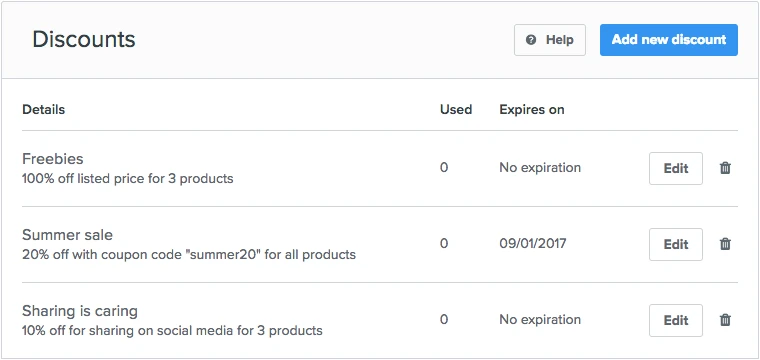
On the marketing side, Sellfy delivers a well-rounded set of built-in tools designed to increase conversions and customer retention. Merchants can create discount codes with flexible conditions, run time-limited promotions, and use in-cart upsell prompts to boost average order value. The platform also includes email marketing features for sending newsletters and product updates, along with customer data tracking for basic segmentation. On higher plans, additional capabilities such as cart abandonment recovery and affiliate marketing further enhance its marketing potential.
Gumroad SEO & Marketing
Gumroad’s approach to SEO is overall quite minimal. Product pages can be indexed by search engines, and users can edit basic titles and descriptions, but there is no real website structure or hierarchy to support long-term SEO strategies. Additionally, most stores operate under the Gumroad domain, limiting flexibility and reducing opportunities for brand-driven organic traffic. As a result, Gumroad is not well-suited for SEO-focused growth and instead relies more on direct traffic or its internal discovery marketplace.
In terms of marketing, Gumroad provides a simplified but focused toolkit aimed at creators. It includes built-in email broadcasting and audience management, allowing sellers to communicate directly with buyers. Features like “pay what you want” pricing and product bundling offer unique ways to experiment with pricing strategies and increase conversions.

However, the platform lacks more advanced marketing capabilities, such as a robust discount system, structured upselling, affiliate programs, or automated recovery campaigns. While these limitations keep the platform easy to use, they also restrict its ability to support more sophisticated marketing strategies.
Security (Gumroad wins)
The Verdict
Gumroad takes the lead in security because it offers a more integrated and hands-off system, handling payments, tax compliance, and licensing within a single platform.
Sellfy still provides solid security fundamentals, especially for protecting digital products, but it relies more on third-party payment processors and offers fewer built-in compliance features. You can see the difference between Sellfy vs Gumroad more closely here:
Sellfy security
Sellfy provides standard security measures expected from a modern eCommerce platform. Payments are processed through trusted providers such as Stripe and PayPal, ensuring compliance with industry standards like PCI DSS through these external gateways. The platform also uses SSL encryption to protect data during transactions.
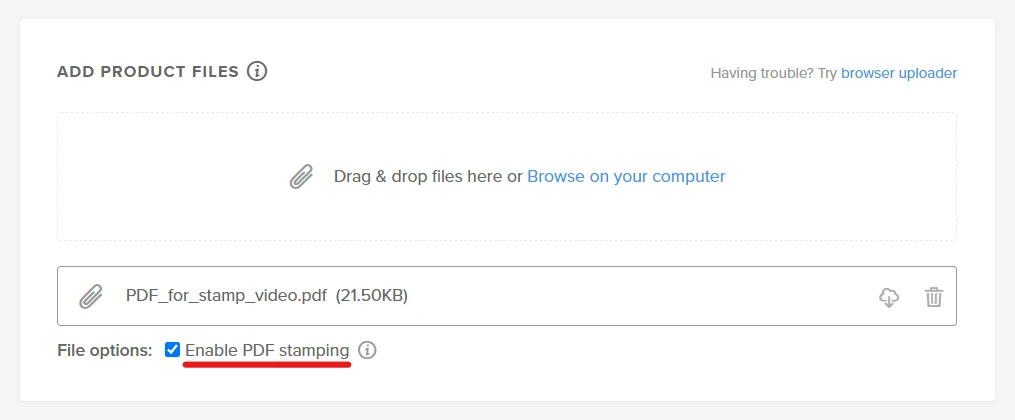
In addition, one of Sellfy’s stronger areas is digital product protection. It includes features such as limited download attempts and PDF stamping, which help reduce unauthorized sharing and protect intellectual property.
On the other hand, Sellfy’s reliance on third-party payment systems means that some aspects of security, such as fraud detection and tax compliance, are handled externally rather than within the platform itself. Also, keep in mind that it does not offer many advanced or customizable security settings, which may be a limitation for more complex use cases.
Gumroad security
Gumroad offers a more all-in-one security and compliance system, which is one of its key advantages.
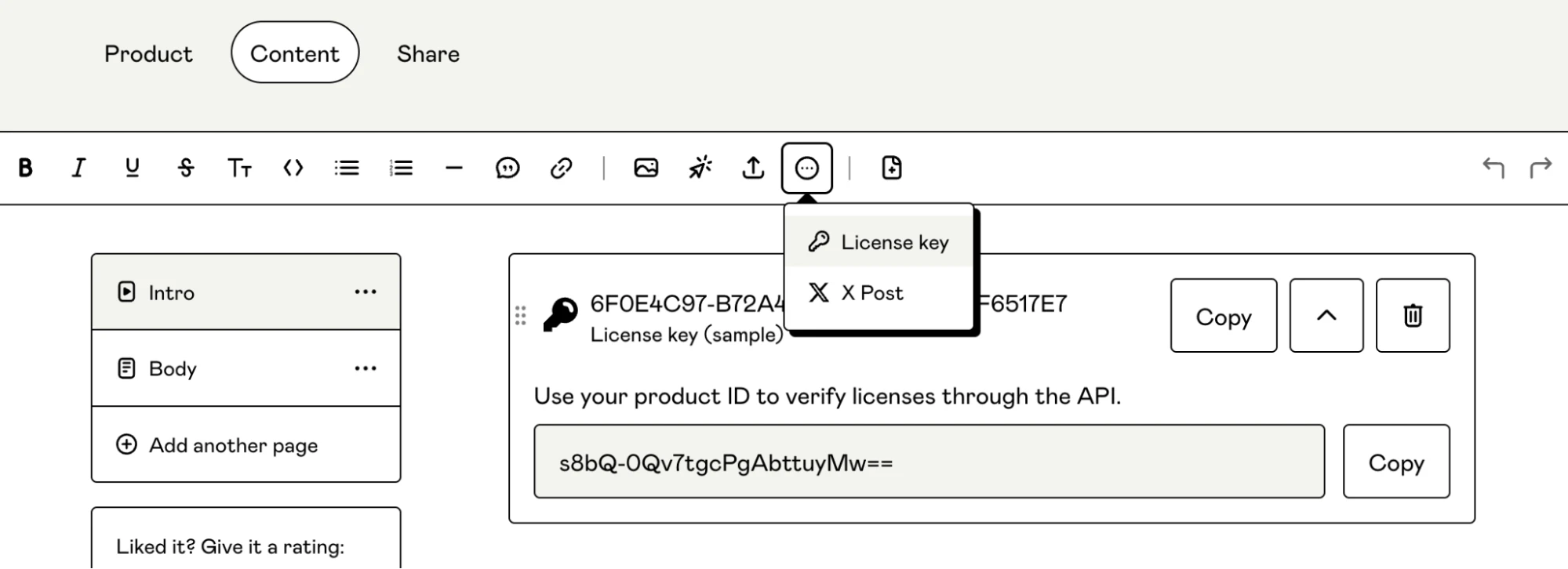
Payments are processed directly within the platform to eliminate the need for external gateways and simplify setup. It also automatically handles tax calculations, including VAT for international sales, which reduces the administrative burden on sellers. In addition to payment security, Gumroad includes features such as license key generation for software products and basic content protection mechanisms.
However, the trade-off is that users have less control over the payment infrastructure, as everything is managed within Gumroad’s system. While this simplifies operations, it may not be ideal for businesses that require more flexibility or customization in their payment workflows.
Support (Sellfy wins)
The Verdict
Sellfy wins in customer support because it offers a more consistent and responsive support experience, particularly for users on paid plans. Its support structure aligns more closely with traditional SaaS platforms, focusing on direct assistance and reliability.
Gumroad, while supported by a large user community and solid documentation, tends to rely more on self-service resources and can be slower in providing direct support. Let’s take a closer look at the Sellfy vs Gumroad comparison in this aspect:
Sellfy support
Sellfy provides a straightforward and reliable support system, primarily through email and a comprehensive help center. Users on higher-tier plans often receive priority support, resulting in faster response times and more personalized assistance. This makes it easier for businesses to resolve issues quickly, especially when dealing with store setup, payments, or product management.
While Sellfy does not typically offer live chat or phone support, its responsiveness and clarity make it a dependable option for most users. Plus, the platform’s documentation is well-organized and covers most common use cases, helping users troubleshoot problems independently when needed.
Gumroad support
Gumroad offers support through a combination of email, help documentation, and a broader creator community.
Its help center is extensive and provides detailed guides on most features, which makes it a useful resource for self-service problem-solving. Additionally, the platform benefits from an active user base, where creators often share solutions and best practices.
However, direct support can be less consistent. Response times are reportedly slow, according to some users, and compared to Sellfy, there is rather limited access to real-time assistance unless the problem is extremely severe.
Pricing (Sellfy wins)
The Verdict
Sellfy wins on pricing because its model is predictable and significantly cheaper at scale, thanks to a fixed monthly subscription and 0% transaction fees. While it requires an upfront cost, sellers keep a much larger share of their revenue over time.
Gumroad, in contrast, offers a no monthly fee model, but takes a substantial percentage from every sale. As a result, it might be more accessible for beginners, yet increasingly expensive as sales volume grows.
Let's discuss how Sellfy vs Gumroad pricing structures differ in more detail:
Sellfy pricing
Sellfy operates on a subscription-based pricing model, where users pay a fixed monthly fee depending on their plan:
- Starter: $29/month
- Business: $79/month
- Premium: $159/month
Also, one key advantage of Sellfy's model is that it charges 0% transaction fees on all paid plans, meaning the platform itself does not take a percentage of each sale. Instead, sellers only need to pay standard payment processing fees through providers like Stripe or PayPal, which are typically around 2.9% + $0.30 per transaction.
Gumroad pricing
On the other hand, Gumroad uses a transaction-based pricing model, eliminating the need for any monthly subscription. Users can sign up and start selling without upfront costs, which makes it particularly appealing for beginners or creators testing new products.
However, this convenience comes at a higher per-sale cost. Gumroad charges approximately 10% + $0.50 per transaction, in addition to standard payment processing fees of around 2.9% + $0.30. In total, this results in roughly 12.9% + $0.80 per sale for direct transactions.
Since fees scale with each purchase, Gumroad becomes progressively more expensive as sales increase. While the absence of a fixed monthly fee lowers the barrier to entry, the high transaction percentage significantly reduces profit margins for sellers with consistent or growing revenue.
FAQs
Is Sellfy a good platform?
Yes. Though Sellfy cannot be compared to more popular platforms like Shopify, Sellfy is still a highly regarded, user-friendly eCommerce platform tailored for creators to sell digital products, subscriptions, and print-on-demand items quickly.
What is Gumroad or Sellfy?
Gumroad and Sellfy are eCommerce platforms designed for creators to sell digital products, subscriptions, and merchandise, offering easy setup for selling e-books, courses, and music. Gumroad operates on a no-monthly-fee basis with a 10% transaction fee, whereas Sellfy charges a flat subscription fee with 0% commissions.
Can I make money on Sellfy?
Yes, you can absolutely make money on Sellfy. It is a beginner-friendly e-commerce platform designed for creators to sell digital products (eBooks, templates, music), print-on-demand merchandise, and subscriptions.
Is Sellfy good for selling digital products?
Yes, Sellfy is an excellent, user-friendly platform for selling digital products, especially for creators looking for a fast, all-in-one setup.
Final Verdict: Which Platform Should You Choose?
Overall, between Sellfy vs Gumroad, Sellfy is the better choice for creators who want to build a structured, scalable online store. Choose it if your goal is to:
- Manage multiple products
- Optimize conversions with upselling
- Leverage SEO for organic traffic
- Maintain higher profit margins as your revenue grows.
Gumroad, on the other hand, is ideal for creators who prioritize simplicity and speed. We recommend this solution if you:
- Want to launch quickly
- Sell directly to an existing audience
- Avoid upfront costs.
Need Help Migrating?
LitExtension provides a well-optimized All-in-One migration service for your data transfer!