Comparing Sellfy vs Etsy means choosing between marketplace traffic and full store ownership. Both let you sell online, but their cost structure, control level, and growth path are very different.
In this guide, we will break down the key differences to help you decide which platform fits your business model.
Category | Sellfy | Etsy | Winner |
Fixed subscription + 0% platform transaction fee | Per-listing + percentage-based transaction fees | Sellfy (for steady volume) | |
Strong for digital, subscriptions, POD | Strong for handmade, vintage, creative goods | Tie (depends on niche) | |
Customizable store design and pages | Standardized marketplace layout | Sellfy | |
Full access to customer data | Limited data within marketplace rules | Sellfy | |
Email campaigns, upsells, discounts, analytics, automation, store control | Coupons, Etsy Ads, marketplace analytics, centralized checkout | Tie (different strengths) | |
Email + Help Center | Broader documentation + marketplace oversight | Etsy | |
SSL + PCI via Stripe/PayPal | Platform-wide fraud protection + buyer programs | Etsy | |
Best for | Creators with their own audience who want brand control and long-term ownership | Handmade sellers who want built-in traffic and low entry barriers |
Let’s dive into the details!
Pros & Cons of Selly vs Etsy
Both platforms offer clear advantages, but they also come with trade-offs. Reviewing the strengths and limitations of Etsy vs Sellfy will help you understand which model better fits your business goals.
Sellfy
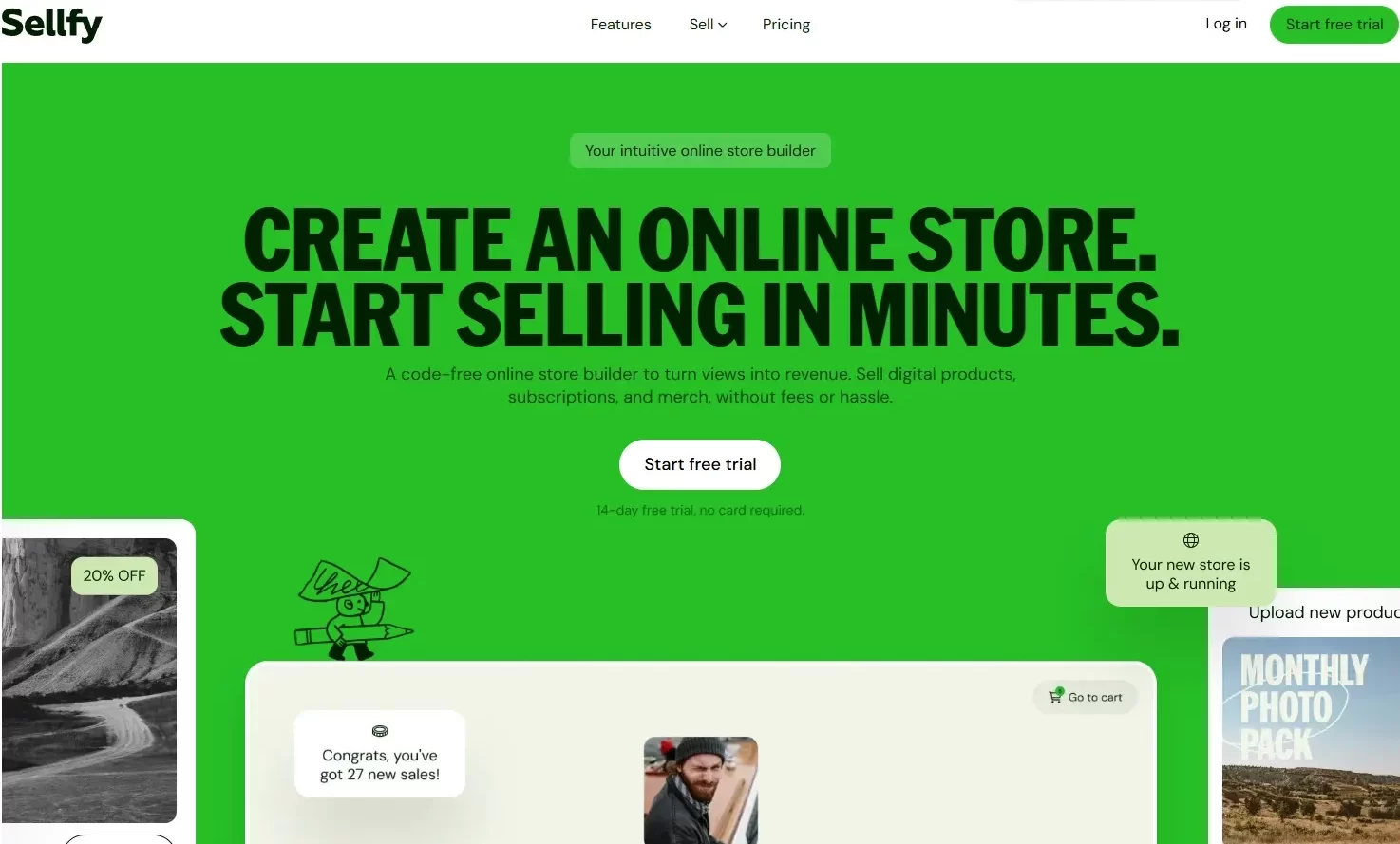
Sellfy is a standalone eCommerce platform designed for creators and small brands who want to sell directly to their audience. It focuses on simplicity, digital product support, and brand control, making it especially suitable for digital-first businesses and lean product catalogs.
Pros:
- You can set up a store very quickly with the beginner-friendly interface.
- Revenue stays higher because no extra marketplace commission and per-sale transaction fee is charged.
- Built-in marketing tools reduce reliance on third-party apps.
Cons:
- The integration ecosystem is relatively small compared to larger platforms.
- Large or highly complex product catalogs may not be an ideal fit.
- Sellfy does not provide built-in marketplace traffic like Etsy, so you must drive your own audience.
Etsy
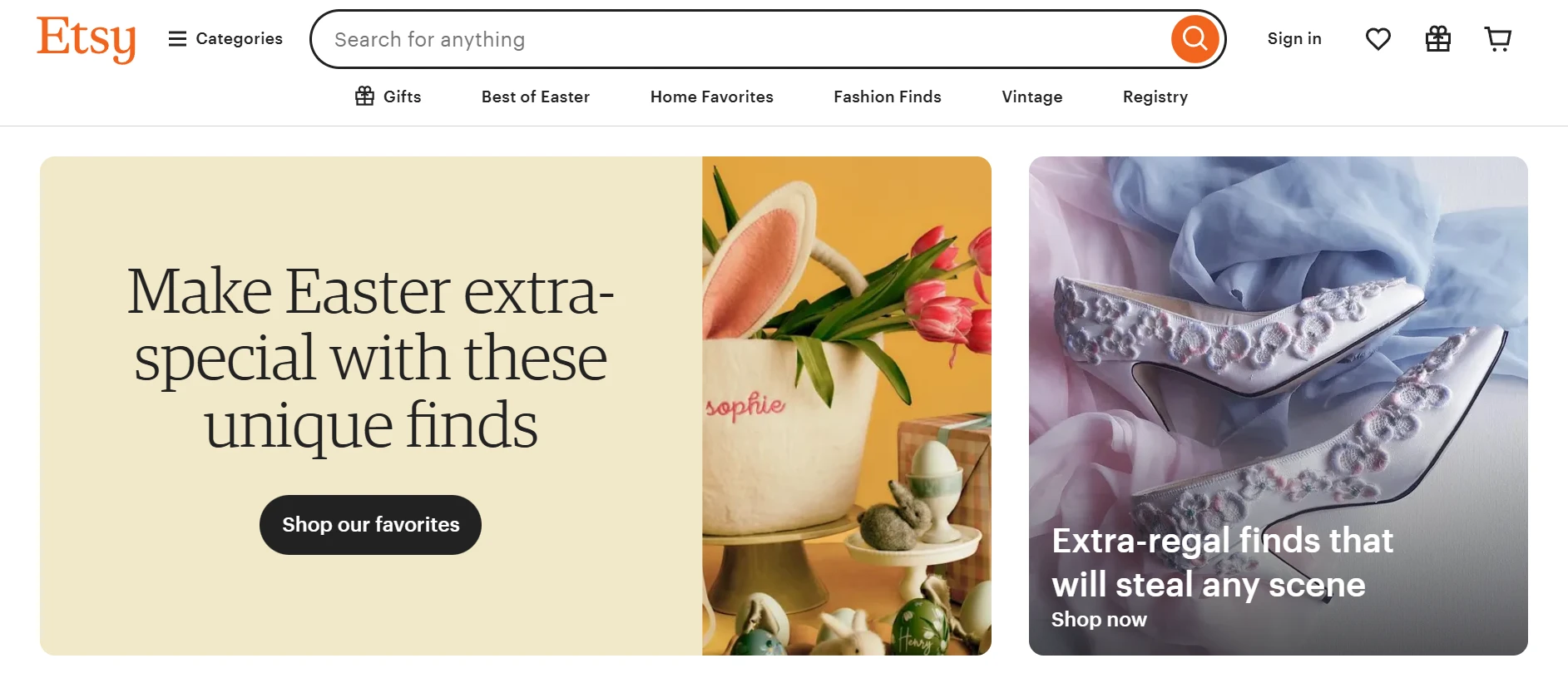
Etsy is a global online marketplace built around handmade, vintage, and creative goods. It provides built-in traffic infrastructure, allowing sellers to tap into an existing buyer base without building a website from scratch.
Pros:
- A large built-in buyer base actively searches for handmade and unique products.
- Built-in search and category systems help optimize listings gain visibility.
- Reviews and buyer protection policies strengthen customer trust.
- Low upfront risk makes it effective for product validation.
Cons:
- High competition makes price differentiation and visibility more challenging.
- Store layout and branding options remain limited within the marketplace structure.
- Listing and transaction fees reduce margins as sales grow.
Total Fees: Sellfy Wins
The Verdict
Due to the different pricing structures in Sellfy vs Etsy, the latter typically becomes more expensive per sale once you have steady volume.
Sellfy
Sellfy uses a subscription-based model combined with standard payment processing fees. The platform itself does not take a cut of each sale, which makes costs easier to forecast over time. If you choose annual billing, you can save around 25% compared to paying month-to-month.
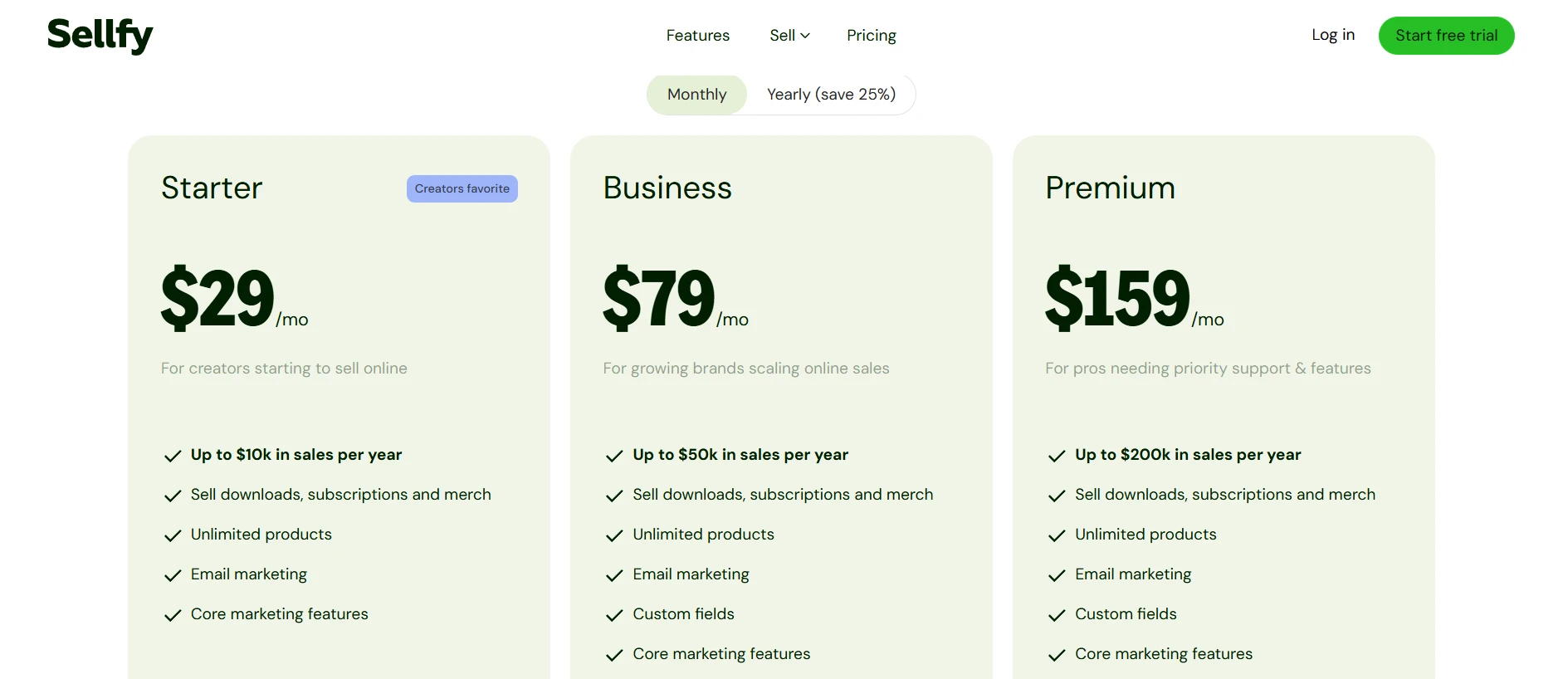
Beyond the subscription fee, you should also factor in the transaction structure:
- Platform transaction fee: 0% on all plans
- Payment processing: Typically around 2.9% + 0.30 USD per transaction via Stripe or PayPal (rates vary by country)
In short, your total cost equals your subscription (monthly or yearly) plus payment processing. There is no additional percentage taken by Sellfy itself, which helps protect your margins as sales increase.
Etsy
In contrast, Etsy follows a pay-as-you-sell model. The barrier to entry is low, but fees apply at multiple stages of each transaction. These are the mandatory core fees you should expect:
- Listing fee: 0.20 USD per listing (valid for 4 months or until sold)
- Transaction fee: 6.5% of the item price plus shipping
- Payment processing: about 3% + 0.25 USD per order in the US (varies by country)
For example, on a 100 USD order (including shipping), total Etsy fees are approximately 9.95 USD. That leaves about 90.05 USD before product costs and other business expenses.
In addition, some costs are optional or conditional:
- Offsite Ads: up to 15% extra if the sale comes through Etsy’s external advertising program
- Etsy Plus and other add-ons: optional monthly subscription fees.
While Etsy keeps upfront costs low, its percentage-based structure means fees grow with every order. Over time, many sellers find that total platform-related costs can take 20–25% of revenue once ads, taxes, and extras are included. That is why Etsy can feel affordable at the beginning, but increasingly expensive as your sales volume grows.
Target Audience & Product: Etsy Wins
The Verdict
In the Sellfy vs Etsy comparison, Etsy is generally more accessible for most beginners. It offers built-in traffic, lower upfront commitment, and a simple way to start selling without building your own audience first.
Sellfy
Sellfy makes the most sense if your business is built around your audience.
If you create digital products like ebooks, templates, presets, music, or courses, Sellfy fits naturally because it handles file hosting and delivery smoothly. If you run memberships or subscription-based content, the structure also supports recurring access without extra tools.
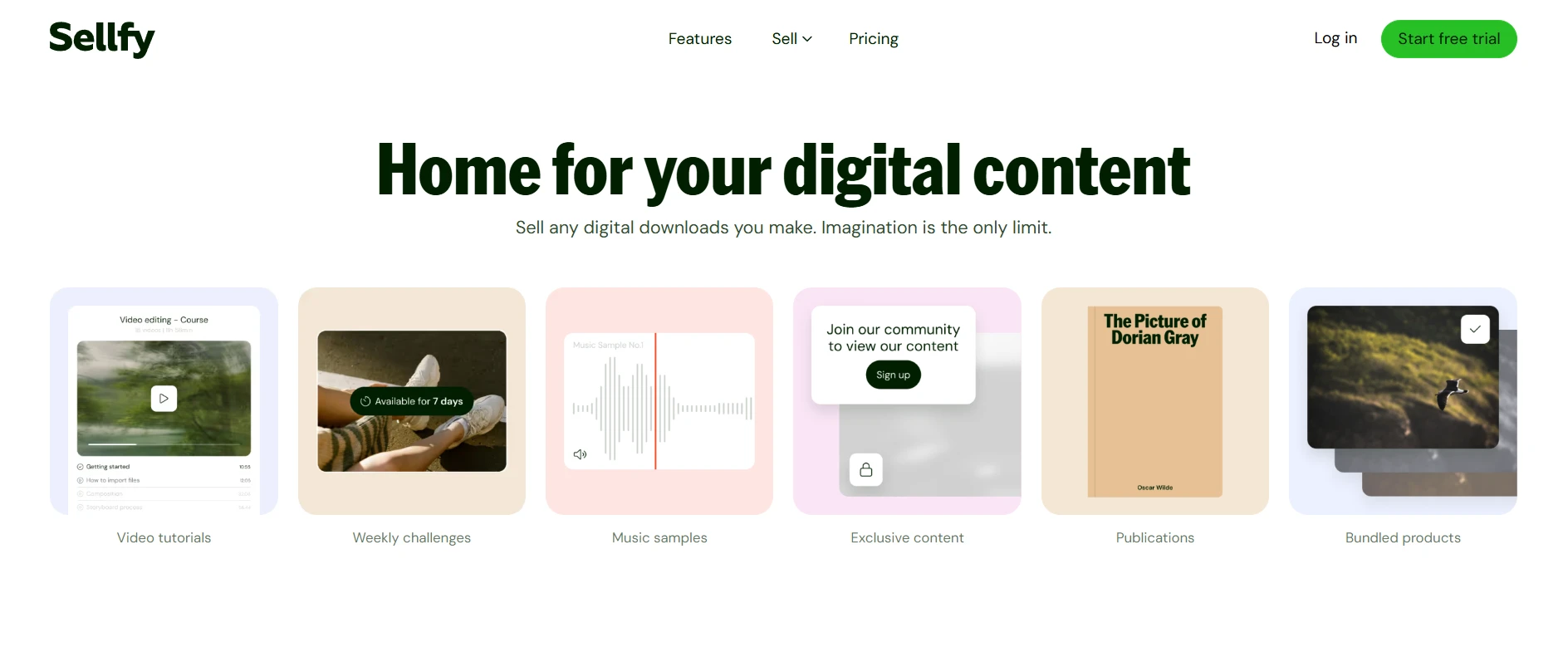
This is where the Sellfy vs Etsy for digital products debate often favors Sellfy, especially for creators who want full control. Even physical or print-on-demand products work well – but especially when you are promoting them directly to your own followers.
In other words, Sellfy is ideal when:
- Your traffic comes from social media, YouTube, email, or ads;
- Your brand matters more than marketplace visibility;
- You want full control over pricing and customer relationships.
It supports creator-led businesses rather than marketplace competition.
Etsy
Meanwhile, Etsy works better when you rely on built-in marketplace traffic.
The shoppers on this marketplace typically look for items that feel personal, handmade, aesthetic, or meaningful. Categories like jewelry, home decor, wedding items, personalized gifts, craft supplies, and vintage pieces naturally perform well because they match that browsing behavior. Even digital downloads succeed when they fit into this creative, design-led environment.
This makes Etsy more suitable for:
- Sellers whose products align with trending or searchable categories;
- Makers who benefit from seasonal or event-driven demand;
- Businesses that are comfortable operating within a marketplace structure.
In short, Sellfy suits audience-led brands, whereas Etsy suits discovery-led sellers.
If Etsy feels like the right fit, the next step is making your migration smooth and hassle-free. With LitExtension, you can move your store data to Etsy accurately and securely, without the technical stress.
Etsy Migration Made Easy With LitExtension!
LitExtension offers great migration solutions that help you transfer your data from the current eCommerce platform to a new one accurately, painlessly with utmost security.
Ownership: Sellfy Wins
The Verdict
Putting Sellfy vs Etsy side-by-side for ownership, Sellfy clearly wins. It gives you full control over branding, customer data, and long-term business direction.
Sellfy
When you sell on Sellfy, you control your storefront, your pricing, and your branding without marketplace layout limits. More importantly, you retain access to your customer data. That means you can build email lists, run remarketing campaigns, and develop direct relationships without platform interference.
There is also less algorithm dependency. Your visibility does not depend on ranking next to competitors inside a shared marketplace. If traffic drops, it is usually because your marketing slowed down – not because the platform changed how products are displayed.
Etsy
Etsy operates under shared ownership within a marketplace system.
While you technically own your shop, many key elements remain controlled by Etsy. Store layout, buyer communication structure, and customer experience follow marketplace rules. Customer data access is more limited, and repeat purchases often happen under Etsy’s brand rather than yours.
Visibility depends heavily on Etsy’s search algorithm. Changes in ranking systems, policy updates, or fee adjustments can directly impact your performance. In this environment, you operate inside the platform’s ecosystem rather than independently.
In short, Sellfy centers on full ownership and independence, while Etsy keeps you operating within its marketplace framework.
Themes & Customization: Sellfy Wins
The Verdict
If you are evaluating Sellfy and Etsy based on customization, Sellfy clearly offers more flexibility. If brand identity and visual control matter to you, Sellfy gives you the space to build a store that feels fully yours.
Sellfy
When you create a store on Sellfy, you begin with the Bio theme by default, but the design is not locked. You can change the overall style, adjust colors, backgrounds, fonts, and buttons, and refine how key pages look – including product pages and checkout.
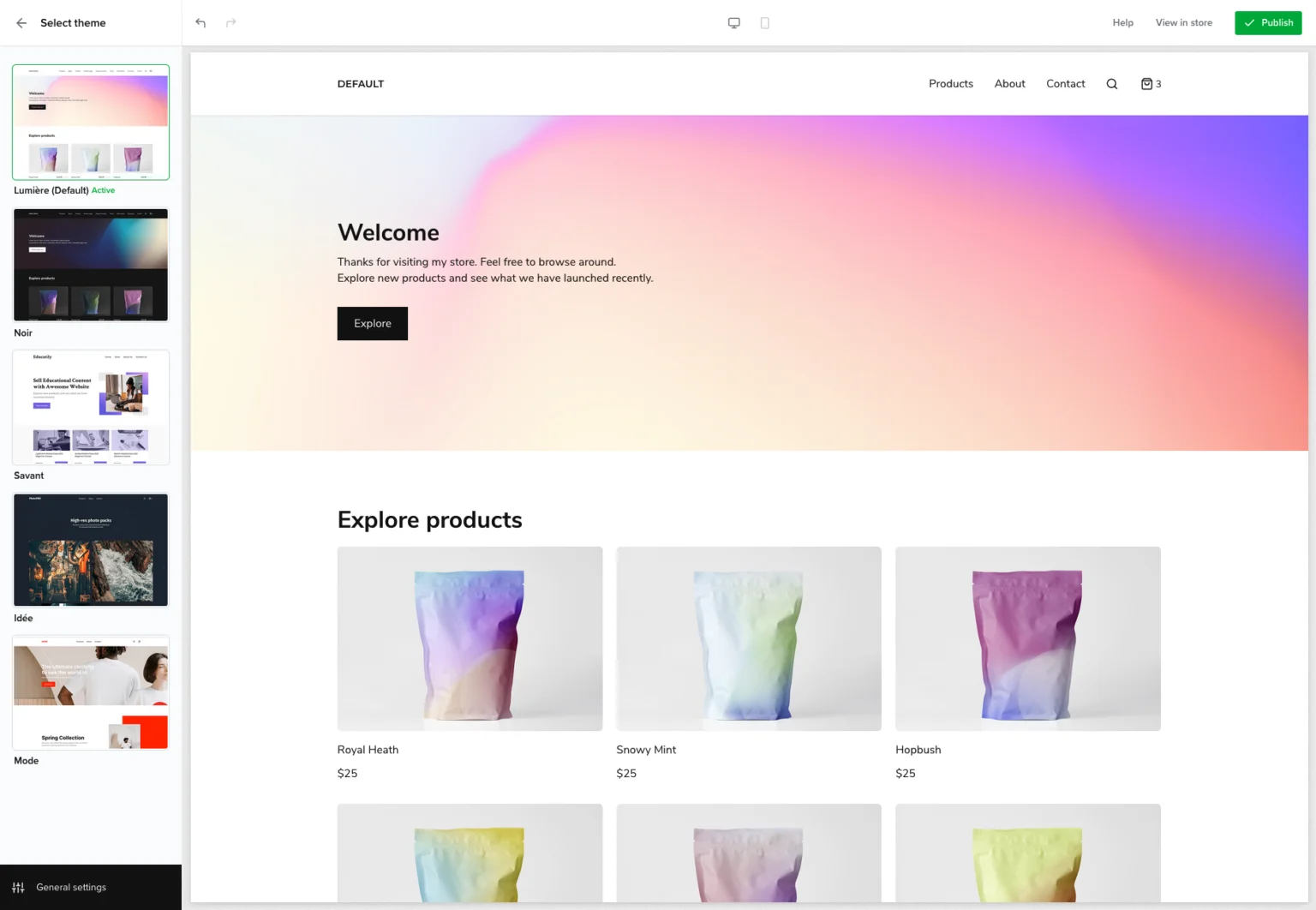
More importantly, pages are built using flexible modules. That means you can rearrange sections, add banners, highlight promotions, or create content blocks without relying on strict templates. You can also create custom pages, such as About or FAQ, and adjust SEO settings for each page.
Even order emails can reflect your branding instead of generic platform messaging. In short, Sellfy allows your store to feel like an independent website rather than a standardized template.
Etsy
Etsy takes the opposite approach. Design consistency across the marketplace is prioritized over individual customization.
Every shop follows the same layout structure. Product pages, checkout flow, and overall presentation are standardized. You can upload a logo, banner, and product images, but you cannot change the core structure or visual hierarchy of the store.
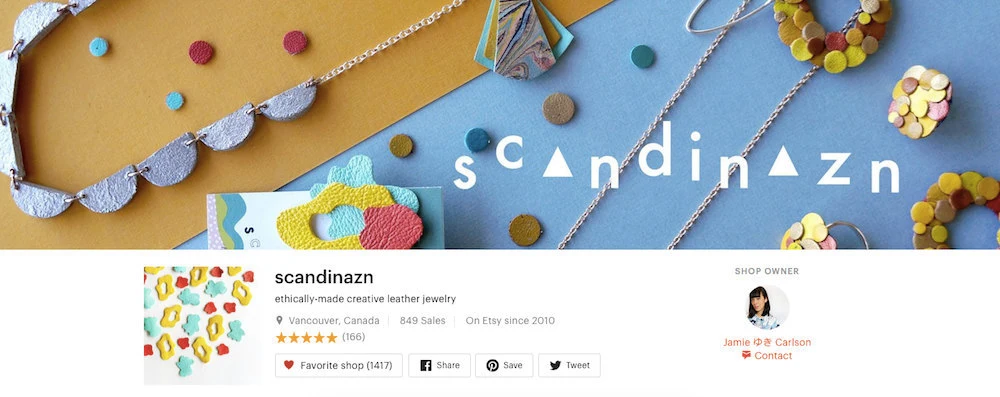
This uniform design has an advantage: buyers instantly recognize how to navigate and trust the platform. But it also limits how much your shop can visually differentiate itself from competitors.
eCommerce Tools: A Tie
Moving on, let’s see how Sellfy vs Etsy can support you to run and grow your business. The table below highlights the eCommerce tools offered by both platforms so you can quickly see where each one stands.
Tools | Sellfy | Etsy |
Product limit | - No explicit limit on number of products. - Main constraints are file size and annual revenue caps per plan. | - No fixed maximum number of listings. - Can scale to hundreds or thousands of listings if policies are followed. |
Bulk management | - Adjust products and variants one by one or via simple lists. - No advanced multi‑location inventory logic. | - Bulk edit tools in Shop Manager for price/quantity/renewals. - Many sellers add external inventory apps for deeper control. |
Cart & checkout | Full shopping cart, mobile‑optimized checkout on your own store. | Etsy‑controlled cart and checkout, standardized for all shops. |
Customer management | You can build your own CRM or export data to other tools for remarketing. | Buyer relationship is mediated by Etsy’s policies and messaging system. |
Payments | Stripe + PayPal directly on your storefront. | Etsy Payments (card, PayPal in some regions, local options) managed by Etsy. |
Discounts & coupons | Built‑in discount codes, upsells, abandoned‑cart emails. | Sales & Coupons tool for promotions and coupon links. |
Marketing tools | Email campaigns, upsells, affiliate program, ad pixels, embeddable buy buttons/store. | Etsy Ads, coupons, sales events, favorites/reviews, plus off‑Etsy marketing you do yourself. |
SEO settings | - Basic SEO controls per page (titles, meta descriptions, URLs). - You can connect your own domain and add tracking (e.g., Analytics, pixels). | - Strong internal SEO via Etsy search (titles, tags, categories, attributes). - Limited control over technical SEO; Etsy controls site structure. |
Sales channels | Own store, link‑in‑bio style store, embeds on any site, social links. | Etsy marketplace only (plus some integrations to social via “Share” and external tools). |
Analytics | Store analytics for sales, traffic, marketing performance. | Shop stats, listing performance, and promo results (sales/coupons, ads). |
Automation & workflows | Basic automation around emails (order, download, abandoned cart) and file delivery. | Some automated Etsy‑wide flows (review prompts, favorites, recommendations). |
Neither Sellfy vs Etsy clearly dominates across all tools – they simply prioritize different strengths within their own models. Sellfy offers stronger control over store features and marketing functions, while Etsy provides built-in systems that simplify selling inside in marketplace.
Support & Security: Etsy Wins
The Verdict
When comparing the support & security side between Sellfy vs Etsy, the latter comes out slightly ahead overall. Its marketplace-level protection, fraud monitoring, dispute handling, and buyer programs provide a stronger safety net.
Sellfy
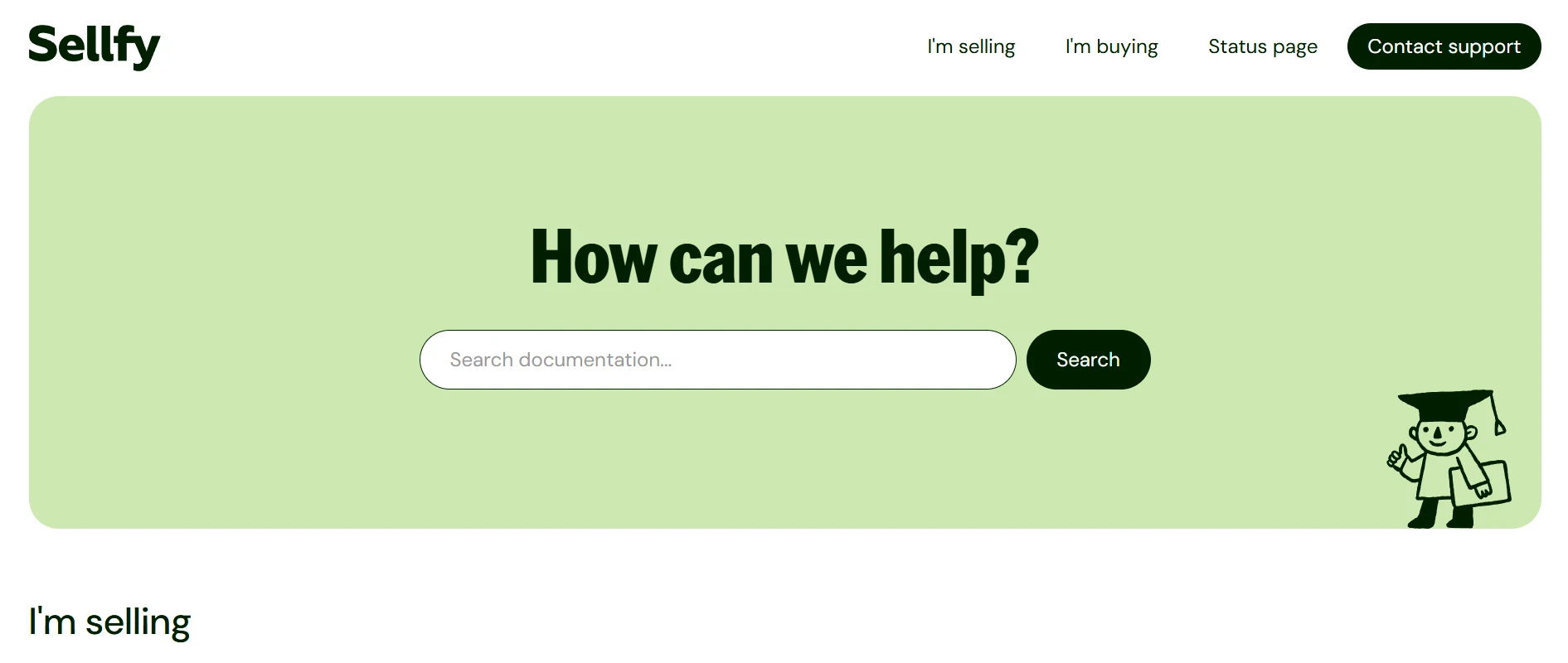
If you run into issues, you can reach out to Sellfy via email or use the Help Center, which covers most setup and troubleshooting topics. There is no live chat or phone support, so responses are handled through tickets rather than real-time channels.
On the security side, your store is protected with SSL encryption, and payments are processed through Stripe or PayPal, both PCI-compliant providers. If you sell digital products, download limits help protect your files from abuse. Data handling follows GDPR standards, but you remain responsible for managing customer data properly.
Etsy
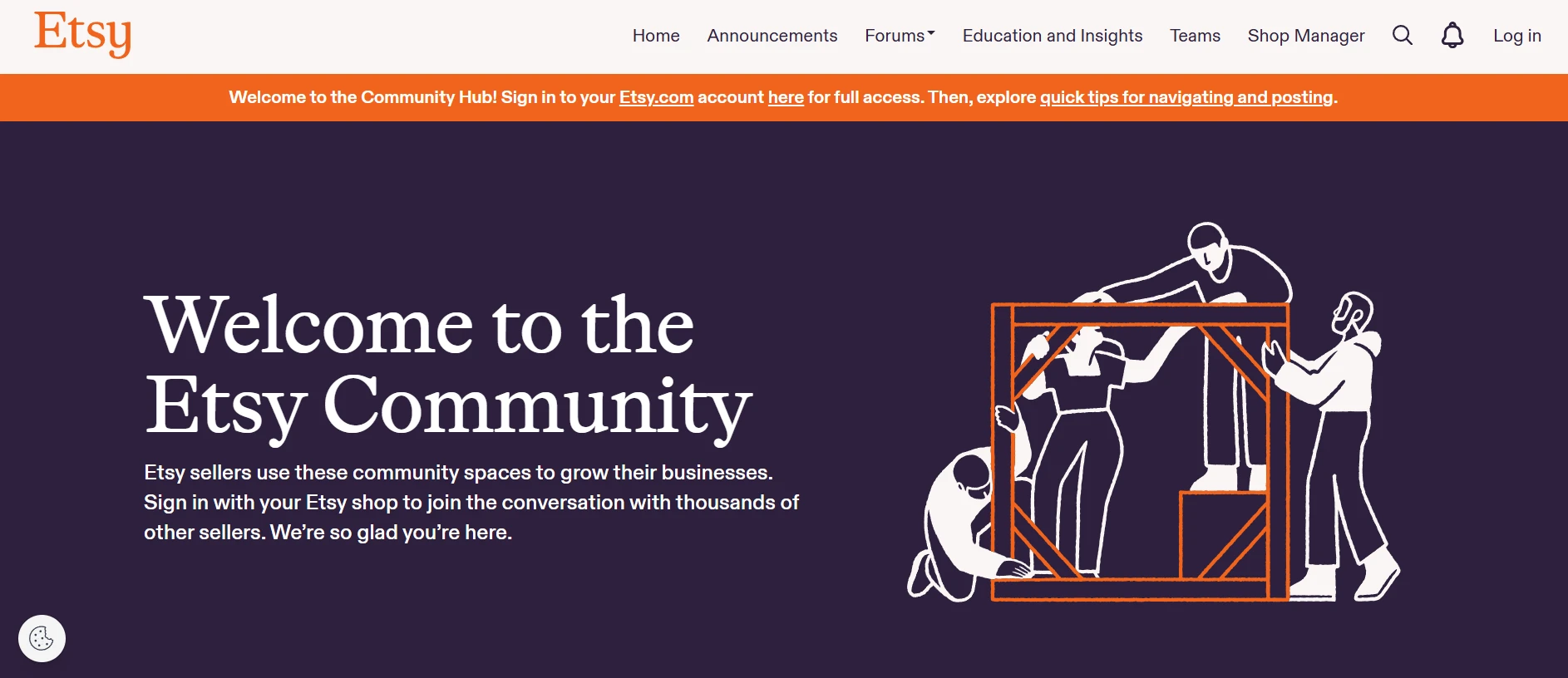
Etsy operates at a marketplace scale, so its support and security model is broader. Sellers can access the Help Center, submit contact forms, and in some regions use chat or callbacks. There is also a large seller community where shared experience often fills the gaps.
Security goes beyond infrastructure. Etsy manages centralized payments with fraud checks, handles disputes, and offers buyer and seller protection programs for eligible orders. New sellers go through identity verification, and platform policies are regularly updated to reduce scams.
Sellfy vs Etsy: FAQs
What is the difference between Etsy and Sellfy?
The main difference is the business model. Etsy is a marketplace with built-in traffic, where sellers compete inside a shared platform. Sellfy is a standalone store builder that gives you full control but requires you to drive your own traffic.
Who is Etsy's biggest competitor?
Etsy’s biggest competitor depends on the selling model. In the marketplace space, platforms like eBay or Amazon compete for similar creative sellers.
In the independent store space, platforms like Shopify and Sellfy compete by offering more control and brand ownership instead of marketplace visibility.
Is Sellfy worth it?
Sellfy is worth it if you already have, or plan to build, your own audience. Its fixed subscription model and 0% platform transaction fee can become cost-efficient as sales grow.
Why are so many sellers leaving Etsy?
Some sellers leave Etsy due to increasing fees, strong competition, and dependency on platform algorithms. Percentage-based fees can reduce margins over time, especially at higher sales volumes.
Conclusion
As you can see, the Sellfy vs Etsy decision ultimately comes down to how you want to build your business:
- Etsy offers accessibility, built-in traffic, and marketplace protection, making it easier to start
- Sellfy offers stronger ownership, branding control, and predictable margins as you grow.
Hopefully, this guide has helped you move closer to a decision. For more eCommerce insights, explore our other blog posts or join our community group to continue the conversation.