AI agents for eCommerce are changing how online stores run in 2026. In the past, stores used simple chatbots and fixed automation rules. Now, AI agents can study data, make decisions, and take action without needing constant human control.
Today, AI agents can:
- Recommend products based on what customers are viewing
- Recover abandoned carts through email, chat, or social channels
- Handle order tracking, returns, and refunds automatically
- Adjust prices based on demand and competitors
- Predict inventory needs to avoid running out of stock
- Create product descriptions and marketing content at scale
Because of this, eCommerce is moving toward autonomous commerce – where sales, support, marketing, and operations are supported by smart systems working in the background.
In this guide, we explain 13 AI agents for eCommerce that are reshaping online retail in 2026. They are grouped by business impact to help you choose the right solution for your store.
What Is an AI Agent for eCommerce?
AI agents for eCommerce are becoming very popular. However, many people still confuse them with chatbots or simple automation tools.
So first, let’s clearly explain what an AI agent is. Then, we will look at its benefits. Finally, we will see how AI agents are used in eCommerce today.
What is an AI agent?
An AI agent is a smart software system that can complete tasks on its own to reach a goal. In eCommerce, that goal may be increasing sales, reducing support work, improving customer experience, or managing inventory better.
Unlike traditional automation, AI agents do not only follow fixed rules. For example, a basic automation rule says: “If cart is abandoned, send email.”
But an AI agent can decide:
- Which message to send
- When to send it
- Whether to offer a discount
- Which product to recommend
In other words, AI agents can understand data, analyze situations, make decisions, and take action. Because of this, AI agents are more flexible and more powerful than legacy automation.
Key benefits of AI agents for eCommerce businesses
Now that we understand what AI agents are, let’s look at why they matter.
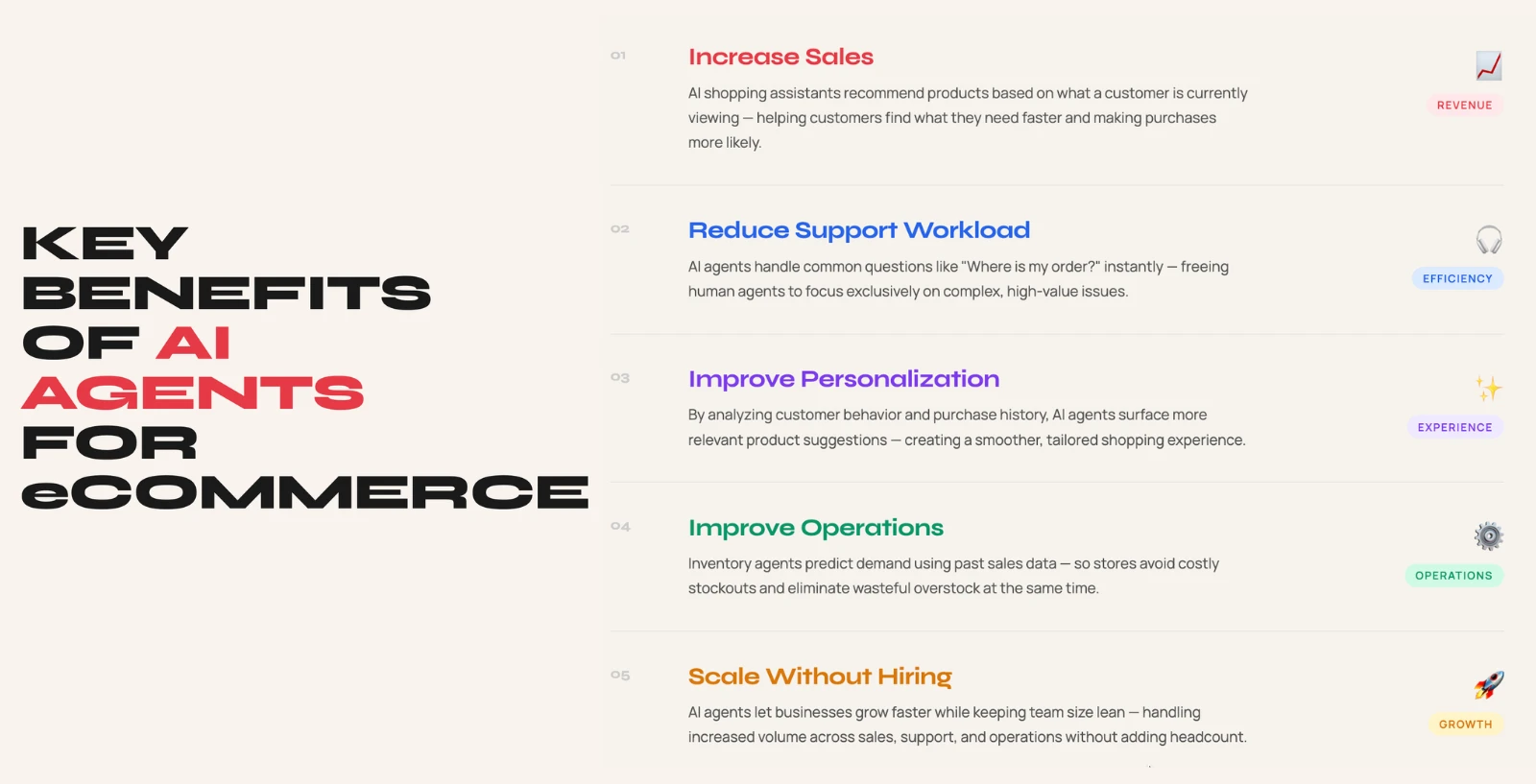
First, they help increase sales. For example, AI shopping assistants can recommend products based on what a customer is viewing. As a result, customers find what they need faster and are more likely to make a purchase.
Second, they reduce support workload. AI agents can answer common questions like “Where is my order?” or “How do I return this item?” Therefore, human agents can focus on more complex issues.
Third, they improve personalization. Because AI agents analyze customer behavior and purchase history, they can suggest more relevant products. This makes the shopping experience smoother.
Fourth, they improve operations. For example, inventory agents can predict demand using past sales data. As a result, stores avoid stockouts and reduce overstock. Finally, AI agents help stores grow without increasing team size. In other words, businesses can scale faster while controlling costs.
How are AI agents used in eCommerce today?
Today, AI agents are used in many parts of an online store. They are no longer limited to chat support or simple automation. Instead, they operate across the entire commerce system, from product discovery to post-purchase support.
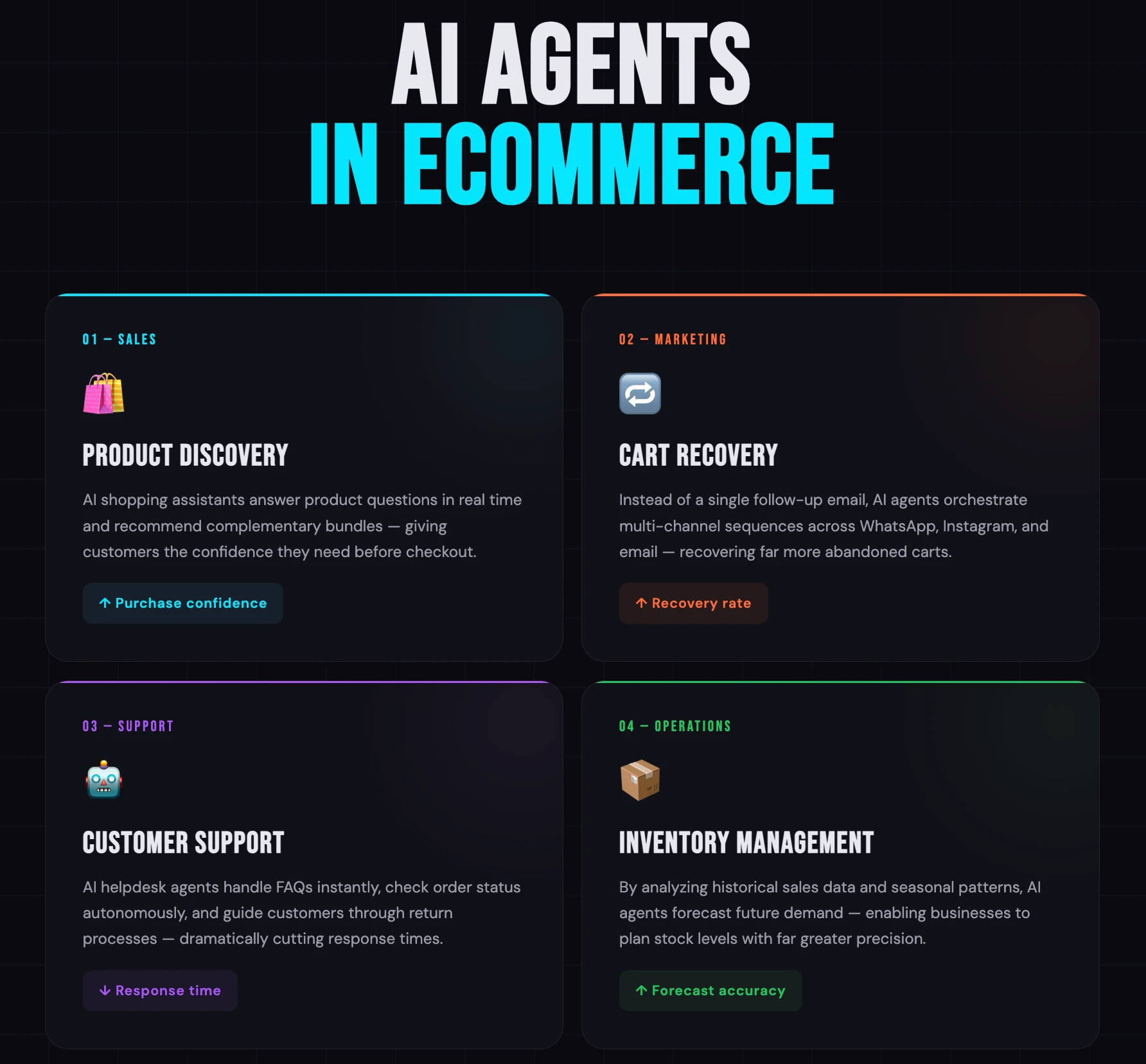
As shown above, AI agents can support multiple workflows at the same time. Because of this shift, many experts now describe modern eCommerce as moving toward “autonomous commerce” – where intelligent systems assist decision-making and execution across the entire store.
This AI agents eCommerce industry trend is reinforced by Yext research, which shows that 86% of AI citations come from brand-controlled sources such as websites, listings, and reviews, with nearly half of retail citations coming directly from first-party sites.
The Best AI Agents for Sales & Customer Growth
In 2026, sales-focused AI agents have evolved beyond simple chat widgets. Today, many of them function as digital sales associates. They do not only answer questions. Instead, they recommend products, guide decisions, and sometimes even trigger offers to close a sale.
Below are three leading AI sales agents and how they differ:
1. Alhena AI (formerly Gleen)
Price: Free tier (up to 25 conversations). Paid plans start at approximately $239/month.
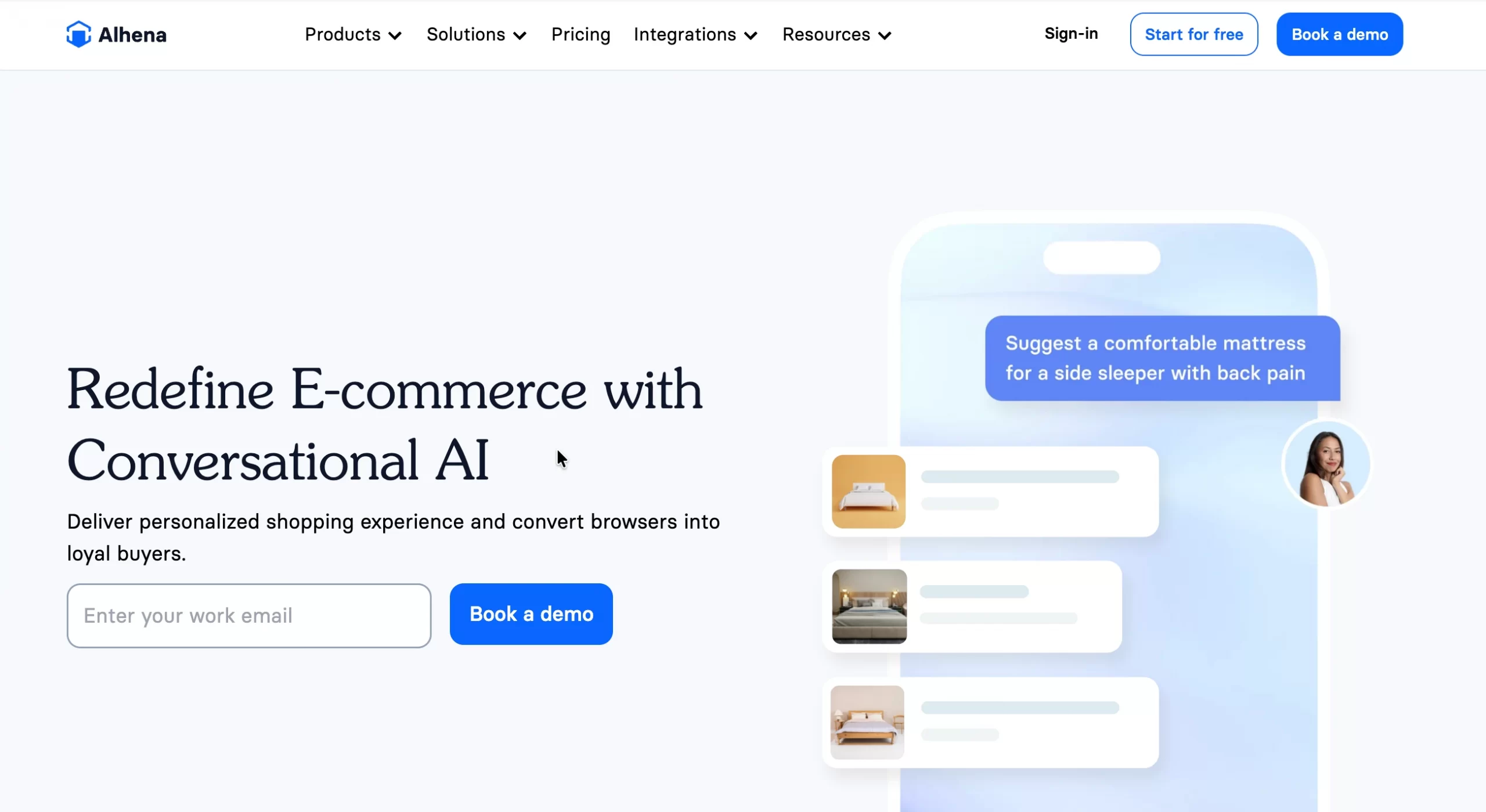
Alhena AI is a knowledge-based AI shopping assistant designed to provide accurate responses using your store’s real data.
What problem it solves: Many AI systems “hallucinate,” meaning they generate incorrect information. In eCommerce, this can cause pricing errors, wrong specifications, or customer mistrust. Alhena reduces this risk by grounding responses in verified store data.
How it works: It connects directly to your product catalog, store policies, and reviews. When a customer asks a question, even in simple or informal language, the system understands the intent and pulls correct information. It can then recommend products or guide the customer to checkout.
Who it’s best for: Mid-to-large retailers with complex catalogs (up to tens of thousands of SKUs) where product accuracy is critical.
2. Rep AI
Price: Tiered pricing based on traffic. Sales Agent plans start around $440/month.
Rep AI is a behavior-driven sales agent that proactively engages visitors based on their browsing behavior.
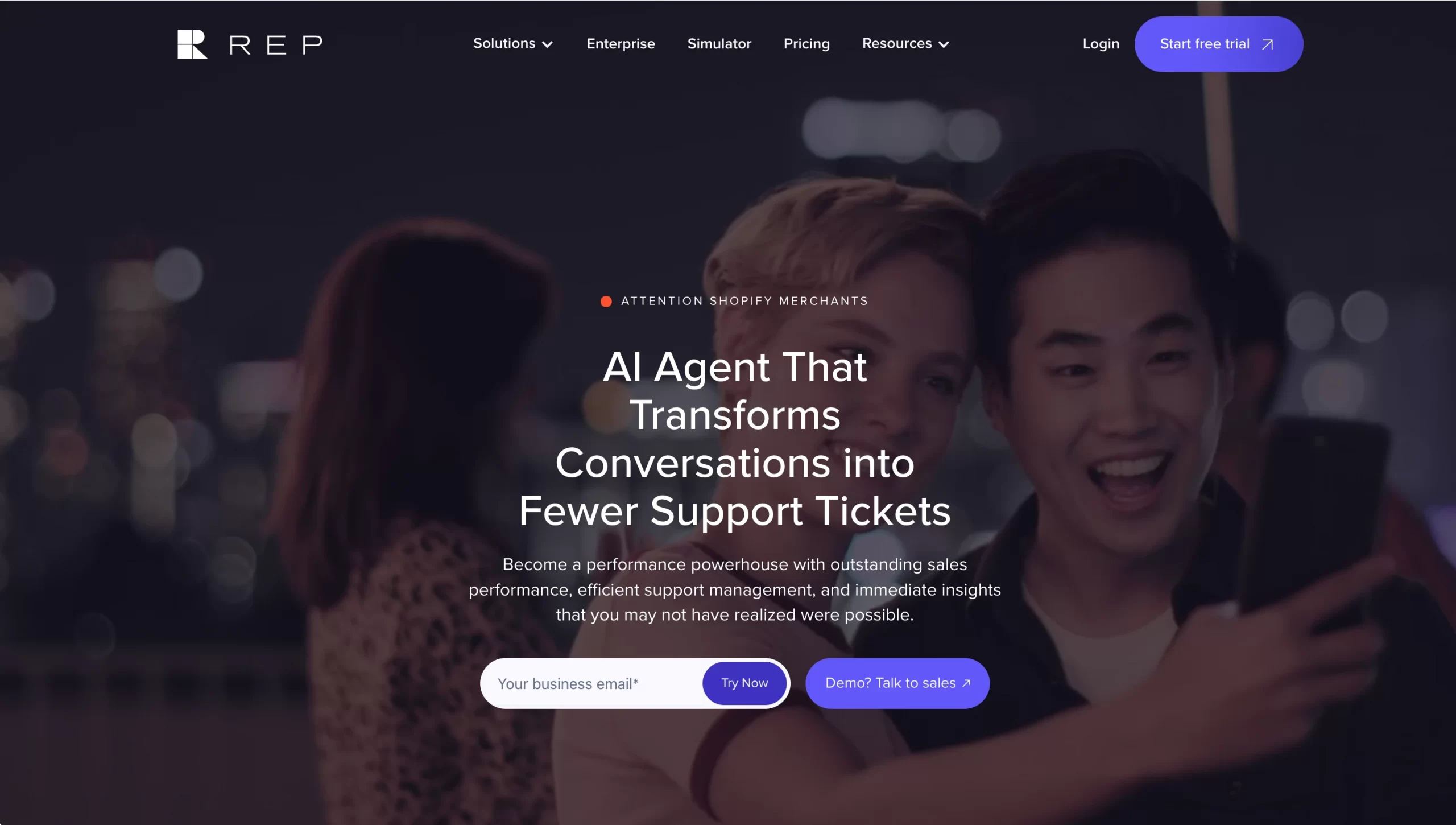
What problem it solves: Many visitors browse but never purchase. Rep AI focuses on converting these passive visitors before they leave the site.
How it works: It monitors behavioral signals such as cursor movement, time spent on a page, and hesitation at checkout. When it detects a potential drop-off, it triggers a targeted message, such as a product comparison, reassurance, or time-sensitive incentive.
Who it’s best for: High-traffic DTC brands that want to increase conversion rate and average order value (AOV).
3. Octane AI
Price: Starts at $50/month. Advanced plans with AI-driven features begin around $200/month.
Octane AI is a quiz-based personalization engine that collects customer preferences to build detailed buyer profiles.
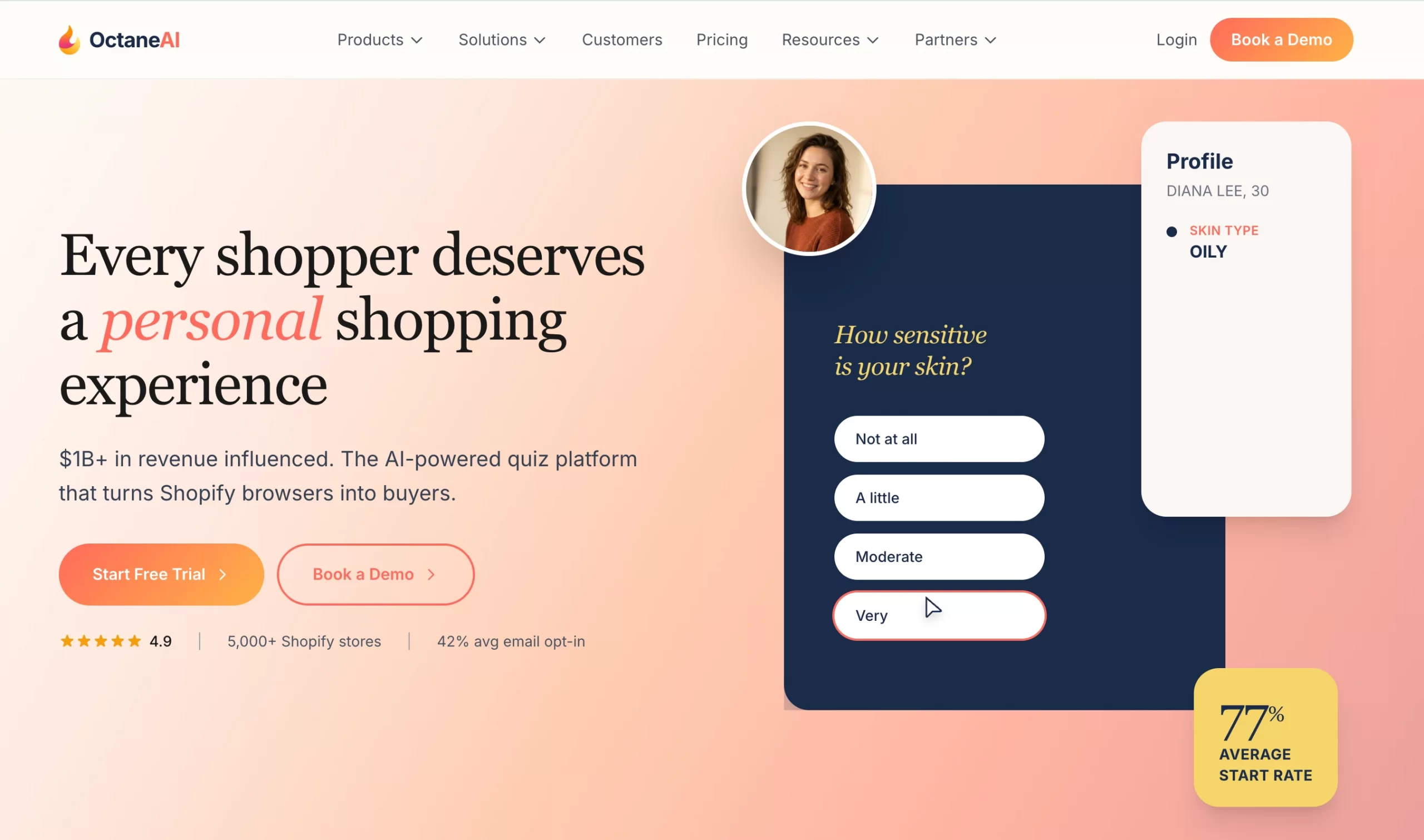
What problem it solves: Many customers leave because they feel overwhelmed by too many product choices. Octane AI reduces this decision fatigue through guided quizzes.
How it works: It asks structured questions about preferences, goals, or characteristics (such as skin type or style). The AI engine maps answers to relevant products and can sync this data to marketing platforms like Klaviyo for personalized follow-ups.
Who it’s best for: Shopify merchants in beauty, fashion, wellness, or supplement industries where personalized recommendations reduce returns and improve repeat purchase rates.
Top AI Agents for Support & Post-Purchase Operations
Sales agents help customers buy. However, support agents help customers stay. Many of them can now access backend systems and complete real actions, such as updating subscriptions, issuing refunds, or generating return labels.
This shift moves support from “ticket deflection” to real resolution.
4. Fin (by Intercom)
Price: $0.99 per successful resolution. Intercom platform seats range from $29 to $132 per month.
Fin is an AI support agent built inside the Intercom ecosystem. It can also connect to other helpdesk systems such as Zendesk or Salesforce.
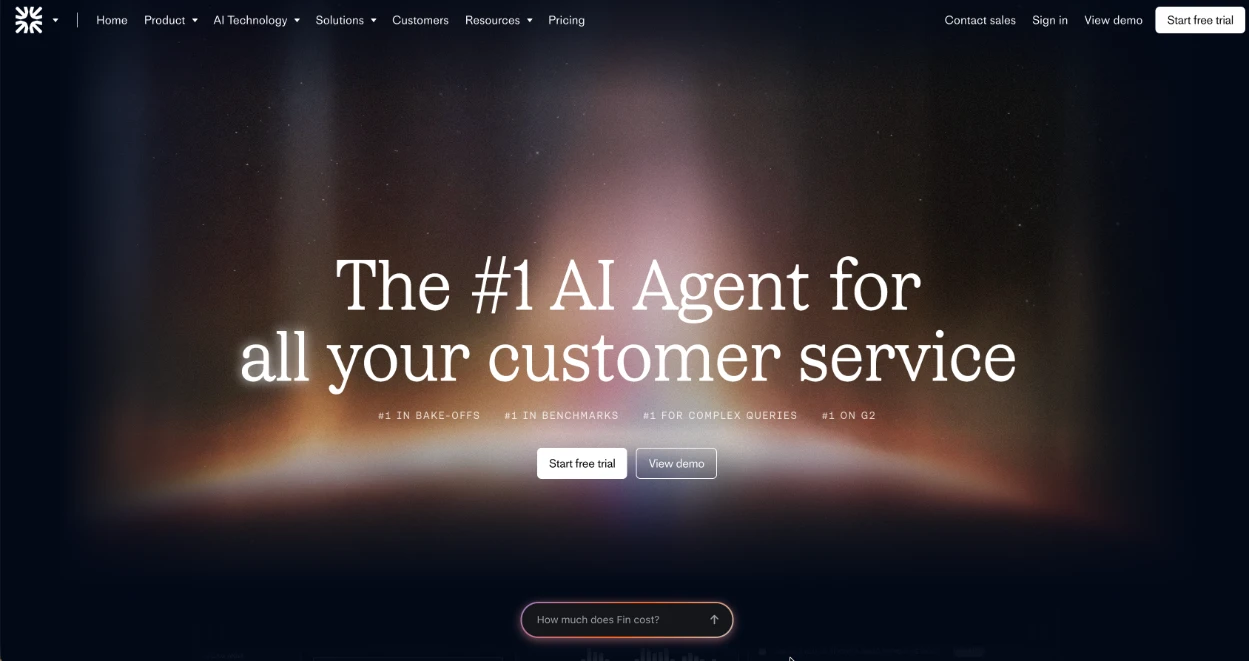
What problem it solves: Many support bots only link to help articles. This often creates frustration when customers need specific answers. Fin is designed to resolve multi-step issues instead of redirecting users in circles.
How it works: Fin reads your help center articles and connected data to find correct information. It gives clear answers based on real data. In addition, it can take action, such as updating a subscription, checking an order, or changing account details in your system.
Who it’s best for: Teams already using Intercom, or companies that prefer a performance-based pricing model where they pay only when an issue is resolved.
5. Gorgias AI Agent
Price: AI Agent charges approximately $0.90 per resolved automated conversation, in addition to the selected Gorgias helpdesk plan (starting from $10/month).
Gorgias AI Agent is one of the top AI agents for retail, designed specifically for eCommerce platforms, especially Shopify, to automate customer support and order management.
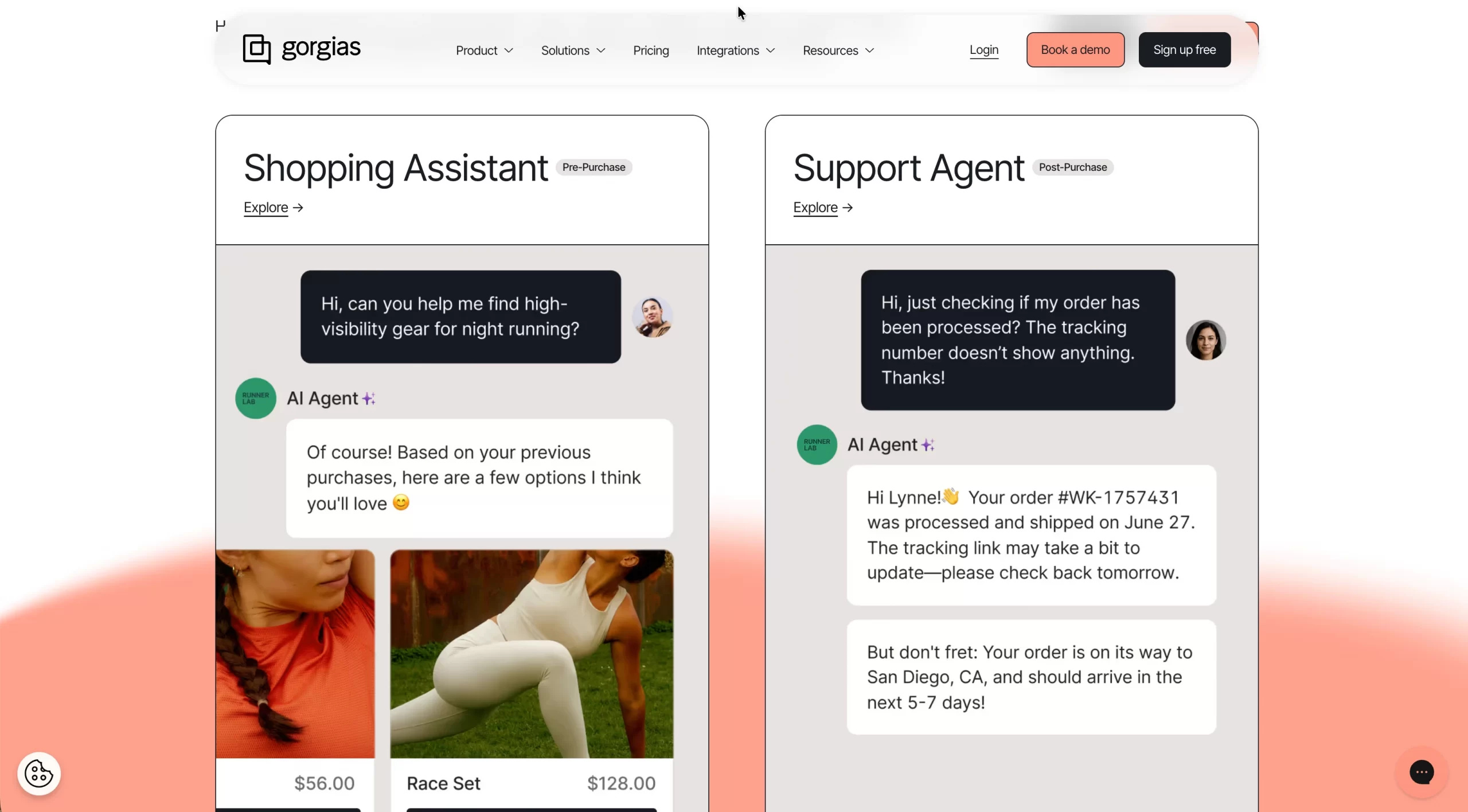
What problem it solves: It automates the most common retail questions:
- “Where is my order?”
- “I want to return this.”
- “Can I cancel my order?”
These three requests often represent a large percentage of support tickets.
How it works: The agent connects directly to your store’s order data. It can retrieve real-time information, process refunds, generate return labels, and update order status inside the chat or email conversation.mất
Who it’s best for: Growing Shopify, BigCommerce, or Magento brands that want deep eCommerce-specific integration without heavy customization.
6. Zowie
Price: Custom pricing for mid-market and enterprise. Entry-level plans may start around $50/month for basic automation, with enterprise pricing significantly higher.
Zowie is an AI-native support automation platform built for high-volume retail operations.
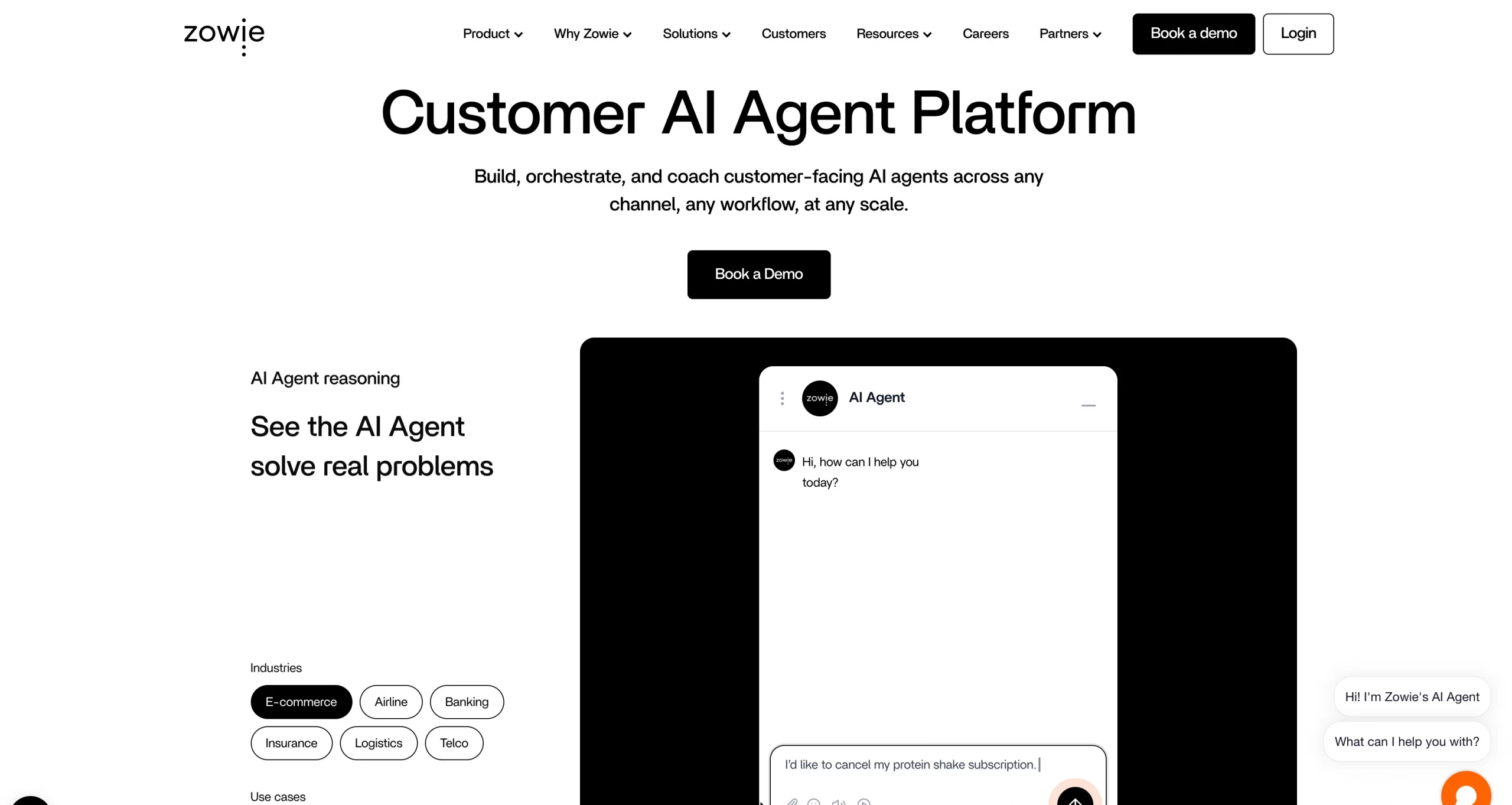
What problem it solves: Large retailers often operate across multiple systems, such as ERP, CRM, warehouse management, and payment providers. Zowie is designed to handle complex workflows that require data from several sources.
How it works: Instead of using one single agent, Zowie uses a multi-agent orchestration model. Different specialized agents handle specific tasks, such as returns, warranties, or order updates, and coordinate to provide one unified response.
Who it’s best for: Enterprise retailers with complex operations, multiple brands, or multilingual support requirements who aim for very high automation rates.
AI Agents for Business Intelligence & Operations
Modern AI agents monitor performance, detect risks, and recommend decisions in real time. Instead of manually checking dashboards, merchants can rely on AI systems to analyze patterns and highlight problems early.
These agents act as digital analysts and operational assistants.
7. Moby (by Triple Whale)
Price: Plans start at approximately $149/month. Advanced AI features typically require higher tiers.
Moby is an AI-driven analytics assistant built inside the Triple Whale dashboard. It allows merchants to ask questions in plain language and receive data-driven insights.
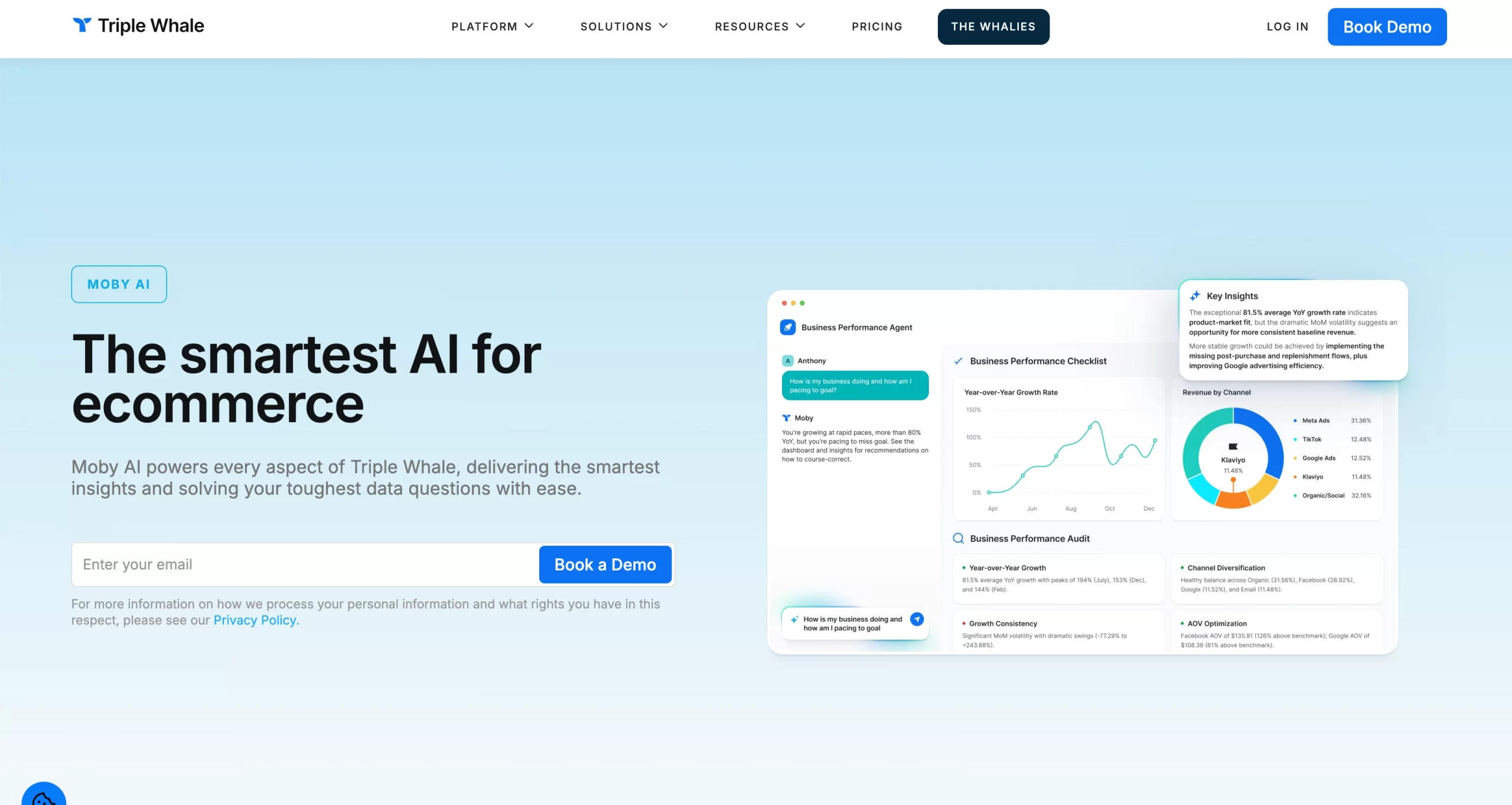
What problem it solves: Many store owners experience “dashboard fatigue.” They see many metrics but struggle to understand why performance changes. Moby helps identify the cause behind drops in ROAS, changes in conversion rate, or unexpected revenue shifts.
How it works: Moby analyzes attribution data, ad performance, inventory metrics, and historical trends. It monitors these in real time and can alert users when campaigns are underperforming or when spending should be adjusted.
Who it’s best for: Shopify-focused brands that rely heavily on paid ads and need clearer attribution insights. Moby is tightly integrated with Shopify. Merchants on WooCommerce or BigCommerce may have limited compatibility.
8. Agentforce (by Salesforce)
Price: Agentforce offers multiple pricing models, including $2 per conversation or $500 per 100,000 Flex Credits, with a free Salesforce Foundations tier available to get started.
Agentforce is an enterprise AI layer within the Salesforce ecosystem. It connects sales, service, and commerce systems.
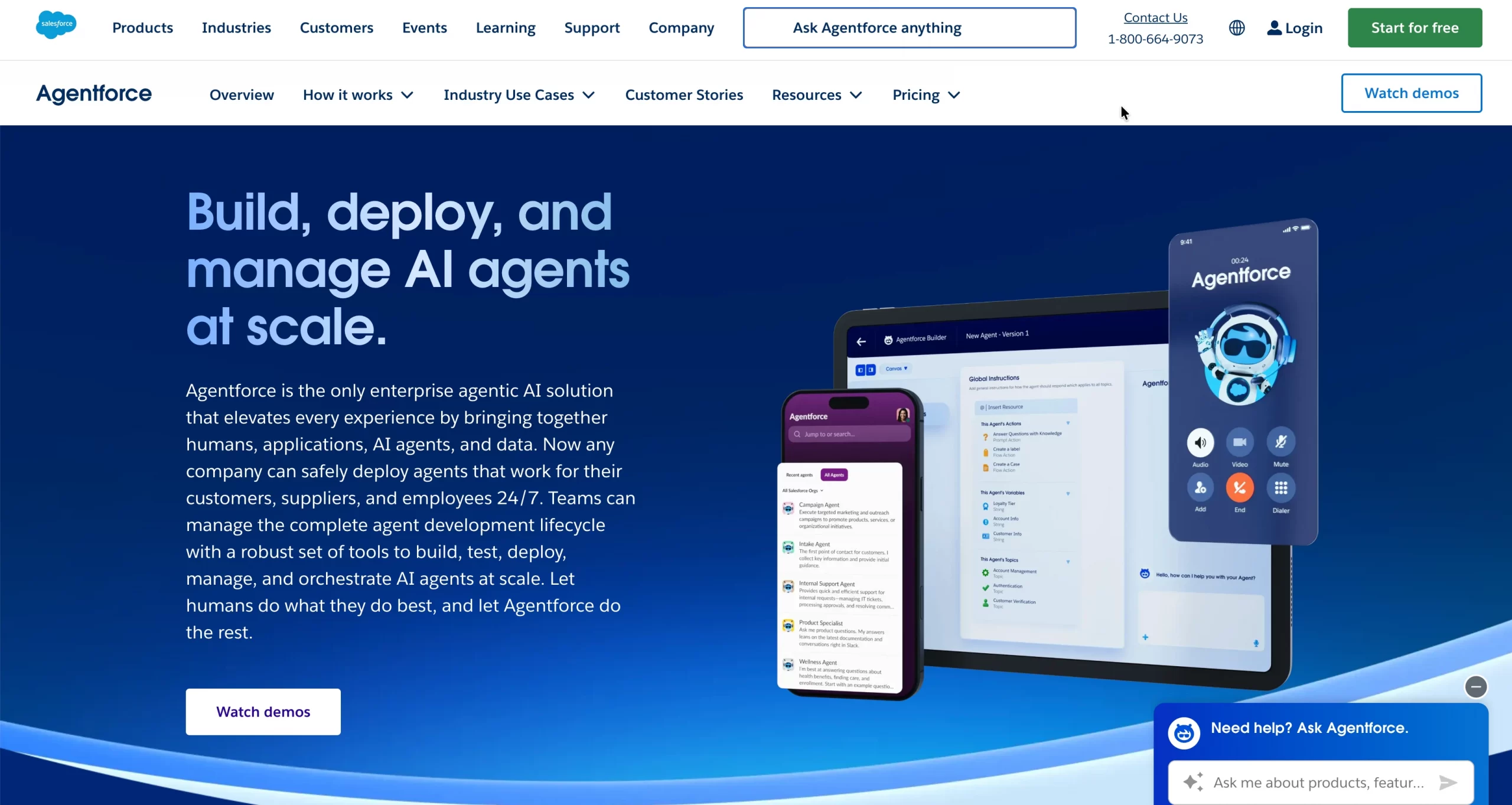
What problem it solves: Large enterprises often struggle with disconnected data between CRM, support, and commerce platforms. Agentforce helps automate workflows across these systems.
How it works: It uses autonomous workflow orchestration. For example, when a deal closes in Sales Cloud, it can automatically trigger onboarding steps or update order information in Commerce Cloud.
However, a proper setup may require well-structured data inside Salesforce. Configuration may be complex without dedicated technical support.
Who it’s best for: Large enterprises with complex internal systems and strong Salesforce infrastructure.
9. Impact Analytics
Price: Enterprise-level pricing, usually custom based on business size and inventory scale.
Impact Analytics is an AI system focused on inventory management, supply chain planning, and demand forecasting.
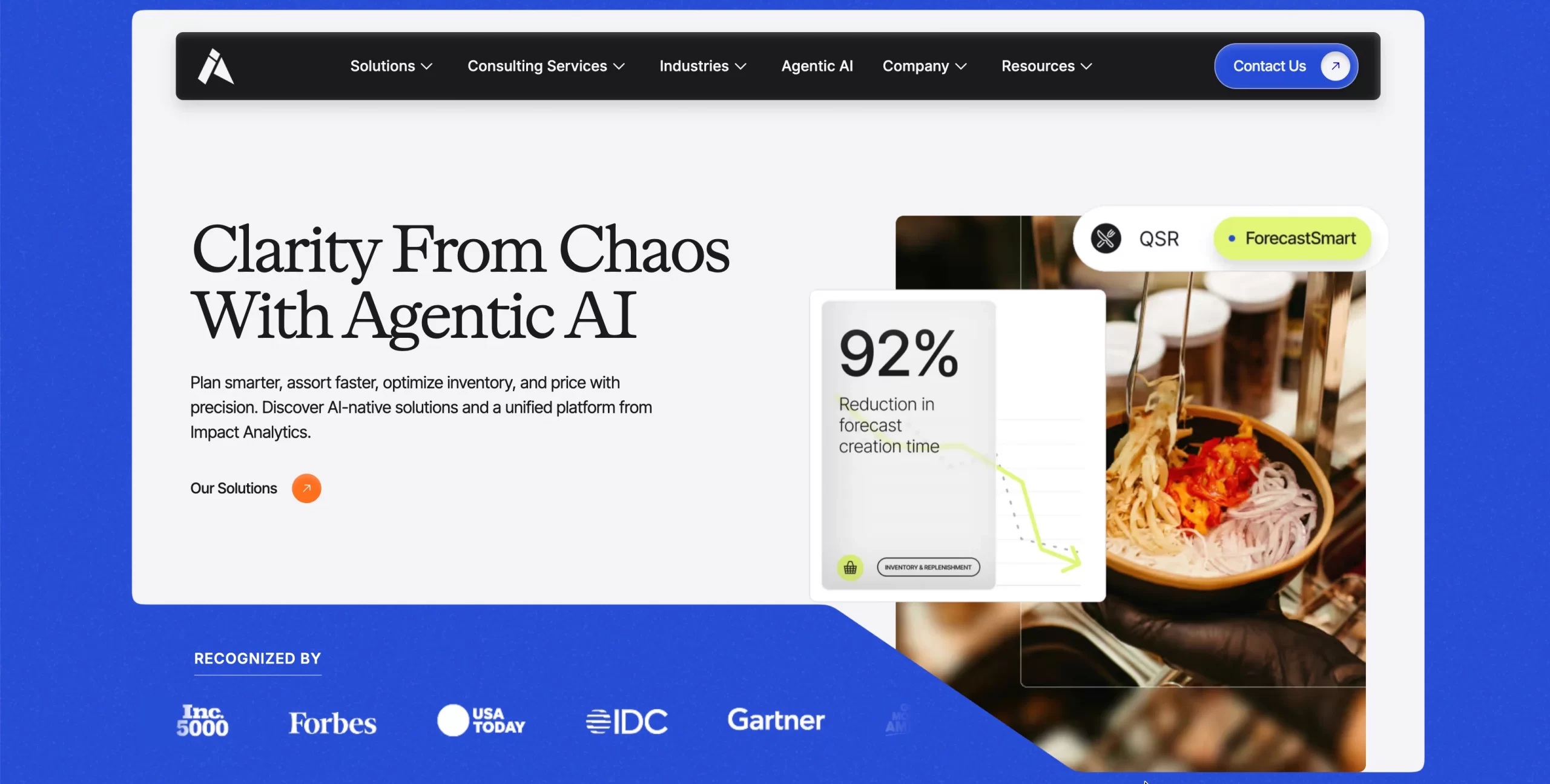
What problem it solves: Retailers often lose profit through overstocking or stockouts. Impact Analytics aims to improve product allocation and reduce waste.
How it works: It analyzes historical sales data, seasonal trends, and demand signals. Based on this data, it recommends allocation strategies and stock planning decisions. Yet, forecast accuracy depends heavily on clean historical sales and inventory data.
Who it’s best for: Multi-channel retailers managing thousands of SKUs across online and offline stores.
10. Prisync
Price: Plans start around $99/month for smaller catalogs, with higher tiers for larger product counts.
Prisync is a dynamic pricing and competitor monitoring agent. If competitors significantly change their website structure, data scraping may require adjustments.
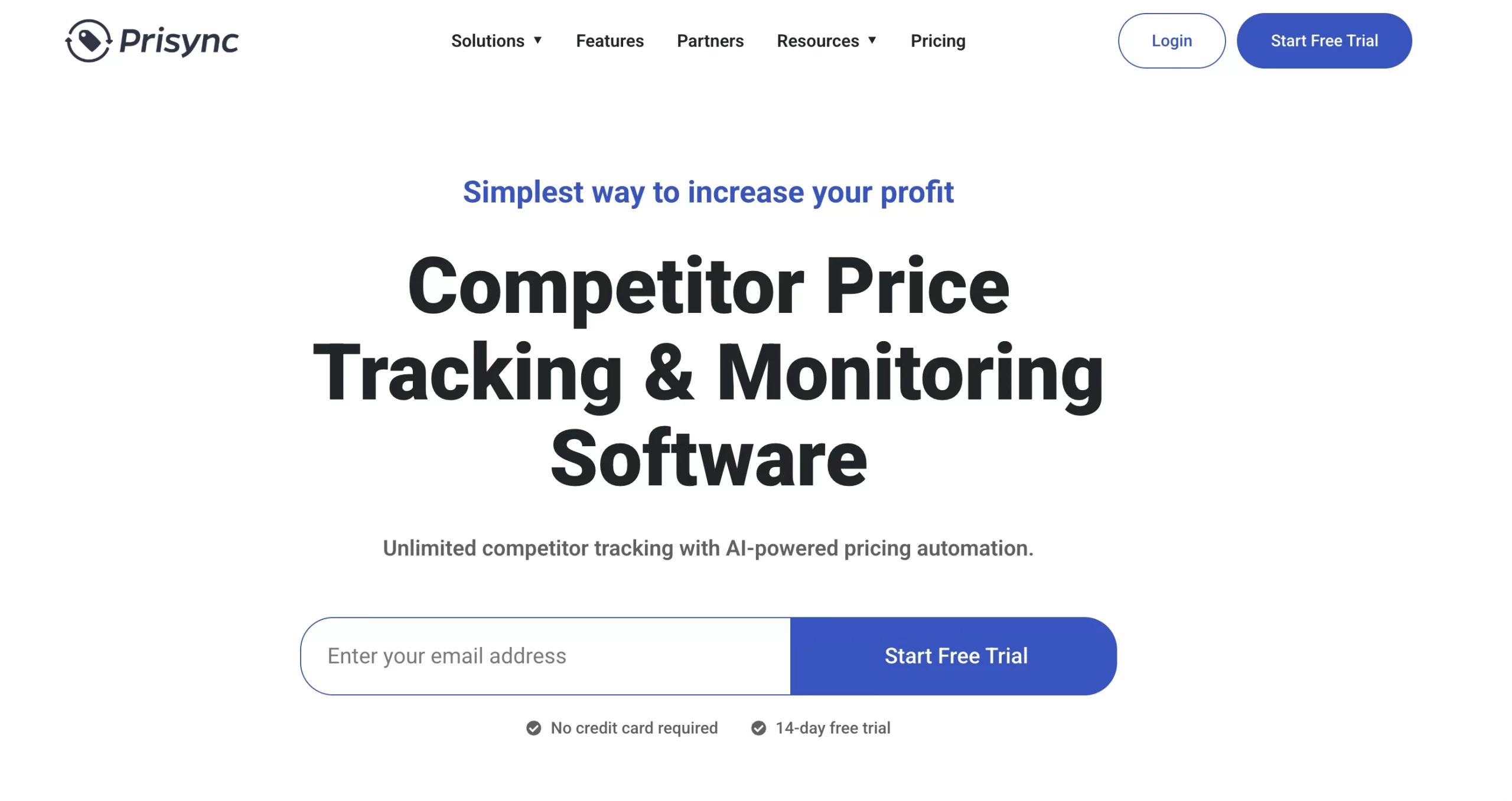
What problem it solves: Manual price monitoring is time-consuming and often inaccurate. Prisync automates competitor tracking and price adjustments.
How it works: Users define pricing rules (for example, minimum margin thresholds). The agent then monitors competitor pricing and adjusts store prices automatically within defined limits.
Who it’s best for: Retailers in competitive categories such as electronics, beauty, or home goods, where price changes frequently.
Business intelligence and operations agents do not directly talk to customers. However, they influence pricing, stock levels, and marketing decisions. Because of this, they impact profit margins and long-term stability.
In many cases, the performance of these agents depends on structured historical data. Without accurate order history, inventory records, and SKU consistency, AI-driven insights may become unreliable. This is why data readiness plays a critical role in successful AI adoption.
Creative & Content Generation Agents for eCommerce
Creative AI agents help merchants manage large product catalogs, generate marketing assets, and maintain brand consistency across channels. These tools are especially useful for stores with hundreds or thousands of SKUs.
11. Hypotenuse AI
Price: Marketing plans start around $19/month. Ecommerce-focused plans typically start higher and may require custom pricing.
Hypotenuse AI is a content automation agent designed specifically for product catalogs. It turns structured product data into optimized descriptions and marketing copy. Still, output quality depends heavily on clean, well-organized product data.
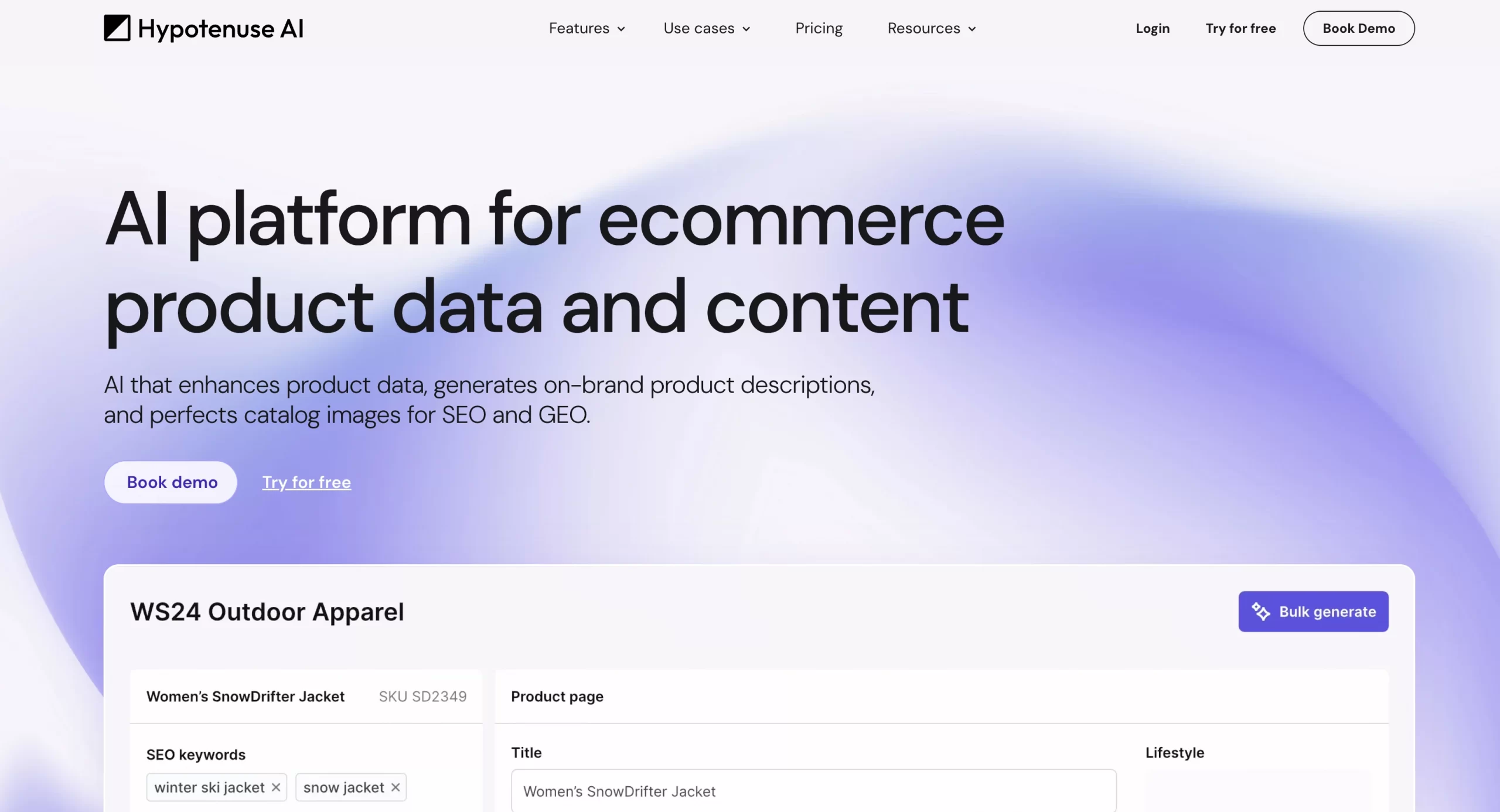
What problem it solves: Many retailers struggle with messy spreadsheets and incomplete supplier data. Writing thousands of unique descriptions manually takes time and resources. Hypotenuse helps automate this process.
How it works: It can clean product data, generate SEO-friendly descriptions, and optimize listings for different marketplaces. In some cases, it can also analyze product images to extract missing attributes such as color or material.
Who it’s best for: High-volume retailers managing large catalogs who need to launch products quickly while keeping descriptions consistent and structured.
12. Jasper
Price: The Pro plan starts at around $59 per user per month. Business plans require custom pricing.
Jasper is an AI marketing tool designed to help brands keep a consistent voice across blogs, emails, ads, and social media campaigns. However, for small stores with limited content needs, its pricing may be higher compared to simpler content generation tools.
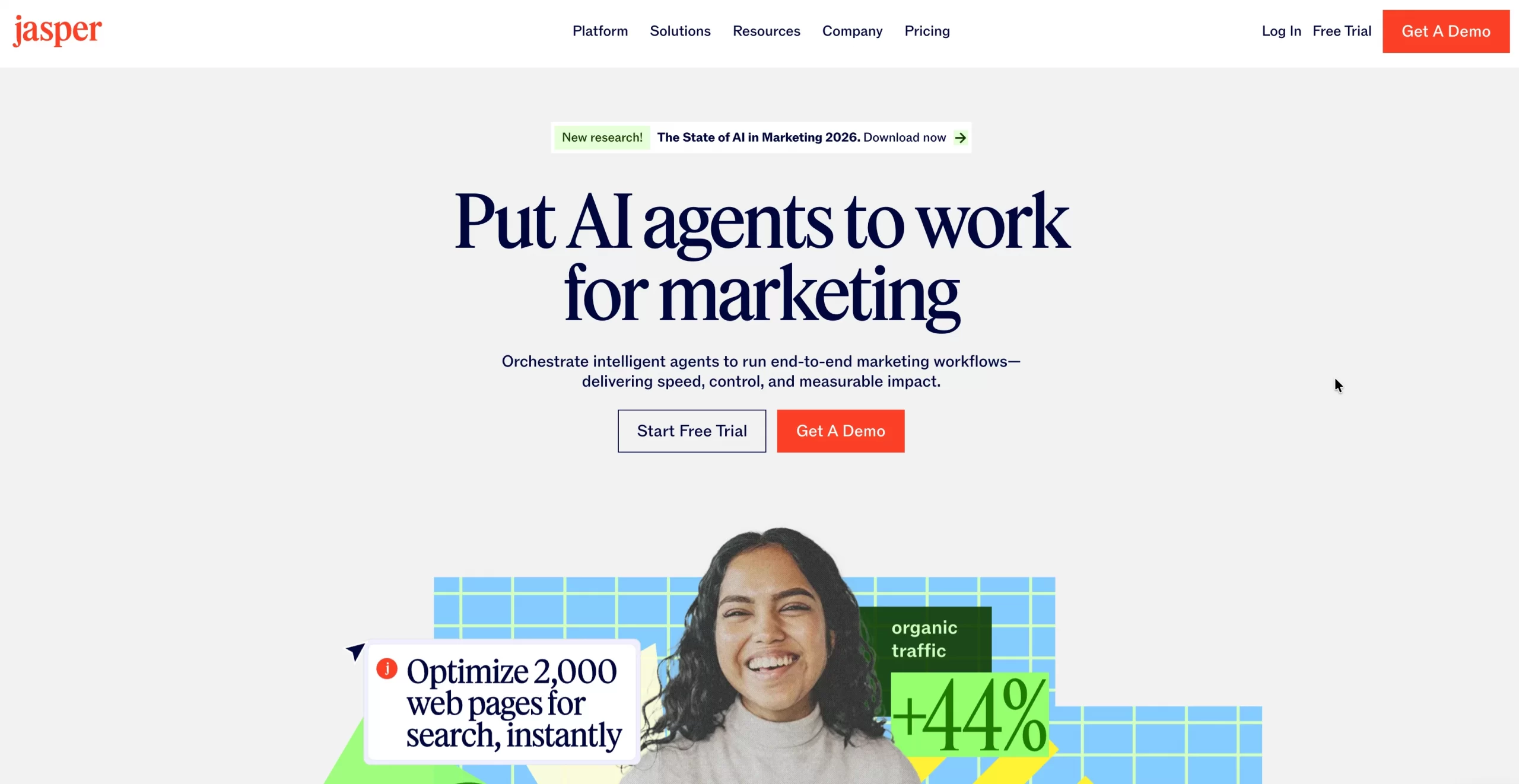
What problem it solves: As brands grow, content can become inconsistent. Blog posts, ads, and emails may sound different. Jasper helps maintain a unified brand voice across platforms.
How it works: It learns from your brand guidelines, previous campaigns, and product information. Then it generates content that follows your tone and messaging rules. Advanced features can also support research and campaign planning workflows.
Who it’s best for: Marketing teams and agencies managing multiple campaigns or brands that need consistent messaging at scale.
13. Flair.ai
Price: Free tier available. Paid plans start at approximately $8/month, with higher tiers for batch processing.
Flair.ai is an AI virtual photo studio that creates product visuals without a physical shoot. Still, brands should review all images to ensure they match brand guidelines and advertising rules.
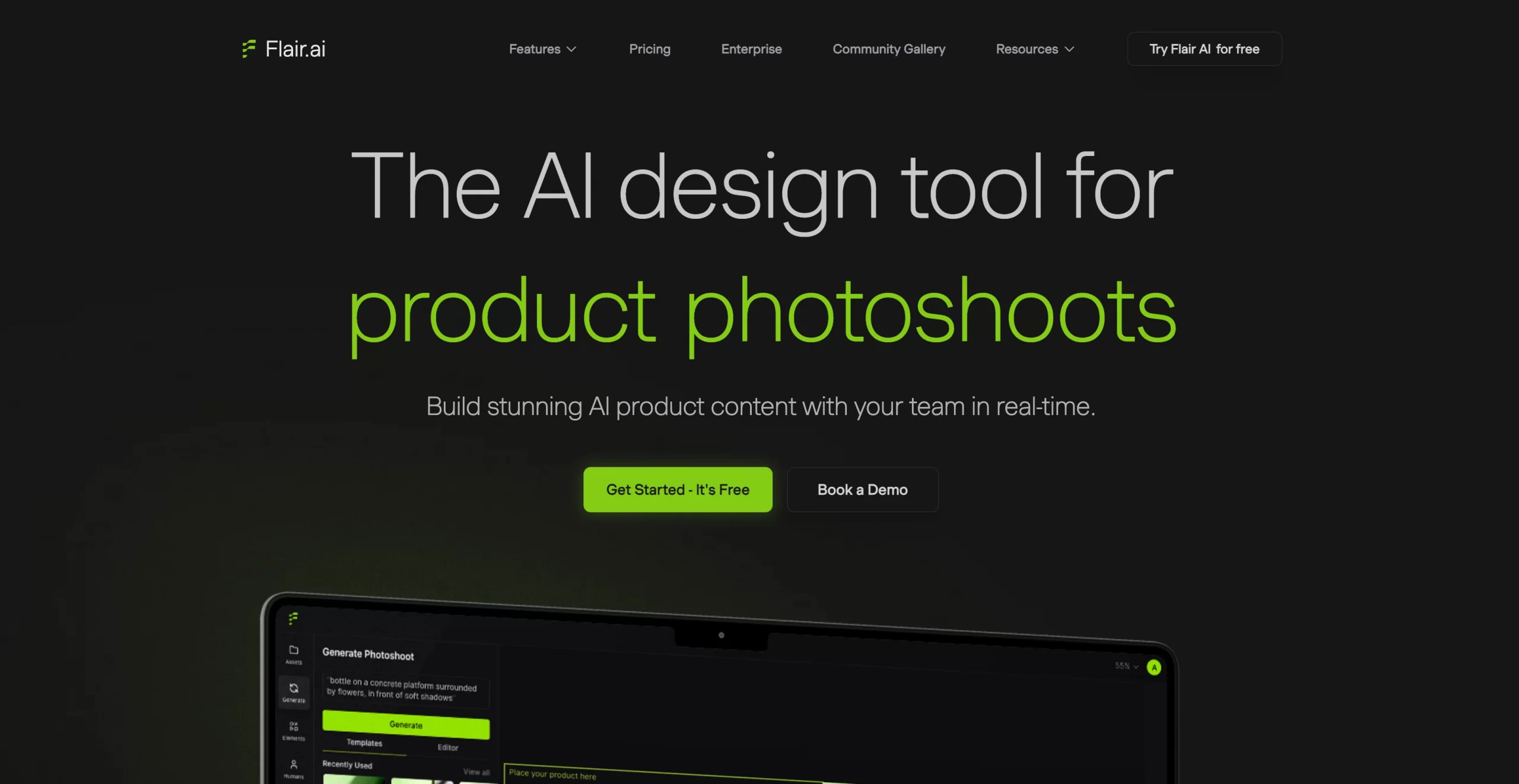
What problem it solves: Professional photoshoots can be expensive and time-consuming. Many small brands cannot produce multiple lifestyle images for ads and social media.
How it works: Users upload a product image. The system then generates realistic backgrounds, lighting, and staging. This allows brands to test different creative variations without organizing a physical shoot.
Who it’s best for: Small to mid-sized brands in visual categories such as beauty, fashion, and beverages that rely heavily on image-based marketing.
Creative and content agents do not directly increase conversion in the same way as sales or support agents. However, they improve product presentation, SEO visibility, and marketing efficiency.
In large catalogs, consistent product data and structured attributes are especially important. If descriptions are generated from incomplete or incorrect data, the output will reflect those gaps. For this reason, content automation works best when product information is clean, standardized, and well-organized.
Challenges of AI Agents in eCommerce
AI agents can automate many workflows. However, they are not completely “plug and play.”
In 2026, many merchants are learning that moving toward autonomous commerce comes with practical challenges. Understanding these risks helps you avoid costly mistakes.
1. Integration silos & cross-agent conflicts
Most online stores use more than one AI agent. For example, one agent handles support, another manages pricing, and another focuses on sales.
The issue: If these systems are not connected properly, they can work in opposite ways. For example, a sales agent may give a first-time discount, while a pricing agent increases prices because demand is high. This can confuse customers and reduce trust.
The solution: Make sure all AI agents use the same updated data. Many businesses use one central system or dashboard so that pricing, promotions, and inventory stay consistent across all agents.
2. The risk of “hallucinations” and policy violations
Even in 2026, large language models can occasionally generate incorrect information.
The issue: A support agent might promise a refund that goes against store policy. A sales agent might use language that does not match your brand tone.
The solution: You should choose AI agents that rely on verified data sources. Systems using strict retrieval methods or rule-based guardrails reduce the risk of incorrect answers. It is also important to set approval rules and escalation paths for sensitive actions.
3. Limited operational transparency
When AI agents operate continuously, it can be difficult to understand why certain decisions were made.
The issue: If a pricing agent lowers margins during a high-traffic weekend, managers need to know whether it followed a rule or made an incorrect calculation.
The solution: Look for agents that provide clear activity logs and decision histories. Transparency allows teams to audit actions and adjust logic when needed.
4. Unrealistic ROI expectations
Some merchants expect instant revenue growth after installing AI agents.
The issue: Not all agents deliver immediate results. Support automation shows quick cost savings, but pricing optimization or forecasting may take time to improve performance.
The solution: Let’s start with one high-impact workflow. Measure results clearly before expanding automation across the store.
AI Agents for eCommerce: FAQs
Can AI agents fully replace my customer support team?
No. AI agents can handle simple and repeated tasks, like checking order status or return requests. But human staff are still needed for complicated problems, sensitive situations, and important customers.
What is the difference between an AI tool and an AI agent?
An AI tool helps you complete a task after you give it instructions. An AI agent, on the other hand, monitors data and takes action automatically based on defined goals.
How much do eCommerce AI agents typically cost?
The pricing varies. Some agents charge per resolution (often between $0.50 and $2.00 per action). Others use monthly subscription models that can range from a few hundred to several thousand dollars, depending on scale and features.
How is AI being used in eCommerce?
AI is used to automate support, personalize product recommendations, adjust pricing, recover abandoned carts, and forecast inventory. In 2026, AI agents do not just suggest, they act.
How much does it cost to run an "Agentic Store" in 2026?
The pricing model has shifted from flat monthly fees to performance-based pricing:
- Small stores can expect to pay $100 - $300/month for a basic sales and support agent stack.
- Growing brands typically spend $500 - $2,000/month, often billed at $0.50 - $1.50 per successful resolution.
- Large-scale "Agentic" operations often involve custom contracts starting at $5,000+/month, covering complex multi-agent orchestration across global regions.
Future Trends: What’s Next for AI Agents in 2026 and Beyond
AI agents are no longer small tools added to a store. They are slowly becoming the “engine” behind how online businesses run. Tasks that once needed teams and long meetings, like adjusting prices, answering customers, or managing stock, are now handled faster and more accurately by intelligent systems.
In the future, the stores that grow fastest will not just have better designs or more ads. They will have smarter systems working in the background. These systems will watch performance, make decisions, and take action automatically. AI agents will not replace business owners – but they will change how businesses operate. The shift has already started, and it is moving quickly.
We hope this guide helped you better understand how AI agents are transforming eCommerce in 2026. For more content like this, be sure to visit the LitExtension blog and join our eCommerce community to gain further insights and connect with fellow business owners.